.svg "CTA Arrow")


.png "Investor Ready Capital decorative background element")

How IRC's Retainer Model Minimizes Capital Raise Risks Compared to Traditional Agents
Series A valuations depend on your burn rate, growth trajectory, market size, and how confidently you can show investors that the raise will get you to the next milestone. This guide breaks down how to calculate the right raise amount and what investors are evaluating before they commit in 2026.
A capital advisory retainer reduces institutional raise risk when it funds pre-market structural work - capital stack design, LP-facing term alignment, and diligence preparation - before a deal ever goes to market. IRC's model is built around this sequence: structure the deal first, then raise capital. That order is what separates advisory models that reduce execution risk from those that accelerate exposure to LP rejection.
Most experienced real estate developers who lose institutional raises do not lose them because they paid for serious advisory support. They lose them because the process breaks before capital ever closes. According to Altss's 2026 LP Due Diligence Checklist, 85% of institutional LP rejections are tied to operational due diligence failures - not investment thesis weaknesses. The data room is incomplete. The capital stack does not hold up under LP scrutiny. The waterfall mechanics give away too much GP economics. The advisor was paid to create motion, not to fix those problems.
That is the real cost of the wrong advisory model. Not the retainer.
The question is not whether a retainer is worth paying. The question is whether the advisor on the other side of that retainer has any financial reason to care whether your raise succeeds. IRC ties its compensation to performance and capital actually raised - not to introductions, meetings, or process milestones. That alignment is what converts a retainer from an upfront cost into a form of downside protection.
Before a deal ever goes to market, IRC invests significant senior-level time in capital stack design, diligence readiness, and LP-facing term alignment. That pre-market work is what turns a retainer from an upfront cost into a form of execution risk control.
IRC's senior advisors have served in a capital advisory capacity on transactions where that question had a clear answer, here are just a few examples:
- Mixed-use development, Florida - $900M total capitalization, requiring a layered institutional capital stack across equity, preferred equity, and structured debt across multiple asset classes and investor relationships
- Multifamily development, Texas - $150M total capitalization, requiring institutional LP equity sourcing and capital structure design built to survive the diligence standards of family offices and private equity allocators
- Condominium development, California - $300M total capitalization, requiring precise alignment of investor economics, waterfall mechanics, and LP-facing terms across a complex, high-profile market
At this scale, cheap advisory is not a bargain. A misaligned advisor who sends a sponsor to market before the deal is structurally ready does not save money. It costs time, credibility, and often the raise itself.
This article is a guide for developers evaluating capital advisory models before going to market. The goal is not to defend retainers in the abstract. It is to show why the advisory model a developer chooses - and how that model is compensated - determines how much execution risk the developer carries alone.
Why Retainers Trigger Skepticism - and Why That Skepticism Is Often Pointed at the Wrong Risk
Fee skepticism is rational. Developers have paid retainers to advisors who generated meetings, decks, and introductions - and then disappeared when the raise stalled. That experience creates a reasonable bias: upfront fees feel like sunk costs when outcomes are uncertain.
According to First Page Sage's 2025 analysis of investment banking and M&A retainer benchmarks, advisory retainers commonly range from $45,000 to $130,000 depending on deal size and scope. That is a real number. The skepticism is understandable.
But the fee range is not the actual problem. The problem is what the retainer buys.
Most developers approach the retainer conversation focused on the wrong variable. They worry the retainer is too high - when the real question is whether the advisor shares execution risk if the raise takes longer than expected. They worry about paying before capital closes - when the real question is whether the advisor's compensation is tied to structure quality and capital actually raised. They worry that other advisors charge less upfront - when the real question is whether the cheaper model fixes capital stack problems or simply markets around them. They worry about not knowing what they are getting - when the real question is whether the engagement includes diligence preparation, LP-facing term design, and investor qualification. And they worry about what happens if the raise fails - when the real question is what the advisor loses if it does.
The right question is not whether a retainer exists. It is whether the advisor's incentives are aligned with yours.
A model that charges less upfront but earns the same fee whether or not the raise closes does not reduce your risk. It transfers it. The sponsor absorbs the cost of a failed process while the advisor collects for the activity that preceded it.
The real sunk cost is not the retainer. It is the time, momentum, and LP credibility lost when the wrong advisor sends you to market unprepared.
What Placement Agents and Fee-Based Advisors Often Miss Before the Raise Even Starts
Most raises do not fail in the pitch. They fail in diligence, and the damage is usually done before the first LP meeting.
Key stat: According to Altss's 2026 LP Due Diligence Checklist, 85% of institutional LP rejections are tied to operational due diligence failures - not investment thesis weaknesses. The deal looked good. The process did not.
That number matters because it reframes where the real advisory risk sits. Institutional investors are not just evaluating returns. They are evaluating whether the sponsor's operational structure, data room, terms, and fund mechanics can hold up under scrutiny. When they cannot, the allocation dies quietly and the sponsor often does not know exactly why.
The most common pre-market failures
The first failure is an incomplete or disorganized data room. Institutional LPs expect a complete, structured data room before serious diligence begins. Gaps signal operational immaturity regardless of deal quality - and once flagged, that impression is difficult to reverse.
The second failure is inconsistent or unsupported valuations. When sponsor projections are not tied to defensible assumptions, LPs flag the discrepancy and move on. The investment thesis is rarely the issue. The underwriting discipline is.
The third failure is LP-facing terms that do not match institutional expectations. Waterfall structures, promote mechanics, and preferred return thresholds that work for high-net-worth investors often fail institutional review entirely. What closes a family raise does not always survive a pension fund's term sheet analysis.
The fourth failure is a capital stack that has not been stress-tested. Layered capital structures that look clean on paper can collapse when LPs model downside scenarios. An advisor who goes to market without pressure-testing the stack is accelerating exposure to that exact outcome.
The fifth failure is having no clear answer to the question: what happens if things do not go to plan? Institutional allocators in 2026 are asking this question directly and early. Sponsors without a credible, specific answer do not advance past the first conversation.
According to Primior's analysis of real estate private equity red flags, operational issues account for roughly half of all fund closures - losses that often follow deals that passed the initial investment case review.
An advisor built primarily to market a deal is not the same as an advisor built to identify and fix the structural weaknesses that institutional investors surface during diligence. That gap is where raises stall, and where the cost of a misaligned advisory model becomes most visible.
The 7 non-negotiables that institutional investors demand are not about narrative. They are about process, structure, and operational readiness.
Capital Architecture Is Not the Same Job as Placement - Here Is the Difference
Placement agents are built to distribute deals. IRC is built to architect them. That is not a difference in quality - it is a difference in function. The comparison that matters is not which firm has a better contact list. It is which model reduces the risk of a failed raise before the first LP conversation ever happens.
Why structure-first matters.
The core difference is not fee structure - it is sequence and alignment. IRC structures the capital stack, waterfall mechanics, and LP-facing terms before the first investor conversation begins, then raises capital through 307,000+ institutional allocators and 77 global investment bank syndicate partners under a single engagement that covers all future raises through exit. Traditional placement agents and fee-based advisors market the deal as presented, earn the same fee regardless of structural outcome, and exit the relationship when the transaction closes.Why structure-first matters
IRC's model is not built around sending materials and hoping the market responds. It begins with significant senior-level pre-market work to tighten structure, pressure-test terms, and improve the odds that investor conversations survive diligence.
IRC's model is built around a specific sequence: structure the deal, then raise capital. That order matters more than it sounds.
A placement agent that markets a deal before the capital stack is institutionally sound is not saving the sponsor time. It is accelerating exposure to rejection. Every LP who passes during diligence is a relationship that becomes harder to re-approach. Every week of stalled momentum is time the sponsor is not deploying capital.
When the advisory model ties compensation to structure quality and capital actually raised, the advisor has a direct financial reason to get the pre-market work right. That is the alignment that converts a retainer from a cost into a form of downside protection.
As research on advisory model risk increasingly shows, technique gets mistaken for outcomes when incentives are not aligned. Advisors who are paid for activity will produce activity. Advisors who are paid for capital raised will work to raise capital.
For developers managing complex, multi-layered capitalizations like those referenced above, the difference between those two models is not a rounding error. It is the raise itself. Understanding the real reason capital raises stall often comes down to exactly this misalignment.
{{main-cta}}
Why This Matters More in a Selective 2026 Capital Market
Capital is available. Access has changed.
The institutional allocator landscape in 2026 is not closed to experienced sponsors. But it is more selective, more structure-sensitive, and more focused on downside protection than it was in easier fundraising cycles. That shift makes advisory alignment more valuable, not less.
The shift toward deal-by-deal allocation behavior raises the bar for every individual transaction. There is no blind pool to hide a weak deal inside. Each allocation must stand on its own structural and economic merits - and LPs evaluating deal-by-deal are scrutinizing each one with the same rigor they would apply to a full fund commitment.
The 524% growth in family office exposure to private equity and venture capital since 2016 has not loosened standards - it has tightened them. Allocators who are more active are also more experienced, more process-oriented, and more likely to surface structural weaknesses that less sophisticated capital would have missed.
The 13% of family offices writing $10M or more per check are the most selective group in the market. Warm access to that group requires a process and a capital structure that can withstand their diligence - not just an introduction. And they are asking "what happens if things do not go to plan" before they ask about projected returns.
A misaligned advisory model was expensive in any market. In this one, it is a direct threat to the raise.
Key data point: According to the J.P. Morgan 2026 Family Office Report, family offices are increasingly moving toward deal-by-deal investment approaches to maintain flexibility and manage risk. Private equity and venture capital exposure among family offices has surged 524% since 2016, but that growth has come with tighter scrutiny, not looser standards.
How to Tell If a Retainer Is Reducing Risk or Just Charging for Activity
Before signing any capital advisory engagement, experienced developers should be able to answer these seven questions. If the advisor cannot answer them clearly, the retainer is likely buying activity, not protection.
7 questions to ask any capital advisor before signing
Is your compensation tied to capital actually raised, or to process milestones? An advisor who earns the same fee regardless of outcome has no financial reason to prioritize yours. IRC ties its compensation to performance and capital actually raised - not to introductions, meetings, or process milestones. That alignment is what separates advisory models that reduce execution risk from those that generate activity and send you an invoice either way.
Do you structure the deal before going to market, or do you market the deal as presented? Going to market with an unvetted capital stack does not save time - it accelerates exposure to LP rejection. Every institutional investor who passes during diligence is a relationship that becomes harder to re-approach. IRC structures the capital stack, waterfall mechanics, and LP-facing terms before the first investor conversation begins. That sequence - structure first, then raise - is the core of how IRC reduces pre-market execution risk.
What does your diligence preparation process look like? If the answer is vague, the data room, terms, and LP-facing materials will be too. A credible advisor should be able to describe exactly what gets built before the first LP conversation - data room structure, term alignment, capital stack stress-testing, and investor qualification criteria. According to Altss's 2026 LP Due Diligence Checklist, 85% of institutional LP rejections are tied to operational due diligence failures, not investment thesis weaknesses. The preparation phase is where raises are won or lost.
How do you qualify investors before making introductions? Generic outreach to a broad list is not the same as warm access to allocators who actually write $10M or more per check. IRC works with 307,000 institutional allocators and 77 global investment bank syndicate partners. Before any introduction is made, investors are screened for deal size, sector fit, capital structure preference, and deployment timeline. An unqualified introduction wastes LP relationship capital that is difficult to rebuild.
What happens if the raise takes longer than expected? A retainer that expires before the raise closes transfers timeline risk entirely to the sponsor. The right advisory model stays engaged through close - not just through the initial outreach phase. IRC's engagement is structured to cover the full raise cycle, not a fixed window of activity. When the advisor's compensation is tied to capital actually raised, there is no incentive to declare the engagement complete before the job is done.
Do you stay engaged across future raises, or is this a single-transaction relationship? A one-and-done advisory model means rebuilding the relationship from scratch for every subsequent project - new engagement terms, new onboarding, new pre-market preparation costs. IRC's model covers all future raises through exit under a single engagement. For sponsors with multiple projects in development, that continuity is a structural advantage that compounds across every subsequent raise.
What do you lose if this raise fails? This is the most important question and the one most developers forget to ask. If the advisor loses nothing when the raise fails, the incentive structure is not aligned with yours. IRC combines a retainer with advisory equity of 3 to 5%, tying IRC's economics directly to sponsor outcomes across the full engagement. Shared downside - through advisory equity, deferred compensation, or performance-linked fees - is what separates aligned advisory from paid activity.
These are not trick questions. They are the same questions a sophisticated LP would ask about a sponsor's capital structure. Developers should apply the same standard to the advisors they hire to help them raise it.
Understanding the 10 mistakes that kill institutional raises starts with choosing an advisory model that is built to prevent them.
The Retainer Is Not the Bet - Misalignment Is
The fee conversation is worth having. It is just not the most important one.
Sophisticated developers should underwrite an advisory model the same way they underwrite any capital relationship: by alignment, shared downside, expected outcomes, and the quality of the process on the other side. A retainer that buys a structurally stronger raise is not an upfront cost. It is a form of downside protection.
The evidence is clear on where raises actually fail
85% of institutional LP rejections are tied to operational due diligence failures - not investment thesis weaknesses. The deal looked good. The process did not hold up. Roughly half of all fund closures trace back to operational issues that a better-prepared advisory process could have addressed before the first LP conversation. And family offices writing $10M or more per check are more selective in 2026 than at any point in the past decade - evaluating sponsor operational discipline and capital structure readiness before they evaluate projected returns.
The pattern is consistent. Raises do not fail in the pitch. They fail in preparation.
IRC's senior advisors and board members have served in a capital advisory capacity on transactions ranging from $150M in Texas multifamily to $300M in California condominiums to $900M in Florida mixed-use development. At that scale, the advisory model is not a line item. It is a core part of the risk profile.
Paying for generic activity is expensive. Paying for aligned, outcome-linked advisory is how experienced developers protect the raise before it goes to market.
If you are a developer raising $10M or more and want to talk about structuring your capital stack before going to market, start a conversation with IRC today.
Frequently Asked Questions
What is a capital advisory retainer and why do firms charge one?
A capital advisory retainer is an upfront fee that funds pre-market structural work, including capital stack design and diligence preparation. Firms charge retainers because institutional advisory begins long before capital closes; it requires significant senior-level time to ensure a deal is market-ready and can withstand the scrutiny of major allocators.
Is a retainer a sunk cost if the raise fails?
No. When the model ties long-term compensation to capital raised, the retainer funds work that de-risks the project. It only becomes a sunk cost in transactional models that sell introductions without addressing the structural flaws—such as weak waterfalls or incomplete data—that cause institutional partners to pass.
What is the difference between a retainer and a success fee?
A success fee is paid only upon the closing of capital, typically ranging from 1 to 3 percent in cash. A retainer is paid upfront to cover the architectural phase of the raise. Sophisticated models often use a retainer for pre-market work combined with advisory equity to align the advisor economics with your long-term project outcomes.
Why do 85 percent of institutional partner rejections happen at diligence?
Most rejections are due to operational failures, such as incomplete data rooms, inconsistent valuations, or capital structures that fail under stress-testing. While the investment thesis might be strong, the underlying process or documentation often fails to survive the rigorous institutional scrutiny applied by large-scale funds.
How do family offices evaluate real estate sponsors in 2026?
In 2026, family offices prioritize downside protection and sponsor discipline. The subset of offices writing 10M dollar plus checks now focuses on what happens if things do not go to plan before they even consider return projections. They seek developers with sophisticated capital stack designs that explicitly account for market volatility.
What does a capital advisor do differently from a placement agent?
A capital advisor structures the deal architecture—including waterfall review and data room prep—before the first introduction is made. This ensures the deal is institutional-grade from day one. Unlike agents who focus on broad outreach, advisors leverage targeted networks of allocators and stay engaged through all future raises until exit.
When should a developer engage an advisory partner?
Engagement should happen before going to market. The most critical work occurs during the pre-pitch phase to refine the narrative and structure. Attempting to bring in an advisor after a raise has already stalled is significantly more difficult, as you must overcome lost momentum and potential damage to your reputation with investors.
Most founders don't lose the raise because of the pitch. They lose it because the structure was wrong before the first investor call. IRC Partners advises founders raising $5M to $250M of institutional capital. 7 strategic partners per quarter. Start here to schedule a call with our team.
Need guidance on your capital raise?


What Fund Administration Agreements Do Institutional LPs Require Before Committing to a Real Estate Fund?
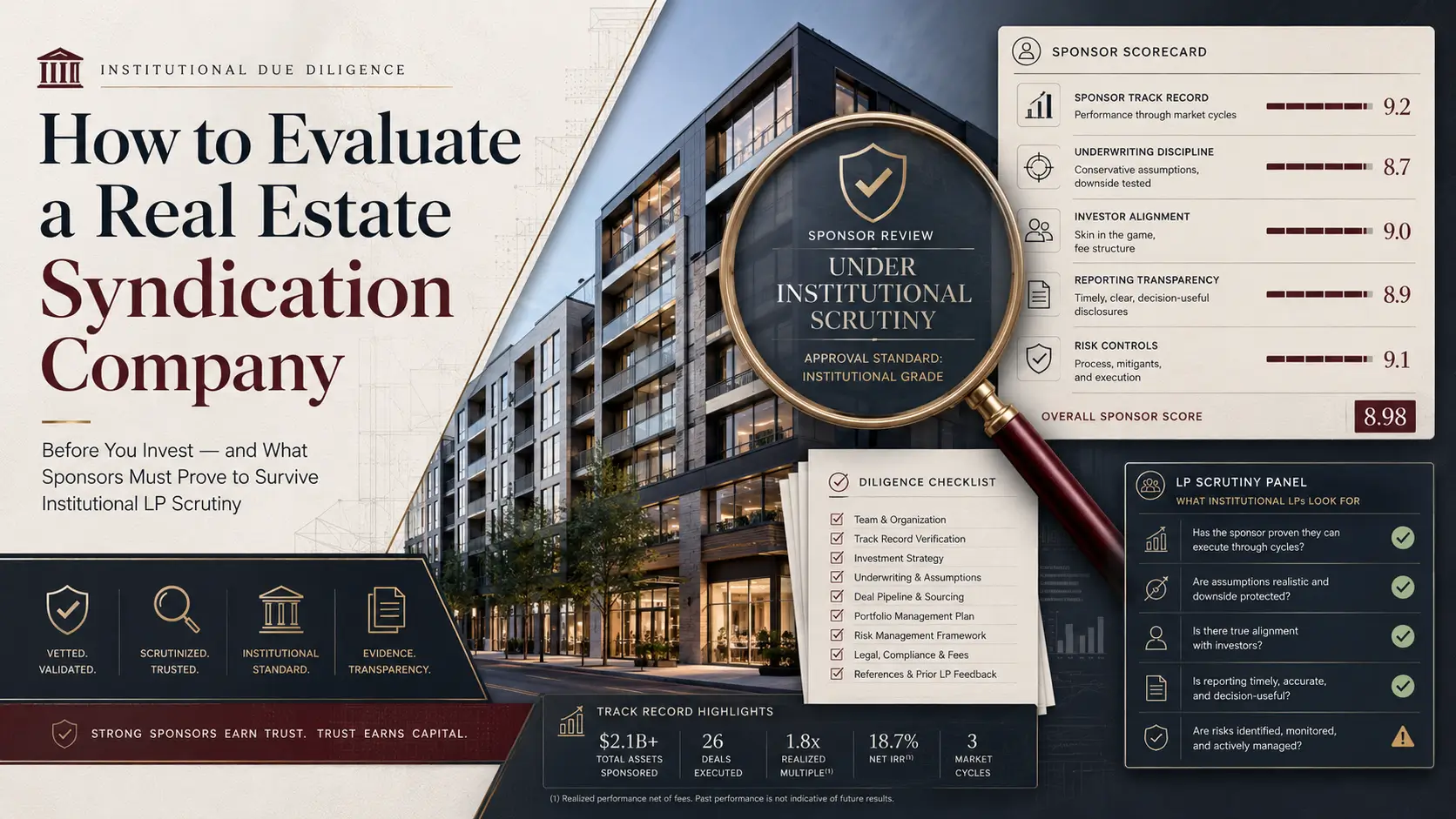
Real Estate Syndication Companies: How to Evaluate a Sponsor Before You Invest (And What Sponsors Must Prove)
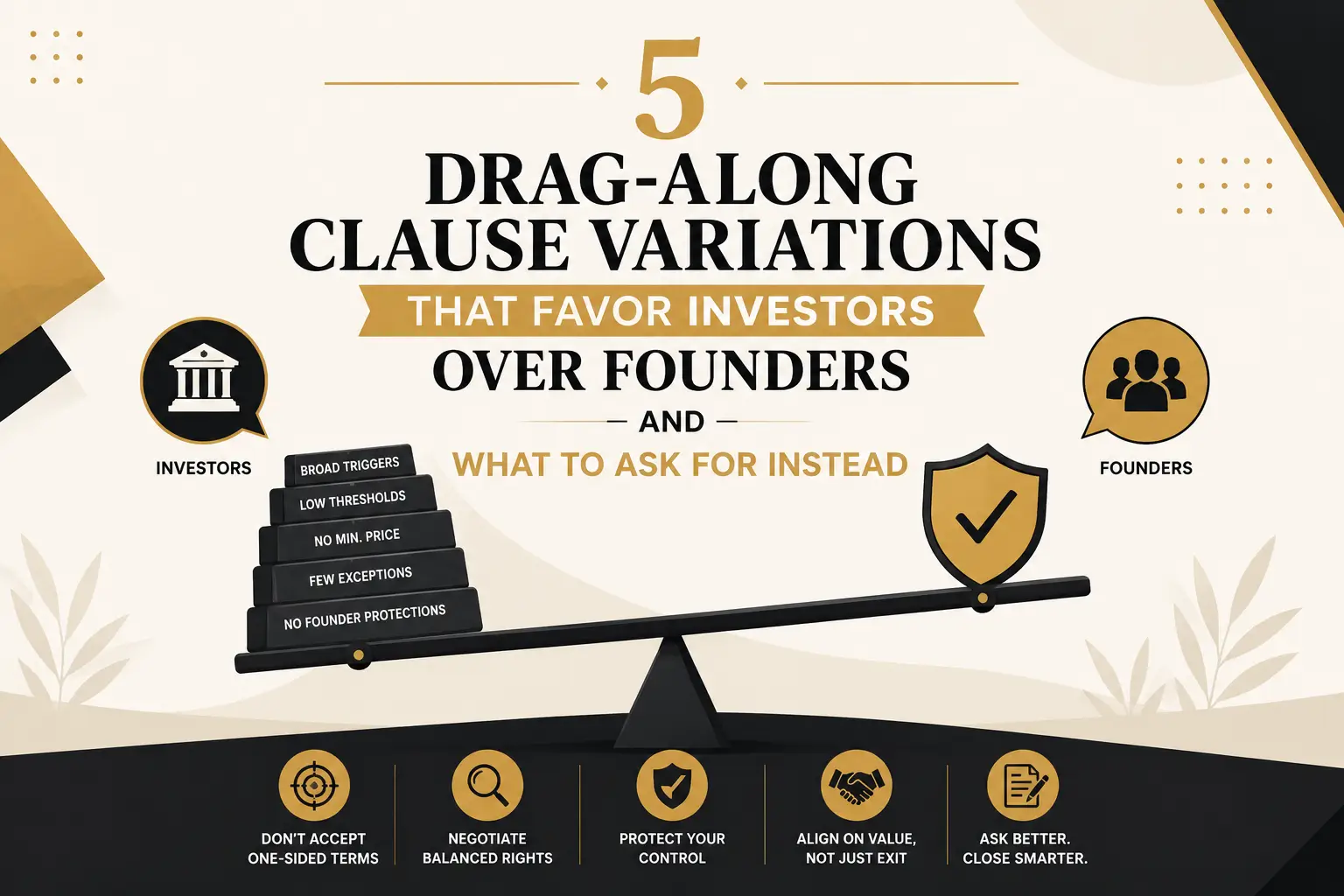
5 Drag-Along Clause Variations That Favor Investors Over Founders - And What to Ask For Instead
Disclosure
Nothing on this site constitutes an offer to sell, or a solicitation of an offer to purchase, any security under the Securities Act of 1933, as amended, or any applicable state securities laws. Any offering of securities is made only by means of a formal private placement memorandum or other authorized offering documents delivered to qualified investors.
IRC Partners is a capital advisory firm. IRC Partners is not a registered investment adviser under the Investment Advisers Act of 1940 and does not provide investment advice as defined thereunder.
Certain statements in this article may constitute forward-looking statements, including statements regarding market conditions, capital availability, investor demand, and transaction outcomes. Such statements reflect current assumptions and expectations only. Actual results may differ materially due to market conditions, regulatory developments, company-specific factors, and other variables. IRC Partners makes no representation that any outcome, return, or result described herein will be achieved.
References to prior mandates, transaction volume, network credentials, or capital raised are provided for illustrative purposes only and do not constitute a guarantee or prediction of future results. Past performance is not indicative of future outcomes. Individual results will vary. Network credentials and transaction statistics referenced on this site reflect the aggregate experience of IRC Partners' principals and affiliated advisors and are not a representation of assets managed or transactions closed solely by IRC Partners.
Certain data, statistics, and information presented in this article have been obtained from third-party sources. IRC Partners has not independently verified such information and expressly disclaims responsibility for its accuracy, completeness, or timeliness. Readers should independently verify any third-party data before relying on it.
Readers are strongly encouraged to consult qualified legal, financial, and tax professionals before making any investment, capital raising, or business decision.
Schedule A Meeting
You get one shot to raise the right way. If this raise is worth doing, it’s worth doing with precision, leverage, and control.
This isn’t a practice run. Serious capital. Serious strategy. Let’s raise it right.
We onboard a maximum of seven
new strategic partners each quarter, by application only, to maximize your chances of securing the capital you need.
