.svg "CTA Arrow")


.png "Investor Ready Capital decorative background element")

How Can a Company Use Bridge Financing to Fund a Signed Acquisition Before Permanent Financing Closes?
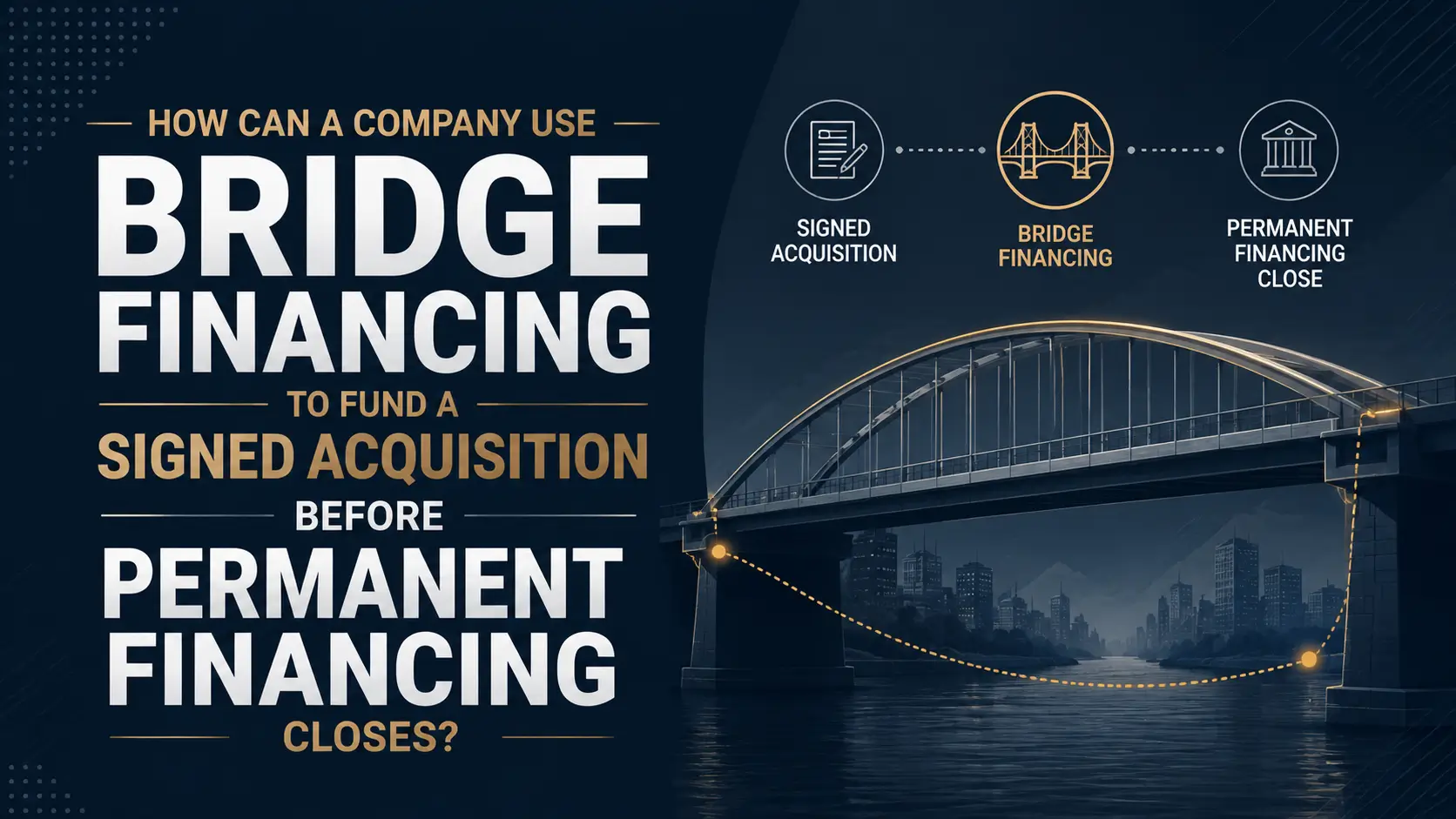
How Can a Company Use Bridge Financing to Fund a Signed Acquisition Before Permanent Financing Closes?
A company can use bridge financing to fund a signed acquisition by raising a short-term loan or convertible note that closes before the permanent financing does. The bridge covers the purchase price at signing, and the permanent capital, whether institutional equity, senior debt, or a structured round, pays off the bridge once it closes. The key is treating the bridge as a standalone credit event with its own documentation, repayment triggers, and lender protections. Doing that correctly is what separates a clean acquisition close from a deal that falls apart in the gap. For a broader look at how bridge financing interacts with preferred investor dynamics, see how to structure a pay-to-play bridge financing when preferred investors decline to participate.
Signed acquisition agreements have deadlines. Sellers expect to close. If your permanent financing takes 60 to 120 days to finalize, you have a problem. That gap is real, and it costs deals every year. Before you approach any lender or investor about filling it, it helps to understand what makes this situation different from a standard operational bridge round.
A standard bridge round keeps the lights on. It funds payroll, extends runway, and buys time to close a priced equity round. An acquisition bridge does something structurally different. It funds a specific external transaction, one with a fixed price, a fixed deadline, and a counterparty who has no obligation to wait. That changes everything about how the instrument needs to be built.
Why Acquisition Bridge Financing Is Structurally Different
When you raise an acquisition bridge, the lender is underwriting the transaction. That distinction shapes every term in the deal.
The Timing Pressure Is External
In a normal bridge, the maturity date is negotiable. You and your investors have shared incentives to extend if the priced round is close. In an acquisition bridge, the seller sets the closing deadline. If you miss it, you may forfeit the deal, lose your deposit, or face breach-of-contract exposure. That external clock forces the bridge to be structured with precision from day one.
The Repayment Source Is Defined
A standard bridge converts to equity in the next priced round or gets repaid from operating cash flow. An acquisition bridge has a defined takeout: the permanent financing. That is a specific event, not a general promise. Lenders who fund acquisition bridges want to see that the permanent financing is not hypothetical. They want a signed term sheet, a committed lead investor, or a formal engagement letter from the capital source that will take them out.
The Use of Proceeds Is Fixed
Acquisition bridge capital has one job: fund the purchase price at closing. Lenders document this tightly. The proceeds are often wired directly to escrow or to the seller on the closing date. Any deviation from that use creates liability risk. As legal practitioners note in guidance on bridge loan documentation and structure, the commitment letter for an acquisition bridge is the operative document where the bank commits to make funds available specifically to finance the acquisition price, and conditionality is typically limited to items within the borrower's control.
Three Structural Differences at a Glance
The Framework: How to Document and Sequence an Acquisition Bridge
The best acquisition bridges are built in a specific order. Skipping steps or running them in parallel is where deals break down.
Step 1: Confirm the Permanent Financing Before You Raise the Bridge
This is the most important step. The bridge lender will ask what takes them out. If your answer is "we are working on it," you will not get funded. You need something concrete in hand before you go to market for the bridge. That means at minimum a signed term sheet from your permanent capital source, a formal engagement letter from a capital advisor, or a committed lead investor with a close timeline. The bridge is only as credible as the takeout behind it.
Step 2: Size the Bridge to the Transaction, Not the Company
Acquisition bridges are sized to cover the purchase price and transaction costs. They are not sized to fund operations, hiring, or integration expenses after closing. Keep the bridge narrow. Lenders underwrite the specific transaction. Adding operational costs to the bridge muddies the use-of-proceeds analysis and raises the cost of capital. If you need integration capital, that is a separate tranche, structured separately, often as part of the permanent financing itself.
Step 3: Document the Four Core Elements
Every acquisition bridge needs four documents in place before funds move:
- Commitment letter. This is the binding document where the lender commits to fund. It states the amount, the conditions to funding, and the roles of any co-lenders. Conditions should be limited to things within your control, such as signing the acquisition agreement and delivering required corporate approvals.
- Bridge term sheet. Attached to the commitment letter. It sets the interest rate, maturity date, repayment mechanics, and any step-up provisions if the bridge is not taken out on schedule. The term sheet also defines what constitutes a "takeout event" that triggers repayment.
- Fee letter. Separate from the term sheet. It documents the commitment fee, the funding fee, and any other economics paid to the lender for providing the bridge. Fees are typically calculated as a percentage of the total committed amount.
- Engagement letter for permanent financing. If the permanent financing involves a capital markets component or a formal advisor process, the bridge lender will often require a signed engagement letter confirming that the takeout is being actively pursued. This gives them confidence that repayment is not indefinitely deferred.
Published guidance on how acquisition bridge facility letters are structured and sequenced confirms that these financing letters are signed concurrently with the acquisition agreement, not after. Waiting until after signing to arrange the bridge is a sequencing error that puts the deal at risk.
Step 4: Set a Maturity Date That Matches the Takeout Timeline
The bridge maturity date should be set to give the permanent financing enough time to close, with a buffer. If your permanent round is expected to close in 90 days, set the bridge maturity at 120 to 150 days. The buffer matters. Institutional financing processes run long. Lender diligence, legal documentation, and regulatory approvals all take longer than initial estimates. A bridge that matures the same week the permanent financing is expected to close gives you no room. Build in the cushion deliberately. If you are also thinking through what happens when investors default on their bridge commitments in a multi-close scenario, the framework in how to document investor default remedies in a multi-close bridge financing is directly relevant.
{{main-cta}}
Step 5: Define the Takeout Event Precisely
The most common documentation error in acquisition bridges is a vague takeout definition. "When the permanent financing closes" is insufficient. The term sheet should specify exactly what constitutes a takeout event, including the minimum capital amount that triggers repayment, the instrument type that qualifies, and the timeline for repayment after the permanent financing closes. Ambiguity here creates disputes between bridge lenders and permanent capital sources about sequencing and priority at closing.
What Proper Bridge Structuring Looks Like in Practice
A growth-stage software company had a signed letter of intent to acquire a smaller competitor in an adjacent market. The acquisition price was $18 million. Their institutional equity round was in late-stage diligence with a lead investor but was not expected to close for another 90 days. The seller would not extend the closing deadline.
The company needed to close the acquisition in 45 days or lose the deal.
The team worked with an advisor to structure a $20 million acquisition bridge. The extra $2 million covered transaction costs, legal fees, and a small cash reserve at the acquired entity. The bridge was documented with a commitment letter signed the same week as the acquisition agreement. The term sheet set a 180-day maturity, giving 90 days of cushion beyond the expected permanent financing close. The takeout event was defined precisely: repayment within five business days of the institutional equity round closing, with a minimum qualifying amount of $15 million.
The bridge lender received a copy of the signed term sheet from the lead equity investor as a condition to funding. That document, showing a committed lead and an expected close date, was what made the bridge credible enough to fund.
The acquisition closed on day 43. The institutional equity round closed 87 days later. The bridge was repaid in full within the five-day window. The combined entity entered the next fiscal year with clean capitalization and no residual bridge debt.
The lesson: the bridge worked because the takeout was documented before the bridge was raised. The lender had proof of the permanent financing, not a promise.
What Founders Should Do Next
If you have a signed acquisition agreement and a timing gap before permanent financing closes, the window to act is narrow. Here is the sequence that gives you the best chance of closing cleanly.
- Lock in your permanent financing first. Get a signed term sheet or formal commitment before approaching bridge lenders. The bridge is only fundable if the takeout is credible.
- Build a clean use-of-proceeds memo. Document exactly how much the acquisition costs, what the bridge covers, and what the permanent financing will repay. Keep the two capital events separated on paper.
- Engage a capital advisor who has done this before. Acquisition bridge structuring is not the same as operational bridge structuring. The documentation requirements, lender expectations, and sequencing are different. An advisor who has navigated this specific situation will compress your timeline and reduce documentation errors.
- Set your maturity date with a real buffer. Do not assume the permanent financing will close on schedule. Add 60 to 90 days of cushion to whatever your current estimate is.
- Define the takeout event in writing. Before you sign the bridge term sheet, make sure the definition of a takeout event is precise. Amount, instrument type, and repayment timeline all need to be explicit.
IRC Partners works with growth-stage companies raising $5M to $250M in institutional capital. If your acquisition requires bridge financing before a larger institutional round closes, we can help you structure the bridge, identify the right capital sources, and sequence the documentation correctly. Reach out to discuss your specific timeline and transaction structure.
Frequently Asked Questions
How long does an acquisition bridge typically last before it needs to be repaid?
Acquisition bridges are typically structured with maturities of 90 to 180 days, depending on how long the permanent financing is expected to take to close. The maturity should give the permanent financing enough time to close with a meaningful buffer, usually 60 to 90 days beyond the expected close date. Bridges with maturities shorter than the realistic close timeline create unnecessary default risk.
Can existing preferred investors participate in an acquisition bridge?
Yes, and in many cases they are the first call. Existing preferred investors already know the company and the acquisition thesis. They can move faster than new lenders. The key is that their participation terms need to be documented the same way any bridge lender's would be, with a commitment letter, bridge term sheet, and a defined takeout event. Informal commitments from existing investors are not sufficient for an acquisition bridge.
What happens if the permanent financing takes longer than expected to close?
If the permanent financing does not close before the bridge matures, the company will need to either negotiate an extension with the bridge lender or find alternative repayment. Extensions are possible but not guaranteed, and they typically come with additional fees or higher interest rates. This is why building a real maturity buffer into the original term sheet matters. A bridge that matures too close to the expected permanent financing close date leaves no room for slippage.
Does the bridge lender have priority over existing preferred stockholders at repayment?
Priority depends on how the bridge is structured. If the bridge is senior secured debt, it sits ahead of equity in the repayment waterfall. If it is structured as a convertible note, its priority depends on the seniority provisions in the note itself and the existing investor rights agreements. Founders should review their existing preferred stockholder agreements before issuing any acquisition bridge instrument to confirm there are no consent rights or blocking provisions that could delay closing. If the bridge is structured as a convertible note, also check whether convertible notes affect your drag-along threshold before the acquisition closes, since that definition gap has derailed deals at the final stage.
What is a step-up provision in an acquisition bridge term sheet?
A step-up provision increases the interest rate automatically if the bridge is not repaid by a specified date. For example, a bridge might carry a 10% annual rate for the first 90 days, then step up to 14% if the bridge is still outstanding at day 91. Step-ups protect the lender against indefinite extension and create a financial incentive for the borrower to close the permanent financing on schedule. Founders should model the all-in cost of the bridge under a step-up scenario before signing.
Can an acquisition bridge be structured as a convertible note instead of straight debt?
Yes. A convertible note is a common structure for acquisition bridges, particularly when the bridge is funded by existing investors or strategic parties rather than institutional lenders. The note converts to equity in the permanent financing round at a discount or cap. The tradeoff is that conversion adds dilution to the cap table at the permanent financing close, which needs to be modeled before the bridge is signed. Understanding how debt and equity instruments sit in your capital stack across equity, debt, and SAFEs helps clarify which structure fits your situation. Straight debt avoids the dilution but requires a clear cash repayment at close.
What due diligence does a bridge lender typically require before committing to fund an acquisition?
Bridge lenders focused on acquisitions typically want to see the signed acquisition agreement, the permanent financing term sheet or commitment letter, a current cap table, the company's most recent financial statements, and a clear use-of-proceeds memo showing how the bridge funds will be applied at closing. Some lenders will also require board approval documentation and confirmation that no existing investor consent rights block the bridge issuance. The diligence package for an acquisition bridge is narrower than a full institutional round but still requires clean, current documentation.
Continue reading this series:
- What happens to non-participating preferred stockholders in a pay-to-play bridge round
- What information should a board review before approving an insider-led bridge financing round
- How should founders negotiate a bridge financing round when an existing investor requests enhanced pro-rata rights
IRC Partners advises operators raising $5M to $250M of institutional capital on structure, positioning, and round architecture. We take seven strategic partners per quarter. No placement agent model. No success-only theater. Capital is raised on the strength of how the deal is built. If you want your current raise reviewed before it reaches the market and silently fails, apply here.
Need guidance on your capital raise?


.jpg "How to get ahead of 99% of startups in seed rounds")
How to Get Ahead of 99% of Startups in Seed Rounds

How to Raise Capital for a Startup: Complete Guide to Funding in 2026

The Investor Update Paper Trail: How What You Told Investors in Writing Becomes a Series B Diligence Liability
Disclosure
Nothing on this site constitutes an offer to sell, or a solicitation of an offer to purchase, any security under the Securities Act of 1933, as amended, or any applicable state securities laws. Any offering of securities is made only by means of a formal private placement memorandum or other authorized offering documents delivered to qualified investors.
IRC Partners is a capital advisory firm. IRC Partners is not a registered investment adviser under the Investment Advisers Act of 1940 and does not provide investment advice as defined thereunder.
Certain statements in this article may constitute forward-looking statements, including statements regarding market conditions, capital availability, investor demand, and transaction outcomes. Such statements reflect current assumptions and expectations only. Actual results may differ materially due to market conditions, regulatory developments, company-specific factors, and other variables. IRC Partners makes no representation that any outcome, return, or result described herein will be achieved.
References to prior mandates, transaction volume, network credentials, or capital raised are provided for illustrative purposes only and do not constitute a guarantee or prediction of future results. Past performance is not indicative of future outcomes. Individual results will vary. Network credentials and transaction statistics referenced on this site reflect the aggregate experience of IRC Partners' principals and affiliated advisors and are not a representation of assets managed or transactions closed solely by IRC Partners.
Certain data, statistics, and information presented in this article have been obtained from third-party sources. IRC Partners has not independently verified such information and expressly disclaims responsibility for its accuracy, completeness, or timeliness. Readers should independently verify any third-party data before relying on it.
Readers are strongly encouraged to consult qualified legal, financial, and tax professionals before making any investment, capital raising, or business decision.
Schedule A Meeting
You get one shot to raise the right way. If this raise is worth doing, it’s worth doing with precision, leverage, and control.
This isn’t a practice run. Serious capital. Serious strategy. Let’s raise it right.
We onboard a maximum of seven
new strategic partners each quarter, by application only, to maximize your chances of securing the capital you need.
