.svg "CTA Arrow")


.png "Investor Ready Capital decorative background element")

The Investor Update Paper Trail: How What You Told Investors in Writing Becomes a Series B Diligence Liability

The Investor Update Paper Trail: How What You Told Investors in Writing Becomes a Series B Diligence Liability
Investor updates can create Series B diligence liabilities when past claims about growth, forecasts, or milestones do not match current results. The solution is to maintain a centralized paper trail, review all investor communications before a raise, and address inconsistencies early.
This is one of the more common failure modes covered in what cap table issues will kill a Series B before the lead investor even reads your deck. The paper trail problem is distinct, but it often surfaces alongside equity record issues because both trace back to the same root cause: informal records that were never reconciled against formal ones.
Key takeaways:
- Investor updates, board decks, fundraising emails, and written KPI summaries are all discoverable in Series B diligence
- Conflicts between written communications and formal records are read as governance and disclosure risk, not messaging errors
- The six most common conflict types involve revenue, churn, runway, litigation, hiring, and cap table statements
- Series B diligence timelines now run 3 to 6 months, giving investors and counsel time to surface inconsistencies
- Reconciliation should start 3 to 4 months before formal investor outreach begins
What Counts as the Investor Update Paper Trail
Most founders think of diligence as the formal data room: audited financials, signed contracts, cap table exports, and legal schedules. Series B investors think broader than that. They compare the formal record against everything you put in writing to insiders and prospective investors.
According to Ascent CFO's fundraising data room guide, investors compare pitch deck claims and KPI metrics directly against financial statements and KPI workbooks. Inconsistent numbers are flagged as an immediate red flag. That comparison logic extends to every document that carried a material statement about the business.
Any written document that described revenue, churn, runway, legal issues, product timing, customer concentration, or equity events is in scope.
The Six Written-Statement Conflicts Investors Now Catch Most Often
Series B diligence is highly complex around customer metrics, accounting, and legal files, according to Kruze Consulting's VC due diligence checklist. These are the six conflict patterns that most often surface when investors compare written communications against the formal record.
- Revenue or ARR statements Written claim: A monthly update reported $3.2M ARR in Q3. Checked against: Booked revenue in the financial statements, accounting treatment, and the KPI workbook. Diligence risk: If the ARR figure used a non-standard definition, included trial accounts, or was calculated differently than GAAP revenue, the discrepancy triggers questions about reporting discipline and revenue quality.
- Churn, retention, or pipeline claims Written claim: An investor email described net revenue retention above 110%. Checked against: CRM data, cohort schedules, board reporting, and customer revenue schedules. Diligence risk: Inconsistent churn definitions across time periods or between emails and board decks signal weak controls and make trend analysis unreliable.
- Runway and burn statements Written claim: A bridge round email stated 14 months of runway at current burn. Checked against: Cash balances, accounts payable, accrued liabilities, and forecast assumptions at the same date. Diligence risk: If actual cash or liabilities did not match the stated runway, investors question whether the bridge was framed accurately to existing investors.
- Product, regulatory, or litigation disclosures Written claim: An investor update described a product launch as on track for Q2. Checked against: Board minutes, legal disclosure schedules, and delay documentation. Diligence risk: Omitting known delays, disputes, or regulatory issues from written updates while disclosing them later in the data room creates a timeline problem that looks like selective disclosure.
- Hiring, customer concentration, and signed-contract claims Written claim: An update reported three enterprise contracts signed. Checked against: Executed agreements, employment records, and revenue concentration schedules. Diligence risk: If contracts were LOIs rather than executed agreements, or if one customer represented more than 30% of revenue without disclosure, the written claim misrepresents the actual business position.
- SAFE, note, option pool, and cap table statements Written claim: A fundraising memo described the cap table as clean after a recent note conversion. Checked against: Board consents, stock ledgers, financing documents, and the current cap table record. Diligence risk: Inconsistencies between written descriptions of equity events and the legal record are among the most serious diligence flags. For more on how equity record mismatches create Series B risk, see how equity records that do not match cap table software create diligence problems.
How Series B Investors and Counsel Test the Written Record
The written record does not get reviewed in isolation. Investors and counsel use four specific discovery paths to compare informal communications against the formal data room. As LawFlex explains in its Series B legal readiness guide, companies that go into diligence without a pre-term-sheet cleanup often find that inconsistencies in governance materials stall the process or trigger valuation adjustments.
The real risk here: investors are not just checking numbers. They are building a picture of how management describes the business under pressure, whether the story is consistent, and whether the people running the company apply the same standards to insiders as they do to new capital.
Poor documentation organization also matters. According to Diligent's governance guidance for startups, version control failures across board materials and centralized record gaps are among the most common reasons diligence stalls at growth stage. Disorganized records amplify the impact of any underlying inconsistency.
Why This Becomes a Bigger Series B Problem in 2026
Earlier funding rounds do not generate enough written history to make the paper trail a serious risk. By Series B, companies have 18 to 36 months of investor updates, multiple board decks, and at least one bridge or extension round behind them. That history is now reviewable.
The market has also shifted. Series B investors in 2026 are not just buying growth. They are underwriting operational maturity, governance quality, and disclosure discipline.
{{main-cta}}
- Average Series B rounds now reach $68M, which means investors are committing significantly more capital and running proportionally deeper diligence
- Standard diligence timelines run 3 to 6 months, giving counsel time to map written communications against formal records systematically
- AI-assisted document review is increasingly used to surface inconsistencies across large volumes of board materials, emails, and data room files faster than manual review
- Tighter capital markets mean less tolerance for narrative drift, unexplained metric changes, or vague answers to timeline questions
"Institutional investors at the Series B stage are purchasing a stake in a functioning corporate machine. They require certainty that the machine is legally sound." — LawFlex, Strategic Legal Readiness for Series B Funding Rounds
The issue is not optimistic language. Founders are expected to put their best case forward. The issue is when the written record shows management described the same metric differently to different audiences, omitted known problems, or changed definitions without explanation. That is what investors read as a controls failure.
Who Is Most Exposed and What Remediation Usually Requires
Not every company carries the same paper trail risk. Four operating patterns create the most exposure heading into a Series B.
If your company fits more than one of these profiles, the reconciliation work is more extensive. For context on how undisclosed issues in related documents create parallel diligence risk, see how poor cap table documentation in your data room kills deals before the first partner meeting.
What to Reconcile Before Approaching a Series B Lead
LawFlex recommends starting Series B legal cleanup at least three to four months before formal investor outreach. The same timeline applies to investor communications reconciliation. The goal is to find and resolve conflicts before a lead investor finds them first.
- Collect the full written record. Pull every investor update, fundraising email, board deck, KPI snapshot, and written diligence response from the last 18 to 24 months. Include bridge round materials and any written explanations sent to existing investors about business changes.
- Compare each material statement against the formal record. Check revenue, churn, runway, pipeline, and hiring claims against financial statements, the KPI workbook, CRM exports, and employment records. Check legal and equity statements against board minutes, legal disclosure schedules, and the cap table.
- Flag every claim that needs resolution. Identify statements that used non-standard definitions, omitted known issues, overstated progress, or described equity events in ways that do not match the signed legal record. Each flagged item needs either supporting documentation or a written correction.
- Prepare a diligence-ready narrative memo. Before outreach begins, document every metric change, definition revision, corrected statement, and timeline explanation in a single memo. This memo becomes your pre-emptive answer to the questions investors will ask. It signals that management identified and resolved these issues proactively, which is a materially better position than being asked to explain them mid-diligence.
For more on how to structure the broader fundraising process ahead of a Series B, the complete guide to raising capital for a startup in 2026 covers the full preparation sequence.
Pre-Series B Investor Communications Reconciliation Checklist
Before approaching a Series B lead investor, confirm the following:
- All monthly and quarterly investor updates from the last 18 to 24 months are collected
- Board decks, shareholder letters, and bridge round materials are gathered and organized
- KPI definitions are reconciled across all time periods and any changes are documented
- Revenue, churn, runway, and pipeline claims are matched to underlying financial and CRM records
- Material legal, regulatory, and customer issues are aligned across investor updates, board minutes, and the data room
- Cap table and financing statements in written communications match the signed legal record
- A diligence-ready narrative memo documenting changes, corrections, and context is prepared
- Finance and legal counsel have reviewed all materials before investor outreach begins
Before approaching a Series B lead, pull every investor update, board deck, fundraising email, and written KPI summary from the last 18 to 24 months, compare each material statement against your financial, legal, and cap table records, and have finance and legal counsel resolve any inconsistency before it reaches diligence. A written mismatch is not just a messaging problem. It is a credibility problem that Series B investors will use to judge how tightly your company is actually run.
Frequently Asked Questions
Are investor updates actually reviewed during Series B diligence?
Yes. Series B investors and their counsel routinely request or access prior investor updates, board decks, and fundraising materials as part of diligence. The review is not always labeled as a "communications audit," but it happens through narrative consistency reviews, timeline testing, and comparison of written claims against the data room. Companies with 18 to 36 months of written investor history give diligence teams significant material to work with.
Can optimistic language in old investor emails create a disclosure problem?
Optimistic framing by itself is not the issue. The problem arises when optimistic language in a written update conflicts with what the formal record shows at the same point in time. If a bridge round email described 14 months of runway while the actual cash position supported fewer, or if a customer win email described a signed deal that was still an LOI, those specific mismatches become disclosure and credibility concerns, not just tone issues.
What happens if our KPI definitions changed between our seed round and now?
Changing KPI definitions is common as companies mature. The risk is not the change itself. The risk is the absence of explanation. If your ARR calculation changed and no update or board deck noted the revision, investors cannot reconcile the trend line. That looks like manipulation or weak controls, even when the change was legitimate. A documented reconciliation showing what changed, when, and why resolves most of this risk before diligence starts.
Do board decks and investor updates need to match each other exactly?
They do not need to be identical, but they need to be consistent on material facts. Board decks typically include more detail than investor updates, and that is expected. The problem appears when the two documents describe the same metric differently, show different numbers for the same period, or where one document discloses a known issue that the other omits entirely. Material inconsistencies across documents are what trigger follow-up questions.
How far back should a company review its written investor communications before a Series B?
The standard window is 18 to 24 months. That typically covers the period since the last institutional raise and includes any bridge or extension rounds. If the company raised a Series A more than 24 months ago, reviewing back to that close date is prudent. Investors will often request board materials and investor updates from the full post-Series A period, so anything in that window is fair game.
Should a founder proactively correct old written statements before starting a Series B process?
Yes, in most cases. Proactive correction through a diligence narrative memo is a better position than being asked to explain inconsistencies mid-process. The memo does not need to be an admission of error. It should document metric changes, revised definitions, corrected timelines, and any known issues that were disclosed informally but need formal data room alignment. Counsel should review the memo before it is shared with any investor.
What should a diligence memo for investor communications include?
A well-structured diligence memo for investor communications should include: a list of all written communications reviewed and the time period covered; a summary of any metric definition changes and the periods affected; a reconciliation of any statements that differed from the formal record, with an explanation; a note on any material issues that were disclosed informally but are now formally reflected in the data room; and confirmation that legal and finance counsel reviewed all materials. The memo is not a public document. It is an internal preparation tool that also becomes a reference document if investors ask questions during diligence.
Continue reading this series:
- How SAFE notes and convertible notes stack up and silently destroy your Series B cap table
- How to value a startup: complete valuation guide for founders 2026
- How IRC's retainer model minimizes capital raise risks compared to traditional agents
IRC Partners works with operators raising $5M to $250M of institutional capital. The full engagement is for founders at $1M+ ARR who have raised before. The $2,997 Capital Raise Pre-Flight audit is open to earlier-stage companies, including pre-revenue, that are raising $5M+ and have a pitch deck and financial model ready for review. If that's you, schedule a call to discuss HERE.
Sponsors weighing this decision should first complete a capital raise readiness assessment for sponsors to confirm the raise is investor-ready.
Need guidance on your capital raise?



How Should a Sponsor Format Projected LP Distribution Outputs for Investor-Facing Materials?
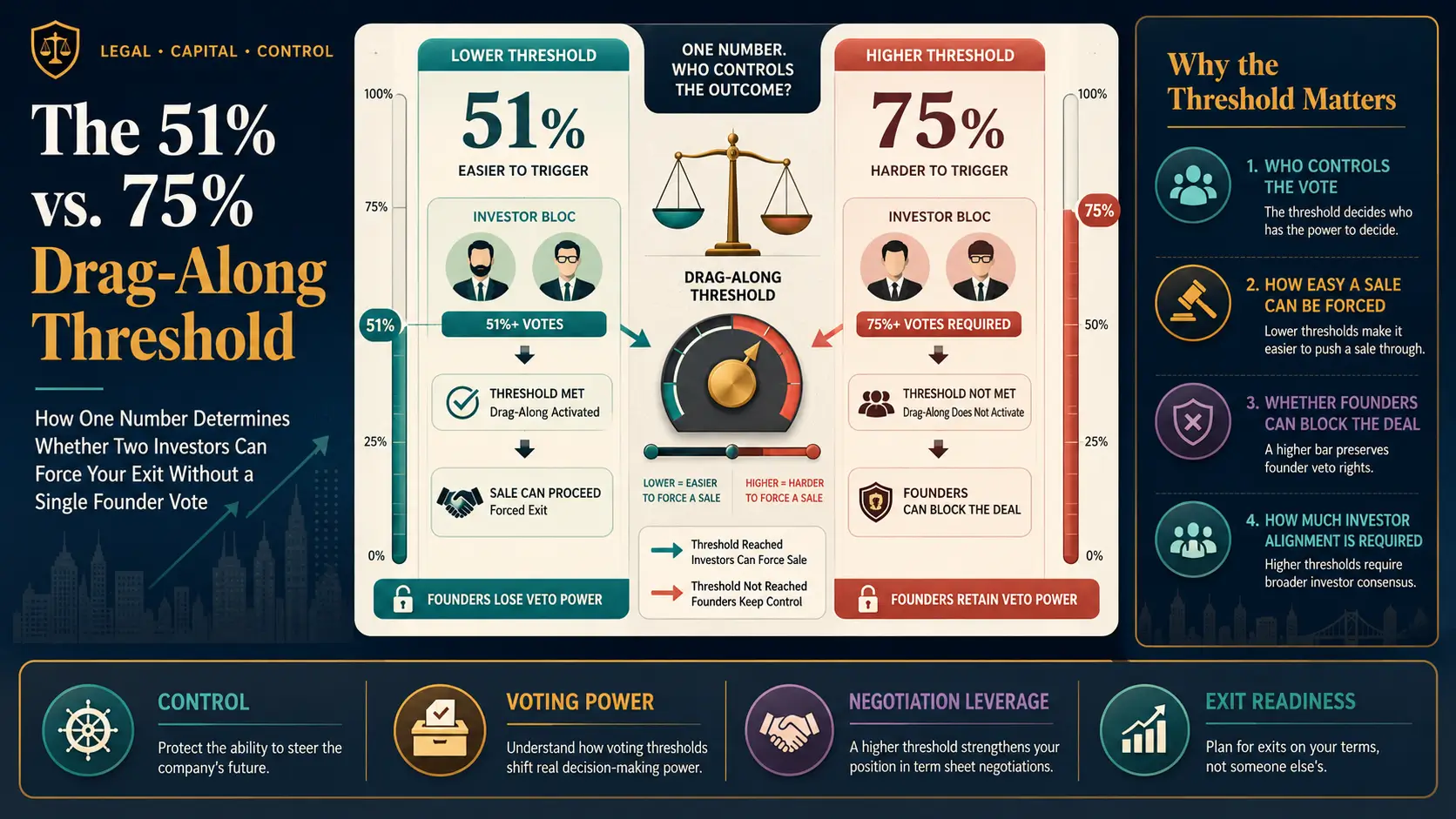
The 51% vs. 75% Drag-Along Threshold: How One Number Determines Whether Two Investors Can Force Your Exit Without a Single Founder Vote

How to Hire an Advisor for Capital Stack Strategy
Disclosure
Nothing on this site constitutes an offer to sell, or a solicitation of an offer to purchase, any security under the Securities Act of 1933, as amended, or any applicable state securities laws. Any offering of securities is made only by means of a formal private placement memorandum or other authorized offering documents delivered to qualified investors.
IRC Partners is a capital advisory firm. IRC Partners is not a registered investment adviser under the Investment Advisers Act of 1940 and does not provide investment advice as defined thereunder.
Certain statements in this article may constitute forward-looking statements, including statements regarding market conditions, capital availability, investor demand, and transaction outcomes. Such statements reflect current assumptions and expectations only. Actual results may differ materially due to market conditions, regulatory developments, company-specific factors, and other variables. IRC Partners makes no representation that any outcome, return, or result described herein will be achieved.
References to prior mandates, transaction volume, network credentials, or capital raised are provided for illustrative purposes only and do not constitute a guarantee or prediction of future results. Past performance is not indicative of future outcomes. Individual results will vary. Network credentials and transaction statistics referenced on this site reflect the aggregate experience of IRC Partners' principals and affiliated advisors and are not a representation of assets managed or transactions closed solely by IRC Partners.
Certain data, statistics, and information presented in this article have been obtained from third-party sources. IRC Partners has not independently verified such information and expressly disclaims responsibility for its accuracy, completeness, or timeliness. Readers should independently verify any third-party data before relying on it.
Readers are strongly encouraged to consult qualified legal, financial, and tax professionals before making any investment, capital raising, or business decision.
Schedule A Meeting
You get one shot to raise the right way. If this raise is worth doing, it’s worth doing with precision, leverage, and control.
This isn’t a practice run. Serious capital. Serious strategy. Let’s raise it right.
We onboard a maximum of seven
new strategic partners each quarter, by application only, to maximize your chances of securing the capital you need.
