.svg "CTA Arrow")


.png "Investor Ready Capital decorative background element")

Drag-Along Provisions and Founder Exit Timing: Who Actually Controls When You Sell
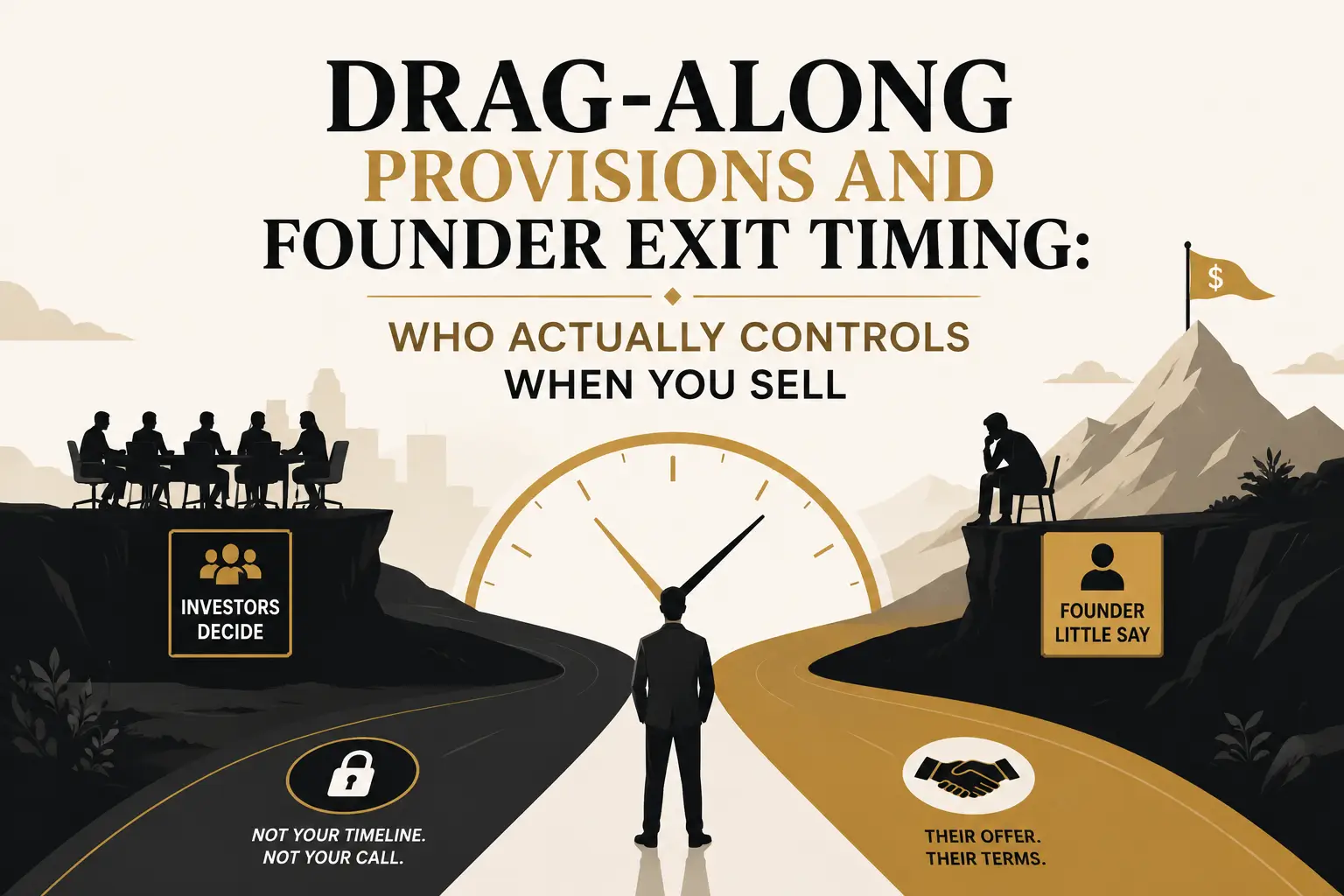
The party that can satisfy the drag-along trigger threshold and assemble the required approvals holds the strongest practical control over when a company is sold. A drag-along provision does not just compel reluctant shareholders to approve a transaction - it gives the holder of the trigger right the ability to initiate a sale process at a time that serves their liquidity needs, not the founder's value-creation timeline. Founders who understand the mechanics of drag-along provisions in growth-stage companies know the threshold percentage is only half the picture. The other half is timing, and when multiple preferred classes are layered into the cap table, the timing problem compounds because ownership concentration can shift practical sale timing power away from the founder before any exit conversation even begins.
Three variables that determine who controls exit timing:
- Who holds the drag-along trigger right. The party or class with the right to initiate the drag sets the clock.
- What approvals are required before the drag can be activated. Board approval requirements, class votes, and written consent mechanics all shape how fast the process can move.
- Whether the founder or common stock holds any independent blocking right. Without a separate founder or common approval component, the threshold alone decides.
How Drag-Along Provisions Interact With Exit Timing: The Mechanics Most Founders Miss
A drag-along clause does not make a value judgment. It creates an enforcement pathway. Once the specified approvals are in place, the clause operates mechanically regardless of whether the founder believes the company is at peak value or not.
Most founders read the threshold percentage and stop there. The mechanics that actually determine timing leverage sit underneath that number.
Four mechanics that shape timing control:
- Written consent compression. Under Delaware General Corporation Law Section 228, stockholders can act by written consent without a formal meeting. Once the required votes are assembled, a sale process can move faster than founders expect. There is no mandatory waiting period built into the drag-along clause itself.
- Board approval design. Some drag-along provisions require board approval before activation. Others do not. If the board is investor-controlled, board approval does not function as a founder protection. It functions as an additional investor lever.
- Shifting thresholds across rounds. A threshold that felt protective at seed may no longer protect the founder at Series A or beyond. The percentage that once required founder participation to satisfy may now be reachable without it.
- Ambiguous voting calculations. When the drag-along clause does not specify exactly how votes are counted, as-converted, fully diluted, or by class, the calculation can be interpreted in ways that move the trigger point. Understanding how ambiguous voting calculations affect drag-along clauses is essential before relying on any threshold as a timing protection.
The moment the threshold is satisfied, a founder's practical ability to object to timing narrows sharply. As covered in the IRC article on what founders actually sign away in a Series A drag-along clause, voting agreements typically require founders to refrain from any action that could reasonably delay or impair the company's ability to close a sale once the drag is triggered.
The clause does not ask whether now is the right time to sell. It asks whether the required approvals exist. If they do, the process can begin.
The Fund Lifecycle Problem: Why Investor Exit Timelines Diverge From Founder Timelines
This is not about bad faith. It is about different return clocks.
A venture fund typically has a 10-year life with a 5 to 7-year investment period. By years 6 to 8, many funds are managing toward realizations to return capital to their own limited partners. A good-enough exit at year 6 can be more valuable to a fund than a potentially larger exit at year 9, because of the impact of timing on IRR and LP distributions.
A founder's value-creation model often runs on a different timeline. Product maturity, market penetration, and revenue growth may point to a larger enterprise value 2 to 3 years later. Those two timelines can diverge sharply, and when the investor holds the drag-along trigger right, that divergence becomes a governance problem for the founder.
This is why the seed-to-Series A threshold shift matters beyond just dilution. As preferred ownership concentrates with institutional investors across rounds, the party most motivated to pursue a timely exit is increasingly the same party with the practical power to trigger one.
How Timing Control Compounds When Multiple Preferred Classes Are Outstanding
A single preferred class creates one timing pressure point. Multiple preferred classes can create alignment between investors that concentrates exit timing power even further away from the founder.
The issue is not just more complex paperwork. When a Series A investor and a Series B investor both hold preferred stock with drag-along rights, and their fund timelines happen to converge around year 6 or 7, they may be able to assemble the required approvals together without the founder's participation. The procedural leverage minority investors can extract from defective or ambiguous consent mechanics becomes even more pronounced when preferred classes stack, a pattern covered in detail in the IRC article on how drag-along defects give minority investors veto power over your exit.
The Series B compounding pattern is covered in detail elsewhere in this series. The timing-specific failure mode here is simpler: more preferred classes means more parties whose fund cycles may align before the founder's value model reaches its peak.
Worked Example: The Founder Who Hit the Threshold but Lost the Timing
Here is a concrete illustration of how timing control plays out in practice.
The setup: A founder raises a Series A in year 1. The drag-along provision requires approval from 60% of preferred stock, voting as a single class, to compel a sale. No independent founder or common approval is required. The lead Series A investor holds 42% of preferred. Two co-investors hold 11% and 9% respectively.
What happens at year 6: The lead investor and one co-investor together hold 53% of preferred. A third co-investor holds 8%, bringing the total to 61%. The 60% threshold is satisfied. Under NVCA model drag-along mechanics, no founder or common approval is required. The investors initiate a sale process at a $55M valuation.
The founder's position: The founder's model showed $95M at year 8. The drag-along was triggered 2 years early. The founder had no independent blocking right, no timing protection clause, and no minimum valuation floor in the drag-along provision. The threshold was met. The process began. The argument was not about whether a sale was permitted. It was about whether $55M was the right price at the right time. That argument had no structural home in the documents.
The lesson: The threshold was satisfied. The timing was not the founder's to control.
{{main-cta}}
What Founders Should Negotiate to Protect Exit Timing Before the Next Round Closes
Timing protections are negotiable. They are far easier to negotiate before a new financing round closes than after an exit process has already started. The goal is not to block every sale. It is to prevent one party from controlling timing by themselves.
The difference between a 51% and a 75% drag-along threshold is meaningful, but threshold alone is not sufficient. Founders need protections that address the timing dimension directly.
Negotiation checklist for exit timing protections:
- Higher threshold percentage. A 75% preferred threshold is harder to satisfy without broader coalition support than a 51% threshold.
- Independent founder or common stock approval component. Require a separate affirmative vote from founders or common holders before the drag can be activated.
- Board approval with independent director requirement. Require approval from an independent director, not just the full board, before the sale process begins.
- Minimum valuation floor. Define a minimum enterprise value or per-share price below which the drag-along cannot be triggered.
- Explicit process requirements. Require a defined marketing process, a minimum number of bids, or a fairness opinion before the drag-along compels any shareholder to approve.
IRC Partners works with founders to review control rights and timing protections before a new financing round closes or an exit conversation begins, so the structural levers are still available to negotiate.
Frequently Asked Questions
Can investors use a drag-along provision to force a sale before the founder is ready?
Yes, if the investor holds the drag-along trigger right and can satisfy the required approval threshold without the founder's participation. The provision does not require founder agreement. Once the specified approvals are assembled, the drag-along can compel all covered shareholders, including the founder, to approve and sign documents for the sale. The founder's readiness is not a condition in the clause.
What is the fund lifecycle problem and how does it affect founder exit timing?
The fund lifecycle problem refers to the structural mismatch between an investor's return timeline and a founder's value-creation timeline. Venture funds typically have 10-year lives with LP distribution obligations that create pressure toward realizations in years 6 to 8. A founder's modeled peak value may sit 2 to 3 years later. When the investor holds drag-along trigger power, fund timeline pressure can translate directly into a sale process initiated before the founder believes the company is at peak value.
Does a drag-along provision give investors the right to set the sale price?
A drag-along provision does not set the sale price. It compels shareholders to approve and execute a sale transaction once the required thresholds are met. However, if the drag-along clause contains no minimum valuation floor and no fairness opinion requirement, investors who control the process can accept a price the founder considers premature or below peak value, and the founder has no structural mechanism to reject it on price grounds alone.
How does having multiple preferred classes outstanding change who controls exit timing?
Multiple preferred classes can allow investors from different rounds to align their voting power and satisfy a drag-along threshold together, often without requiring common stock or founder participation. If a Series A and Series B investor each hold significant preferred positions and their fund timelines converge around the same exit window, they may be able to assemble the required approvals as a coalition. This makes the timing control problem more acute than in a single-class structure.
What is a timing protection clause and how does it work in a drag-along context?
A timing protection clause is a negotiated provision that limits when or under what conditions a drag-along can be activated. Examples include minimum valuation floors, requirements for a defined sale process or fairness opinion, mandatory board approval from an independent director, or an explicit founder or common stock consent requirement. These provisions do not prevent a sale. They prevent any single party from controlling sale timing without meeting additional structural conditions first.
When should founders negotiate exit timing protections, and what leverage do they have?
Founders have the most leverage to negotiate timing protections before a new financing round closes. At that stage, investors need the founder's cooperation to complete the round, and document terms are still open. Once the round closes and preferred rights are locked in, the structural leverage shifts. Waiting until an exit process is active leaves founders with limited options beyond negotiation or dispute resolution, neither of which is as effective as having the right clause in the document from the start.
Can a founder block a drag-along sale if they believe the timing destroys value?
A founder cannot block a drag-along sale on timing or valuation grounds alone unless the governing documents contain an explicit protection that creates that right. Without a minimum valuation floor, a founder or common approval requirement, or another timing protection clause, the drag-along operates on threshold mechanics only. If the threshold is met, the sale process can proceed. A founder's belief that the company is worth more at a later date is not a structural defense under a standard drag-along provision.
Continue reading this series:
- Why your drag-along threshold from your seed round no longer protects you at Series A
- How drag-along consent structures can let a minority investor force a majority outcome
- 51% vs. 75% drag-along threshold: what the difference actually means for founders
By the time most founders are rehearsing the pitch, the outcome of the raise has already been set by the structure underneath it. IRC Partners advises operators raising $5M to $250M of institutional capital and accepts seven strategic partners per quarter. If you are going to market this year, have the structure reviewed before investors do. Schedule a call with our team here.
Sponsors weighing this decision should first complete a capital raise readiness assessment for sponsors to confirm the raise is investor-ready.
Need guidance on your capital raise?



Industrial Real Estate Investment: How $10M+ Sponsors Structure Warehouse and Logistics Deals That Institutional Capital Funds

What SEC Filings Are Required to Raise a $100M Real Estate Fund From Institutional Investors and How to Avoid Costly Compliance Mistakes
Project Financing: How Sponsors Use Project Finance Structures to Raise $10M+ Without Personal Guarantees
Disclosure
Nothing on this site constitutes an offer to sell, or a solicitation of an offer to purchase, any security under the Securities Act of 1933, as amended, or any applicable state securities laws. Any offering of securities is made only by means of a formal private placement memorandum or other authorized offering documents delivered to qualified investors.
IRC Partners is a capital advisory firm. IRC Partners is not a registered investment adviser under the Investment Advisers Act of 1940 and does not provide investment advice as defined thereunder.
Certain statements in this article may constitute forward-looking statements, including statements regarding market conditions, capital availability, investor demand, and transaction outcomes. Such statements reflect current assumptions and expectations only. Actual results may differ materially due to market conditions, regulatory developments, company-specific factors, and other variables. IRC Partners makes no representation that any outcome, return, or result described herein will be achieved.
References to prior mandates, transaction volume, network credentials, or capital raised are provided for illustrative purposes only and do not constitute a guarantee or prediction of future results. Past performance is not indicative of future outcomes. Individual results will vary. Network credentials and transaction statistics referenced on this site reflect the aggregate experience of IRC Partners' principals and affiliated advisors and are not a representation of assets managed or transactions closed solely by IRC Partners.
Certain data, statistics, and information presented in this article have been obtained from third-party sources. IRC Partners has not independently verified such information and expressly disclaims responsibility for its accuracy, completeness, or timeliness. Readers should independently verify any third-party data before relying on it.
Readers are strongly encouraged to consult qualified legal, financial, and tax professionals before making any investment, capital raising, or business decision.
Schedule A Meeting
You get one shot to raise the right way. If this raise is worth doing, it’s worth doing with precision, leverage, and control.
This isn’t a practice run. Serious capital. Serious strategy. Let’s raise it right.
We onboard a maximum of seven
new strategic partners each quarter, by application only, to maximize your chances of securing the capital you need.
