.svg "CTA Arrow")


.png "Investor Ready Capital decorative background element")

Drag-Along Rights Gone Wrong: The Clause That Lets Minority Investors Block Your Series B Exit or Recap

Drag-Along Rights Gone Wrong: The Clause That Lets Minority Investors Block Your Series B Exit or Recap
Drag-along rights are a contractual provision in your voting agreement that require all shareholders to vote in favor of a company sale once a specified approving group has consented. The clause is supposed to prevent one small holder from blocking a transaction the board and majority investors have already approved.
When the clause is drafted correctly, it works exactly as designed. When it is not, it inverts. A defective threshold, a missing carve-out, or a coordination failure with your tag-along or ROFR provisions can hand a minority holder a procedural choke point that has nothing to do with how much of the company they own. That choke point becomes leverage: delay, side-payment demands, or a broken deal.
If you are preparing for a Series B, approaching a buyer, or entering a recapitalization, your drag-along clause is not background paperwork. It is a live transaction risk. The broader guide to cap table issues that can stop a Series B before the lead investor reads your deck covers the full landscape of governance problems that surface at this stage. This article focuses on drag-along mechanics specifically.
Key takeaways:
- Drag-along rights only protect a transaction when the trigger requires alignment across board, preferred, and common holders.
- Weak thresholds, per-series consent requirements, and missing carve-outs can give a small holder veto power they were never meant to have.
- The leverage is usually time pressure, not litigation. Deals break from delay and uncertainty before they reach a courtroom.
- Coordination failures between drag-along, tag-along, and ROFR provisions create procedural conflicts that buyers and new leads do not want to untangle.
- The cheapest cleanup happens before a buyer or Series B lead is waiting. After that, the cost shifts to founders.
How Drag-Along Rights Are Supposed to Work
A well-drafted drag-along provision lives inside the voting agreement and does one job: it ensures that once a qualified majority has approved a sale, every other holder is contractually required to vote in favor and cooperate with the process.
The NVCA model voting agreement, updated in October 2025, uses a three-part approval structure as the market standard. All three groups must consent before the drag obligation activates.
When all three prongs are satisfied, the drag activates and every remaining holder, regardless of ownership percentage, must vote in favor, sign required documents, and cooperate with closing. According to Carta's term sheet framework, the drag-along is designed for administrative ease: it is a consent-collection mechanism, not a governance override.
Dragged holders are protected. They receive the same per-share consideration as everyone else. Their liability is typically capped at the amount they receive, and they are only required to make limited representations about their own ownership. Clean mechanics like these make approval collection faster and give buyers confidence that the deal will close without holdout risk.
The Drafting Failures That Create Minority Blocking Power
Most drag-along clauses look fine at signing. The problems surface when a transaction arrives and counsel starts checking the mechanics against a cap table that has changed since the original document was signed.
Cooley's analysis of drag-along triggers identifies the trigger design as the most negotiated and most failure-prone element of the provision. Here are the specific failures that convert a sale-enabling clause into a blocking mechanism.
- Threshold set by class only, not all shares. When the drag can be triggered by a majority of one preferred series without requiring common-holder or board alignment, a single investor class can force a sale founders oppose. The reverse is also true: a per-series threshold can require consent from a series that no longer has economic interest in the outcome, creating a veto pocket where none was intended.
- No board-approval prong. Without a required board vote, the drag can be triggered unilaterally by investors, which breaks the fiduciary legitimacy of the process and gives other holders grounds to contest the activation.
- Silent interaction with pre-emption rights. DWF's analysis of drag-along and tag-along rights notes that pre-emption rights take precedence when the agreement is silent on their interrelationship with drag-along. If that conflict is not resolved in the document, a holder can assert pre-emption rights to stall the sale process.
- No coordination with tag-along or ROFR. Drag-along and tag-along are separate rights that operate at different levels. When the documents do not address which takes precedence or how notice periods interact, a holder can use the overlap to create a procedural delay that has no clean resolution without renegotiation.
- Outdated threshold after new rounds. A threshold based on a Series A cap table may no longer reflect the actual ownership structure after SAFEs convert, notes mature, or a new preferred series is issued. If the clause was not updated at each subsequent financing, the math may no longer work. This is closely related to the broader problem of convertible note overhang and why uncapped notes become a Series B red flag: both problems trace back to financing instruments that change the cap table in ways the original documents did not anticipate.
The real risk: A buyer typically wants 90 to 95 percent or more of holders to sign off before closing. A single unresolved defect in the drag-along mechanics can prevent that threshold from being reached, even when the economic majority fully supports the deal.
How a Minority Holder Uses Drag-Along Leverage in Practice
The blocking mechanism rarely starts with a lawsuit. It starts with a letter from counsel pointing to a specific defect in the consent mechanics, usually at the worst possible moment in the deal timeline.
Here is the sequence as it typically plays out:
- The transaction arrives. A buyer submits a letter of intent, or a recap term sheet circulates. Counsel begins drafting the consent package.
- The defect surfaces. One holder, often owning 5 to 10 percent or less, identifies a gap in the drag-along threshold, a pre-emption right that was never waived, or a tag-along notice period that has not expired.
- Signing pauses. The holder does not need to file anything. The defect alone is enough to slow the process while the parties negotiate a resolution.
- Time pressure creates leverage. The buyer has a closing deadline. The recap has a financing window. The longer the delay, the more the holder's cooperation is worth in side-payment terms, revised economics, or document changes.
- The deal reprices or breaks. If the holder's ask is too high, the buyer walks or retrades. If the ask is met, founders absorb the cost.
The part most coverage misses: A minority holder owning 6 percent of the cap table does not need 6 percent of the economic leverage to cause damage. They need one sentence in an old document that nobody fixed between rounds. The leverage is procedural, not proportional.
Many deals never reach litigation. They break from uncertainty and delay while the parties try to determine whether the defect is fatal or fixable.
How Blocking Converts Into Economic Damage
Governance friction does not stay in the governance layer. It converts into money, valuation, and dilution.
The core mechanism: Buyers price certainty of close. When a drag-along defect introduces doubt about whether all holders will sign off, the buyer either reduces the offer to account for execution risk or adds conditions that shift risk back to founders and existing investors. According to Cooley's analysis of drag-along provisions, acquirers of US companies often seek 95 percent or more of stockholder approval before closing, precisely to limit post-closing claim exposure. One unresolved consent problem can prevent that threshold from being met.
The downstream economic consequences include:
- Retrading. A buyer who discovers document defects mid-diligence may reduce the offer price or add escrow holdbacks to cover the risk of post-closing claims from unsatisfied holders.
- Broken recaps. A recapitalization requires cooperation from existing holders. A legacy investor using a consent defect to extract better terms forces founders to either accept worse economics or restart the process.
- Series B diligence friction. Institutional leads at the Series B stage read document inconsistencies as a signal that the cap table was not managed carefully. That perception can slow diligence, reduce term sheet appetite, or prompt requests for expensive legal cleanup before the round closes.
- Legal and advisory costs. Even when the deal survives, resolving a drag-along defect mid-process requires legal work, negotiation time, and often a concession. Those costs come directly out of founder proceeds.
The cleaner the drag-along mechanics, the less leverage any single holder has to extract value from the process.
What to Fix Before You Go to Market
The best time to clean up your drag-along clause is before you have a buyer, a recap term sheet, or a Series B lead in the room. Once a transaction is live, every change requires negotiation with parties who now have leverage over timing.
Work through this checklist with your legal counsel before launching any process:
- Audit the trigger. Pull the voting agreement and confirm whether the drag requires board approval, preferred approval, and common-holder approval. Confirm which specific series or classes are covered and whether the threshold still reflects the current cap table after every SAFE conversion, note maturity, or new preferred issuance.
- Test the math. Run the current cap table against the drag threshold. If the math does not work with the current ownership structure, the clause may be unenforceable as written.
- Check coordination with tag-along and ROFR. Confirm that your ROFR and co-sale agreement does not create a notice period or pre-emption right that would override or delay the drag-along process. If the documents are silent on which right takes precedence, that silence is a defect.
- Review side letters. Any side letter granting a holder special consent rights, information rights with veto implications, or modified transfer terms can interact with the drag-along in ways the original document did not anticipate.
- Confirm equal treatment and liability language. Dragged holders must receive the same per-share consideration, capped indemnity, and limited reps. If that language is missing or inconsistent, a holder has grounds to resist.
- Resolve gaps proactively. If you find a defect, fix it through an amendment before the process starts. Amendment consent is easier to obtain when there is no transaction pressure and no holder has identified the defect as leverage.
If you are also thinking through how your valuation and startup funding strategy affects your transaction readiness, the complete startup valuation guide for founders and the complete guide to raising capital for your startup in 2026 are useful starting points before you engage a lead investor or buyer.
{{main-cta}}
Frequently Asked Questions
Can a holder with less than 10 percent of the cap table actually block a sale using drag-along rights?
Yes. The blocking mechanism is procedural, not proportional. A small holder who identifies a defect in the drag-along trigger, an unresolved pre-emption right, or a tag-along notice period that has not expired can pause the consent collection process regardless of their ownership percentage. Buyers seeking 90 to 95 percent approval before closing are particularly exposed to this kind of friction.
Does drag-along apply to a recapitalization, or only to a sale?
It depends on how your voting agreement defines the triggering event. Many drag-along provisions are scoped to mergers, acquisitions, and change-of-control transactions. A recapitalization that restructures existing equity without a full sale may fall outside that definition, meaning you cannot use the drag-along to compel consent from a reluctant holder during a recap. Check the definition of "Approved Sale" or equivalent language in your voting agreement.
What is the difference between drag-along rights and tag-along rights?
They are separate rights that operate in opposite directions. Drag-along rights allow a majority to compel a minority to sell on the same terms. Tag-along rights allow a minority to join a sale initiated by a majority on the same terms. The coordination problem arises when both rights apply to the same transaction and the documents do not specify which notice period governs or which right takes precedence.
Can a side letter override or suspend a drag-along obligation?
Yes, if it was drafted to do so. Side letters granting a specific investor enhanced consent rights, modified transfer terms, or information rights with embedded veto triggers can create obligations that conflict with the drag-along mechanics in the main voting agreement. Any side letter signed after the original voting agreement should be reviewed against the drag-along provision before a transaction launches.
What approval threshold should a drag-along clause require?
Market practice, as reflected in the NVCA model voting agreement updated in October 2025, converges on a three-part threshold: board approval, majority of preferred stockholders, and majority of common stock held by current or former employees. Founder-protective versions require all three prongs. Investor-friendly versions may allow preferred holders to trigger the drag without founder consent, which creates a different kind of risk.
How does a Series B lead investor evaluate drag-along mechanics during diligence?
Institutional leads review the voting agreement as part of governance diligence. They are looking for a clean, enforceable drag-along that would allow a future sale to close without holdout risk. A clause with an outdated threshold, missing board-approval prong, or unresolved coordination conflict signals that the cap table was not maintained carefully between rounds. That signal can slow the process or prompt a request for legal cleanup before the term sheet is finalized.
If the drag-along threshold is no longer accurate after a new financing round, is the clause still enforceable?
Not reliably. If the threshold was defined against a specific share count or class structure that no longer reflects the current cap table, a court may find that the clause cannot be triggered as written. This is one of the most common and least visible drag-along defects. Every new financing round, SAFE conversion, or note maturity should trigger a review of whether the voting agreement needs to be amended to reflect the updated ownership structure.
Continue reading this series:
- You Raised Three SAFEs. Here's How They're About to Detonate at Your Series B
- That Seed Round Term Looked Fine. It's Now Costing You $8M at Series B
- Co-Sale Rights and Tag-Along Provisions: The Cap Table Clauses That Force Institutional Investors to Share Their Deal With Your Seed Angels
The wrong structure doesn't just cost you this round. It costs you the next three. IRC Partners advises founders raising $5M to $250M of institutional capital. If you're about to go to market and want the structure reviewed before investors see it, book a call here
Sponsors weighing this decision should first complete a capital raise readiness assessment for sponsors to confirm the raise is investor-ready.
Need guidance on your capital raise?


Real Estate Asset Management Fees: What $10M+ Sponsors Charge and How to Present Fee Structure to Institutional LPs

Commercial Real Estate Appraisal: How $10M+ Sponsors Get an Institutional-Grade Valuation That Lenders Accept Without Dispute
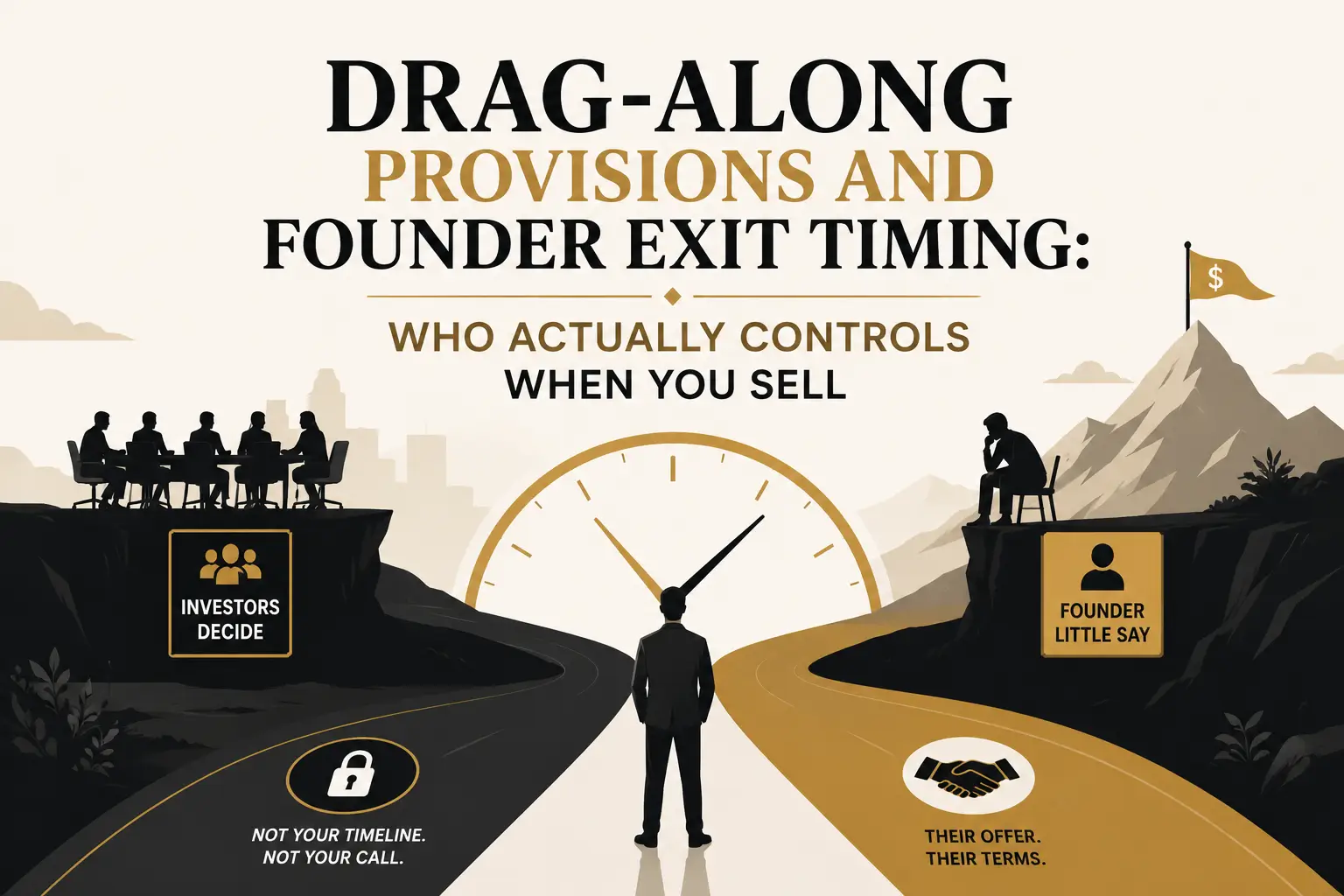
Drag-Along Provisions and Founder Exit Timing: Who Actually Controls When You Sell
Disclosure
Nothing on this site constitutes an offer to sell, or a solicitation of an offer to purchase, any security under the Securities Act of 1933, as amended, or any applicable state securities laws. Any offering of securities is made only by means of a formal private placement memorandum or other authorized offering documents delivered to qualified investors.
IRC Partners is a capital advisory firm. IRC Partners is not a registered investment adviser under the Investment Advisers Act of 1940 and does not provide investment advice as defined thereunder.
Certain statements in this article may constitute forward-looking statements, including statements regarding market conditions, capital availability, investor demand, and transaction outcomes. Such statements reflect current assumptions and expectations only. Actual results may differ materially due to market conditions, regulatory developments, company-specific factors, and other variables. IRC Partners makes no representation that any outcome, return, or result described herein will be achieved.
References to prior mandates, transaction volume, network credentials, or capital raised are provided for illustrative purposes only and do not constitute a guarantee or prediction of future results. Past performance is not indicative of future outcomes. Individual results will vary. Network credentials and transaction statistics referenced on this site reflect the aggregate experience of IRC Partners' principals and affiliated advisors and are not a representation of assets managed or transactions closed solely by IRC Partners.
Certain data, statistics, and information presented in this article have been obtained from third-party sources. IRC Partners has not independently verified such information and expressly disclaims responsibility for its accuracy, completeness, or timeliness. Readers should independently verify any third-party data before relying on it.
Readers are strongly encouraged to consult qualified legal, financial, and tax professionals before making any investment, capital raising, or business decision.
Schedule A Meeting
You get one shot to raise the right way. If this raise is worth doing, it’s worth doing with precision, leverage, and control.
This isn’t a practice run. Serious capital. Serious strategy. Let’s raise it right.
We onboard a maximum of seven
new strategic partners each quarter, by application only, to maximize your chances of securing the capital you need.
