.svg "CTA Arrow")


.png "Investor Ready Capital decorative background element")
Commercial Real Estate Financing Rates: What $10M+ Sponsors Need to Know Before Approaching Institutional Lenders

Commercial Real Estate Financing Rates: What $10M+ Sponsors Need to Know Before Approaching Institutional Lenders
Commercial Real Estate Financing Rates Are a Risk Price, Not a Market Number
In 2026, strong $10M+ sponsors pursuing stabilized assets can expect senior bank and agency executions in the mid-5% to upper-6% range. Construction debt typically prices at SOFR plus 250 to 500 basis points. Bridge debt commonly runs 7.5% to 10% or higher. Mezzanine debt and preferred equity generally land between 10% and 15% all-in, depending on structure and risk. These are not fixed prices. They are starting points that shift based on how a lender reads your deal.
The real question is not "what is the market rate?" It is "what does my deal price at, and why?"
Institutional lenders do not quote a single commercial real estate financing rate. They build a spread from the ground up, starting with a benchmark, then adding risk premium based on leverage, cash flow stability, asset class, market, sponsor track record, business plan complexity, recourse, and execution certainty.
According to the NAIOP Debt Market Survey for Q4 2025, benchmark rates fell further in the second half of 2025, but fixed-rate spreads widened modestly. Working with experienced real estate sponsor capital advisory ensures you understand how these pricing mechanics are constructed before approaching institutional lenders. This article covers three things every $10M+ sponsor needs:
- How institutional lenders actually build commercial real estate financing rates
- Indicative 2026 pricing ranges by debt layer, with the underwriting variables that move them
- What your data room must prove before lenders sharpen their pricing
How Institutional Lenders Actually Quote Commercial Real Estate Financing Rates
Most sponsors think of a loan rate as a number a lender quotes from a rate sheet. Institutional lenders do not work that way. Pricing is a conclusion, not a starting point. It is the output of underwriting, not the input.
The Two Core Quoting Frameworks
Fixed-rate debt is typically priced as a spread over a benchmark index, usually the 5-year or 10-year U.S. Treasury or the corresponding swap rate. If the 10-year Treasury sits at 4.36% and the lender requires a 200 basis point spread for your deal, the all-in rate lands around 6.36%. Move the Treasury 30 basis points and the quote moves with it.
Floating-rate debt is quoted as a spread over SOFR, the Secured Overnight Financing Rate that replaced LIBOR as the standard benchmark for adjustable commercial loans. If 30-day SOFR is at 3.65% and the lender quotes SOFR plus 300 basis points, the current coupon is roughly 6.65%. But that number changes with every SOFR reset.
How the Spread Gets Built
Once a lender picks its benchmark, it determines the spread based on a layered risk assessment:
- Asset class and market - Multifamily and industrial carry the tightest spreads in 2026. Office and retail command premiums.
- Leverage - Lower LTV and LTC compress spreads. Higher leverage widens them, sometimes significantly.
- Debt service coverage - Lenders commonly require DSCR of 1.20x to 1.35x minimum. Deals below that threshold face wider spreads or lower proceeds.
- Debt yield - Many institutional lenders size to a minimum debt yield of 8% to 10%. Deals that fall short may not qualify at all.
- Business plan complexity - A stabilized, cash-flowing asset prices tighter than a ground-up development or heavy value-add with unproven lease-up assumptions.
- Sponsor track record - Lenders weigh completed projects, realized exits, and prior lender relationships.
- Execution certainty - Incomplete diligence packages, inconsistent financials, or unclear exit assumptions all widen spreads.
As FRED data from the Federal Reserve shows, SOFR has moved into the 3.65% to 3.78% range in 2026, and the 10-year Treasury has hovered around 4.27% to 4.36%. A lower benchmark does not automatically produce a lower coupon. If a lender widens its spread to compensate for perceived risk, the all-in rate can stay flat or rise even as benchmarks fall. That is exactly what the NAIOP Q4 2025 survey found for fixed-rate borrowers.
The practical implication: Indicative pricing is not firm pricing. Lenders sharpen their quotes when they trust the sponsor's information, believe the business plan, and see a credible path to execution.
Commercial Real Estate Financing Rate Ranges by Debt Layer in 2026
The table below shows indicative 2026 pricing ranges by debt layer and lender type for $10M+ institutional deals. These are not guaranteed quotes. They reflect the range a well-prepared sponsor with a credible deal can reasonably expect. Deals with weaker metrics, transitional risk, or thin execution certainty will price toward the wider end or may not qualify at all.
Sources: NAIOP Debt Market Survey Q4 2025; Mortgage Bankers Association commercial research; Trepp 2026 market data; Federal Reserve / FRED benchmark rates. All ranges are indicative and subject to deal-specific underwriting.
Key observations from the table
- Agency debt remains the tightest execution for multifamily sponsors with strong leverage metrics. Fannie Mae and Freddie Mac raised their combined 2026 multifamily lending caps to $176 billion, keeping agency pricing competitive for qualifying deals.
- Construction debt spans a wide band because bank executions (SOFR + 250–450 bps) price meaningfully tighter than non-bank debt fund executions (SOFR + 350–650 bps). The difference often comes down to sponsor track record and asset class.
- Bridge debt pricing is highly deal-specific. A light value-add on a well-located multifamily property may price near 7.5%. A heavy repositioning in a secondary market with speculative lease-up can reach 11% to 12% or beyond.
- Mezzanine and preferred equity are not interchangeable. Mezz typically prices lower but requires senior lender intercreditor consent. Preferred equity costs more but offers more flexibility on complex or ground-up deals. For a deeper comparison of how these layers interact, see Senior Debt vs. Mezzanine vs. Preferred Equity.
- Private credit fills gaps that banks and agencies leave open. According to Deloitte's commercial real estate outlook, the wall of roughly $1.7 trillion in maturing U.S. CRE mortgages has made private credit a significant and growing part of the refinancing and transitional deal market.
What Actually Moves Pricing Up or Down
Understanding the rate table is useful. Understanding what changes the numbers in that table is what separates sponsors who negotiate from sponsors who accept. The variables below are the levers lenders actually pull when they build a spread. Sponsors who can improve any of these inputs before outreach will price better.
What this means for sponsors
PwC's Emerging Trends in Real Estate 2026 found that institutional lenders continue to favor lower leverage and stronger sponsorship as essential filters for deal selection. According to Trepp, the median LTV for CRE CLOs tightened to 62.25% in 2025, reflecting a market-wide preference for conservative leverage structures.
The practical implication is that two sponsors with similar assets in similar markets can receive quotes that differ by 100 to 200 basis points based entirely on sponsor strength, leverage choice, and how clearly they can demonstrate execution certainty. That spread difference, compounded over a 3-year to 5-year hold, is material.
For a detailed look at how to structure capital stack layers to improve these metrics before lender outreach, see Structuring the Capital Stack for $10M+ Real Estate.
SOFR, Floating-Rate Debt, and What Sponsors Need to Watch
Most construction loans, bridge loans, and transitional debt facilities are quoted on a floating-rate basis, using SOFR as the benchmark. As of 2026, 30-day SOFR sits around 3.65% and 90-day SOFR around 3.67%, per Federal Reserve benchmark data. That is meaningfully lower than the peak levels of 2023 and 2024. Floating-rate borrowers have benefited from that decline, as the NAIOP Q4 2025 survey confirmed.
But a lower SOFR does not mean floating-rate debt is cheap or simple. There are five things every sponsor needs to model before committing to floating-rate commercial mortgage debt.
Five Sponsor Watchpoints for Floating-Rate Debt
- SOFR floors - Many lenders build a minimum SOFR floor into the loan, often 1.00% to 3.25%. If SOFR drops below the floor, your effective rate does not fall with it. Understand the floor before you accept the spread.
- Rate cap requirements - Most institutional lenders require borrowers to purchase a rate cap on floating-rate loans. In 2026, cap costs have moderated from their 2023 peaks, but they remain a real expense. A 2-year cap on a $30M construction loan can add 50 to 150 basis points to your effective cost of capital depending on the strike rate and term.
- Interest reserves - Lenders typically require a funded interest reserve to cover debt service during lease-up or construction. That reserve is drawn from loan proceeds, which reduces effective loan availability and increases your equity requirement.
- Extension fees - Most bridge and construction loans carry 1-year to 3-year initial terms with extension options. Extensions are not free. Expect 25 to 50 basis points per extension, plus potential requalification requirements.
- Exit timing and refinance risk - Floating-rate debt works when your business plan executes on schedule and the refinance market is open when you need it. If lease-up takes longer than projected or the permanent debt market tightens, you may face an extension at worse terms or a forced sale.
A worked example
A sponsor takes a bridge loan at SOFR plus 325 basis points, with a 1.00% SOFR floor, on a $20M value-add multifamily acquisition. At current SOFR of 3.65%, the coupon is 6.90%. Add origination fees of 1.00%, a rate cap cost of roughly 0.75% annualized, and a funded interest reserve of 6 months, and the true all-in cost of capital for year one is closer to 8.5% to 9.0%. The headline spread was 325 basis points. The real cost of capital was something else entirely.
Why the Cheapest Headline Rate Is Often the Most Expensive Capital
A sponsor who selects a lender based on the lowest quoted coupon is making the same mistake as a buyer who buys a house based on the asking price without reading the inspection report. The coupon is one line in a much longer cost structure.
The full cost of capital for a commercial real estate loan includes:
- Coupon - The interest rate, fixed or floating
- Origination fees - Typically 0.50% to 1.50% of the loan amount, paid at closing
- Exit fees - Some lenders charge 0.25% to 1.00% of the loan balance at payoff
- Rate cap cost - Required on floating-rate loans; cost varies by term, strike, and notional amount
- Interest reserves - Funded from proceeds, reducing net availability
- Prepayment premium - Yield maintenance, step-down penalties, or lockout periods can cost 1% to 5%+ of the loan balance
- Extension fees - 25 to 50 basis points per extension period
- Covenant burden - Cash management triggers, DSCR maintenance covenants, and cash sweep provisions add operational friction and risk
The trade-off most sponsors miss
A lender quoting 6.25% with full recourse, a 1.50% origination fee, a 6-month interest reserve, and a yield maintenance prepayment structure may be meaningfully more expensive over a 5-year hold than a lender quoting 6.75% with carve-out recourse only, a 0.75% origination fee, no exit fee, and step-down prepayment.
The difference is not just math. It is also certainty. Lenders who price slightly wider sometimes offer:
- Higher loan proceeds relative to cost
- Lower or no funded reserves
- Cleaner recourse structure
- More flexible extension options
- Faster execution and fewer retrades
Key insight: In a market where over $1.7 trillion in CRE mortgages are facing maturities, according to Deloitte, lenders who can actually close on schedule are worth a premium. A lender who quotes tight but retracts at the last moment is not cheap. They are expensive.
The right comparison is not coupon A versus coupon B. It is total cost of capital over the hold period, net of fees, reserves, and structural protections, against the probability of execution.
What Lenders Need to See Before They Tighten Pricing
Lenders do not just price the asset. They price the sponsor's ability to execute. A strong data room reduces uncertainty, and reduced uncertainty compresses spreads. Sponsors who show up to lender conversations with a complete, consistent diligence package routinely receive sharper indicative quotes than sponsors who submit partial materials and promise more later.
The core lender package for a $10M+ deal
Before a lender will move from a soft indication to a firmer quote or term sheet, they typically need:
- Rent roll - Current, unit-by-unit, with lease expiration dates and any concessions
- T12 operating statements - Trailing 12 months of income and expense, reconciled to the rent roll
- Sources and uses - Full project cost breakdown, including acquisition, hard costs, soft costs, carry, and reserves
- Sponsor track record - Completed project list with asset class, size, cost, delivery date, and exit or current status
- Liquidity statement - Sponsor and guarantor liquid net worth, typically required at 10% to 20% of the loan amount
- Organizational chart - Entity structure, ownership percentages, and key person identification
- Existing debt schedule - All current obligations, maturities, and guarantees
- Business plan - Clear description of the value creation thesis, timeline, and exit assumptions
- Construction budget or capex plan - Detailed line-item budget with contingency for development or value-add deals
- Market support - Comparable rents, sales comps, absorption data, and submarket vacancy trends
- Exit assumptions - Cap rate, sale price, or refinance sizing at stabilization, with market support
{{main-cta}}
Why incomplete materials widen spreads
When a lender cannot underwrite the deal fully because materials are missing or inconsistent, they price the gap. That means wider spreads, lower proceeds, or more reserves to compensate for the uncertainty they cannot resolve. The sponsor pays for every unanswered question in basis points.
For guidance on how to structure a complete diligence package before outreach, see Data Room Setup for a First-Time $100M Real Estate Fund and Fund Documents Needed to Raise $100M From Institutional LPs. The documentation standards are directly applicable to lender outreach, not just LP raises.
Sponsors who want to compress the time between first lender conversation and firm term sheet should also review how to build a data room that closes institutional investors in 30 days instead of 90. The same speed-to-trust principles that shorten LP diligence cycles apply directly to lender underwriting. A room that answers questions before they are asked gives lenders fewer reasons to pause and more confidence to sharpen pricing. For the full document-level breakdown of what institutional lenders request at each stage, see the real estate due diligence checklist for $10M+ sponsors.
Execution certainty also matters beyond the paper. Lenders track how long institutional LP due diligence takes and whether sponsors can sustain momentum through a full underwriting cycle. For context on that timeline, see How Long Does Institutional LP Due Diligence Take?.
Ask What Your Deal Prices At, Not What the Market Rate Is
Commercial real estate financing rates in 2026 are not a single number. They are a range, and where your deal lands in that range depends on your leverage, your asset, your market, your business plan, and your ability to prove execution certainty before a lender commits.
The sponsors who get the best pricing are not the ones who shop the hardest. They are the ones who show up prepared, with a lender-ready data room, a credible business plan, and a clear understanding of what the full cost of capital actually looks like across the term.
The rate is not the price. The structure, the fees, the reserves, and the certainty of close are the price.
Start with your deal's underwriting variables, not a headline rate. Then build your lender package to prove those variables as clearly as possible before the first conversation.
Frequently Asked Questions
How much can a sponsor realistically move their commercial real estate financing rate by improving their leverage metrics?
Sponsors who reduce LTV from 75% to 65% on a stabilized deal can often compress their spread by 50 to 100 basis points with the same lender. Improving DSCR from 1.20x to 1.35x or above can produce a similar effect. The combination of lower leverage and stronger coverage is the most reliable way to earn tighter pricing before a formal term sheet is issued.
When does providing full recourse actually improve pricing on a commercial real estate loan?
Full recourse or completion guarantees most consistently improve pricing on construction and bridge loans where lender risk is highest. On a construction deal, moving from carve-out recourse to full completion guarantee can compress spreads by 50 to 150 basis points and may allow a lender to increase LTC from 65% to 70% or higher. On stabilized permanent debt, recourse has less impact on pricing because the asset's cash flow already supports the loan.
What is debt yield and why do institutional lenders use it to size commercial real estate loans?
Debt yield is calculated as stabilized net operating income divided by the loan amount. It measures a lender's return on the loan balance independent of interest rate or amortization assumptions. Most institutional lenders require a minimum debt yield of 8% to 10% before they will size a loan, regardless of LTV or DSCR. A deal with $1.2M in NOI and a $15M loan request produces a debt yield of 8.0%. If the lender requires 9%, the maximum loan amount drops to $13.3M. Sponsors who do not understand this constraint often arrive at lender conversations with a loan request that exceeds what the income can support.
At what point do institutional lenders typically require a rate cap on a floating-rate commercial real estate loan?
Most institutional lenders require a rate cap on any floating-rate loan with a term of 12 months or longer. The cap is typically sized to keep the debt service coverage ratio above the minimum threshold even if SOFR rises by 200 to 300 basis points above the origination level. Sponsors should budget for cap costs at origination. In 2026, cap costs have moderated from peak levels, but a 2-year cap on a $20M to $30M loan can still add $100,000 to $400,000 or more depending on the strike rate and term.
How does a heavy transitional business plan affect a bridge loan quote compared to a light value-add deal?
A light value-add deal with in-place occupancy of 85% or above and a clear path to stabilization within 12 to 18 months may price in the 7.5% to 9.0% range from institutional bridge lenders. A heavy repositioning with below-50% occupancy, significant capital expenditure requirements, and a 24-month to 36-month lease-up timeline can price 200 to 400 basis points wider, reaching 10% to 12.75% or beyond. The spread difference reflects lease-up risk, execution uncertainty, and the lender's view of the sponsor's ability to execute a complex business plan.
What is the difference between how CMBS lenders and life insurance companies price commercial real estate loans?
CMBS lenders price primarily off the 10-year Treasury plus a spread, targeting deals where the loan can be securitized into a bond pool. They tend to favor full-term interest-only structures, 10-year terms, and assets with stable in-place cash flow. Life insurance companies also price off Treasuries or swaps but apply tighter leverage constraints, often capping LTV at 55% to 65%, and favor lower-risk, long-duration assets in primary markets. Life company pricing is often tighter than CMBS for the right deal, but the qualifying bar is higher. CMBS can accommodate more leverage and lease-up deals that life companies typically decline.
How does a sponsor's liquidity position affect institutional lender pricing and term sheet terms?
Lenders view sponsor liquidity as a proxy for execution certainty. Most institutional lenders require guarantors to demonstrate liquid net worth equal to 10% to 20% of the loan amount, with some requiring post-closing liquidity minimums as a covenant. Sponsors who can demonstrate liquidity well above the minimum threshold often receive better terms on reserves, recourse structure, and extension conditions. Sponsors near the liquidity floor may face larger required reserves, more restrictive cash management provisions, or a personal guarantee requirement even on deals that would otherwise qualify for non-recourse treatment.
Continue reading this series:
- Structuring the Capital Stack for $10M+ Real Estate Deals
- Data Room Setup for a First-Time $100M Real Estate Fund
- Senior Debt vs. Mezzanine vs. Preferred Equity: Which Layer Do You Actually Need?
Most founders don't lose the raise because of the pitch. They lose it because the structure was wrong before the first investor call. IRC Partners advises founders raising $5M to $250M of institutional capital. 7 strategic partners per quarter. Start here to schedule a call with our team
Sponsors weighing this decision should first complete a capital raise readiness assessment for sponsors to confirm the raise is investor-ready.
Need guidance on your capital raise?


How to Negotiate Investor Reporting Before Signing a $20M Raise

What a Capital Advisor Should Flag in Your Existing Drag-Along Provisions Before You Launch a $5M+ Raise
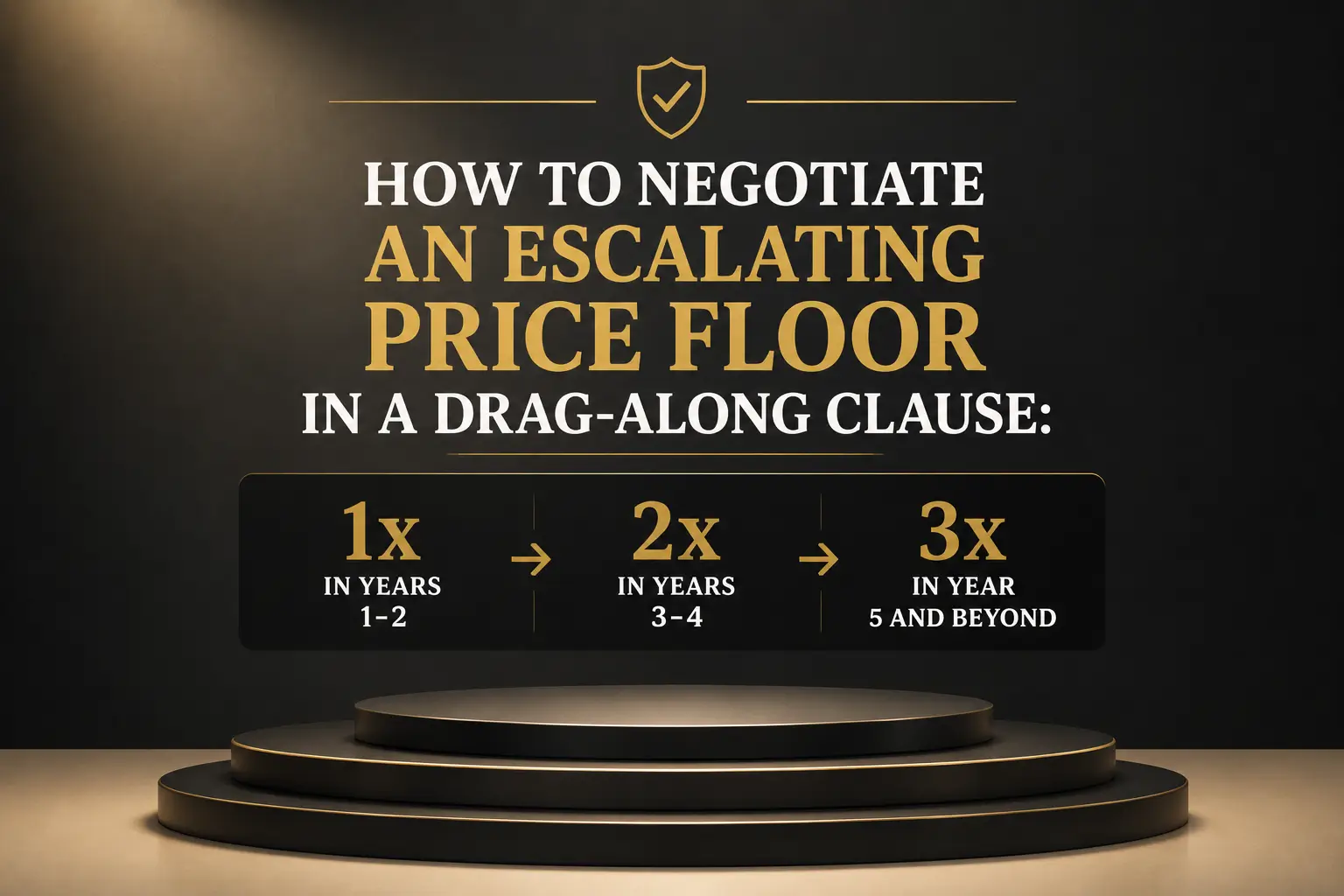
How to Negotiate an Escalating Price Floor in a Drag-Along Clause: 1x in Years 1-2, 2x in Years 3-4, 3x in Year 5 and Beyond
Disclosure
Nothing on this site constitutes an offer to sell, or a solicitation of an offer to purchase, any security under the Securities Act of 1933, as amended, or any applicable state securities laws. Any offering of securities is made only by means of a formal private placement memorandum or other authorized offering documents delivered to qualified investors.
IRC Partners is a capital advisory firm. IRC Partners is not a registered investment adviser under the Investment Advisers Act of 1940 and does not provide investment advice as defined thereunder.
Certain statements in this article may constitute forward-looking statements, including statements regarding market conditions, capital availability, investor demand, and transaction outcomes. Such statements reflect current assumptions and expectations only. Actual results may differ materially due to market conditions, regulatory developments, company-specific factors, and other variables. IRC Partners makes no representation that any outcome, return, or result described herein will be achieved.
References to prior mandates, transaction volume, network credentials, or capital raised are provided for illustrative purposes only and do not constitute a guarantee or prediction of future results. Past performance is not indicative of future outcomes. Individual results will vary. Network credentials and transaction statistics referenced on this site reflect the aggregate experience of IRC Partners' principals and affiliated advisors and are not a representation of assets managed or transactions closed solely by IRC Partners.
Certain data, statistics, and information presented in this article have been obtained from third-party sources. IRC Partners has not independently verified such information and expressly disclaims responsibility for its accuracy, completeness, or timeliness. Readers should independently verify any third-party data before relying on it.
Readers are strongly encouraged to consult qualified legal, financial, and tax professionals before making any investment, capital raising, or business decision.
Schedule A Meeting
You get one shot to raise the right way. If this raise is worth doing, it’s worth doing with precision, leverage, and control.
This isn’t a practice run. Serious capital. Serious strategy. Let’s raise it right.
We onboard a maximum of seven
new strategic partners each quarter, by application only, to maximize your chances of securing the capital you need.
