.svg "CTA Arrow")


.png "Investor Ready Capital decorative background element")

Why 95% of VC Term Sheets Include Drag-Along Rights - and the Three Clauses Inside Them That Actually Determine Your Outcome
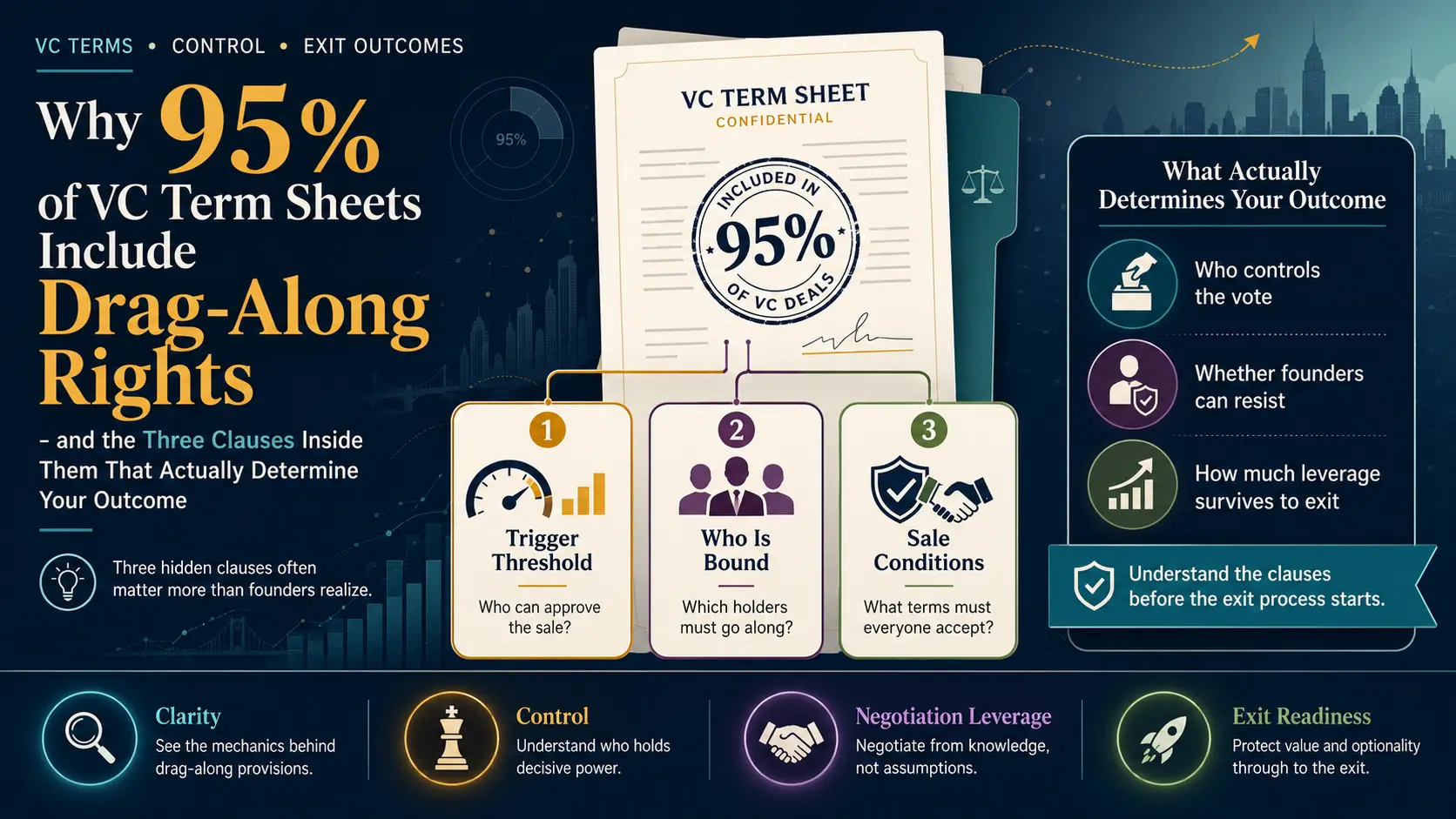
Why 95% of VC Term Sheets Include Drag-Along Rights - and the Three Clauses Inside Them That Actually Determine Your Outcome
Drag-along rights appear in virtually every VC term sheet because they solve a specific coordination problem: they prevent a small group of minority stockholders from blocking a sale that the required decision-makers have already approved. That is the investor rationale, it is legitimate, and it is why the clause is standard across nearly all venture financings from Seed through late-stage growth rounds. What founders should focus on is not whether drag-along is in the term sheet - it will be - but which version of the clause they are agreeing to. Three specific sub-clauses determine whether drag-along functions as a neutral coordination tool or an investor-favorable exit lever: the approval threshold, the covered transaction definition, and the minority protection mechanics. The gap between the investor-favorable and founder-neutral versions of each is where outcomes are decided.
What founders should focus on is not whether drag-along is in the term sheet. It will be. The question is which version of the clause they are agreeing to. The broader governance risks that drag-along creates across a company's lifecycle are covered in What Growth-Stage Companies Need to Know About Drag-Along Provisions Before They Become a Problem. If you want to understand how this clause gets embedded in term sheet language before most founders notice it.
This article narrows the focus to three specific sub-clauses that determine whether drag-along functions as a neutral coordination tool or an investor-favorable exit lever.
The three outcome-driving levers inside every drag-along provision:
- Approval threshold: which stockholder classes, and what percentage, must consent before the drag-along can be triggered
- Covered transaction definition: which types of exits actually activate the clause
- Minority protection mechanics: what economic and procedural safeguards apply to dragged stockholders
The Investor Rationale: Why VCs Want Drag-Along and Why That Does Not Make It Hostile
Investors require drag-along because fragmented cap tables are a predictable outcome of multiple financing rounds, option grants, and early-stage convertible instruments. By the time a growth-stage company reaches a meaningful exit, dozens of stockholders may hold small positions. Without a drag-along provision, any one of those holders can refuse to tender shares, demand a premium, or create legal friction that delays or kills a deal.
Buyers have the same concern. Acquirers want clean execution. Broad stockholder participation reduces post-closing disputes, limits appraisal-right exposure under Delaware General Corporation Law Section 262, and gives the buyer confidence that the deal will close as negotiated. Drag-along is the mechanism that delivers that confidence.
That context matters because it explains why calling drag-along hostile misframes the issue. The clause exists for a real operational reason, not as an attempt to disadvantage founders. The problem is not the clause's existence. The problem is that the three levers inside it can be drafted in ways that shift meaningful control and economic exposure toward investors.
The Three Clauses That Actually Determine Your Outcome
Most founders read drag-along as a single provision. It is not. It is a bundle of three distinct drafting decisions, each of which has an investor-favorable version and a founder-neutral version. The gap between those versions is where outcomes are decided.
Approval Threshold
The threshold defines who must approve the transaction before the drag-along can compel other holders to participate. An investor-favorable threshold lets a majority of preferred stockholders trigger the clause without any founder or common stockholder consent. A founder-neutral threshold requires approval from both the preferred class and a separate founder or common class, or the board, before the drag-along activates.
This is the most consequential lever. A founder who holds significant common stock but has no consent right in the threshold has, in practice, no veto over a compelled sale.
Covered Transaction Definition
The transaction definition controls which types of exits activate the drag-along. A narrow definition limits the clause to a sale of the company, typically a merger or stock acquisition resulting in a change of control. A broad definition can extend to asset sales, deemed liquidation events, or any transaction where more than 50% of voting power transfers.
Broad definitions matter because they can activate drag-along in situations that do not feel like a traditional exit, including recapitalizations or restructurings that trigger a deemed liquidation clause in the preferred stock terms.
Minority Protection Mechanics
Protections determine the economic and procedural conditions under which dragged holders must participate. A founder-neutral version guarantees the same price and same terms as the lead sellers, limits any representations or indemnity obligations to the dragged holder's pro-rata share, and requires advance notice. An investor-favorable version can impose broader reps, joint and several indemnity exposure, or allow the lead sellers to negotiate side payments or adjustments that do not flow to dragged holders.
These three levers interact. A founder-friendly threshold does not protect a founder if the transaction definition is broad enough to activate drag-along in a deemed liquidation event. Similarly, strong minority protections matter less if the threshold already excludes founder consent entirely.
Threshold Mechanics: Why 51% vs. Dual Approval vs. Supermajority Changes Founder Leverage
The approval threshold is the single most debated element of drag-along negotiations, and for good reason. The percentage number matters, but the voting group definition matters more. A 51% threshold that requires only preferred stockholder approval gives two large investors the ability to force a sale without a single founder vote. A 75% threshold defined the same way is better for founders, but still does not require founder consent.
Spoke 15 in this series goes deep on the 51% vs. 75% distinction and the math behind how as-converted calculations shift that analysis. The table below captures the practical founder risk at each threshold model.
The key insight is that threshold analysis should focus on who must say yes, not just on the percentage. A dual-approval structure requiring both investor and common consent is what converts drag-along from a potential investor lever into a genuine coordination mechanism. Understanding how information rights and consent mechanics interact is part of the same pre-signing review.
{{main-cta}}
What "Standard" Really Means in Practice
Standard means common in venture financings. It does not mean balanced, founder-neutral, or reviewed by anyone other than the investor's counsel before it landed in the document.
The same drag-along label can describe two very different clauses. One version requires dual approval, limits scope to a direct change of control, and guarantees the same price and terms to all dragged holders. Another version triggers on any deemed liquidation event, requires only a preferred majority, and exposes dragged holders to broad indemnity obligations. Both are called standard.
Cooley GO's definition of drag-along rights makes this point clearly: the clause is common, but the trigger and the protections are where the real negotiation lives.
Myths founders carry into term sheet review, and what is actually true:
- Myth: Standard language is reviewed for founder fairness. Reality: Standard language reflects what investors ask for by default, not what founders negotiated.
- Myth: If my lawyer approved it, it must be reasonable. Reality: Approval means the clause is legal and enforceable, not that it is favorable to you.
- Myth: Drag-along only matters if there is a sale. Reality: A broad transaction definition can activate drag-along in a recapitalization, restructuring, or deemed liquidation event long before a traditional exit.
- Myth: The percentage threshold is the only number that matters. Reality: The voting group definition matters as much as the percentage. A 75% preferred-only threshold still excludes founder consent entirely.
- Myth: Drag-along terms are fixed after signing. Reality: They can be renegotiated at the next round, but only if the founder raises it before leverage shifts.
How to Evaluate Your Current Drag-Along Before the Next Raise
Founders lose negotiating leverage after a term sheet is signed. The right time to review drag-along mechanics is before investor outreach intensifies, not after a deal is on the table. The review does not require a full legal audit. It requires isolating the three levers and checking each one against a simple standard.
Five-step pre-raise drag-along review:
- Identify the threshold clause. Which stockholder classes must approve before drag-along activates? Is founder or common class consent required, or is the trigger preferred-only?
- Map the transaction definition. Does the clause apply only to a direct sale or merger, or does it extend to asset sales, deemed liquidation events, or any transfer of majority voting power?
- Review the minority protections. Are dragged holders guaranteed the same price and terms as lead sellers? Is indemnity exposure capped at the dragged holder's pro-rata share? Is advance notice required?
- Check the as-converted math. If the threshold is percentage-based, calculate whether the required percentage can be reached by preferred holders alone at current cap table composition.
- Note what is vague or missing. Silence on any of these points is not neutral. Ambiguity in a drag-along clause tends to resolve in favor of the party with more resources to litigate it.
If the clause is investor-favorable on any of these dimensions, a founder approaching the next raise has a window to address it. That window closes once new investors sign on to the existing governance structure.
Founders preparing for a $5M+ round often benefit from reviewing their full capital stack and governance documents before outreach begins. The M&A due diligence checklist covering the 47 documents buyers request is a useful reference for understanding what acquirers will eventually scrutinize in these same provisions. Understanding the difference between drag-along and tag-along rights is also worth reviewing before the next round, since both provisions interact at exit.
IRC Partners works with growth-stage founders on capital structure and governance readiness before investor outreach begins. The founders who get the most out of term sheet negotiations are the ones who arrive having already reviewed their existing documents, not the ones reviewing them for the first time after a term sheet lands.
Frequently Asked Questions
Is drag-along negotiable, or do investors treat it as a non-starter?
Drag-along itself is rarely negotiable as an inclusion. Investors will almost always require it. What is negotiable is the version: the threshold voting group, the transaction scope, and the minority protections. Most investors will accept a dual-approval structure or a narrower transaction definition if the founder raises it before the term sheet is finalized. Waiting until after signing eliminates that window entirely.
Can drag-along be triggered during a financing round, or only at exit?
It depends on how the transaction definition is drafted. A narrowly written clause applies only to a sale or merger resulting in a change of control. A broadly written clause can activate on any deemed liquidation event, which may include certain preferred stock issuances, recapitalizations, or restructurings depending on how the preferred terms define a liquidation. Founders should confirm their clause applies only to a direct exit before assuming it is dormant during financing activity.
What happens to founder shares if drag-along is triggered and the founder votes against the sale?
The drag-along provision compels the founder to vote in favor of the transaction and, if required, to tender shares at the approved price. A vote against the sale does not prevent the drag-along from operating. The founder's consent right, if any, must exist in the threshold clause itself. Once the required approval threshold is met, the drag-along overrides individual dissent. This is the core reason threshold design matters more than any other element of the provision.
Does drag-along apply to unvested founder shares?
It depends on the specific language of the drag-along agreement and the applicable equity plan. Many drag-along provisions apply to all outstanding shares, including unvested shares subject to a repurchase right. In practice, the acquirer and the company often negotiate accelerated vesting as part of the transaction terms, but that is a deal-level negotiation, not a right guaranteed by the drag-along clause itself. Founders should confirm whether unvested shares are covered before signing.
How does drag-along interact with a liquidation preference at exit?
Drag-along compels participation in the transaction. The liquidation preference determines how proceeds are distributed once the transaction closes. The two provisions operate independently, but they interact at exit: a founder dragged into a below-preference sale may receive little or no proceeds even after being compelled to participate. This is why reviewing drag-along in isolation from the preferred stock waterfall gives an incomplete picture of actual exit exposure.
What is a "deemed liquidation" trigger and why does it matter for drag-along scope?
A deemed liquidation event is a transaction that the preferred stock certificate of incorporation treats as a liquidation even though the company has not actually dissolved. Common examples include a merger, a sale of substantially all assets, or any transaction where existing stockholders lose majority voting control. If the drag-along transaction definition incorporates deemed liquidation events, the clause can activate in situations that do not look like a traditional exit. Founders should verify whether their drag-along scope is limited to direct sales or extends to deemed liquidation triggers.
At what point in the fundraising process is it realistic to push back on drag-along terms?
The most realistic window is before the term sheet is finalized, during the period when economic terms are still being discussed and the relationship with the investor is still being established. Once a term sheet is signed and the company is in diligence, investors are unlikely to reopen governance provisions. The next realistic window is at the subsequent financing round, where the incoming investor's counsel will review existing governance documents and the company has some leverage to request amendments as a condition of closing.
Continue reading this series:
- How Drag-Along Rights Get Buried in Your Term Sheet
- Drag-Along Rights Explained: What Growth-Stage Founders Actually Sign Away at Series A and Forget Until Exit
- The 51% vs. 75% Drag-Along Threshold: How One Number Determines Whether Two Investors Can Force Your Exit Without a Single Founder Vote
The Capital Raise Pre-Flight is IRC Partners’ fixed-fee diagnostic that scores a raise against the same twelve institutional gates a deal must clear before IRC Partners takes it into a strategic partnership. It is where every engagement begins, whether you are pre-revenue building toward a first institutional round or scaling a company that has raised before. For deals that clear, the full strategic partnership follows. IRC Partners advises operators raising $5M to $250M of institutional capital. If you are taking a raise to market, start here.
Sponsors weighing this decision should first complete a capital raise readiness assessment for sponsors to confirm the raise is investor-ready.
Need guidance on your capital raise?



What Operating Covenants Do Family Offices Commonly Request From Real Estate Sponsors After Closing?

How Long Does Venture Capital Fundraising Take

Fees for Sovereign Wealth and Pension Capital
Disclosure
Nothing on this site constitutes an offer to sell, or a solicitation of an offer to purchase, any security under the Securities Act of 1933, as amended, or any applicable state securities laws. Any offering of securities is made only by means of a formal private placement memorandum or other authorized offering documents delivered to qualified investors.
IRC Partners is a capital advisory firm. IRC Partners is not a registered investment adviser under the Investment Advisers Act of 1940 and does not provide investment advice as defined thereunder.
Certain statements in this article may constitute forward-looking statements, including statements regarding market conditions, capital availability, investor demand, and transaction outcomes. Such statements reflect current assumptions and expectations only. Actual results may differ materially due to market conditions, regulatory developments, company-specific factors, and other variables. IRC Partners makes no representation that any outcome, return, or result described herein will be achieved.
References to prior mandates, transaction volume, network credentials, or capital raised are provided for illustrative purposes only and do not constitute a guarantee or prediction of future results. Past performance is not indicative of future outcomes. Individual results will vary. Network credentials and transaction statistics referenced on this site reflect the aggregate experience of IRC Partners' principals and affiliated advisors and are not a representation of assets managed or transactions closed solely by IRC Partners.
Certain data, statistics, and information presented in this article have been obtained from third-party sources. IRC Partners has not independently verified such information and expressly disclaims responsibility for its accuracy, completeness, or timeliness. Readers should independently verify any third-party data before relying on it.
Readers are strongly encouraged to consult qualified legal, financial, and tax professionals before making any investment, capital raising, or business decision.
Schedule A Meeting
You get one shot to raise the right way. If this raise is worth doing, it’s worth doing with precision, leverage, and control.
This isn’t a practice run. Serious capital. Serious strategy. Let’s raise it right.
We onboard a maximum of seven
new strategic partners each quarter, by application only, to maximize your chances of securing the capital you need.
