.svg "CTA Arrow")


.png "Investor Ready Capital decorative background element")

How to Negotiate Investor Reporting Before Signing a $20M Raise
Why Reporting Negotiations Get Harder at $20M
At the $20M raise level, investor reporting negotiations transition from simple single-thread discussions into categorically complex, multi-party coordination exercises. Multiple institutional allocators and parallel legal teams frequently arrive with competing expectations, allowing broad template language to quietly stack across limited partnership agreements (LPAs), side letters, schedules, and annexes. Rather than reacting to each individual request, sponsors must take an active role early in the process to consolidate reporting into a single commercially tight standard. By utilizing neutral market reference points like the October 2025 NVCA Model Investors' Rights Agreement, sponsors can successfully shift the narrative from operational resistance to sophisticated, decision-useful calibration.
Sponsors who enter this conversation with a defined framework and neutral benchmarks close faster and protect more bandwidth than those who react to whatever arrives in the first draft. The full negotiation framework is covered in negotiating information rights and reporting obligations with institutional investors. This article focuses on the specific tactics that apply once you are raising $20M and managing a multi-party document set.
If you are still building your investor list at this level, the investor sourcing guide for a $20M raise covers how to identify and approach institutional capital sources before reporting terms become the conversation.
Three things that define the $20M reporting negotiation:
- Scope creep does not come from one bad actor. It comes from multiple parties each adding reasonable-sounding asks that compound across the document set.
- The sponsor's job is to consolidate reporting into one commercially tight package, not to negotiate a separate regime for each party.
- Framing the negotiation around investor usefulness and stage-appropriate standards protects credibility better than pushing back without a reference point.
What Is Actually Different at the $20M Level
The complexity jump at $20M is not just about deal size. It is about the number of institutional reviewers, parallel counsel comments, and document streams that all need to resolve to the same reporting standard.
A smaller raise might involve one LP, one agreement, and one set of reporting expectations. A $20M raise typically means a lead position, one or more co-investors, and a document set that spans the core agreement, schedules, annexes, and side letters. Each party may arrive with its own template. Each template may be reasonable in isolation. But the combined effect is a reporting package that is broader than any single party intended.
The sponsor who waits for all parties to align on their own is not being patient. They are ceding control of the reporting scope conversation. The right move is to establish a consolidated reporting standard early and ask parties to depart from it expressly, not to embed custom asks quietly in secondary documents.
The Reporting Asks Most Likely to Be Overbroad
Not every reporting ask is unreasonable. But at the $20M level, certain categories of obligation tend to expand beyond what any party actually needs and beyond what the sponsor can sustain without dedicated production resources.
As SEC Commissioner Hester Peirce noted in her March 2026 remarks at SEC Speaks, "by definition, immaterial information costs more to produce than it is worth to investors." That principle applies directly to how sponsors should evaluate reporting asks before they sign.
The five categories that create the most recurring burden at this deal size:
- Monthly financials as a standing obligation. Monthly reporting can be appropriate in limited, defined circumstances. When drafted as an automatic entitlement rather than a defined request tied to a specific condition, it becomes a standing production burden. The NVCA Model Investors' Rights Agreement (October 2025) treats monthly financials as available upon request for Major Investors, not as a default cadence. That distinction matters. Why it expands: Counsel often copies standing monthly language from a prior agreement without flagging it as a departure from market standard.
- Bespoke KPI schedules. Custom KPI schedules require the sponsor to track and report metrics that may not map to the information they already maintain. The NVCA model is explicit that sponsors should not be obligated to create new information beyond what is reasonably maintained. Why it expands: Investors often request KPI schedules during diligence and the language migrates into the agreement without a defined scope limit.
- Ad hoc memo requests. Open-ended language permitting investors to request written analysis or management commentary on any topic creates an unlimited production obligation. There is no market standard supporting this as a general right. Why it expands: It is often framed as a "reasonable request" carve-out, which sounds harmless but is undefined in practice.
- Portfolio-level reporting. When a $20M deal is part of a broader development pipeline, investors may request reporting across the sponsor's full portfolio. That is a management-rights-style oversight ask, not an LP visibility right. Why it expands: Multi-asset sponsors are more susceptible because investors frame it as context for the specific investment.
- Undefined information rights. Language permitting investors to "inspect books and records" or "request such information as reasonably necessary" without defined scope, timing, or recipient limits creates open-ended obligations. Why it expands: Vague drafting is easier to get through initial review and harder to narrow after it is normalized across the document set.
How to Use NVCA as a Calibration Anchor
The NVCA Model Investors' Rights Agreement is not a take-it-or-leave-it position. It is a market reference point that reflects current norms across institutional transactions. Using it as a calibration anchor means citing it to support narrow, specific points in the negotiation, not re-teaching the whole framework.
The CAQ's 2025 Institutional Investor Survey reinforces why this approach works: 91% of institutional investors trust audited financial statements as their primary information source, and 96% say current U.S. public company financial reporting has provided the information they need. Clear, structured reporting carries more credibility than sprawling bespoke packages.
Here is a three-step sequence for using the NVCA model without sounding defensive:
- Anchor on cadence first. The NVCA standard sets quarterly unaudited financials within 45 days of quarter-end and annual audited financials within 120 days of fiscal year-end. Present this as the baseline and ask parties to confirm departures from it expressly. This puts the burden on expansion, not contraction.
- Narrow monthly reporting to defined requests. The NVCA model makes monthly financials available upon request for Major Investors (defined as investors holding at least $10M or 5-10% of the preferred stake), not as a default standing obligation. Use that framing to push monthly reporting from automatic to conditional.
- Invoke the no-new-information principle. The NVCA model is explicit that sponsors are not obligated to create information beyond what is reasonably maintained. When a KPI schedule or ad hoc request requires new production, cite this directly. It is not resistance to transparency. It is alignment with market standard.
The goal is not to minimize what investors receive. It is to ensure what they receive is decision-useful. As Commissioner Peirce put it, disclosure should be "grounded in materiality" and "tied to risk-adjusted economic returns," not broad administrative production.
{{main-cta}}
How to Handle Multiple Institutional Parties Without Losing Control
The document-set risk at the $20M level is not just that one party asks for too much. It is that narrowed language in the core agreement quietly re-expands in a schedule, an annex, or a side letter that a different party's counsel drafted independently.
The distinction between LP visibility rights and management-rights-style oversight is where this usually breaks down. LP visibility means investors receive standardized financial reporting on a defined cadence. Management-style oversight means investors can request custom analysis, approve operational decisions, or access information across the sponsor's broader portfolio. The two are fundamentally different in operational cost, and they are not always clearly labeled in draft language.
Visibility rights vs. oversight asks: If the reporting obligation requires the sponsor to produce something new, respond to open-ended requests, or provide information about assets outside the deal, it has crossed from visibility into oversight. That is a management-rights-style ask and should be negotiated as one.
A workflow for keeping the document set tight:
- Build a reporting matrix before drafting escalates. List cadence, content, timing, recipients, and document location for every reporting obligation across the full set. This becomes the reference point for all parties.
- Require express departures. Any party that wants something outside the consolidated standard must surface it expressly. No silent embedding in schedules or annexes.
- Assign one sponsor-side decision-maker for reporting terms. When multiple people can accept or revise reporting language, narrowed terms re-expand. One person clears all reporting changes across all drafts.
- Review side letters last, against the matrix. Side letters are where custom asks get normalized. Reviewing them against the consolidated matrix catches re-expansion before it is locked.
Sponsors navigating the access and confidentiality side of this negotiation can also reference the guide on limiting institutional investor access to sensitive data before signing, which covers how to define scope limits on what investors can access beyond standard financial reporting.
An Anonymized Sponsor Example
A growth-stage real estate sponsor raising $20M received overlapping reporting requests from multiple institutional parties across the core agreement and side comments. The requests included monthly financials as a standing obligation, a bespoke KPI schedule tied to metrics the sponsor did not already track, and open-ended language permitting "such additional information as reasonably requested." Taken together, the package would have required dedicated reporting staff and ongoing production work beyond anything the parties had discussed in term-sheet conversations.
The sponsor, working with counsel and an advisory team, used the NVCA 2025 model as a neutral reference point to anchor a consolidated scope conversation. Monthly financials were narrowed from a standing obligation to a defined request available to Major Investors. The KPI schedule was replaced with a defined set of metrics already maintained by the sponsor. The open-ended information rights language was replaced with specific scope, timing, and recipient definitions.
Side letters were reviewed against the consolidated reporting matrix before they were finalized, catching two instances where custom asks had re-introduced language that had already been narrowed in the core agreement. The close stayed on track. The conversation was framed around consistency and investor usefulness, not resistance to transparency, and no party raised a credibility concern.
Pre-Sign Checklist and When to Involve an Advisor
Before any reporting obligation is locked into a signed document, run through this checklist against the full document set, not just the core agreement.
- Cadence confirmed. Quarterly unaudited within 45 days, annual audited within 120 days, monthly reporting limited to defined requests for qualifying investors only.
- Scope defined. Every reporting obligation specifies what is being produced, in what format, and whether it is information the sponsor already maintains or new production.
- Recipients named. Reporting rights are tied to specific investor thresholds or named parties, not open-ended entitlements.
- Side letters reviewed against the matrix. No custom reporting ask in a side letter re-introduces scope that was narrowed in the core agreement.
- Schedules and annexes cleared. Secondary documents do not contain reporting language that was not surfaced and agreed in the primary negotiation.
- One decision-maker confirmed. A single sponsor-side point of contact has reviewed and approved all reporting language across every document in the set.
The right time to involve an advisor is before documents circulate to multiple institutional parties, not after the first round of comments arrives. Once custom asks are normalized across a multi-party draft, they are harder to consolidate without creating friction with one or more parties.
IRC Partners works with growth-stage real estate sponsors to structure credible, institution-ready reporting packages before they become recurring burdens. The goal is a reporting framework that satisfies institutional expectations, protects operating bandwidth, and stays commercially tight through signing.
Frequently Asked Questions
Why does a $20M raise create more reporting negotiation complexity than a $10M raise?
At $20M, it is common to have a lead investor plus one or more co-investors, each arriving with their own counsel and their own reporting template. The core agreement, schedules, annexes, and side letters all become active negotiation surfaces. A $10M raise typically involves fewer parties and fewer documents, so scope consolidation is simpler. At $20M, the sponsor has to actively manage the document set to prevent reasonable individual asks from compounding into an unmanageable combined obligation.
How should a sponsor handle two institutional parties that have conflicting reporting expectations?
The sponsor should not try to satisfy both templates simultaneously. The better approach is to establish a consolidated reporting standard anchored to a neutral market reference like the NVCA 2025 model, then present it to both parties as the baseline. Any departure from that baseline should be surfaced expressly and negotiated as a specific carve-out. This frames the conversation around consistency and investor usefulness rather than forcing the sponsor to adjudicate between two competing asks.
How do you use NVCA benchmarks as a calibration tool without appearing to resist transparency?
The framing matters more than the citation. Sponsors who lead with "we are following market standard" sound defensive. Sponsors who lead with "here is the reporting package we believe gives you the information you need to evaluate this investment" and then anchor specific terms to NVCA norms sound commercially sophisticated. The NVCA model reflects what institutional investors across the market have agreed is appropriate. Citing it as a reference point, not a ceiling, keeps the conversation constructive.
What is the most common way side letters re-expand reporting scope that was already narrowed in the LPA?
The most common pattern is a co-investor requesting a side letter after the core agreement is substantially negotiated, with their counsel drafting reporting language independently. That language often includes terms that were already narrowed in the LPA, because the side letter counsel did not have full visibility into the prior negotiation. The fix is to review every side letter against the consolidated reporting matrix before it is finalized, specifically checking for any obligation that re-introduces language that was already removed or narrowed.
How should sponsor counsel and an advisory team coordinate on reporting terms across a multi-party document set?
The sponsor should designate a single point of contact for all reporting language decisions before drafting begins. Counsel handles the legal drafting and redlines. The advisor supports the commercial framing and helps the sponsor understand which asks are outside market norms and how to respond without creating a credibility problem. When both roles operate independently without a shared reporting matrix, narrowed terms can re-expand in secondary documents without anyone catching it until the document set is nearly final.
At what point in the $20M raise process should a sponsor start the reporting negotiation?
The reporting negotiation should begin before documents circulate to multiple institutional parties. Once a first draft has gone to several parties and each has commented independently, custom asks become normalized and harder to consolidate without creating friction. The ideal entry point is during term sheet or letter of intent discussions, when reporting scope can be established at a high level before counsel begins drafting. Sponsors who wait until the first full draft arrives are negotiating from a reactive position.
Is there a meaningful difference between an LP's right to inspect books and records versus their right to receive periodic financial statements?
Yes, and the difference has significant operational implications. The right to receive periodic financial statements is a defined, scheduled obligation with a known production cost. The right to inspect books and records is an on-demand access right that can require the sponsor to make internal systems, records, and personnel available on short notice. At the $20M level, inspection rights should be defined with scope limits, notice requirements, and frequency caps. Without those limits, an inspection right functions more like a management oversight power than a standard LP visibility right.
Continue reading this series:
- How to negotiate information rights and reporting obligations with institutional investors before signing
- Top negotiation tactics for VC information rights before signing
- How sponsors push back on heavy VC reporting requirements before signing
IRC Partners advises founders raising $5M to $250M in institutional capital on structure, positioning, and round architecture. We work with 7 strategic partners per quarter - no placement agent model, no success-only theater. If you want a structural review of your current raise, apply HERE.
Sponsors weighing this decision should first complete a capital raise readiness assessment for sponsors to confirm the raise is investor-ready.
Need guidance on your capital raise?


.jpg "Give me 12 minutes and I'll teach you how to raise 100M")
Give me 12 minutes and I'll teach you how to raise $100M
How to Build a Data Room that Closes Institutional Investors in 30 Days Instead of 90
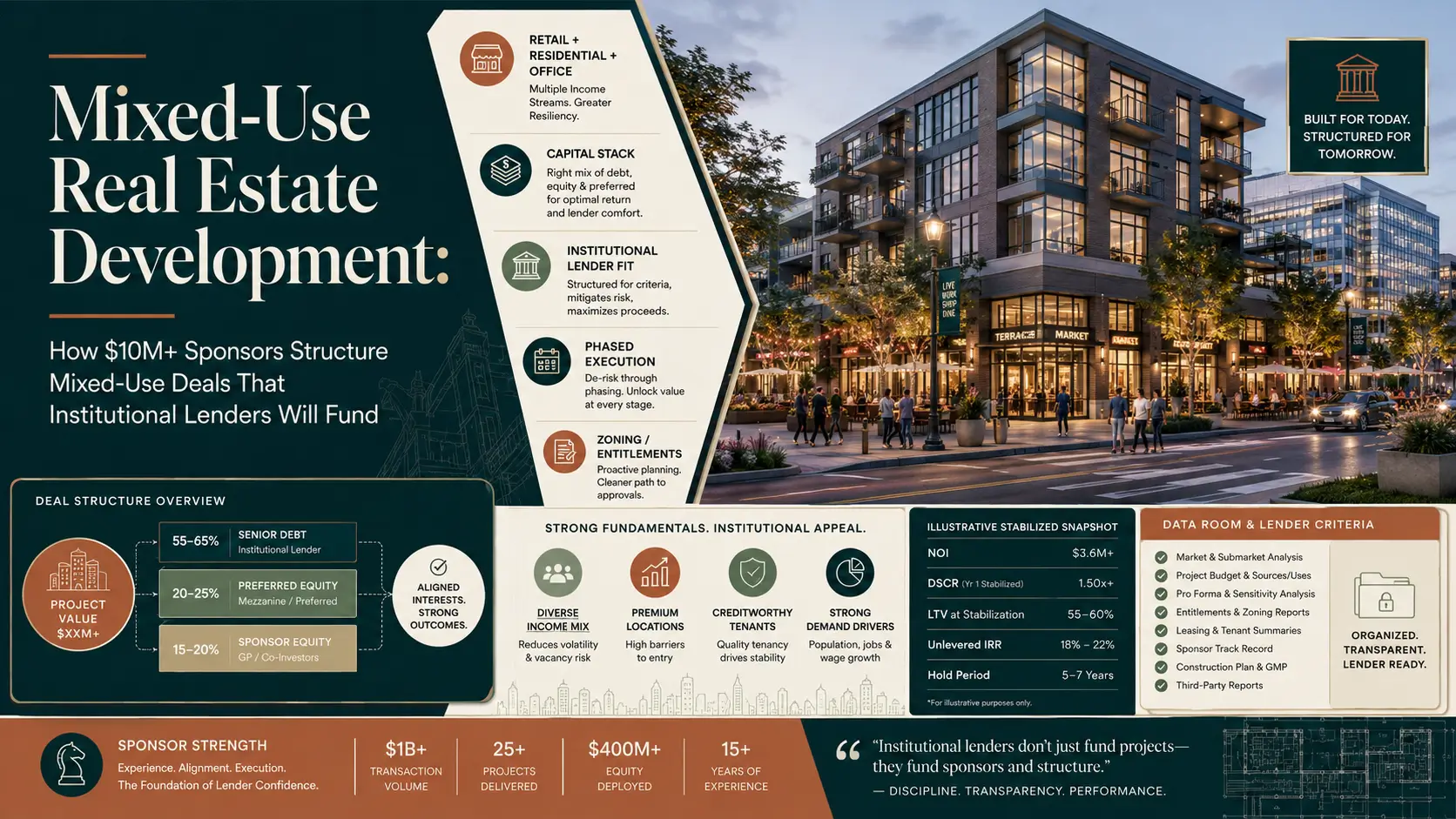
Mixed-Use Real Estate Development: How $10M+ Sponsors Structure Mixed-Use Deals That Institutional Lenders Will Fund
Disclosure
Nothing on this site constitutes an offer to sell, or a solicitation of an offer to purchase, any security under the Securities Act of 1933, as amended, or any applicable state securities laws. Any offering of securities is made only by means of a formal private placement memorandum or other authorized offering documents delivered to qualified investors.
IRC Partners is a capital advisory firm. IRC Partners is not a registered investment adviser under the Investment Advisers Act of 1940 and does not provide investment advice as defined thereunder.
Certain statements in this article may constitute forward-looking statements, including statements regarding market conditions, capital availability, investor demand, and transaction outcomes. Such statements reflect current assumptions and expectations only. Actual results may differ materially due to market conditions, regulatory developments, company-specific factors, and other variables. IRC Partners makes no representation that any outcome, return, or result described herein will be achieved.
References to prior mandates, transaction volume, network credentials, or capital raised are provided for illustrative purposes only and do not constitute a guarantee or prediction of future results. Past performance is not indicative of future outcomes. Individual results will vary. Network credentials and transaction statistics referenced on this site reflect the aggregate experience of IRC Partners' principals and affiliated advisors and are not a representation of assets managed or transactions closed solely by IRC Partners.
Certain data, statistics, and information presented in this article have been obtained from third-party sources. IRC Partners has not independently verified such information and expressly disclaims responsibility for its accuracy, completeness, or timeliness. Readers should independently verify any third-party data before relying on it.
Readers are strongly encouraged to consult qualified legal, financial, and tax professionals before making any investment, capital raising, or business decision.
Schedule A Meeting
You get one shot to raise the right way. If this raise is worth doing, it’s worth doing with precision, leverage, and control.
This isn’t a practice run. Serious capital. Serious strategy. Let’s raise it right.
We onboard a maximum of seven
new strategic partners each quarter, by application only, to maximize your chances of securing the capital you need.
