.svg "CTA Arrow")


.png "Investor Ready Capital decorative background element")

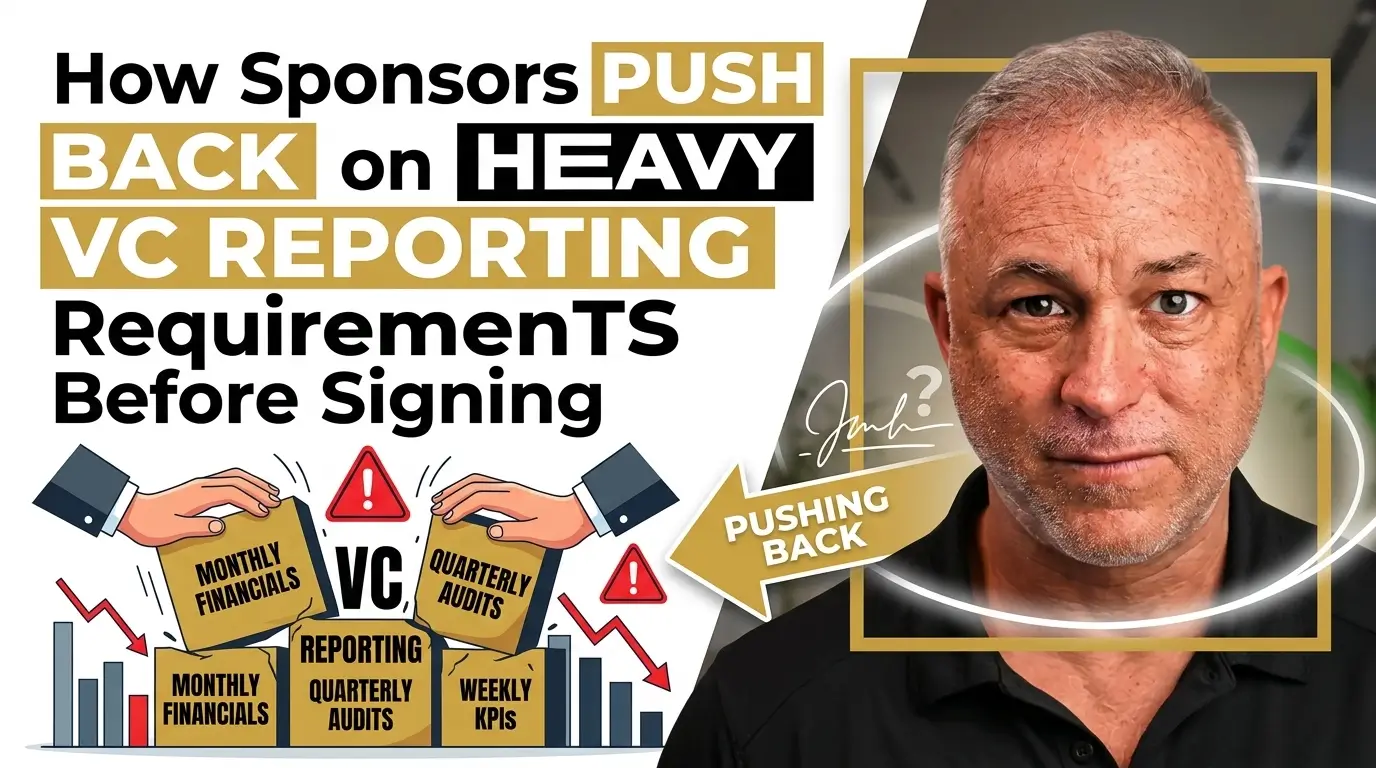
How Sponsors Push Back on Heavy VC Reporting Requirements Before Signing
What Heavy Reporting Requirements Actually Mean in a $10M+ Deal
Real estate sponsors raising institutional capital above $10M must recognize that heavy reporting requirements are negotiable governance terms rather than fixed boilerplate. A reporting package is typically considered "heavy" when it forces a sponsor to generate new information not already maintained for management, meet compressed deadlines that ignore actual audit cycles, or accept open-ended "other information" rights. Because these obligations can create permanent administrative drag and management distraction for the life of the investment, the most effective strategy is to address them before the investors' rights agreement hardens. By anchoring negotiations to the October 2025 NVCA standard—which favors quarterly financials within 45 days, annual auditeds within 120 days, and no mandate to create net-new reporting—sponsors can frame their pushback as operational sophistication rather than resistance.
Heavy reporting requirements in a $10M+ investors' rights agreement are not boilerplate. They are negotiable governance terms, and the window to narrow them closes the moment the agreement is signed.
In most institutional deals, a reporting package is considered heavy when it asks a sponsor to do one or more of the following: produce information the company does not already maintain, deliver financial statements on a compressed timeline that does not match the actual close and audit cycle, or accept open-ended obligations to provide "other information" at investor request. These are not edge cases. They appear regularly in draft agreements, and sponsors who treat them as standard closing friction tend to sign obligations that follow the business for years.
Understanding how to negotiate information rights and reporting obligations with institutional investors before signing is the foundation. This article goes one level deeper: the specific pushback moves that work, how to sequence them, and how to make sure narrowed terms actually hold through closing.
What makes a reporting package "heavy" in practice:
- The package requires the sponsor to create new information not already maintained for management, lenders, or the board
- Delivery deadlines are shorter than the company's existing financial close and audit rhythm
- The agreement includes fixed monthly reporting, broad custom KPI schedules, or open-ended "other information" rights with no materiality threshold
The real cost is not one extra report. It is a recurring finance burden, management distraction, and a permanent operating obligation that compounds across every future reporting period.
How to Spot Which Asks Are Actually Disproportionate
Not every aggressive reporting ask is disproportionate. The test is not whether investors commonly request it. The test is whether the obligation fits the company's stage, deal size, finance team capacity, and what sophisticated institutional investors actually rely on to monitor performance.
According to the CAQ's 2025 Annual Institutional Investor Survey, 91% of institutional investors trust audited financial statements as their primary source of financial information, and 96% say current reporting has provided the information they need to make investment decisions. That data point matters in negotiation. It means a well-structured baseline package, quarterly unauditeds plus annual auditeds, already covers what most institutional investors actually rely on. Anything beyond that baseline warrants scrutiny.
The practical filter: apply this question to each reporting obligation in the draft. Is this ask material to investor economics, or does it shift significant administrative cost to the company while producing information the investor rarely uses?
Sponsors reviewing a term sheet or investors' rights agreement should flag every obligation in the right column before the document hardens. These are the asks worth pushing back on, and they are the ones most likely to survive unchanged if the sponsor does not raise them.
Use the NVCA Baseline as an Anchor, Not a Lecture
The October 2025 NVCA Investor Rights Agreement sets a clear market standard for reporting obligations. Sponsors do not need to explain the model to the investor. They need to use it as a reference point when marking up outlier asks.
The NVCA standard establishes quarterly unaudited financials within 45 days of quarter-end, annual audited financials within 120 days of fiscal year-end, monthly financials only upon reasonable request, and no obligation to create new information beyond what the company reasonably maintains. That last point is significant. The 2025 update made explicit that companies are not required to generate net-new reporting for investors. That is a direct anchor for pushing back on custom dashboards, investor-only KPI schedules, and open-ended "other information" obligations.
Three markup moves that land well with institutional counterparties:
- Align delivery timelines to the NVCA standard. If the draft calls for quarterly financials within 30 days or annual auditeds within 75 days, mark up to 45 days and 120 days respectively. Frame the edit as aligning to current market practice, not as a request for more time.
- Convert fixed monthly reporting to monthly-upon-request. The NVCA model treats monthly financials as an on-request right, not a default obligation. Propose the same structure and explain that it preserves investor access while removing a recurring production burden on the finance team.
- Add a "no new information" carve-out to open-ended reporting rights. For any "other information" or "additional information" clause, add language limiting the obligation to information the company already maintains in the ordinary course of business. This is consistent with the NVCA standard and is difficult for an investor to resist without appearing unreasonable.
The goal is not to withhold information. It is to commit to timely, reliable, decision-useful reporting on the metrics that actually drive investor economics.
Sequence the Pushback So It Reads as Governance-Minded
How a sponsor frames the markup matters as much as what the markup says. An investor who receives a redline full of deletions and no explanation reads it as resistance. An investor who receives a redline organized around governance logic reads it as operational sophistication.
The top negotiation tactics for VC information rights before signing establish the general approach. The sequencing specific to reporting pushback works like this:
- Start with investor visibility, not sponsor burden. Open any pushback conversation by affirming the investor's need for reliable oversight. "We want to make sure you have timely, accurate visibility into the metrics that drive your investment decision" lands better than "this reporting package is too heavy."
- Group comments by governance logic. Organize markup into four categories: timing, scope, materiality, and production burden. This structure makes the redline look organized and principled rather than a list of objections.
- Propose rather than delete. Every deletion should come with a substitution. Removing a fixed monthly package without offering a monthly-on-request alternative reads as evasion. Offering the substitute reads as collaboration.
- Use escalation triggers instead of permanent obligations. Propose that enhanced reporting kicks in only when defined conditions are met, such as a material variance from budget, a covenant stress event, or a major business change. This gives investors meaningful protection without locking in default production overhead.
"We're proposing a baseline package aligned to current market practice, with escalation rights if the business hits a defined trigger. That gives you reliable visibility and gives us the operational runway to actually execute."
That framing positions every edit as a governance improvement, not a sponsor preference. It is the difference between a markup that gets accepted and one that creates friction.
{{main-cta}}
Substitutions That Preserve Investor Visibility Without Creating Reporting Drag
The most effective pushback does not just narrow obligations. It replaces them with alternatives that give the investor equivalent visibility at lower production cost. Substitutions are harder to reject than deletions because they demonstrate that the sponsor is solving the investor's governance problem, not avoiding it.
The SEC's 2026 materiality guidance reinforces this logic directly: disclosures should be decision-useful and tied to investor economics. Reporting that produces high volume but low governance signal does not serve investors well. That principle supports substitution proposals that narrow scope while sharpening relevance.
Sponsors limiting quarterly reporting burdens should also consider how to limit quarterly reporting burdens when signing with institutional investors as a companion resource when structuring the cadence side of the package alongside scope substitutions.
Make Sure the Win Holds Through Side Letters and Ancillary Documents
Narrowing the investors' rights agreement is not enough on its own. Reporting obligations can re-enter the deal through side letters, disclosure schedules, board observer arrangements, or information undertakings buried in ancillary documents. Sponsors who do not run a final consistency check across the full document set can find that a narrowed IRA sits alongside a side letter that restores the same fixed monthly package they just removed.
Before signing, confirm each of the following:
- The IRA and all side letters are consistent. No side letter should restore a reporting obligation that was narrowed in the main agreement.
- Board observer rights do not carry implicit reporting duties. Observer arrangements sometimes include language requiring the company to provide pre-meeting packages, operational updates, or ad hoc information that effectively creates a parallel reporting obligation.
- Disclosure schedules do not expand scope. Schedules attached to the agreement should not reference reporting obligations broader than what the IRA itself requires.
- Ancillary documents use the same materiality thresholds. If the IRA includes a materiality carve-out for "other information" requests, confirm that any ancillary information undertakings use the same standard.
- The "no new information" carve-out appears consistently. If the NVCA-aligned carve-out was added to the IRA, verify it is not contradicted in any other signed document.
Sponsors looking to secure better information rights terms in growth capital raises should treat this cross-document review as a required step, not an optional one. The negotiation is not complete until every document in the closing set reflects the narrowed terms.
How One Sponsor Narrowed Three Reporting Asks Before Signing
A sponsor reviewing a draft investors' rights agreement for a $10M+ growth round identified three above-baseline reporting obligations: a fixed monthly financial package, a custom KPI schedule covering metrics not maintained for any other party, and a broad "other information" clause with no materiality threshold. Rather than accepting the package as standard, the sponsor reframed the conversation around governance reliability. The redline proposed quarterly unauditeds on NVCA-standard timing, monthly financials converted to an on-request right, KPIs limited to metrics already prepared for the lender, and a "no new information" carve-out on the open-ended clause. All three changes were accepted before signing. The economics of the deal did not move. The investor retained full access to decision-relevant financial information. The sponsor avoided a permanent production obligation that would have required dedicated finance team capacity every month for the life of the agreement.
The outcome was not unusual. It is what happens when a sponsor enters the conversation with a clear framework, a credible anchor, and substitutions that solve the investor's governance problem rather than just reducing the sponsor's workload.
Pre-Sign Confirmation Checklist
Before the investors' rights agreement is signed, run through each of the following:
- Reporting cadence matches NVCA standard timing (quarterly unauditeds within 45 days, annual auditeds within 120 days)
- Monthly reporting is structured as an on-request right, not a fixed default obligation
- KPI reporting is limited to metrics already maintained for management, lenders, or the board
- Open-ended "other information" rights include a materiality threshold and a "no new information" carve-out
- All side letters, board observer arrangements, and ancillary documents are consistent with the narrowed IRA terms
The goal is not minimum disclosure. It is a reporting package proportionate to company stage, deal size, and what institutional investors actually rely on to monitor performance.
If institutional reporting terms in your draft agreement look heavier than the deal warrants, the time to address them is before documents harden. IRC Partners works with sponsors at this stage to identify disproportionate obligations, structure credible pushback, and confirm that narrowed terms hold across the full closing set.
Frequently Asked Questions
How do I know if a reporting obligation in my investors' rights agreement is above the stage-appropriate baseline?
The clearest signal is whether the obligation requires you to create information you do not already produce. If the ask covers metrics not maintained for management, lenders, or the board, it is above baseline. Delivery timelines shorter than your actual financial close and audit cycle are also a reliable indicator. Compare every obligation against the October 2025 NVCA standard before accepting anything as market-standard.
What is the strongest argument for converting fixed monthly reporting to a monthly-on-request structure?
The NVCA Investor Rights Agreement treats monthly financials as an on-request right, not a default obligation. That makes the conversion a market-standard ask rather than a sponsor preference. The argument to the investor is straightforward: you retain full access to monthly data when you need it, and the company avoids a recurring production burden on obligations that most investors rarely exercise.
How should a sponsor handle a broad "other information" clause with no materiality threshold?
Propose two edits: add a materiality threshold so the obligation is limited to information that would reasonably affect investor decision-making, and add a "no new information" carve-out limiting the obligation to data the company already maintains in the ordinary course of business. Both edits are consistent with the October 2025 NVCA update and are difficult for an investor to resist without appearing to be asking for something beyond market practice.
Can a sponsor push back on reporting timelines without appearing operationally unprepared?
Yes, and the framing matters. Propose alignment to NVCA-standard delivery windows, quarterly unauditeds within 45 days and annual auditeds within 120 days, and explain that these timelines reflect the company's actual financial close and audit cycle. Investors understand that compressed timelines produce rushed, less reliable financials. Framing the edit around reporting quality rather than sponsor convenience makes it a governance argument, not an operational excuse.
What is the risk of accepting a custom KPI reporting obligation without a scope limitation?
Custom KPI obligations can require the company to build and maintain investor-only data infrastructure that no other stakeholder uses. Without a scope limitation, the obligation is open-ended and can expand over time as investor interests shift. The standard fix is to limit KPI reporting to metrics already prepared for management or lenders, with a clear definition of what "already maintained" means so the boundary holds.
How does a sponsor confirm that pushback on reporting terms holds through side letters?
After the investors' rights agreement is finalized, review every side letter, board observer arrangement, and ancillary document for reporting language. Specifically check whether any side letter restores a fixed monthly package, whether board observer rights include implicit pre-meeting reporting duties, and whether any ancillary information undertaking uses a broader scope than the narrowed IRA. The narrowed terms are only secure when every document in the closing set is consistent.
At what point in the negotiation process is it too late to push back on reporting obligations?
The practical window closes when the investors' rights agreement is signed. Once signed, reporting obligations become contractual and survive long after closing. Pushback is most effective during the markup phase, before the document is circulated for final review. Sponsors who raise reporting concerns after a term sheet is agreed but before the IRA is finalized have the most leverage, because the deal economics are set and the investor is focused on closing rather than reopening structural terms.
Continue reading this series:
- How to negotiate information rights and reporting obligations with institutional investors before signing
- Top negotiation tactics for VC information rights before signing
- Reduce VC reporting burdens before signing a $10M+ growth round
The wrong structure doesn't just cost you this round. It costs you the next three. IRC Partners advises founders raising $5M to $250M of institutional capital. If you're about to go to market and want the structure reviewed before investors see it, book a call here.
Sponsors weighing this decision should first complete a capital raise readiness assessment for sponsors to confirm the raise is investor-ready.
Need guidance on your capital raise?


Real Estate Asset Management: How $10M+ Sponsors Build the Operating Track Record That Institutional Investors Require in the Data Room

How Long Does Investor Relations Management Take

Common Mistakes Companies Make in Capital Raising Outcomes and Advisor Success Rates
Disclosure
Nothing on this site constitutes an offer to sell, or a solicitation of an offer to purchase, any security under the Securities Act of 1933, as amended, or any applicable state securities laws. Any offering of securities is made only by means of a formal private placement memorandum or other authorized offering documents delivered to qualified investors.
IRC Partners is a capital advisory firm. IRC Partners is not a registered investment adviser under the Investment Advisers Act of 1940 and does not provide investment advice as defined thereunder.
Certain statements in this article may constitute forward-looking statements, including statements regarding market conditions, capital availability, investor demand, and transaction outcomes. Such statements reflect current assumptions and expectations only. Actual results may differ materially due to market conditions, regulatory developments, company-specific factors, and other variables. IRC Partners makes no representation that any outcome, return, or result described herein will be achieved.
References to prior mandates, transaction volume, network credentials, or capital raised are provided for illustrative purposes only and do not constitute a guarantee or prediction of future results. Past performance is not indicative of future outcomes. Individual results will vary. Network credentials and transaction statistics referenced on this site reflect the aggregate experience of IRC Partners' principals and affiliated advisors and are not a representation of assets managed or transactions closed solely by IRC Partners.
Certain data, statistics, and information presented in this article have been obtained from third-party sources. IRC Partners has not independently verified such information and expressly disclaims responsibility for its accuracy, completeness, or timeliness. Readers should independently verify any third-party data before relying on it.
Readers are strongly encouraged to consult qualified legal, financial, and tax professionals before making any investment, capital raising, or business decision.
Schedule A Meeting
You get one shot to raise the right way. If this raise is worth doing, it’s worth doing with precision, leverage, and control.
This isn’t a practice run. Serious capital. Serious strategy. Let’s raise it right.
We onboard a maximum of seven
new strategic partners each quarter, by application only, to maximize your chances of securing the capital you need.
