.svg "CTA Arrow")


.png "Investor Ready Capital decorative background element")

What a Capital Advisor Should Flag in Your Existing Drag-Along Provisions Before You Launch a $5M+ Raise

What a Capital Advisor Should Flag in Your Existing Drag-Along Provisions Before You Launch a $5M+ Raise
Before a $5M or larger raise launches, a capital advisor reviews existing drag-along provisions to identify three categories of structural risk: threshold gaps that no longer fit the current cap table, missing process protections that allow a sale to proceed without adequate notice or market-check mechanics, and consent mechanics that give prior investors unexpected leverage over a new deal. This is not a legal audit - it is a capital strategy review. Institutional investors and their counsel will read these provisions during diligence. The founder who reads them first, and resolves the problems before outreach begins, enters negotiations from a position of strength. The founder who does not discovers the problems after a term sheet is on the table, when leverage has already shifted.
Key takeaways before you read further:
- Drag-along provisions written at Seed or Series A are almost never reviewed before the next raise. By Series B, they may already contain structural problems.
- A capital advisor is not checking whether the clause is legally valid. The advisor is checking whether the clause creates deal friction, shifts leverage, or generates amendment demands in diligence.
- The right time to fix a drag-along problem is before investor outreach begins, not after a lead investor has made it a condition of closing.
This piece covers the specific categories a capital advisor flags, why cap table growth makes old provisions riskier, and what founders should ask their advisor to review before the raise launches. For a broader foundation on how drag-along clauses work and what founders typically sign at Series A.
Why Drag-Along Provisions Get Riskier as the Cap Table Grows
Most founders treat a drag-along provision as a document they signed once and do not need to revisit. That assumption is wrong, and here is why it becomes more wrong with every new round.
- The threshold math changes. A drag-along approval threshold written for a Seed cap table with two investor classes may produce a completely different control outcome once Series A preferred, Series B preferred, and weighted voting rights have been added. A threshold set at "holders of a majority of preferred shares" at Seed may now be satisfied by a single large investor, or it may now require a coalition that did not exist when the clause was drafted. Neither outcome is what the founder intended. The ambiguous voting calculations that create drag-along defects are often invisible until the next round forces a re-read.
- New instruments interact with old language. New preferred series, convertible notes, SAFEs, and board consent rights can interact with existing drag-along mechanics in ways the original parties did not model. A denominator definition that made sense before convertible notes existed may produce a contested vote count once those instruments convert. A consent right granted to a Seed investor may now interact with a drag-along trigger in a way that gives that investor leverage over a transaction the founder assumed they controlled. The mechanics of what happens to drag-along rights when you layer a Series B on top of your Series A show exactly how that compounding works in practice.
- The clause stops being dormant the moment a new institutional investor appears. Incoming investors and their counsel will read the existing drag-along provisions as part of standard diligence. They are not reading to understand the company's history. They are reading to understand what rights existing holders have over a future sale, recap, or exit. Any gap, ambiguity, or unusual mechanic in those provisions becomes a diligence question, and diligence questions become amendment demands when a lead investor has leverage.
Founders who have not reviewed these provisions before the raise are entering diligence with an unknown. That unknown belongs to whoever finds it first.
The Five Things a Capital Advisor Looks for in Existing Drag-Along Provisions
A capital advisor reviewing drag-along provisions before a raise is not reading for legal validity. The advisor is reading for business leverage. These are the five categories that generate the most risk before a new institutional round closes.
- Threshold design. The first question is whether the approval threshold still fits the current cap table. Who can satisfy it today? A single large preferred holder? A class that did not exist at drafting? A coalition that would require the founder to negotiate with multiple legacy investors simultaneously? Threshold design that concentrated drag power in one investor or one class is the most common structural problem advisors find. Understanding why your Seed-round drag-along threshold no longer protects you at Series A is the starting point for every pre-raise threshold review. The NVCA Model Legal Documents treat threshold design as a negotiated term precisely because the wrong design creates unintended control outcomes.
- Notice and process protections. Does the provision require a notice period before a drag-along can be exercised? Is there a competing-offer window or any market-check mechanism that gives minority holders time to evaluate alternatives? Many early-stage drag-along clauses were drafted without these protections because the parties did not anticipate how quickly the company would grow or how complex the cap table would become. A clause that allows a sale to proceed immediately once the threshold is met gives the triggering holder significant leverage and gives everyone else very little. For a detailed breakdown of how competing-offer windows work and why they matter.
- Consent mechanics. Are there consent rights attached to the drag-along that give prior investors a separate veto or approval right over a future sale, recap, or new round? Consent mechanics layered on top of a drag-along provision can create a situation where a transaction clears the drag-along threshold but is still blocked by a side consent held by a Seed investor. This is more common than founders realize, and it is one of the primary ways investor consent rights create governance blockers before a Series B closes.
- Carve-outs and exceptions. Does the provision carve out founder shares, common holders, or specific transaction types from the drag-along obligation? Carve-outs that made sense at Seed may now be too broad or too narrow. A carve-out that excluded common holders may now exclude a class of converted instruments the parties did not anticipate. A carve-out that protected founder shares may now create an asymmetry that a new institutional investor's counsel will flag immediately. The 5 drag-along clause variations that favor investors over founders are most visible in carve-out language, where small drafting choices at Seed produce outsized imbalances by Series B.
- Interaction with new preferred terms. The most forward-looking question an advisor asks is how the existing drag-along provisions will interact with the governance package being negotiated in the current round. New preferred series often come with their own consent rights, board approval requirements, and exit-process terms. If those terms conflict with or layer on top of existing drag-along language, the result can be a governance structure that is more complicated, more contested, and more expensive to unwind than either party intended.
What Founders Get Wrong About Drag-Along Risk Before a Raise
Most founders make one of four mistakes when it comes to drag-along provisions and a new institutional raise. Each one is avoidable. None of them are cheap once a term sheet is signed.
- "Legal counsel reviewed it at signing, so it's fine." Legal counsel reviewed whether the clause was valid at the time of signing, for the cap table that existed at the time of signing. That is not the same as reviewing whether the clause creates deal friction for the cap table that exists today. A capital advisor is not checking legal validity. The advisor is checking business leverage, and those are different questions with different answers.
- "Investors will only care if there's a problem." Institutional investors and their counsel read drag-along provisions in every deal. They are not waiting for a problem to surface. They are mapping the governance structure of the company they are about to join. Unusual mechanics, missing process protections, and threshold designs that give any single holder outsized drag power will generate questions. Questions become requests to amend. Requests to amend become conditions of closing. The founder who has not already addressed these issues is negotiating from a reactive position.
- "We can fix it during diligence if something comes up." This is the most expensive mistake. Diligence is when the lead investor has the most leverage. Amendments negotiated as conditions of closing cost more, take longer, require existing investor consent, and may expose governance gaps the founder would have preferred to resolve quietly. Fixing a drag-along defect before outreach begins is a private, low-cost cleanup. Fixing it after a term sheet is signed is a public, high-cost negotiation.
- "The drag-along has never been triggered, so it doesn't matter." A drag-along provision does not need to be triggered to affect a raise. Its mere existence, with whatever mechanics it contains, shapes how incoming investors evaluate the company's governance structure. A cap table with fragmented consent rights and ambiguous drag-along thresholds signals institutional unreadiness, regardless of whether those provisions have ever been used.
How a Capital Advisor Uses Drag-Along Findings to Strengthen the Raise
A pre-raise drag-along review is not just a risk-avoidance exercise. When the findings are used correctly, they strengthen the founder's position going into negotiations.
- A clean drag-along structure signals institutional readiness. Incoming investors want to join a company with clear governance, not one where they have to negotiate around legacy provisions before the round can close. A founder who has already reviewed and resolved drag-along gaps presents a cleaner deal. That matters to institutional investors who are evaluating multiple opportunities and have limited tolerance for governance complexity.
- Resolving threshold gaps before outreach preserves negotiating leverage. When a capital advisor identifies a threshold problem before the raise launches, the founder can address it while still in control of the timeline and the conversation. Once a lead investor is engaged and the problem surfaces in diligence, the founder is no longer setting the terms of the fix.
- Pre-raise amendments are simpler and less expensive. Amending a drag-along provision before a new round requires consent from existing holders, but it does not require negotiating that amendment as a condition of closing with a new investor watching. The process is quieter, faster, and cheaper. Waiting until diligence turns a governance cleanup into a deal-pressure negotiation.
{{main-cta}}
Recommended approach: The capital advisor identifies the business leverage gaps. Legal counsel drafts or reviews any amendments. The founder negotiates with existing holders before outreach begins. By the time institutional investors enter diligence, the structure is clean.
IRC Partners works with founders at the pre-raise stage to identify structural gaps in drag-along and exit-process terms before those gaps become diligence issues. In a recent $150M multifamily capitalization engagement, pre-close structuring work included a review of existing governance provisions to identify terms that would require amendment before the institutional raise launched. Addressing those issues before the raise, rather than during it, kept the closing timeline intact.
When to Do the Review and Who Should Be in the Room
Timing rule: The drag-along review should happen before any investor outreach begins. Not during diligence. Not after an LOI. Before the first conversation with a prospective lead investor.
Once outreach starts, the founder's leverage over the cleanup process starts declining. Every conversation with a prospective investor is a conversation with someone who may later be in a position to condition the round on amendments the founder has not yet negotiated.
The three parties who should be involved in the review are:
- The capital advisor, focused on business leverage: which provisions create deal friction, which thresholds no longer fit the cap table, and which mechanics will generate diligence questions.
- The founder, who understands the history of the existing provisions and has the relationships with existing holders needed to negotiate any amendments.
- Legal counsel, focused on legal validity: whether any identified issues require formal amendments, what consent is needed to make those amendments, and how to document the changes correctly.
These are distinct roles. The advisor is not doing legal work. Counsel is not doing capital strategy work. The founder is not doing either. All three are necessary.
If amendments are needed, they are easiest to negotiate before a new lead investor is at the table. Existing holders are more cooperative when they are not being asked to consent under deal pressure, and the founder has more flexibility to offer something in exchange when the raise is not already in motion.
What Founders Should Ask Their Capital Advisor to Review Before the Raise Launches
Use this checklist as the starting point for your pre-raise drag-along conversation with your advisor. Each question is a category of risk, not a legal question. The answers tell you whether you are entering diligence clean or with a problem waiting to be discovered.
- Does the current drag-along threshold still reflect the intended voting math for the current cap table? Who can satisfy the threshold today? Has dilution from subsequent rounds, convertible instruments, or new preferred series changed the answer in a way that concentrates drag power unexpectedly?
- Is there a notice period and a process protection written into the existing provision? Does the clause require advance notice before a drag-along can be exercised? Is there any competing-offer window, market-check mechanism, or minimum process requirement? Or does the clause allow a transaction to proceed immediately once the threshold is met?
- Do any existing consent rights interact with the drag-along in a way that could give a prior investor unexpected leverage over the new round or a future sale? Consent rights and drag-along provisions are often drafted separately and rarely modeled together. The interaction between them is one of the most common sources of governance friction in a Series B.
- Are the carve-outs still appropriate, or do they create gaps that a new investor's counsel will flag? Carve-outs for founder shares or common holders may have made sense at Seed. By Series B, they may be too broad, too narrow, or inconsistent with the current ownership structure. What happens to employee option holders when a drag-along is activated without proper carve-out language is one of the most overlooked gaps in early-stage drag-along provisions.
- Will the existing drag-along provisions need to be amended as a condition of the new round, and if so, what is the plan? If the answer is yes, the next question is whether the amendment can be negotiated before outreach begins. Knowing the answer before the raise launches is the difference between a planned cleanup and a forced concession.
Frequently Asked Questions
What does a capital advisor look for in drag-along provisions before a raise?
A capital advisor reviews existing drag-along provisions to identify three categories of business leverage risk: threshold gaps that no longer fit the current cap table, missing process protections that allow a sale to proceed without notice or market-check mechanics, and consent mechanics that give prior investors unexpected leverage over a future transaction. This review is separate from a legal audit. The advisor is not checking whether the clause is valid. The advisor is checking whether it creates deal friction, shifts leverage, or generates amendment demands in diligence.
Why do drag-along provisions become riskier as the cap table grows?
Drag-along provisions become riskier with each new round because the approval math changes every time a new preferred class, convertible instrument, or consent right is added. A threshold set at "majority of preferred" at Seed may now be satisfiable by a single large Series A holder, or it may require a coalition that did not exist at drafting. Neither outcome is what the founder intended. The denominator, the class definitions, and the interaction between instruments all shift with each new round, and old drag-along language rarely accounts for those shifts.
What is the difference between a legal review and a capital advisor's review of drag-along terms?
A legal review determines whether the drag-along provision is enforceable, properly executed, and consistent with governing law, including Delaware General Corporation Law Section 251 for merger transactions. A capital advisor's review determines whether the provision creates deal friction, concentrates leverage in the wrong holder, or generates diligence questions that will slow or complicate a new institutional round. Both reviews are necessary. They answer different questions and should not be substituted for each other.
When is the right time to review drag-along provisions before a $5M+ raise?
The right time is before any investor outreach begins. Once a founder is in active conversations with a prospective lead investor, the leverage to negotiate amendments quietly begins to decline. Amendments that are completed before outreach are internal governance cleanups. Amendments that surface during diligence are deal conditions, and deal conditions are negotiated at the point of maximum leverage for the incoming investor, not the founder.
Can drag-along provisions be amended before a new round closes?
Yes. Drag-along provisions can be amended before a new round closes, typically through a written consent or amendment agreement signed by the holders whose consent is required under the existing governance documents. The practical question is not whether amendments are possible but whether they are easier to negotiate before or after a new lead investor is engaged. The answer is almost always before. Existing holders are more cooperative when they are not being asked to consent under deal-pressure timelines, and the founder retains more flexibility to offer something in exchange.
What happens if institutional investors find a drag-along problem during diligence?
When institutional investors or their counsel identify a drag-along gap or unusual mechanic during diligence, the typical outcome is a request to amend the provision as a condition of closing. That request puts the founder in a reactive negotiating position: amend on the incoming investor's timeline, accept the investor's preferred language, and negotiate existing holder consent while the deal clock is running. The result is a more expensive, more visible, and more time-consuming cleanup than the same amendment would have required before outreach began.
How does a drag-along review strengthen a founder's position in a new round?
A pre-raise drag-along review strengthens a founder's position by converting unknown governance risk into a resolved governance structure before institutional investors enter the picture. A founder who enters diligence with clean drag-along provisions, appropriate thresholds, and documented process protections presents a lower-friction deal. That signals institutional readiness, reduces the number of diligence questions, and removes one of the most common sources of late-stage amendment demands. The review does not guarantee a clean outcome, but it eliminates avoidable problems before they become someone else's leverage.
Continue reading this series:
- Co-Sale Rights That Shrink Your Founder Secondary Sale
- Cap Table Issues That Kill a Series B Before Your Deck
- How Silent Zombie Investors Block Series B Governance
By the time most founders are rehearsing the pitch, the outcome of the raise has already been set by the structure underneath it. IRC Partners advises operators raising $5M to $250M of institutional capital and accepts seven strategic partners per quarter. If you are going to market this year, have the structure reviewed before investors do. Schedule a call with our team here.
Sponsors weighing this decision should first complete a capital raise readiness assessment for sponsors to confirm the raise is investor-ready.
Need guidance on your capital raise?


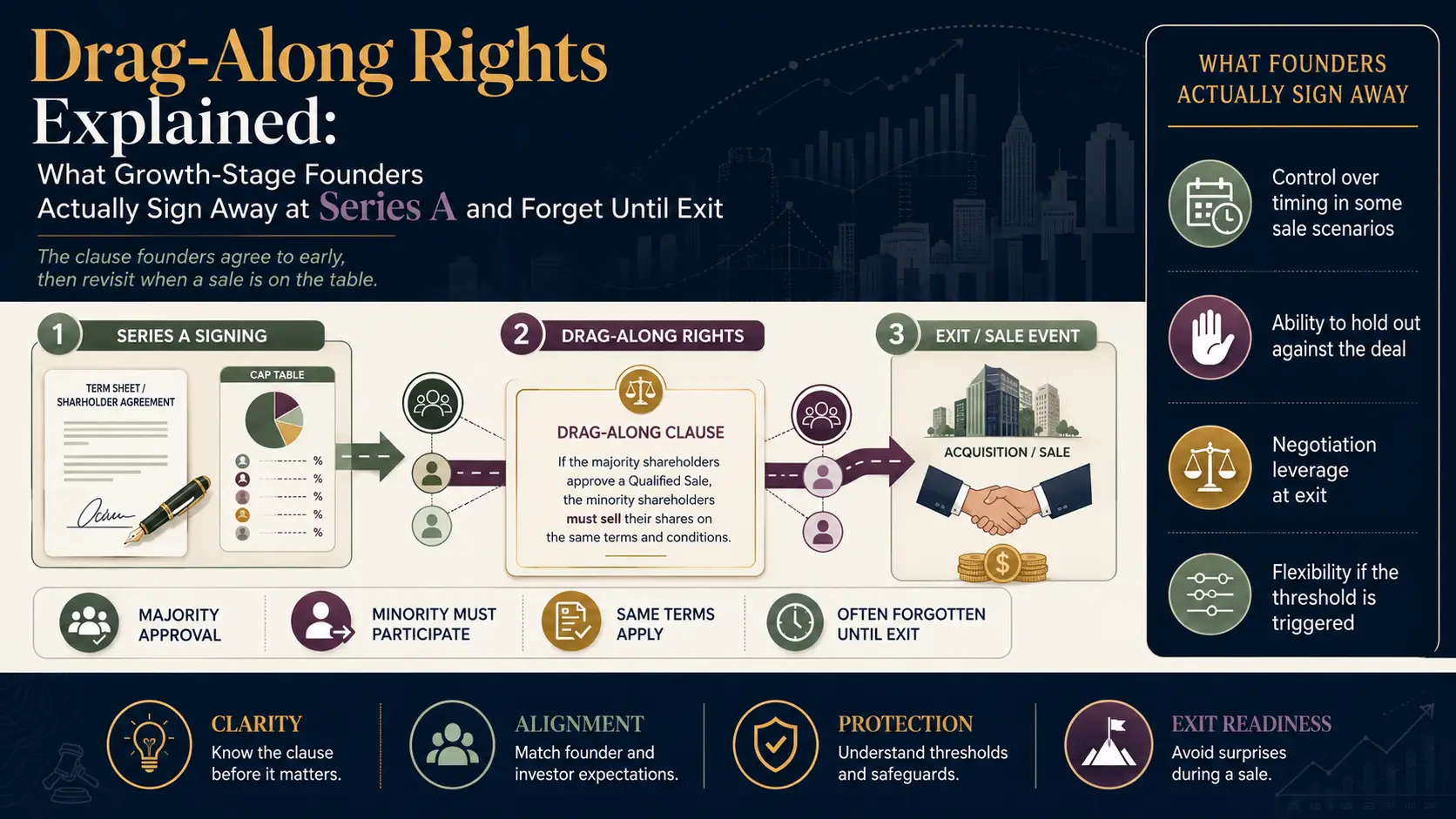
Drag-Along Rights Explained: What Growth-Stage Founders Actually Sign Away at Series A and Forget Until Exit

The Option Pool Shuffle: How Investors Use Pre-Money Pool Creation to Dilute You Before the Round Closes

How Should a Real Estate Sponsor Present Preferred Return Coverage in Investor Materials?
Disclosure
Nothing on this site constitutes an offer to sell, or a solicitation of an offer to purchase, any security under the Securities Act of 1933, as amended, or any applicable state securities laws. Any offering of securities is made only by means of a formal private placement memorandum or other authorized offering documents delivered to qualified investors.
IRC Partners is a capital advisory firm. IRC Partners is not a registered investment adviser under the Investment Advisers Act of 1940 and does not provide investment advice as defined thereunder.
Certain statements in this article may constitute forward-looking statements, including statements regarding market conditions, capital availability, investor demand, and transaction outcomes. Such statements reflect current assumptions and expectations only. Actual results may differ materially due to market conditions, regulatory developments, company-specific factors, and other variables. IRC Partners makes no representation that any outcome, return, or result described herein will be achieved.
References to prior mandates, transaction volume, network credentials, or capital raised are provided for illustrative purposes only and do not constitute a guarantee or prediction of future results. Past performance is not indicative of future outcomes. Individual results will vary. Network credentials and transaction statistics referenced on this site reflect the aggregate experience of IRC Partners' principals and affiliated advisors and are not a representation of assets managed or transactions closed solely by IRC Partners.
Certain data, statistics, and information presented in this article have been obtained from third-party sources. IRC Partners has not independently verified such information and expressly disclaims responsibility for its accuracy, completeness, or timeliness. Readers should independently verify any third-party data before relying on it.
Readers are strongly encouraged to consult qualified legal, financial, and tax professionals before making any investment, capital raising, or business decision.
Schedule A Meeting
You get one shot to raise the right way. If this raise is worth doing, it’s worth doing with precision, leverage, and control.
This isn’t a practice run. Serious capital. Serious strategy. Let’s raise it right.
We onboard a maximum of seven
new strategic partners each quarter, by application only, to maximize your chances of securing the capital you need.
