.svg "CTA Arrow")


.png "Investor Ready Capital decorative background element")

Fees for Sovereign Wealth and Pension Capital
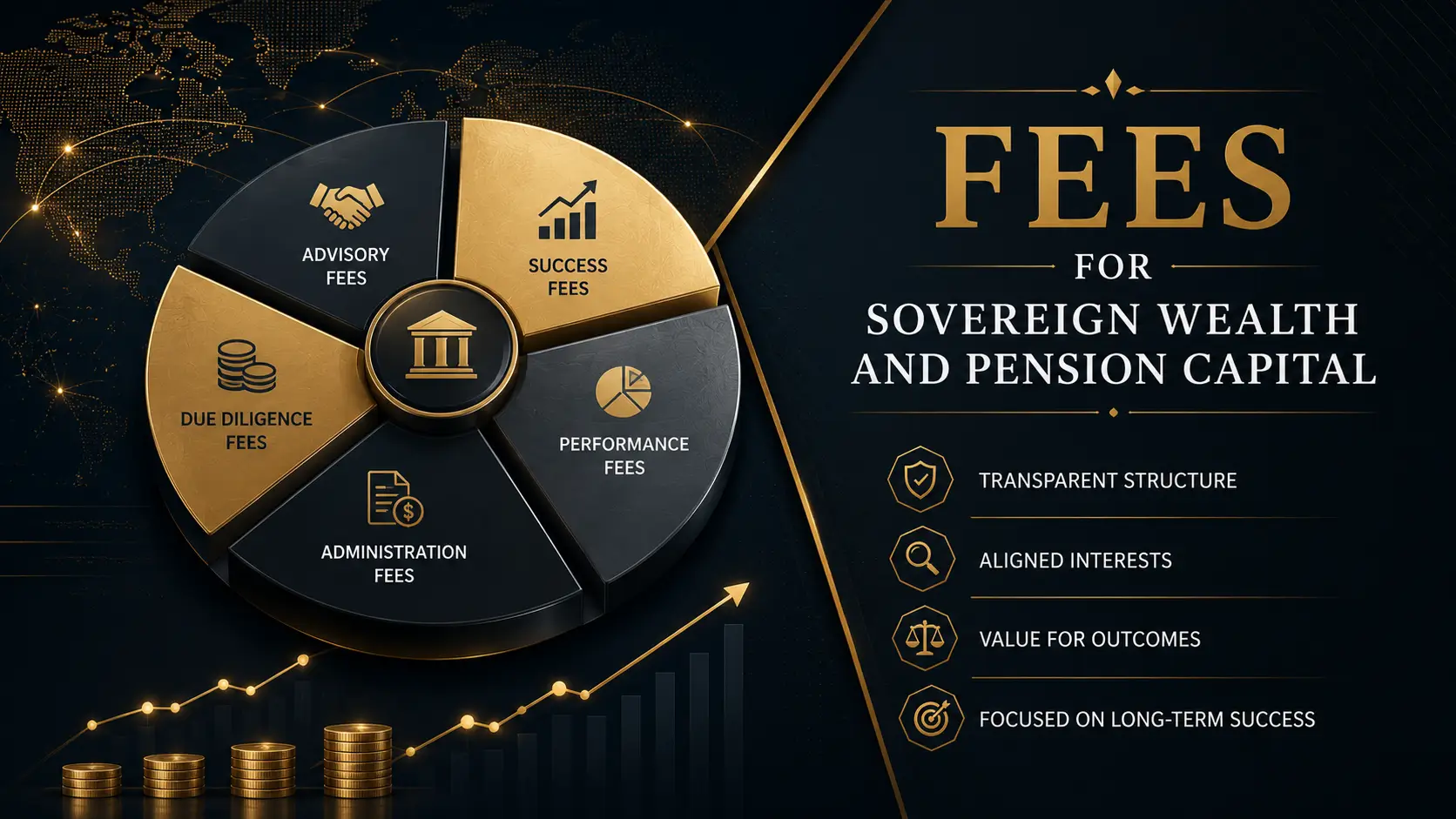
Fees for sovereign wealth and pension capital raising are not just a percentage negotiation. In this channel, the structure of the fee reveals whether the advisor is built for a long-cycle institutional process or optimized for quick placements in softer capital channels. The trigger mechanics, scope of work, retainer logic, tail provisions, and equity alignment all determine whether the advisor's economics are tied to a funded close or merely to activity along the way. Sponsors who evaluate the headline rate before understanding the fee structure risk protecting percentage points while leaving the real economic and timeline risk unresolved.
Before evaluating any fee proposal, it helps to understand how capital raising advisory works for real estate teams, because the scope of the advisory relationship shapes every fee term you will be asked to agree to.
Three things every sponsor should know before reviewing a fee proposal:
- The fee trigger, not the fee percentage, determines whether the advisor's economics align with a close or just with activity
- A retainer in an institutional engagement is not a red flag; it is a signal that the advisor is doing preparation work, not just making introductions
- A lower headline rate on an introduction-triggered arrangement can cost more than a higher rate on a close-triggered one if the raise stalls before commitment
Why Fee Structure Matters More Than Fee Rate in This Channel
Sovereign wealth funds and pension funds run longer diligence cycles than family offices or private equity funds. A sovereign investor evaluating a $25M real estate commitment may take six to twelve months from first introduction to investment committee approval. Pension funds often require governance review, external consultant sign-off, and investment policy compliance screening before any commitment is made.
That timeline changes what an advisor actually has to do. The work does not end at the introduction. It extends through materials refinement, IC preparation support, diligence queue management, and close coordination. An advisor whose fee trigger stops at introduction has no financial reason to stay engaged through that process.
The table below maps fee trigger type to the operating model it reflects.
The trigger type is the single most important variable in any fee proposal. Read it before you read the percentage.
The Three Fee Components Sponsors Should Expect
Institutional advisory engagements for sovereign and pension capital typically include three distinct fee components. Each one has a standard function, a negotiable range, and a set of red flags that signal misalignment.
- Retainer
The retainer covers pre-market work: positioning analysis, materials review, capital stack refinement, investor targeting, and the preparation required before any sovereign or pension fund introduction is appropriate. In a long-cycle channel, this work can span weeks or months. The standard structure is a monthly retainer credited against the success fee at close. Non-creditable retainers, where the retainer is kept regardless of outcome, shift economics toward the advisor and away from the sponsor.
Red flag: A retainer with no credit provision and no defined scope of deliverables. You are paying for access, not execution.
- Success Fee
The success fee is paid at a defined trigger event, typically close or funded commitment. The percentage, trigger definition, credited capital sources, tail period, and treatment of partial closes all need to be written into the agreement before outreach begins. Vague trigger language is where fee disputes concentrate.
Red flag: A success fee triggered by "introduction" or "introduction leading to a meeting." That language converts the advisor's incentive from closing to scheduling.
- Equity or Carry Participation
Some institutional advisors, particularly those operating on an equity-aligned model, take an advisory equity position rather than, or in addition to, a cash success fee. This can signal deeper alignment when the advisor's role extends across multiple raises or into capital strategy. It requires clear definition of role, vesting logic, dilution impact, and treatment in future capital events.
Red flag: Advisory equity with no defined vesting schedule, no role scope, and no expiration tied to engagement completion. Open-ended equity grants create long-term economics leakage with no accountability mechanism.
What Retainer Fees Signal About Advisor Quality
A retainer is not a red flag. In sovereign and pension fund capital raising, it is often the opposite. Advisors who work without a retainer in this channel are typically not doing the institutional preparation work the channel requires. They are running volume introductions and hoping something sticks.
Sovereign and pension investors expect a sponsor to arrive with a complete, diligence-ready package: audited financials, a defensible capital stack, a track record presentation that matches the fund's mandate, and materials formatted for institutional IC review. Preparing that package takes time. A retainer funds that time.
The real test is not whether a retainer exists. It is whether the retainer is:
- Credited against the success fee at close, not kept as a separate charge
- Tied to a defined scope of pre-market deliverables
- Matched to a realistic timeline for materials readiness and investor targeting
A no-retainer model in this channel shifts the advisor toward quick-hit outreach or broad prospecting with low mandate specificity. That is the wrong operating model for a sovereign or pension raise where a single misaligned introduction can damage the sponsor's credibility with that allocator for years. Understanding how long capital raising advisory takes makes clear why preparation time is not overhead — it is the work.
To understand how retainer structure fits into the broader engagement model, the capital raising engagement model and outcomes article covers what each phase of a structured engagement should produce and how fees map to deliverables.
Equity Alignment and Carry Participation
Advisory equity is a different instrument from a success fee, and sponsors should evaluate it differently. When an advisor takes an equity position, they are accepting long-term exposure to the deal's outcome. That can be a meaningful alignment signal, particularly for sponsors who want an advisory partner embedded across multiple raises rather than a transactional agent who exits after one close.
The alignment benefit is real when the equity is structured correctly. The structural risk is also real when it is not.
Before agreeing to advisory equity, model the dilution. Understand how the equity interacts with your waterfall, your promote, and your LP economics. The capital stack advisory fees article covers how advisory equity compares to cash fee models across different raise structures and what to require in the grant documentation before signing.
How to Compare Fee Proposals Across Advisors
Most sponsors compare fee proposals by looking at the success fee percentage. That comparison is almost meaningless without context. Two proposals at the same percentage can have completely different economics depending on trigger, scope, exclusivity, and tail terms.
Use the following checklist to compare proposals on the variables that actually determine total cost and alignment. ILPA Principles 3.0 sets the industry standard for what explicit fee definitions and transparency between GPs and LPs should look like, and it is a useful benchmark when reviewing what an engagement letter does or does not disclose.
- Fee trigger: Is the success fee triggered by introduction, commitment, or funded close? Close-triggered is the institutional standard in this channel.
- Scope of work: What does the advisor own after the introduction? Materials refinement, IC prep, diligence coordination, and close management should be defined, not assumed.
- Retainer credit: Is the retainer credited against the success fee at close, or is it a separate, non-refundable charge?
- Exclusivity terms: What is the exclusivity period, and are your existing investor relationships carved out? Broad exclusivity with no carve-outs can expose you to fee claims on capital you sourced independently.
- Tail period and covered-party definition: How long does the tail run after the engagement ends, and how broadly is a covered party defined? A 24-month tail with a vague covered-party definition can restrict your ability to raise independently long after the engagement closes.
- Source-credit rules: Which capital sources are credited to the advisor, and which are not? Disputes over source credit are the most common post-engagement conflict in institutional raises.
- Post-introduction obligations: What is the advisor required to do after an introduction is made? If the answer is nothing, the engagement is a placement, not advisory.
{{main-cta}}
Red Flags in Fee Structures for This Channel
The following fee structure patterns are not negotiation points. They are signals that the advisor is not built for sovereign and pension fund capital raising. Each one has a specific consequence.
- Introduction-triggered success fee with no post-introduction scope. The advisor gets paid when they make the call. You manage everything that follows. Consequence: no support through diligence, IC prep, or close coordination in a channel where that work takes months.
- Non-creditable retainer with no defined deliverables. You are paying a monthly fee with no offset at close and no written commitment on what the retainer produces. Consequence: sunk cost with no accountability mechanism.
- Vague exclusivity with no carve-outs. The engagement locks you out of capital sources you already have relationships with. Consequence: fee claims on capital you sourced independently, sometimes years after the engagement ends.
- Tail period longer than 18 months with a broad covered-party definition. Any investor you meet during the engagement, or who was introduced by anyone connected to the advisor, may be covered. Consequence: your ability to raise independently is restricted long after the engagement closes.
- Scope left undefined in the engagement letter. If the agreement does not specify what the advisor owns, everything defaults to dispute. Consequence: workstream gaps emerge under diligence pressure, and the sponsor absorbs the execution risk.
- Success fee triggered by "interest" or "engagement" rather than funded commitment. Consequence: you owe fees when an investor expresses interest but does not close, which is a common outcome in long-cycle sovereign and pension raises.
How to Avoid the Most Common Fee Negotiation Mistake
The most common mistake sponsors make is negotiating the percentage before they understand the structure. A sponsor who gets the rate down by half a point but leaves the trigger, scope, and tail terms undefined has optimized for the wrong variable. The rate determines how much you pay if the raise closes. The structure determines whether it closes at all, and what you owe if it does not.
The correction is simple: before any rate discussion, ask each advisor to walk through the trigger, scope, exclusivity, tail, and no-close scenario in writing. Standardize that comparison across all advisors you are evaluating. Once the structure is visible, the rate becomes a secondary negotiation.
Before negotiating rate, confirm in writing:
- What event triggers the success fee
- What the advisor owns after an introduction is made
- What happens to the retainer if the raise does not close
Frequently Asked Questions
What is a typical success fee percentage for sovereign wealth and pension fund capital raising?
Published fee ranges for sovereign and pension capital raising are not standardized, and advisors rarely disclose them publicly. The more useful question is what triggers the fee and what scope it covers. A success fee at a lower percentage triggered by introduction carries different economics than a higher-percentage fee triggered by funded close with full diligence support. Evaluate the trigger and scope before comparing percentages.
Is a retainer fee standard for institutional advisory engagements in this channel?
Yes. A retainer is standard in institutional advisory engagements for sovereign and pension capital because the pre-market preparation work is substantial. Positioning analysis, materials development, capital stack review, and investor targeting all happen before the first introduction. Advisors who work without a retainer in this channel are typically running volume placement models, not institutional advisory processes. The standard structure credits the retainer against the success fee at close.
What is the difference between a placement fee and an advisory fee in institutional capital raising?
A placement fee is paid for making an introduction or completing a transaction. It is typically triggered by introduction or by close, with no defined obligation between those two events. An advisory fee covers a broader scope: preparation, positioning, materials refinement, diligence support, IC coordination, and close management. In sovereign and pension fund raising, the distinction matters because the work between introduction and close is where most raises succeed or fail.
How does equity alignment in an advisory engagement affect the fee structure?
When an advisor takes advisory equity instead of, or alongside, a cash success fee, the fee structure shifts from transactional to partnership-oriented. The advisor's compensation is tied to the deal's long-term outcome rather than a single close event. This can reduce upfront cash cost for the sponsor and create stronger incentive alignment across multiple capital events. It requires clear documentation of role, vesting, dilution impact, and treatment in future raises to avoid open-ended economics leakage.
Can sponsors negotiate fee structures after the engagement has started?
Technically yes, but practically it is far harder. Once outreach has begun and introductions have been made, the advisor has leverage over tail and source-credit terms that did not exist before signing. Sponsors who want to negotiate structure should do so before the engagement letter is executed, not after the first investor meeting. The time to define trigger mechanics, retainer credit, exclusivity carve-outs, and the no-close scenario is before any capital source has been introduced.
What happens to fees if the raise does not close?
This depends entirely on what the engagement letter says, which is why the no-close scenario must be defined explicitly before signing. In a well-structured engagement, the retainer is the only fee obligation if the raise does not close, and it may be partially credited against future work. In a poorly structured engagement, vague language around "covered parties" and "interest expressed" can create fee obligations even when no capital is committed. Do not leave this term undefined.
How do fees differ between a $15M raise and a $75M raise in this channel?
The fee structure components are the same at both sizes: retainer, success fee, and potentially advisory equity. The absolute dollar amounts scale with raise size, which means the total cost of a misaligned fee structure is significantly higher on a $75M raise than on a $15M raise. At larger raise sizes, the tail period and covered-party definition also carry more financial risk because the pool of potentially covered investors is larger. The evaluation criteria in this article apply at both ends of that range.
Continue reading this series:
- How capital raising from sovereign wealth and pension funds works
- How to hire an advisor for a capital raise
- Engagement model for capital raising outcomes and success rates
The structure you carry into your first investor meeting sets the terms for every round that follows it. Founders who get it wrong spend the next three rounds negotiating from behind. IRC Partners advises operators raising $5M to $250M of institutional capital. The Capital Raise Pre-Flight runs your deal through the twelve gates institutional investors screen for, before any of them see it. Book your Capital Raise Pre-Flight consult here.
Sponsors weighing this decision should first complete a capital raise readiness assessment for sponsors to confirm the raise is investor-ready.
Need guidance on your capital raise?


What Do Pension Funds and Endowments Require Before Investing in a First-Time Real Estate Fund?
What Financing Documents Should Be Updated When Bridge Capital is Raised Through Multiple Affiliated Entities?
Virtual Data Room vs. Physical Data Room: What Institutional Investors Actually Prefer in 2026
Disclosure
Nothing on this site constitutes an offer to sell, or a solicitation of an offer to purchase, any security under the Securities Act of 1933, as amended, or any applicable state securities laws. Any offering of securities is made only by means of a formal private placement memorandum or other authorized offering documents delivered to qualified investors.
IRC Partners is a capital advisory firm. IRC Partners is not a registered investment adviser under the Investment Advisers Act of 1940 and does not provide investment advice as defined thereunder.
Certain statements in this article may constitute forward-looking statements, including statements regarding market conditions, capital availability, investor demand, and transaction outcomes. Such statements reflect current assumptions and expectations only. Actual results may differ materially due to market conditions, regulatory developments, company-specific factors, and other variables. IRC Partners makes no representation that any outcome, return, or result described herein will be achieved.
References to prior mandates, transaction volume, network credentials, or capital raised are provided for illustrative purposes only and do not constitute a guarantee or prediction of future results. Past performance is not indicative of future outcomes. Individual results will vary. Network credentials and transaction statistics referenced on this site reflect the aggregate experience of IRC Partners' principals and affiliated advisors and are not a representation of assets managed or transactions closed solely by IRC Partners.
Certain data, statistics, and information presented in this article have been obtained from third-party sources. IRC Partners has not independently verified such information and expressly disclaims responsibility for its accuracy, completeness, or timeliness. Readers should independently verify any third-party data before relying on it.
Readers are strongly encouraged to consult qualified legal, financial, and tax professionals before making any investment, capital raising, or business decision.
Schedule A Meeting
You get one shot to raise the right way. If this raise is worth doing, it’s worth doing with precision, leverage, and control.
This isn’t a practice run. Serious capital. Serious strategy. Let’s raise it right.
We onboard a maximum of seven
new strategic partners each quarter, by application only, to maximize your chances of securing the capital you need.
