.svg "CTA Arrow")


.png "Investor Ready Capital decorative background element")

Fees for Capital Stack Strategy
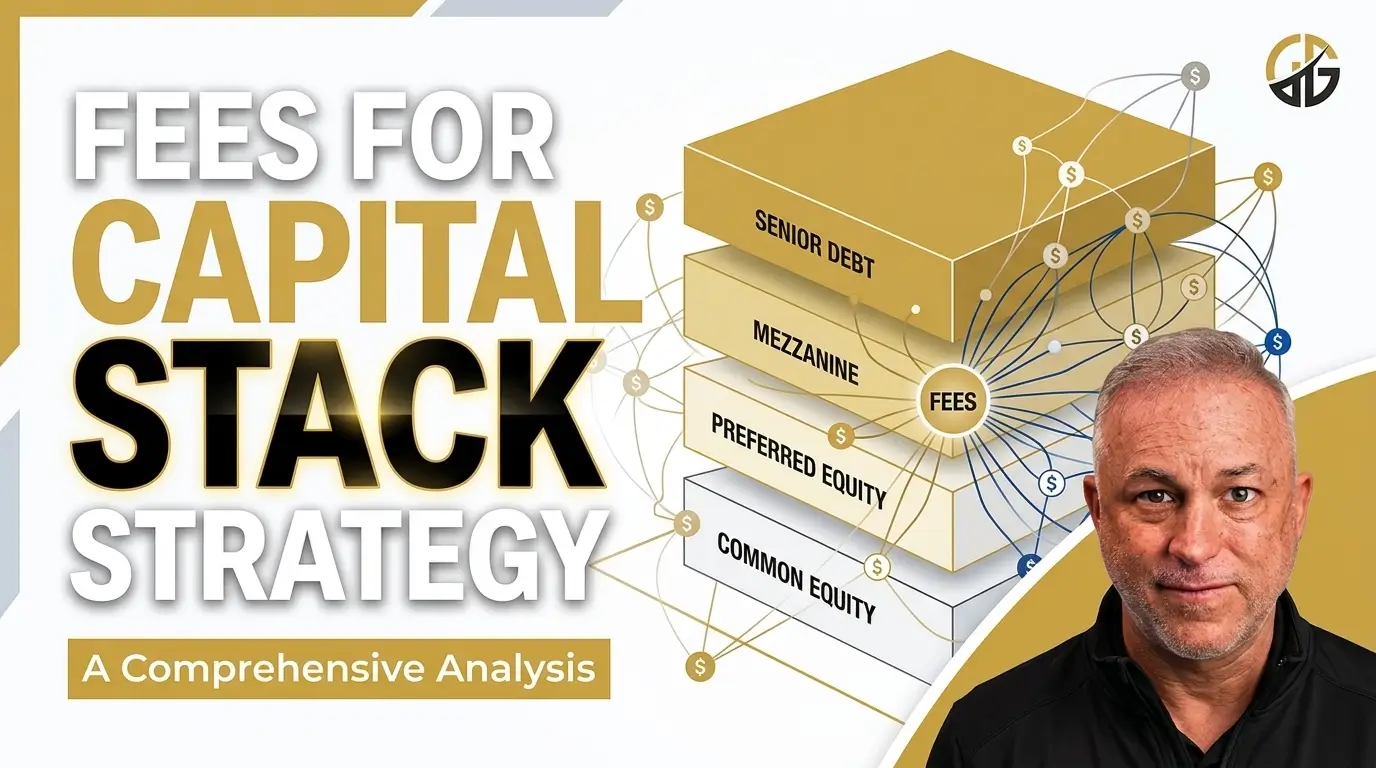
Capital stack strategy fees vary based on the complexity of the transaction, the capital sources involved, and the scope of advisory support required. For most real estate sponsors, the right fee structure should align the advisor's incentives with the financing outcome while making total costs clear before engagement. This guide explains common fee models and how to evaluate them.
Those ranges answer the surface question. But the more important question is what each structure makes the advisor optimize for. A fee proposal is not just a cost line. It is a signal of where the advisor's incentives sit during diligence, negotiation, and closing. Developers who evaluate fee proposals purely on headline cost often end up with the most expensive outcome: an advisor whose structure rewards speed over fit, or process over performance.
This guide covers how each fee model shapes advisor behavior, where each one creates alignment or misalignment, and how to compare competing proposals before committing to an engagement. For broader context on capital stack advisory as a discipline, the Hub 30 overview covers the full scope of what advisors do and when the relationship adds value.
Key takeaways:
- Fee structure determines what the advisor is incentivized to optimize for, not just how much they earn
- Hybrid models are the most common structure for institutional mandates, used by approximately 75% of emerging managers
- Total economics across the raise period matter more than any single line item in the proposal
What Capital Stack Advisory Fees Typically Look Like
Fee ranges shift based on mandate size, capital type, documentation complexity, and whether the advisor is engaged for a single raise or an ongoing capital formation relationship. Debt-plus-equity or structured capital raises typically justify higher fees than straightforward LP equity raises because the advisory workload is heavier: multiple capital tranches, more LP diligence coordination, and greater structural complexity.
Fee ranges also shift by manager experience. First-time institutional issuers often pay at the higher end of each range because the advisory burden is greater: more preparation, more LP education, and longer raise cycles. Experienced developers with clean track records and institutional-grade materials typically negotiate tighter terms.
A few pricing drivers worth understanding before comparing proposals:
- Raise size: Larger mandates often compress the success fee percentage while increasing absolute retainer levels
- Capital type: Structured debt or preferred equity mandates carry heavier documentation and coordination loads than pure LP equity
- Raise timeline: Projected 12-to-18-month raise cycles affect how retainer economics accumulate relative to the success fee
- Scope: Advisors covering structuring, materials, LP preparation, and diligence coordination command more than those providing introductions only
Total economics matter more than any single line item. A 1.5% success fee sounds cheaper than 2.5% until you account for a 12-month retainer at $20,000 per month sitting alongside it.
Retainer-Only Models: What They Signal
Retainer-only structures compensate the advisor for time, process, and strategic work. They can make sense when the developer needs architecture before active capital introduction begins: structuring the capital stack, preparing LP materials, coordinating diligence readiness, or building a capital formation strategy across multiple raises. In those contexts, a monthly retainer reflects real advisory labor, not just access.
The limitation is urgency. Without any outcome-linked component, the advisor bears no economic pressure tied to closing quality or timeline. In a 12-to-18-month institutional raise cycle, that can become expensive if scope is loosely defined and milestones are not contractually attached to deliverables.
When retainer-only models make sense:
- Ongoing capital formation strategy across multiple projects or raises
- Early-stage structuring and LP positioning before active outreach
- Multi-year embedded advisory relationships where the work is continuous, not transactional
When they create risk:
- Single-transaction mandates where the developer needs outcome accountability
- Mandates with vague scope and no milestone schedule
- Engagements where the raise timeline is uncertain and monthly costs accumulate without clear progress markers
For single-transaction raises, a retainer without any performance component can reduce the advisor's urgency, particularly when the advisor carries multiple mandates simultaneously. The best retainer agreements include a milestone schedule: specific deliverables tied to each phase of the raise cycle, with clear definitions of what the retainer actually covers month by month.
{{main-cta}}
Success-Fee-Only Models: Where Incentive Misalignment Lives
Success-fee-only structures are the standard broker model. The advisor earns nothing unless the deal closes, which sounds like pure alignment. In practice, it creates a specific and predictable misalignment: the advisor is incentivized to close something, not necessarily the right thing.
The core risk: When an advisor only earns on close, the pressure is always toward speed and deal completion, not toward capital stack quality, LP fit, or term durability.
This shows up in institutional mandates in three concrete ways:
- Pressure on LP terms. An advisor with no retainer income has strong incentive to accept weaker investor rights, lower preferred return thresholds, or unfavorable waterfall structures if those terms move the deal toward close faster.
- Shortcut on diligence preparation. Thorough LP diligence preparation takes time. Under a success-fee-only structure, that time is uncompensated. Advisors operating under this model often underinvest in materials, LP education, and structural documentation.
- Adverse selection on mandate load. Because the cost of underperforming on any single mandate is low, success-fee-only advisors tend to take on more mandates than they can execute well. A developer on a success-fee-only engagement is competing for advisor attention with every other live mandate in the pipeline.
Understanding how retainer structures reduce execution risk compared to traditional placement agent models helps clarify why process compensation matters for institutional mandates over $20M. A pure success-fee arrangement at that scale is almost always a broker engagement dressed in advisory language.
The ILPA Principles 3.0 address this directly from the LP side: governance and alignment standards require that advisor incentives be structured to support decision quality, not just transaction completion. Institutional LPs increasingly scrutinize the advisory relationships on the other side of a raise for exactly this reason.
Hybrid Models: How to Evaluate Whether the Balance Is Right
A well-structured hybrid model pays for real advisory labor during the raise and still keeps meaningful compensation tied to closing. That combination is what makes it the most common structure for institutional mandates: it compensates process without removing outcome accountability.
The challenge is that not all hybrid proposals are actually balanced. Two specific imbalances are common:
- Retainer too low relative to success fee. If the monthly retainer is nominal, say $3,000 to $5,000 against a 2% to 3% success fee on a $30M raise, the structure still behaves like a success-fee-only model. The advisor's meaningful income is still tied entirely to close, and the retainer does not create enough process accountability to change their behavior.
- Retainer too high relative to deliverables. If the retainer is $25,000 per month with no defined milestone schedule, the developer is paying for access and availability, not execution. This is expensive, and it creates the same urgency problem as a pure retainer model.
The 30-50% Benchmark
A practical way to evaluate hybrid balance: look at what percentage of the advisor's expected total compensation sits in the retainer component.
Benchmark: In a well-aligned hybrid for an institutional mandate, the retainer component typically represents 30% to 50% of projected total compensation over the raise cycle.
Example: A $25M raise with a 12-month timeline, a $10,000/month retainer, and a 1.5% success fee produces $120,000 in retainer income and $375,000 in success fee income. The retainer represents about 24% of total expected compensation. That sits below the benchmark, meaning the structure still leans heavily toward outcome compensation and the misalignment risks of a success-fee-heavy model apply.
If a proposal does not give you enough information to run this math, that is itself a red flag.
Equity-Based Advisory Compensation: What It Means for Long-Term Alignment
Equity-based advisory structures replace or supplement cash fees with a direct stake in the project or fund, typically 3% to 5% of advisory equity. The logic is straightforward: when the advisor's return depends on the same outcome metrics as the developer's, the incentive to protect deal quality, LP terms, and capital stack durability is embedded in the economics rather than bolted on through contract language.
IRC Partners operates on an equity-aligned advisory model, taking 3% to 5% advisory equity in lieu of or alongside cash fees. The structure is designed for developers building multi-raise institutional capital strategies across multiple projects, not single-transaction mandates. That distinction matters: equity-based advisory works when the advisory relationship is long enough for the equity to be meaningful, and when the advisor's contribution extends beyond one close.
The tradeoff is governance. Equity compensation without a documented scope, clear vesting or entitlement terms, and explicit definitions of what triggers or extinguishes the equity stake is a structural risk for both parties. Any equity-based proposal that lacks this documentation should be treated as incomplete, not just as a negotiating starting point.
How to Compare Fee Proposals Across Shortlisted Advisors
Most developers compare fee proposals by looking at the success fee percentage or the monthly retainer in isolation. Neither number tells you what you need to know. The right comparison is total expected economics across the likely raise period, adjusted for what the advisor is actually accountable for delivering.
Before comparing fee proposals, pair this review with the reference and attribution validation work you completed in the prior step. Fee structure analysis only makes sense once you have validated that the advisor can actually execute. A well-priced proposal from an advisor with a weak execution record is not a good deal.
Five questions to ask before accepting any fee proposal:
- Is the success fee calculated on gross capital raised or only on capital the advisor directly sourced?
- What is the minimum fee if the raise closes in month three versus month eighteen?
- Are there trailing fees on invested capital after close, and over what time horizon?
- What happens to the fee structure if the target raise amount changes mid-mandate?
- What is the retainer scope in writing, and what specific deliverables trigger each monthly payment?
Red Flags in How Advisors Present Their Fees
How an advisor presents fees tells you almost as much as the fee structure itself. Watch for these four patterns:
- Vague retainer scope. A monthly retainer with no defined deliverables, no milestone schedule, and no written explanation of what the advisor will produce each month is a process accountability problem waiting to surface. Retainers should be attached to specific outputs: materials drafted, LP introductions coordinated, diligence documents prepared.
- Success-fee-only on mandates over $20M. At this scale, a pure success-fee structure is almost always a broker engagement. The advisory burden on a $20M-plus institutional raise is too significant to be absorbed without process compensation. An advisor presenting success-fee-only on a mandate of this size is signaling their model, not making a concession.
- Equity requests without documentation. An advisor asking for advisory equity without a written scope, defined vesting terms, and a clear explanation of what triggers or extinguishes the equity stake is not offering alignment. They are requesting dilution without accountability.
- Fee terms that shift after the LOI. If the calculation base, minimum fee, cap structure, or post-close economics change materially between the proposal stage and the engagement letter, the advisor is renegotiating from a position of leverage. This pattern predicts similar behavior during the raise itself.
Questions to ask any advisor before signing:
- What exactly does the retainer cover, and what deliverables are attached to each monthly payment?
- How is the success fee calculated, and on what capital base?
- What adjustments apply if the raise closes below target, above target, or takes longer than projected?
- Have any of your fee terms changed between proposal and engagement letter in the past two years?
Use Alignment to Choose, Then Move to Engagement Terms
Fee structure is where advisor incentives become visible. Compare proposals by total economics and incentive alignment, not by headline success fee or monthly retainer alone. The cheapest proposal can easily become the most expensive outcome if it produces weak LP terms, low advisor attention, or poor execution discipline across a 12-to-18-month raise cycle.
Once you have identified the fee model that best aligns with your mandate, the next step is understanding what the retainer actually covers before you sign. The engagement model for capital stack strategy advisory covers exactly that: what a well-structured advisory engagement includes, how scope is defined, and what accountability mechanisms should appear in the engagement letter.
Decision recap:
- Evaluate fee proposals by incentive alignment and total economics, not headline rates
- Use the 30%-50% retainer benchmark to test whether a hybrid model is genuinely balanced
- Move to engagement model review before signing, because fee logic only holds when scope is clearly defined
Frequently Asked Questions
What is a typical success fee percentage for a capital stack strategy advisor on a $10M+ raise?
Success fees for institutional real estate capital raises typically range from 1% to 3% of total capital raised. For mandates between $10M and $30M, 2% to 3% is common, especially for first-time institutional issuers. Larger raises above $50M often compress to 1.5% to 2% in percentage terms while producing higher absolute fees. Advisors sourcing only a portion of the capital may apply the success fee only to advisor-sourced commitments, which materially changes the total economics.
Is a retainer-only fee structure normal for institutional capital advisory?
Retainer-only structures are used in institutional advisory, but they are less common for single-transaction mandates above $15M. They are most appropriate for ongoing capital formation relationships, multi-raise strategy engagements, or early-stage structuring work before active LP outreach begins. On a stand-alone raise, a retainer-only arrangement at $10,000 to $30,000 per month without any outcome component removes the advisor's economic accountability for closing quality and timeline.
What does a hybrid fee model look like for a $25M real estate capital raise?
A typical hybrid on a $25M raise might combine a $10,000 monthly retainer over a 12-month raise cycle with a 1.5% success fee on capital raised. That produces $120,000 in retainer income and $375,000 in success fee income, for total expected compensation of approximately $495,000. In this example, the retainer represents about 24% of total expected compensation, which sits below the 30% to 50% benchmark for a well-balanced hybrid and signals the structure still leans heavily toward outcome incentives.
How does advisory equity differ from a standard success fee?
A success fee is a one-time cash payment triggered at close, typically calculated as a percentage of capital raised. Advisory equity is an ongoing economic stake, usually 3% to 5% of project or fund equity, that gives the advisor exposure to the same performance metrics as the developer. Advisory equity aligns incentives across the full hold period, not just through closing. It requires documented scope, clear vesting terms, and defined exit mechanics. A success fee does not.
What should a monthly retainer for a capital stack advisor actually cover?
A monthly retainer at $10,000 to $30,000 per month should be attached to specific, documented deliverables. At minimum, this includes capital stack structuring work, LP materials preparation and revision, diligence document coordination, and active LP outreach management. Retainers that cover only availability, advisory calls, or general access without defined outputs are paying for access rather than execution. Any retainer proposal without a written milestone schedule should be treated as incomplete.
How do you compare two advisors with different fee structures to determine total cost?
Model total expected compensation over the projected raise timeline for each proposal. Multiply the monthly retainer by the expected raise duration in months, then add the success fee on the target capital raise amount. Adjust for any trailing fees, minimum fee floors, or tiered structures. Also check whether the success fee applies to gross capital raised or only to advisor-sourced capital, since that distinction alone can shift total fees by 20% to 40% on a competitive raise where multiple capital sources are involved.
What happens to advisor fees if a capital raise closes below the original target?
Fee treatment on below-target closes varies significantly by proposal and is often not addressed explicitly in early-stage fee discussions. Well-structured agreements define minimum success fees, prorated retainer credits, or adjusted success fee percentages tied to closing thresholds. Advisors without this language in their proposal retain full fee entitlement regardless of performance. Before signing, ask specifically how fees adjust if the raise closes at 60%, 75%, or 90% of target, and get the answer in writing.
Continue reading this series:
- Engagement Model for Capital Stack Strategy Advisory
- How to Choose an Advisor for Capital Stack Strategy
- IRC Growth Advisory Equity
IRC Partners works with operators raising $5M to $250M of institutional capital. The full engagement is for founders at $1M+ ARR who have raised before. The $2,997 Capital Raise Pre-Flight audit is open to earlier-stage companies, including pre-revenue, that are raising $5M+ and have a pitch deck and financial model ready for review. If that's you, schedule a call to discuss HERE.
Sponsors weighing this decision should first complete a capital raise readiness assessment for sponsors to confirm the raise is investor-ready.
Need guidance on your capital raise?



Best Practices For Investment Committee Deck Design 2026

When Does a Company Need Capital Raising Outcomes and Advisor Success Rates

What Blue Sky Laws Apply to a Real Estate Fund Raising Capital From Pension Funds Across Multiple States?
Disclosure
Nothing on this site constitutes an offer to sell, or a solicitation of an offer to purchase, any security under the Securities Act of 1933, as amended, or any applicable state securities laws. Any offering of securities is made only by means of a formal private placement memorandum or other authorized offering documents delivered to qualified investors.
IRC Partners is a capital advisory firm. IRC Partners is not a registered investment adviser under the Investment Advisers Act of 1940 and does not provide investment advice as defined thereunder.
Certain statements in this article may constitute forward-looking statements, including statements regarding market conditions, capital availability, investor demand, and transaction outcomes. Such statements reflect current assumptions and expectations only. Actual results may differ materially due to market conditions, regulatory developments, company-specific factors, and other variables. IRC Partners makes no representation that any outcome, return, or result described herein will be achieved.
References to prior mandates, transaction volume, network credentials, or capital raised are provided for illustrative purposes only and do not constitute a guarantee or prediction of future results. Past performance is not indicative of future outcomes. Individual results will vary. Network credentials and transaction statistics referenced on this site reflect the aggregate experience of IRC Partners' principals and affiliated advisors and are not a representation of assets managed or transactions closed solely by IRC Partners.
Certain data, statistics, and information presented in this article have been obtained from third-party sources. IRC Partners has not independently verified such information and expressly disclaims responsibility for its accuracy, completeness, or timeliness. Readers should independently verify any third-party data before relying on it.
Readers are strongly encouraged to consult qualified legal, financial, and tax professionals before making any investment, capital raising, or business decision.
Schedule A Meeting
You get one shot to raise the right way. If this raise is worth doing, it’s worth doing with precision, leverage, and control.
This isn’t a practice run. Serious capital. Serious strategy. Let’s raise it right.
We onboard a maximum of seven
new strategic partners each quarter, by application only, to maximize your chances of securing the capital you need.
