.svg "CTA Arrow")


.png "Investor Ready Capital decorative background element")

Why Ambiguous Voting Calculations in Drag-Along Clauses - "Majority of Shares" vs. "Majority of Voting Shares" - Become Litigation When an Offer Arrives
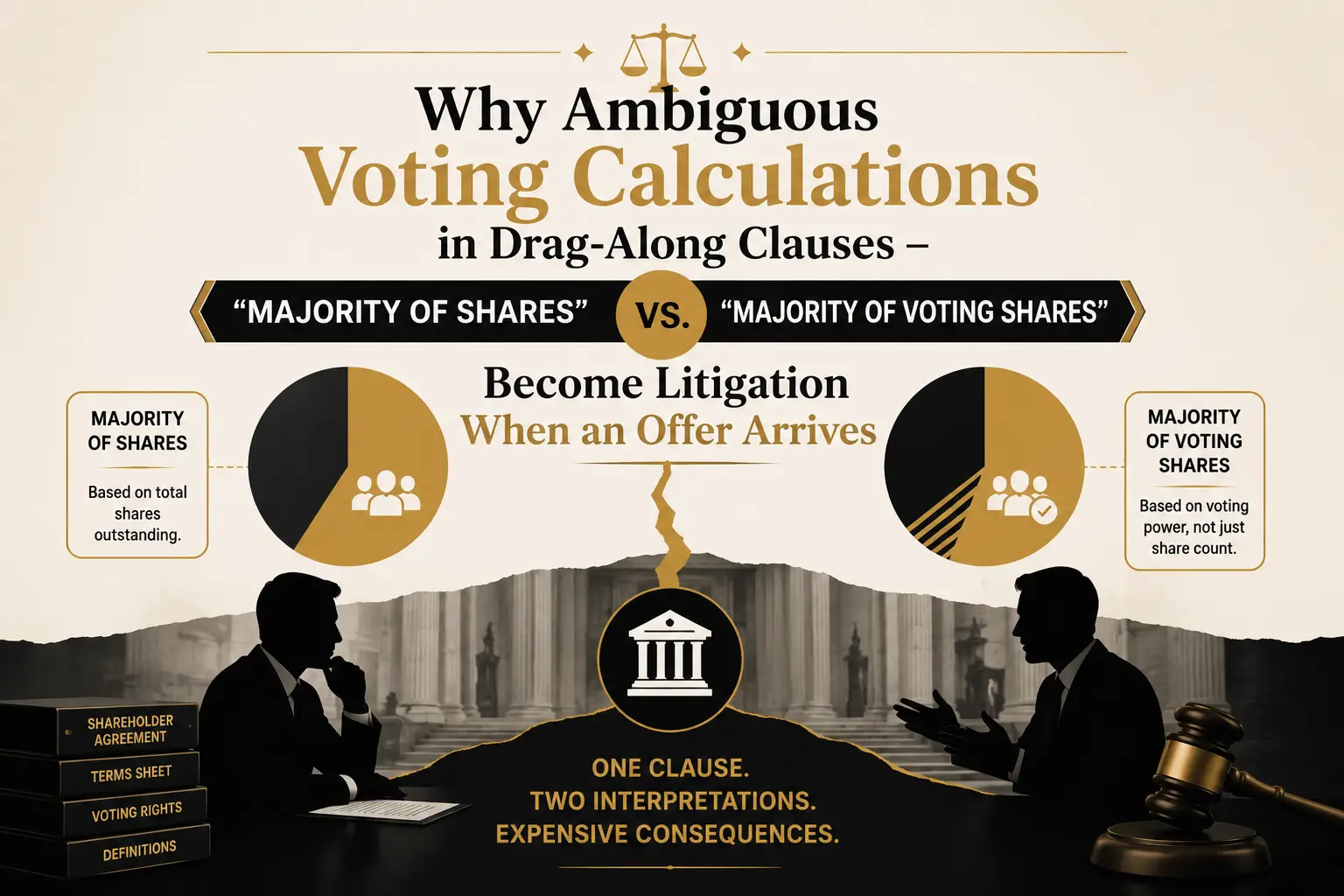
Why Ambiguous Voting Calculations in Drag-Along Clauses - "Majority of Shares" vs. "Majority of Voting Shares" - Become Litigation When an Offer Arrives
When a drag-along clause says "approved by a majority of shares," it is not the same as "approved by a majority of voting shares." The first counts raw share units. The second counts voting power, which can be inflated or deflated by weighted voting rights attached to preferred stock. When preferred carries multiple votes per share, the two formulas can produce opposite results from the same cap table - a drag-along activation that clears one test may fail the other, and if the agreement does not specify which method applies, the outcome is not a legal certainty. It is a dispute. Most founders review drag-along provisions for the headline threshold percentage and never audit the calculation method underneath it - which is exactly where the ambiguity that kills time-sensitive acquisitions lives.
Most founders review drag-along provisions for the headline threshold percentage. This piece goes one level deeper: the calculation method used to determine whether the threshold has been met is itself a source of ambiguity that most founders never audit.
Three things to take from this piece:
- "Majority of shares" and "majority of voting shares" are not synonyms. They measure different things.
- Weighted voting rights in preferred stock can change which coalition controls a drag-along vote.
- Undefined calculation mechanics are not a minor drafting gap. They are how drag-along disputes become litigation when a real offer arrives.
"Majority of Shares" vs. "Majority of Voting Shares": What Each Method Actually Counts
Both phrases appear in venture agreements, sometimes interchangeably, but they measure fundamentally different things. Before parsing either formula, it helps to understand how preferred stock is structured in the capital stack, since the voting rights attached to preferred are what make the two formulas diverge.
"Majority of shares" counts the number of shares outstanding. Every share counts as one unit regardless of how many votes that share carries under the charter or stockholders agreement. A holder with 1,000 shares counts as 1,000 units whether those shares carry 1 vote each or 10 votes each.
"Majority of voting shares" counts voting power. If a share carries 2 votes, it contributes 2 voting units to the denominator and the numerator. A holder with 1,000 shares at 2 votes per share counts as 2,000 voting units. The same physical share count produces a different threshold result.
The table below shows how the two methods diverge in practice.
The drafting problem is not just which phrase appears. It is whether the agreement also defines the denominator, specifies how each class is treated, and states whether preferred counts on an as-converted or as-issued basis. As Cooley GO notes in its drag-along rights glossary, drag-along mechanics that look clean on the surface can break down when the underlying voting structure is not fully specified.
If those details are missing, no party can reliably confirm whether the threshold has been met, and that ambiguity does not stay theoretical once a real offer is on the table.
Worked Example: The Same Cap Table Produces Two Different Outcomes
Here is a concrete illustration using a single cap table with a simple majority threshold.
Cap table assumptions:
Test 1: Majority of Shares (raw count)
- Total shares outstanding = 100 units (normalized to percentages).
- A simple majority requires more than 50 units.
- Series A (35) plus Series B (28) = 63 shares.
- Result: The coalition clears the threshold. 63 > 50.
Test 2: Majority of Voting Shares (voting-power weighted)
- Total voting units = 128 (Series B's 28 shares count as 56 units at 2x weight).
- A simple majority requires more than 64 voting units.
- Series A (35 voting units) plus Series B (56 voting units) = 91 voting units.
- Result: The coalition still clears the threshold. 91 > 64.
Now reverse the scenario. Suppose founders and others want to evaluate whether they can block the drag-along.
- Under raw share count: founders plus others = 37 shares. They cannot block a majority-of-shares vote.
- Under voting-power weighting: founders (30 units) plus others (7 units) = 37 voting units. Against a 64-unit majority requirement, they still cannot block.
But change Series B's voting weight to 3x and the math shifts. Series B alone holds 84 voting units out of 149 total, which means Series B can clear a majority-of-voting-shares test without Series A. Under raw share count, Series B at 28% cannot do that alone. The calculation method determines who actually controls the vote, not just the threshold percentage.
This is the fault line. When the agreement does not specify which method applies, every holder can argue for the interpretation that serves their position.
Why Vague Calculation Language Becomes a Dispute When an Offer Arrives
Nobody challenges ambiguous vote-counting language in the abstract. The challenge arrives when a real offer creates real winners and losers. What founders actually sign away in a drag-along clause at Series A is often far broader than they realize until a buyer appears.
A buyer at $80 million looks very different to a Series B investor with a 2x liquidation preference than it does to founders holding 1x participating common. When the economics diverge, every party has an incentive to read the drag-along approval language in the way that favors their outcome. If the agreement does not clearly define the calculation method, both readings may be legally defensible.
The real risk is not that the clause is unenforceable. It is that the clause is ambiguous enough to be litigated, and litigation during a sale process kills the deal.
That dynamic creates a specific set of dispute triggers founders should recognize before signing or before the next round closes.
Calculation ambiguity risk checklist:
- The agreement uses "majority of shares" without defining whether that means issued shares, outstanding shares, or fully diluted shares.
- The agreement uses "majority of voting shares" without specifying whether preferred counts at its stated voting weight or on an as-converted-to-common basis.
- Different series carry different voting rights but the agreement treats them as a single class for threshold purposes without a blended-weight formula.
- The agreement is silent on what happens when a new financing round adds shares or changes voting weights after the drag-along was originally drafted.
- Minority holders can plausibly argue the threshold was not met under one reading even though the majority believes it was under another.
Understanding how drag-along rights get buried in a term sheet is the first step. Knowing whether the calculation mechanics inside those rights are actually defined is the step most founders skip.
Under Delaware General Corporation Law Section 212, the default rule is one vote per share unless the certificate of incorporation provides otherwise. But venture charters routinely do provide otherwise, and drag-along agreements that do not align with or reference those charter-level voting rights create the gap that generates disputes.
What Precise Calculation Language Looks Like in Your Agreement
Founders do not need to redraft their agreements. They need to know what to look for so they can flag gaps before the next round.
A well-defined drag-along calculation clause answers four questions:
- Denominator definition. Does "majority" apply to issued shares, outstanding shares, or fully diluted shares? Each produces a different denominator and a different threshold.
- Voting power definition. Does the clause count shares or votes? If it counts votes, does it reference the voting rights in the certificate of incorporation or define them independently?
- Class and series treatment. Are all preferred series counted together in one pool, or does each series vote separately? If counted together, is there a blended weighting formula?
- As-converted versus as-issued basis. If preferred stock counts for drag-along purposes, does it count at its stated preferred-share number or at the number of common shares it would represent upon conversion?
Agreements that answer all four questions clearly are enforceable by design. Agreements that are silent on one or more of these points create interpretive space that opposing counsel will use. The NVCA Model Legal Documents provide a baseline for how sophisticated venture agreements approach these definitions, and reviewing your own language against that standard is a reasonable starting point.
The goal is not to self-draft legal text. It is to know where your clause is undefined so that counsel and advisors can address it before a financing process begins.
{{main-cta}}
How Founders Should Raise This Before the Next Round
The right time to fix drag-along calculation mechanics is before the next round closes, not during a sale process. Once new investors are in and the agreement is signed, cleanup requires consent from every party who benefits from the ambiguity.
Before investor outreach, founders should review drag-along language alongside voting rights, protective provisions, and consent mechanics as a single package. Calculation mechanics do not exist in isolation. They interact with every other provision that defines how approval power is measured. The same discipline applies to other investor rights clauses: negotiating information rights in a $10M+ term sheet follows the same logic of fixing vague language before signing, not after.
Pre-round action checklist:
- Locate the drag-along clause in your investors' rights agreement or stockholders agreement.
- Identify which calculation phrase is used and whether the four precision markers above are defined.
- Flag any series with enhanced voting rights and check whether the drag-along clause references or ignores those rights.
- Bring gaps to counsel before term sheet negotiations begin, not after.
- Ask whether the new round's preferred stock will carry voting weights that change the calculation outcome under the existing clause.
Founders who understand the difference between drag-along and tag-along rights and who have mapped their approval mechanics before outreach are in a stronger position to negotiate precision language into the next round. IRC works with growth-stage founders to pressure-test capital structure and investor agreement language before outreach begins, so that calculation ambiguities are identified and addressed while founders still have leverage to fix them.
Understanding the calculation mechanics in your existing agreement is the logical step before accepting new drag-along language in the next one.
Frequently Asked Questions
What does "as-converted basis" mean in a drag-along voting calculation?
As-converted basis means preferred stock is counted as if it had already converted into common shares. A Series B investor holding 1,000 preferred shares that convert at a 1:1 ratio would count as 1,000 common-equivalent shares. This matters because the conversion ratio can differ by series, and counting preferred on an as-issued versus as-converted basis changes both the numerator and the denominator in the threshold calculation.
Can a drag-along clause be triggered by a single investor class if the calculation method is undefined?
Yes, in some structures. If the agreement uses "majority of voting shares" but does not cap or separate voting classes, a single preferred series with sufficiently high per-share voting rights can accumulate enough voting units to clear the threshold alone. Whether that result is enforceable depends on how the charter defines those voting rights and whether the drag-along agreement was drafted to incorporate or override them.
Does Delaware law specify which calculation method applies if the agreement is silent?
Delaware General Corporation Law Section 212 establishes that each share is entitled to one vote unless the certificate of incorporation provides otherwise. That default applies to stockholder votes under the DGCL, but drag-along rights are typically governed by a separate stockholders agreement or investors' rights agreement, not by a stockholder vote under the DGCL. If that private agreement is silent on calculation method, the default is not automatically clear, and courts will look to the agreement's plain language, intent, and surrounding documents to resolve the ambiguity.
What is the difference between "outstanding shares" and "fully diluted shares" as a denominator in a drag-along clause?
Outstanding shares counts only shares that have been issued. Fully diluted shares includes all shares that would exist if all options, warrants, and convertible instruments were exercised or converted. Using fully diluted shares as the denominator increases the total and makes the threshold harder to reach. Agreements that do not specify which denominator applies leave room for a party to argue for the version that benefits their position when a vote is being counted.
Can a minority investor block a drag-along activation by challenging the calculation method?
A minority investor cannot block activation simply by objecting, but they can create delay, threaten litigation, and raise enough uncertainty to complicate closing. If the calculation method is genuinely ambiguous and the minority holder can articulate a plausible alternative reading under which the threshold was not met, deal counsel may advise the buyer to require indemnification, escrow, or a re-vote before proceeding. That friction alone can kill time-sensitive transactions.
How do tiered voting rights from multiple preferred series interact in a single drag-along threshold calculation?
When a company has multiple preferred series, each with different per-share voting rights, the drag-along clause needs to specify whether those series are pooled together or treated separately. If pooled, the agreement should define a blended voting-unit formula. If treated separately, the clause may require approval from each series independently. Agreements that pool multiple series without a blended formula, or that require separate approvals without specifying the threshold for each, are common sources of calculation disputes when the series holders have conflicting economic interests in the proposed sale.
What should founders ask their counsel to review specifically when auditing drag-along calculation language before a raise?
Founders should ask counsel to confirm four things: whether the denominator is defined as issued, outstanding, or fully diluted shares; whether the clause counts shares or votes and how it handles preferred voting weights; whether multiple preferred series are pooled or treated separately and on what basis; and whether the calculation method aligns with the voting rights defined in the certificate of incorporation. If any of those four points is undefined or internally inconsistent, that gap should be addressed before new investors are brought in and consent requirements increase.
Continue reading this series:
- How Drag-Along Rights Get Buried in Your Term Sheet
- Why 95% of VC Term Sheets Include Drag-Along Rights
- 51% vs. 75% Drag-Along Thresholds
The Capital Raise Pre-Flight is IRC Partners’ fixed-fee diagnostic that scores a raise against the same twelve institutional gates a deal must clear before IRC Partners takes it into a strategic partnership. It is where every engagement begins, whether you are pre-revenue building toward a first institutional round or scaling a company that has raised before. For deals that clear, the full strategic partnership follows. IRC Partners advises operators raising $5M to $250M of institutional capital. If you are taking a raise to market, start here.
Sponsors weighing this decision should first complete a capital raise readiness assessment for sponsors to confirm the raise is investor-ready.
Need guidance on your capital raise?



Real Estate Syndication Companies: How to Evaluate a Sponsor Before You Invest (And What Sponsors Must Prove)

Preferred Equity Real Estate: When Sponsors Use It, What It Costs, and What the Data Room Must Include

Convertible Note Overhangs: Why Unresolved Notes From Your Seed Round Are a Series B Time Bomb
Disclosure
Nothing on this site constitutes an offer to sell, or a solicitation of an offer to purchase, any security under the Securities Act of 1933, as amended, or any applicable state securities laws. Any offering of securities is made only by means of a formal private placement memorandum or other authorized offering documents delivered to qualified investors.
IRC Partners is a capital advisory firm. IRC Partners is not a registered investment adviser under the Investment Advisers Act of 1940 and does not provide investment advice as defined thereunder.
Certain statements in this article may constitute forward-looking statements, including statements regarding market conditions, capital availability, investor demand, and transaction outcomes. Such statements reflect current assumptions and expectations only. Actual results may differ materially due to market conditions, regulatory developments, company-specific factors, and other variables. IRC Partners makes no representation that any outcome, return, or result described herein will be achieved.
References to prior mandates, transaction volume, network credentials, or capital raised are provided for illustrative purposes only and do not constitute a guarantee or prediction of future results. Past performance is not indicative of future outcomes. Individual results will vary. Network credentials and transaction statistics referenced on this site reflect the aggregate experience of IRC Partners' principals and affiliated advisors and are not a representation of assets managed or transactions closed solely by IRC Partners.
Certain data, statistics, and information presented in this article have been obtained from third-party sources. IRC Partners has not independently verified such information and expressly disclaims responsibility for its accuracy, completeness, or timeliness. Readers should independently verify any third-party data before relying on it.
Readers are strongly encouraged to consult qualified legal, financial, and tax professionals before making any investment, capital raising, or business decision.
Schedule A Meeting
You get one shot to raise the right way. If this raise is worth doing, it’s worth doing with precision, leverage, and control.
This isn’t a practice run. Serious capital. Serious strategy. Let’s raise it right.
We onboard a maximum of seven
new strategic partners each quarter, by application only, to maximize your chances of securing the capital you need.
