.svg "CTA Arrow")


.png "Investor Ready Capital decorative background element")

What Should a Company Fix Before Presenting Customer Concentration, Contracts, and Renewals to Institutional Investors?

What Should a Company Fix Before Presenting Customer Concentration, Contracts, and Renewals to Institutional Investors?
Companies should review customer concentration first, contract structure second, and renewal rates third before presenting revenue quality to institutional investors. This sequence identifies concentrated relationships, separates contracted from at-risk revenue, and builds renewal analysis on audited contract data. The resulting documentation gives allocators the information they use to assess revenue durability.
Institutional allocators score customer concentration, contract structure, and renewal rates as revenue quality signals during first-pass diligence review. Structural weaknesses in any of the three categories produce flags that stall or end a raise before a second conversation is scheduled. A company carrying 60% of its revenue in a single customer, operating on month-to-month agreements, and unable to document renewal rates presents a revenue profile that fails the first-pass quality screen regardless of headline figures. Revenue quality determines whether reported income is durable, and allocators apply that screen before they evaluate anything else in the materials.
The three categories below are the most common sources of revenue-quality flags in first-pass diligence. Each section identifies the specific threshold that creates a problem, the structural fix required, and the documentation that resolves the flag before outreach begins. Sponsors preparing for a raise in the $5M to $250M range who have customer and contract data but have never stress-tested it against institutional standards should treat this as a pre-outreach checklist.
The Trap Zone analysis of institutional readiness documents what happens when a raise looks presentable enough to get meetings but fails under scrutiny. Revenue quality is one of the primary categories where that gap surfaces.
The Capital Raise Pre-Flight is IRC Partners' fixed-fee diagnostic that scores a raise against the same twelve institutional gates a deal must clear before IRC Partners takes it into a strategic partnership.
Customer Concentration: The Thresholds That Trigger a Flag
Institutional allocators apply a concentration screen during first-pass review. The specific thresholds vary by allocator, but a single customer generating 20% or more of total revenue is a common yellow-flag trigger. A single customer at 30% or more is a level where most allocators require an active explanation before the review continues.
The concern is straightforward: revenue concentrated in one relationship is revenue that disappears in a single event. An allocator who discovers mid-diligence that one contract termination would reduce the company's top line by a third will flag the revenue as structurally exposed.
The Concentration Threshold Table
What Remediation Looks Like
The fix is a documented diversification plan with a timeline, paired with a proactive disclosure in the materials. Sponsors who present concentration data without context force the allocator to draw their own conclusions. Sponsors who present concentration data alongside a specific plan to reduce it to below 20% within a defined period, with evidence of active pipeline development, convert the flag into a managed risk.
Proactive disclosure requires three elements: the current concentration percentage stated explicitly by customer, a written explanation of the relationship history and contract structure for that customer, and a pipeline or signed-contract summary showing the diversification trajectory over the next 12 to 24 months.
Allocators who receive all three elements treat concentration as a known variable. The mandate alignment framework covers how allocators evaluate structural risks in the raise before they evaluate deal quality. Concentration is one of the first items on that screen.
Contract Structure: What Allocators Read Before They Read Revenue
Revenue figures are the starting point. Contract structure is what allocators use to determine whether those figures are defensible. For a public-company example of how renewal exposure and customer contracts appear in SEC risk disclosure, see renewal risk in customer contracts. A company with multi-year agreements and termination-for-cause provisions presents a different risk profile than the same revenue figure backed by month-to-month arrangements that any customer can exit with 30 days' notice.
Allocators run the contract audit to answer one question: how much of this revenue would survive a stress event?
The Four Contract Elements That Get Scored
How to Fix Contract Structure Before Outreach
A company with a weak contract portfolio has two paths before institutional outreach. The first is to renegotiate the highest-revenue contracts to include multi-year terms and cause-only termination before the raise begins. The second is to prepare a contract-by-contract revenue schedule that separates recurring, contracted revenue from discretionary or at-risk revenue, with a written explanation of each category.
Allocators accept the second approach when renegotiation is impractical on the raise timeline, provided the disclosure is complete, the at-risk revenue is quantified, and the methodology is stated explicitly. A revenue schedule that separates contracted revenue locked under multi-year agreements with cause-only termination from at-risk revenue gives the allocator a quantified exposure figure to underwrite against.
Renewal Rates: The Metric Allocators Use to Verify Revenue Durability
Renewal rate is the metric allocators use when they want to verify that revenue growth is organic and repeatable. A company that grows revenue by 20% year over year but cannot produce a renewal rate figure is presenting growth without evidence of durability. Allocators treat that as a gap.
Allocators commonly screen for a gross revenue renewal rate of 85% or above, though the threshold varies by sector and deal type. Gross revenue renewal rate measures the percentage of prior-period revenue that renewed in the current period, before new customer additions. A company with a 90% gross revenue renewal rate is retaining nine dollars of every ten it earned in the prior period before accounting for expansion or new business.
Renewal Rate Benchmarks by Category
How to Document Renewal Rates for Institutional Review
The documentation standard is a cohort-level renewal schedule, prepared on a gross revenue basis, covering at least two full annual periods. The schedule should show:
- Starting revenue for each cohort period
- Revenue renewed in the following period from the same customers
- Revenue lost to churn, with a category breakdown (price, product, competitive loss, customer closure)
- Net revenue after churn, before new customer additions
A company that produces this schedule before outreach gives the allocator the data at the point of first review. The allocator's review of renewal rates becomes a verification exercise, which compresses the timeline and reduces follow-up requests.
When the Renewal Rate Requires Remediation
A gross revenue renewal rate below 85% requires one of two responses before outreach. The first is a documented improvement plan with specific initiatives, timelines, and measurable milestones. The second is a cohort analysis that isolates the churn to a specific customer segment, vintage, or product line, and demonstrates that the remainder of the portfolio is renewing at 85% or above.
When the presentation is complete, the allocator scores the at-risk segment as a bounded exposure and evaluates the remaining portfolio against the 85% standard independently. A company that presents a below-threshold blended renewal rate alongside a cohort analysis isolating the churn to a discontinued segment, with the remainder of the portfolio renewing above 85%, is presenting a bounded exposure figure. A company that presents a below-threshold rate with no further breakdown leaves the allocator to draw their own conclusions about the scope of the problem.
The due diligence sequence that institutional investors run from first meeting to wire covers when renewal rate documentation is requested and what format survives the diligence review without generating follow-up requests.
{{main-cta}}
The Pre-Outreach Remediation Sequence
Addressing all three categories before outreach follows a specific order. Concentration is addressed first because it has the widest impact on how allocators read every other revenue figure. Contract structure is addressed second because it provides the legal basis for the renewal rate data. Renewal rates are documented last because they depend on the contract data being clean and complete.
The sequence matters because a sponsor who documents renewal rates before completing the contract audit may be presenting renewal figures that include month-to-month agreements in the base. An allocator who catches that will discount the renewal rate and flag the methodology.
The Three-Step Pre-Outreach Revenue Quality Checklist
Step 1: Run the concentration screen. Pull a customer-by-customer revenue schedule for the trailing 12 months and the prior full year. Identify any customer at 20% or above. For each flagged customer, prepare a written summary of the relationship history, the current contract structure, and the forward pipeline that shows the diversification trajectory.
Step 2: Complete the contract audit. For each customer in the top 80% of revenue, document the contract term, termination provisions, pricing structure, and assignment rights. Separate the revenue into two buckets: contracted revenue under multi-year agreements with cause-only termination, and at-risk revenue under shorter or more flexible arrangements. The at-risk bucket requires a written explanation.
Step 3: Build the renewal rate schedule. Using the contract audit as the base, prepare a cohort-level renewal schedule covering two full annual periods. Calculate gross revenue renewal rate for each period. If the rate is below 85%, prepare the segmented analysis before the materials go to any allocator.
A sponsor who completes all three steps before outreach has removed the most common source of revenue-quality flags from the first-pass review. The diligence conversation moves to verification, which shortens the review cycle and reduces the probability of a committee stall.
Frequently Asked Questions
What is the difference between gross revenue renewal rate and net revenue renewal rate, and which one do allocators use?
Gross revenue renewal rate measures the percentage of prior-period revenue that renewed in the current period before counting new customer additions or expansions. Net revenue renewal rate includes upsells and expansions, which can push the figure above 100% even when meaningful churn is present. Allocators use gross revenue renewal rate as the baseline because it isolates retention from growth and shows what the business keeps before adding new revenue.
How do allocators treat a company that has strong revenue growth but has never formally tracked renewal rates?
A company that shows strong top-line growth but produces no renewal rate documentation is presenting growth without evidence of durability. Allocators treat the absence of renewal data as a gap in the revenue quality file, and they will request cohort-level data during diligence. The practical effect is that the sponsor loses control of the narrative at a critical stage. Preparing a two-year cohort schedule before outreach removes that gap before it becomes a diligence issue.
Does the order in which a sponsor addresses concentration, contracts, and renewals actually matter?
The sequence matters because each category provides the evidentiary foundation for the next. Concentration is addressed first because it determines which customer relationships receive the most scrutiny. The contract audit is completed second because contract terms define which revenue is contractually secured. Renewal rates are documented last because the cohort schedule must be built on clean, audited contract data. A renewal rate schedule built before the contract audit may include month-to-month agreements in the base, which an allocator will flag as a methodology problem.
What does a proactive disclosure look like when a company carries a concentrated customer at 30% or above?
A proactive disclosure for a 30% or above concentration includes three elements: the current concentration percentage stated explicitly by customer name, a written summary of the relationship history and the contract structure governing that customer, and a forward pipeline or signed-contract summary showing the diversification trajectory over the next 12 to 24 months. Allocators who see all three elements treat concentration as a known and managed variable. Those who see only the number draw their own conclusions about the risk.
Can a company present contract weaknesses to an allocator without renegotiating the contracts first?
A company with a weak contract portfolio can go to allocators before renegotiations are complete if it prepares a contract-by-contract revenue schedule. That schedule separates contracted revenue under multi-year agreements with cause-only termination from at-risk revenue under shorter or more flexible arrangements. Each at-risk category requires a written explanation. Allocators accept this structure when the disclosure is complete and the exposure is fully quantified. A vague reference to contract flexibility produces a flag.
How does a segmented cohort analysis work when the blended renewal rate is below 85%?
A segmented cohort analysis isolates the churn to a specific customer segment, vintage, or product line and calculates the renewal rate for the remaining portfolio separately. The analysis must disclose the segmentation methodology, quantify the revenue in the at-risk segment, and explain why the churn pattern does not apply to the broader base. Allocators accept a segmented presentation when the methodology is clean and the at-risk segment is fully quantified. A complete segmented analysis converts the overall rate into a bounded exposure figure the allocator can underwrite against.
What is the earliest point in a raise process when revenue quality documentation should be ready?
Revenue quality documentation should be complete before the first allocator conversation. Concentration schedules, contract audits, and renewal rate cohorts requested during live diligence force the sponsor into a reactive posture and extend the timeline. Allocators who receive this documentation proactively at the outreach stage treat it as evidence of operational discipline, which is a separate signal from the revenue figures themselves.
Continue reading this series:
- How Should a Company Sequence Readiness Work, Materials Preparation, Deal Structuring, and Diligence Before Launching an Institutional Raise?
- What Should Be Included in an Investor-Ready Materials Package for a Real Estate Sponsor
- The Critical-Gate Override: Why One Failed Category Zeroes Out a Strong Deal
The structure you carry into your first investor meeting sets the terms for every round that follows it. Founders who get it wrong spend the next three rounds negotiating from behind. The Capital Raise Pre-Flight is IRC Partners’ fixed-fee diagnostic that scores a raise against the same twelve institutional gates a deal must clear before IRC Partners takes it into a strategic partnership. IRC Partners advises operators raising $5M to $250M of institutional capital. Book your Capital Raise Pre-Flight here.
Need guidance on your capital raise?



Fees for Debt Advisory and Venture Debt
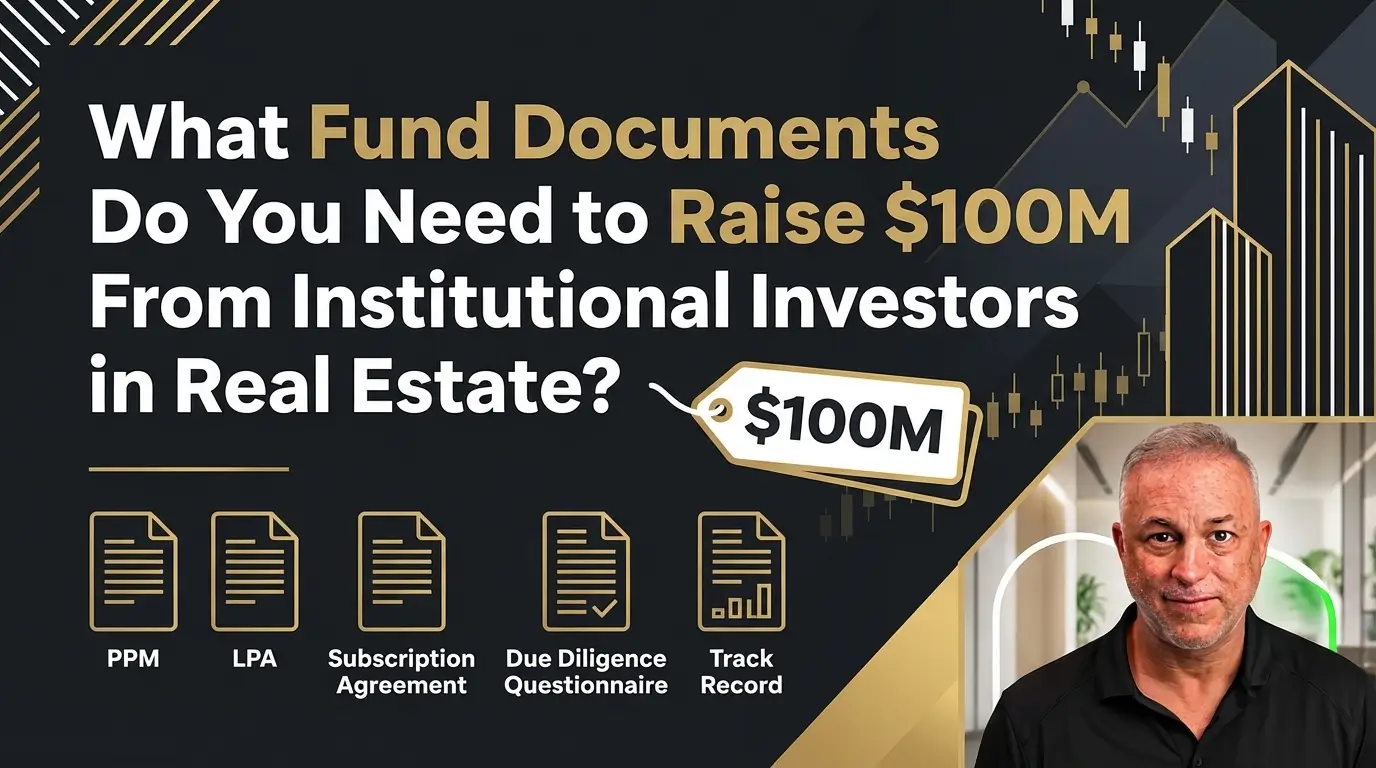
What Fund Documents Do You Need to Raise $100M From Institutional Investors in Real Estate?

How Investor Consent Rights Turn Your Cap Table Into a Governance Hostage Situation Before Series B
Disclosure
Nothing on this site constitutes an offer to sell, or a solicitation of an offer to purchase, any security under the Securities Act of 1933, as amended, or any applicable state securities laws. Any offering of securities is made only by means of a formal private placement memorandum or other authorized offering documents delivered to qualified investors.
IRC Partners is a capital advisory firm. IRC Partners is not a registered investment adviser under the Investment Advisers Act of 1940 and does not provide investment advice as defined thereunder.
Certain statements in this article may constitute forward-looking statements, including statements regarding market conditions, capital availability, investor demand, and transaction outcomes. Such statements reflect current assumptions and expectations only. Actual results may differ materially due to market conditions, regulatory developments, company-specific factors, and other variables. IRC Partners makes no representation that any outcome, return, or result described herein will be achieved.
References to prior mandates, transaction volume, network credentials, or capital raised are provided for illustrative purposes only and do not constitute a guarantee or prediction of future results. Past performance is not indicative of future outcomes. Individual results will vary. Network credentials and transaction statistics referenced on this site reflect the aggregate experience of IRC Partners' principals and affiliated advisors and are not a representation of assets managed or transactions closed solely by IRC Partners.
Certain data, statistics, and information presented in this article have been obtained from third-party sources. IRC Partners has not independently verified such information and expressly disclaims responsibility for its accuracy, completeness, or timeliness. Readers should independently verify any third-party data before relying on it.
Readers are strongly encouraged to consult qualified legal, financial, and tax professionals before making any investment, capital raising, or business decision.
Schedule A Meeting
You get one shot to raise the right way. If this raise is worth doing, it’s worth doing with precision, leverage, and control.
This isn’t a practice run. Serious capital. Serious strategy. Let’s raise it right.
We onboard a maximum of seven
new strategic partners each quarter, by application only, to maximize your chances of securing the capital you need.
