.svg "CTA Arrow")


.png "Investor Ready Capital decorative background element")

What is a first close versus final close in a real estate fund and how is each documented for institutional LPs?
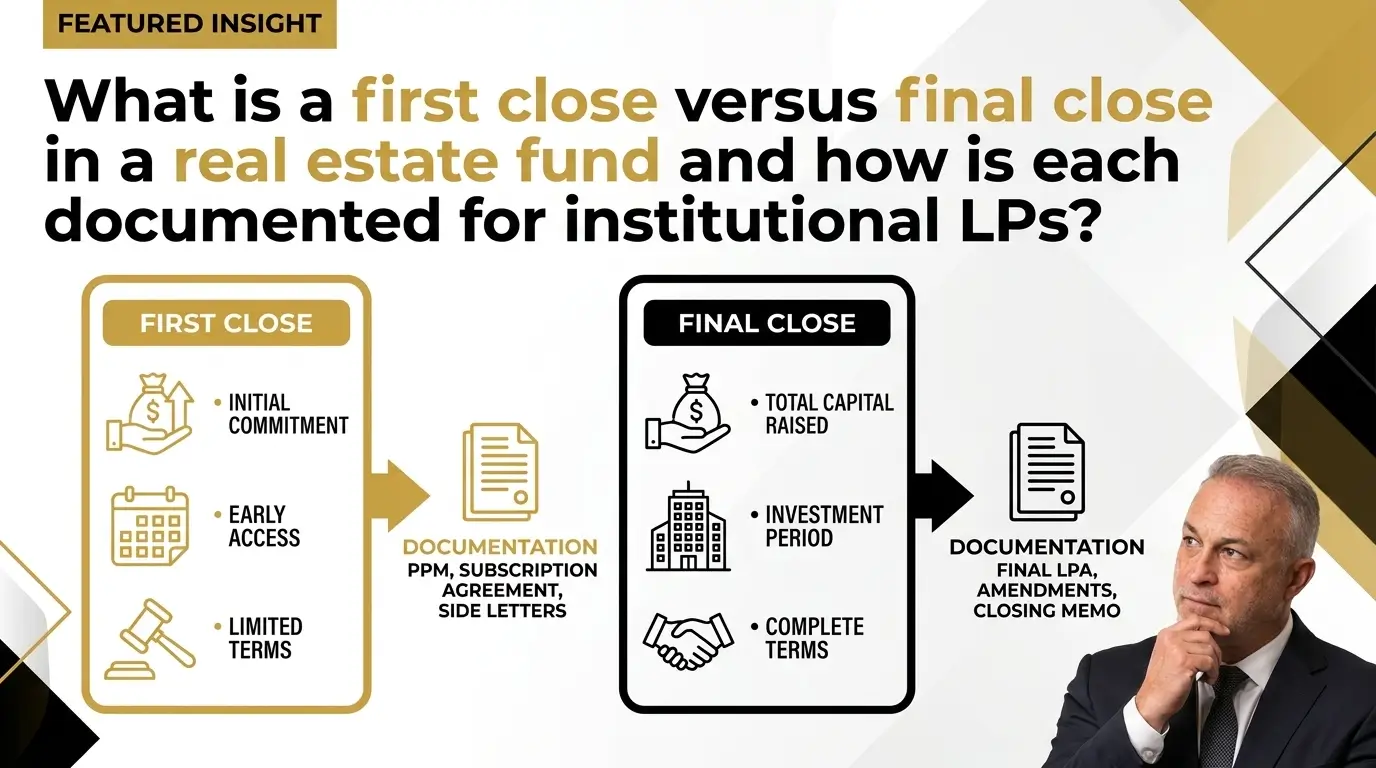
What is a first close versus final close in a real estate fund and how is each documented for institutional LPs?
A first close is the initial admission of investors once minimum commitment thresholds and launch conditions are met. A final close is the last admission point after which no new LP commitments are accepted. The fund's governing documents define both.
That is the short answer. But institutional LPs are not asking for a vocabulary lesson.
They want to know whether your close mechanics are documented precisely enough to hold up under scrutiny. Who was admitted when. What documents bound them. How the fund treats LPs who came in early versus those who came in later. Whether fees, notices, and equalization calculations are clean and consistent.
The real risk for first-time managers: bad close documentation creates LP friction faster than almost any other error in the fund document stack. It shows up immediately, because every LP admitted after the first close will ask questions about fairness, timing, and economics.
This guide covers the practical mechanics: what each close does, which documents govern it, how equalization and catch-up contributions work, what capital call notices should contain, and what first-time managers most often get wrong.
This article is a practical guide only. It is not legal or financial advice. Engage qualified fund counsel before finalizing any close mechanics or documentation.
What a First Close Actually Does
The first close is the moment the fund transitions from marketing to operation. Once it occurs, the fund can admit its initial LP cohort, begin making investments, and issue capital calls if the Limited Partnership Agreement permits.
Key point: The first close does not mean the fund is fully capitalized. It means the fund is legally open and operationally active with its founding investors.
For institutional LPs, the first close carries a signal beyond mechanics. It tells them whether the GP can execute. A clean first close with organized documentation, properly countersigned subscription packages, and a clear capital call schedule signals institutional readiness. A rushed first close with loose paperwork signals the opposite.
What the first close requires in practice:
- The LPA must be executed and the GP entity properly formed
- Each first-close LP must execute and deliver a completed subscription agreement
- The GP must formally accept each subscription and issue an admission confirmation
- Any initial capital call must follow the notice requirements in the LPA
- The fund administrator must open LP capital accounts and record commitments
ILPA Principles 3.0 recommends that the fundraising period terminate within a reasonable time after the initial close, typically within 12 months. That window shapes how long the GP has to bring in subsequent-close LPs before the final close deadline arrives.
A later LP will diligence every decision made at the first close. Get it right the first time.
What a Final Close Means, and Why It Matters to LPs
The final close ends the fundraising period. After it occurs, no new LP commitments are accepted unless the governing documents are amended or the GP seeks a formal extension with LP consent.
The table below shows how the two closes differ across the dimensions institutional LPs care about most.
The final close is also a trust moment. Institutional LPs expect that by the final close, the fund's fee mechanics are settled, all LP notices are consistent, and the equalization process for any subsequent-close investors has been completed and documented.
When a GP misses the final close deadline and needs to extend it, the extension itself is not necessarily a problem. How it is communicated is. Institutional LPs read an unexplained or poorly timed extension as a sign of weak momentum. The LPA should include explicit extension mechanics, and any extension should be communicated proactively with a clear rationale.
Which Documents Govern Each Close
Close mechanics do not live in one document. They are distributed across a hierarchy of fund documents that must be internally consistent.
The subscription agreement is the document that formally binds each LP to the fund at the close in which they are admitted. It must align with the LPA. Contradictions between the two documents create enforceability risk.
All close documents, including executed subscription packages, admission confirmations, and capital call notices, should be stored in a structured institutional data room where LPs and their counsel can access them during diligence and throughout the fund's life.
The fund administration agreement is the operational layer that governs how the administrator calculates equalization, prepares notices, and maintains LP-level records across all closes.
How Equalization Interest and Catch-Up Contributions Work
When an LP joins after the first close, they are entering a fund that has already called capital from the founding investors. That creates an imbalance. Equalization is the mechanism that corrects it.
The two-step equalization process
Step 1: Catch-up contribution. The new LP contributes their pro-rata share of all capital already called since inception. This brings them current on funding alongside the earlier LP cohort.
Step 2: Equalization interest. The new LP pays interest on the catch-up amount to compensate the earlier investors for having capital at risk first. Per ILPA Principles 3.0, this interest should be credited pro rata to the initial investors and not treated as a fund asset.
How the interest is calculated
The formula is straightforward:
Equalization interest = Catch-up amount x Annual rate x (Days between calls / 365)
Illustrative example: A subsequent-close LP has a $15M catch-up amount. The LPA specifies an 8% equalization rate. The time between the prior capital call and the new LP's admission is 150 days. The equalization interest owed is approximately $493,200.
The LPA must specify:
- The equalization interest rate (often tied to the preferred return hurdle or a fixed rate)
- The day-count convention used (Actual/365 is common)
- How multiple prior capital calls are treated separately
- Whether interim gains or distributions between closes affect the calculation
The ILPA Capital Call and Distribution Notice template includes a dedicated line item for subsequent-close interest, which helps LPs track and verify equalization payments in their own records.
Equalization is not just math. It is the mechanism that keeps your first-close investors from feeling penalized for committing early.
{{main-cta}}
Management Fees, Capital Calls, and LP Notices at Each Close
Three operational mechanics create the most LP friction when they are underdocumented: management fee commencement, capital call notice content, and existing-LP notification when new investors are admitted.
Management fee commencement
When fees begin is a document-driven question, not a market standard. Some funds start management fees at the first close on committed capital. Others start at the final close. Others use a hybrid, starting fees on each LP's commitment at the close they are admitted.
The LPA must state the commencement date explicitly. Ambiguity here creates immediate tension between early and late investors.
What a capital call notice must include
Per ILPA Capital Call and Distribution Notice Best Practices, each notice should include:
- Fund name and notice date
- LP commitment amount and percentage of total fund
- LP unfunded commitment prior to the current call
- LP cumulative contributions prior to the current call
- Current call amount and purpose
- Subsequent-close interest, if applicable
- Wire instructions and payment deadline
Standard notice periods typically run 10 to 20 business days, depending on the LPA.
Notifying existing LPs when a new investor is admitted
When a new LP is admitted at a subsequent close, existing LPs should receive notice. Their ownership percentages and future capital call allocations may change. Failing to communicate this proactively is a governance gap that institutional LPs will flag.
The fund administrator, operating under the fund administration agreement, is typically responsible for preparing and distributing these notices consistently across all LP accounts.
What First-Time Managers Get Wrong About Close Mechanics
Most first-time managers understand the concept of a first close and a final close. The mistakes happen in execution.
Underdocumenting equalization. The LPA describes equalization in general terms, and the GP assumes the administrator will handle the details. When the first subsequent-close LP arrives and asks for a calculation, there is no clear methodology to point to. That conversation erodes trust fast.
Misaligning the LPA, subscription agreement, and notices. Each document is drafted at a different time by different people. Without a cross-document review before the first close, contradictions appear: the LPA says one thing about fee commencement, the subscription agreement implies another, and the notice template does not match either.
Setting an unrealistic final close deadline. Many first-time managers set an aggressive final close date to create urgency. When they cannot meet it, they request an extension without a clear LP communication plan. Institutional LPs notice. The extension itself is manageable. The silence around it is not.
Treating close notices as back-office paperwork. Every notice an LP receives is also a data point about how the GP operates. Sloppy, inconsistent, or late notices are read as a management signal, not just an administrative failure.
For a full overview of the document stack that supports each close, see What Fund Documents Do You Need to Raise $100M From Institutional Investors in Real Estate?
Treat Close Timing as a Governance Signal
First close and final close are easy to define. They are hard to execute well without disciplined documentation.
Institutional LPs evaluate fairness, clarity, and credibility through the mechanics of admission, equalization, fees, and notices. Every LP admitted after the first close is asking the same question: was I treated the same way as the investors who came before me? Your document stack either answers that question cleanly or it does not.
Key takeaways:
- The LPA governs close mechanics. The subscription agreement formalizes each LP's admission. Both must be internally consistent.
- Equalization interest must be defined in the LPA with a rate, timing method, and multi-call methodology.
- Management fee commencement must be explicit. Ambiguity is not a neutral position.
- Capital call notices must show LP-level detail, not just fund-level totals.
- Final close extensions are manageable when communicated proactively and with clear rationale.
Work with qualified fund counsel before finalizing any close mechanics or documentation. The cost of getting this right before the first close is far lower than the cost of correcting it after an institutional LP has flagged a problem.
If you need help structuring an institutional-grade fund raise and document stack, contact IRC Partners.
Frequently Asked Questions
What is the minimum capital threshold required to hold a first close in a real estate fund?
There is no universal legal minimum. The threshold is set by the LPA and is usually tied to the GP's ability to begin making investments. In practice, many institutional funds require commitments representing a meaningful portion of the target before triggering the first close, but the exact percentage is a negotiated document term, not a regulatory floor.
Can an LP join a real estate fund after the final close?
No, not without amending the governing documents or obtaining LP consent to reopen the fund. The final close locks the investor base. Any admission after that point requires a formal process and creates new equalization and documentation obligations. Institutional LPs treat post-final-close admissions as a governance red flag if not handled transparently.
How is equalization interest different from the preferred return?
They serve different purposes. Equalization interest compensates early LPs for having capital at risk before a later LP joined. The preferred return is the minimum return threshold all LPs must receive before the GP earns carried interest. Both are defined in the LPA, but they operate on different timelines and apply to different investor groups.
Does management fee commencement have to be the same for all LPs?
Not necessarily. Some LPAs use a tiered or hybrid approach where fees begin on each LP's committed capital at the close in which they are admitted. Others start fees for all LPs at the final close. The key is that the LPA must state the approach clearly. Inconsistent fee start dates across the LP base without explicit documentation create disputes.
What happens if a GP needs to extend the final close deadline?
Most LPAs include an extension provision that allows the GP to extend the final close deadline, often by 6 to 12 months, subject to LP consent or GP election depending on the document terms. The extension itself is manageable. What damages LP confidence is a silent extension or one communicated without a clear rationale. Proactive, documented communication is the standard institutional LPs expect.
Are capital call notices required at each close, or only when capital is actually drawn?
Capital call notices are issued when capital is actually being drawn, not automatically at each close. However, when a subsequent-close LP is admitted and must make a catch-up contribution to match earlier capital calls, that contribution is typically structured as a capital call notice that includes both the catch-up amount and any equalization interest owed.
What role does the fund administrator play in managing close mechanics?
The fund administrator is the operational layer responsible for calculating equalization interest, preparing capital call notices, maintaining LP-level capital accounts, and distributing close documentation. The scope of these responsibilities is defined in the fund administration agreement. Institutional LPs increasingly expect the administrator to provide individualized LP-level reporting, not just fund-level summaries, across all closes.
Continue reading this series:
- What Goes Into a Private Placement Memorandum for a Real Estate Closed-End Fund
- What KYC and AML Documents Do Institutional LPs Need
- How to Present Management Fees and Carried Interest in a Real Estate Fund Terms Sheet
This isn't for pre-revenue companies or first-time founders. It's for operators at $1M+ ARR, raising $5M to $250M of institutional capital, who've done this before and want the next round architected right. If that's you, schedule a call to discuss HERE.
Sponsors weighing this decision should first complete a capital raise readiness assessment for sponsors to confirm the raise is investor-ready.
Need guidance on your capital raise?


Your Series A Investors Have Rights That Block the Series B Lead You Want

You Raised Three SAFEs. Here's How They're About to Detonate at Your Series B

How to Use a Competing Offer Window to Protect Shareholder Value When a Drag-Along Is Triggered
Disclosure
Nothing on this site constitutes an offer to sell, or a solicitation of an offer to purchase, any security under the Securities Act of 1933, as amended, or any applicable state securities laws. Any offering of securities is made only by means of a formal private placement memorandum or other authorized offering documents delivered to qualified investors.
IRC Partners is a capital advisory firm. IRC Partners is not a registered investment adviser under the Investment Advisers Act of 1940 and does not provide investment advice as defined thereunder.
Certain statements in this article may constitute forward-looking statements, including statements regarding market conditions, capital availability, investor demand, and transaction outcomes. Such statements reflect current assumptions and expectations only. Actual results may differ materially due to market conditions, regulatory developments, company-specific factors, and other variables. IRC Partners makes no representation that any outcome, return, or result described herein will be achieved.
References to prior mandates, transaction volume, network credentials, or capital raised are provided for illustrative purposes only and do not constitute a guarantee or prediction of future results. Past performance is not indicative of future outcomes. Individual results will vary. Network credentials and transaction statistics referenced on this site reflect the aggregate experience of IRC Partners' principals and affiliated advisors and are not a representation of assets managed or transactions closed solely by IRC Partners.
Certain data, statistics, and information presented in this article have been obtained from third-party sources. IRC Partners has not independently verified such information and expressly disclaims responsibility for its accuracy, completeness, or timeliness. Readers should independently verify any third-party data before relying on it.
Readers are strongly encouraged to consult qualified legal, financial, and tax professionals before making any investment, capital raising, or business decision.
Schedule A Meeting
You get one shot to raise the right way. If this raise is worth doing, it’s worth doing with precision, leverage, and control.
This isn’t a practice run. Serious capital. Serious strategy. Let’s raise it right.
We onboard a maximum of seven
new strategic partners each quarter, by application only, to maximize your chances of securing the capital you need.
