.svg "CTA Arrow")


.png "Investor Ready Capital decorative background element")

The Offshore Entity Problem: How Holding Companies, Cayman Structures, and Offshore Cap Table Layers Block US Institutional Series B Investment

The Offshore Entity Problem: How Holding Companies, Cayman Structures, and Offshore Cap Table Layers Block US Institutional Series B Investment
When a Cayman Islands holding company, BVI entity, or any foreign parent sits above your U.S. operating company, U.S. institutional Series B investors face structural problems that go far beyond standard paperwork. These cross-border arrangements can trigger intensive national security reviews under the Committee on Foreign Investment in the United States (CFIUS), expose tax-exempt limited partners to unwanted unrelated business taxable income (UBTI), create complex sanctions and beneficial-ownership diligence friction, and directly conflict with fund mandates prohibiting foreign entity investments. Because a lead investor discovering an undisclosed offshore layer mid-diligence will typically withdraw rather than wait to resolve it, founders must proactively treat cap table cleanups as a vital element of their pre-marketing preparation. Executing a security-by-security reorganization 6 to 12 months before launching a raise ensures a clean, investable Delaware structure that satisfies institutional standards and maintains critical fundraising momentum.
Key takeaways:
- CFIUS looks through intermediary entities to assess ultimate foreign ownership and control, regardless of whether the investable entity is a U.S. company
- Tax-exempt LPs in institutional funds face UBTI exposure from certain cross-border structures, which can make a fund structurally unwilling to invest
- Fund mandate documents often prohibit investment into non-U.S. entities, even when the operating business is U.S.-based
- Sanctions and FCPA diligence burdens increase sharply when offshore layers, nominee arrangements, or undisclosed foreign beneficial ownership are present
- A reorganization done 6-12 months before outreach is manageable; the same reorganization done mid-process is a deal-killer
This article is part of the series on cap table issues that kill a Series B before the lead investor reads your deck.
Why U.S. Institutional Series B Investors Cannot Invest Into Offshore Structures
There are four distinct reasons a U.S. institutional fund may be legally or structurally unable to invest when a foreign entity sits in the ownership chain. Each one operates independently. A company does not need to trigger all four to lose the lead.
The Offshore Structures That Create the Problem
Founders build offshore holding structures for legitimate reasons: early foreign investor accommodation, tax planning, or international operations. The problem is not the original intent. The problem is what the structure looks like to a U.S. institutional fund at Series B.
Understanding which structure you have is the first step. Each one requires a different reorganization path, and the documentation requirements are not identical. Founders who understand how capital structures affect investor expectations before approaching a Series B are far better positioned to address these questions before they become deal-killers.
What a Reorganization Actually Involves at the Cap Table Level
A reorganization is not a single filing. It is a security-by-security, entity-by-entity process that touches every layer of the ownership chain. Here is what it typically involves.
The five-step reorganization sequence
- Map the full ownership structure. Document every entity in the chain, every beneficial owner behind each entity, every side letter, nominee arrangement, and informal governance agreement. Nothing can be cleaned up that has not been found first.
- Collapse the offshore holding layer. The offshore entity is typically merged into, or its interests are exchanged into, the U.S. operating entity or a clean U.S. parent. This requires board and stockholder approvals at every level, updated charter documents, and a new or restated cap table that reflects direct U.S. ownership.
- Convert foreign-held interests into U.S.-compliant securities. Each foreign investor's interest must be exchanged into shares of the U.S. entity on documented terms. This requires new subscription agreements, updated stock ledgers, and investor consent documents aligned with NVCA model document standards for institutional venture financings.
- Resolve CFIUS filing and mitigation questions. If the business operates in a TID sector or if any foreign government has held a 25% or greater indirect interest, CFIUS counsel must assess whether a voluntary notice is appropriate. Filing before the raise removes the uncertainty. Leaving it unresolved does not.
- Prepare the reorganization summary for the data room. The data room must explain the old structure, why it was changed, what was exchanged and on what terms, and whether any residual foreign governance rights remain. Investors will ask. A prepared memo is far better than a discovery conversation.
Structure-by-structure treatment
Founders who are also working through debt and equity structure decisions as part of Series B preparation should complete the entity reorganization first. A clean cap table in a clean entity is the prerequisite for every other financing decision.
The offshore entity problem compounds quickly when other structural issues exist in the same cap table. How stacked SAFEs and convertible notes silently destroy your Series B cap table explains how instrument-level dilution problems layer on top of entity-level problems to make a round structurally unfundable. And how investors use pre-money option pool mechanics to quietly dilute founders before the round closes is the third structural lever that gets pulled at Series B, often before the first partner meeting.
Where the Offshore Structure Creates Diligence Risk at Series B
The offshore structure does not just slow down diligence. It creates specific risk zones that can end the process at any point after the first conversation.
- Background screening. Institutional investors run background checks on all significant owners before or during diligence. Undisclosed foreign beneficial ownership surfaces here. Even if no CFIUS filing is ultimately required, discovering that a founder did not disclose a foreign ownership layer damages credibility in a way that is very hard to recover from.
- Fund counsel review. Most funds require legal sign-off before issuing a term sheet. If fund counsel identifies a mandate conflict or a structure that requires CFIUS analysis, the investment committee process stops until that question is resolved. The investment team may remain interested. Fund counsel may still say no.
- LP-level tax review. A fund with significant endowment or pension LP exposure will have its own counsel assess UBTI risk. If the structure creates avoidable complexity at the LP level, the fund's economics change in ways that make the investment unattractive regardless of the business quality.
- Document-level conflicts. Side agreements, nominee arrangements, or competing equity claims that surface during document review are treated as major red flags. They suggest the cap table presented to investors is not the actual cap table.
"CFIUS assesses the ultimate foreign beneficial owner and control, regardless of intermediary jurisdictions." — U.S. Department of the Treasury, CFIUS Laws and Guidance
The part most coverage misses: fund counsel's concern is not always about the legal risk to the fund. It is often about the signal the structure sends about how the company was built and managed.
The Timing Problem: Why Restructuring Mid-Process Is Worse Than Restructuring Early
The hard truth: a reorganization that takes three months before the raise takes six months during it, and it often takes the lead investor with it.
When a restructuring surfaces mid-process, it does not just add time. It changes the nature of the process entirely.
- Diligence scope expands. Every document produced during the reorganization becomes a new diligence item. The investor is now reviewing both the business and the restructuring, simultaneously.
- Legal costs multiply. The company is paying restructuring counsel and financing counsel at the same time, often with overlapping questions and competing timelines.
- Investor confidence drops. The lead investor's internal question shifts from "is this a great business?" to "why wasn't this clean before they came to market?" That question is difficult to answer in a way that restores full confidence.
- CFIUS uncertainty compounds. If a voluntary CFIUS notice becomes appropriate, the 30-day review period (and potential 45-day investigation period) cannot be compressed. A live financing timeline cannot absorb that uncertainty.
The right approach is to treat the reorganization as part of Series B preparation, not as a response to investor feedback. The process for raising institutional capital in 2026 rewards founders who arrive at market with a clean, investable structure already in place.
What to Complete Before You Go to Market
Start the offshore restructuring at least 12 months before launching a Series B process. Here is the pre-raise checklist.
- Collapse offshore layers. The data room must reflect the final investable structure, not a structure you are still working through. Investors do not underwrite a company in transition.
- Document all foreign beneficial ownership. Every natural person with 25% or greater indirect ownership must be identified, documented, and cleared through OFAC sanctions screening. Side agreements, nominee arrangements, and informal governance rights must be reconciled and disclosed.
- Get CFIUS counsel review. If the business involves critical technology, critical infrastructure, or sensitive personal data of U.S. citizens, or if any foreign government has held a substantial indirect interest, CFIUS counsel must assess whether a voluntary notice is appropriate before the raise begins.
- Confirm LP mandate eligibility. Review the investment mandate of your likely lead investor candidates. If their fund documents restrict investment to U.S.-organized entities, the final structure must satisfy that requirement before outreach begins.
- Prepare a reorganization summary for the data room. The memo should describe the prior structure, the reason for the change, what was exchanged and on what terms, and whether any residual foreign rights remain. This document prevents the reorganization from becoming a surprise discovery during diligence.
- Verify the cap table reflects the post-reorganization structure. The cap table in the data room must match the corporate records, the stock ledger, and the charter. Any gap between these documents is a diligence problem.
Understanding how Series A valuations are calculated and what institutional investors look for is relevant context here. Investors at Series B apply the same structural scrutiny, and a clean entity structure is a prerequisite for that conversation.
{{main-cta}}
Frequently Asked Questions
Can a company with a Cayman holdco raise a U.S. Series B without restructuring?
In most cases, no. A Cayman holding company sitting above a U.S. operating entity creates CFIUS exposure, potential fund mandate conflicts, and beneficial-ownership diligence requirements that U.S. institutional funds cannot resolve mid-process. Some funds may engage if the Cayman layer holds no foreign-government-linked ownership and the business is outside TID sectors, but this is the exception and requires advance legal analysis, not a discovery conversation during diligence.
What does CFIUS review actually mean for a startup?
CFIUS is the U.S. government committee that reviews foreign investment in U.S. businesses for national security implications. Under FIRRMA, it covers foreign control of any U.S. business and certain non-controlling investments in TID sectors. For startups, CFIUS review means a formal notice process with a 30-day initial review period and a potential 45-day investigation period. CFIUS can require mitigation agreements, impose conditions, or block transactions. Investors cannot close a financing round with an unresolved CFIUS review.
How long does a typical offshore reorganization take?
A straightforward reorganization, collapsing a single Cayman or BVI layer into a clean U.S. entity, typically takes 3-6 months when started with adequate runway. Complex structures involving multiple offshore entities, foreign government-linked investors, or nominee arrangements can take 9-12 months or longer. This is why the 12-month pre-raise timeline matters. Starting after investor conversations begin is almost always too late.
What happens to foreign investor equity during the restructuring?
Foreign investor equity is exchanged into shares of the U.S. entity on negotiated terms. The exchange ratio, share class, and investor rights must be documented in new subscription agreements and reflected in the updated cap table and stock ledger. Foreign investors must consent to the exchange. If any foreign investor refuses, the restructuring cannot be completed and the Series B process cannot proceed on a clean basis.
Can UBTI risk be mitigated without a full restructuring?
In some cases, fund managers use parallel fund structures or offshore feeder vehicles to block UBTI at the fund level rather than requiring a company-level restructuring. However, this approach depends entirely on the fund's architecture and its LP composition. It is not a solution the company controls. If the lead fund does not have an offshore feeder or a UBTI blocker structure in place, the company's offshore layer remains a problem regardless of what the company would prefer.
What is a nominee arrangement and why does it surface in diligence?
A nominee arrangement is a structure in which a person or entity holds equity or governance rights on behalf of another party whose identity is not disclosed in the corporate records. Nominee arrangements are common in certain offshore jurisdictions. They surface in diligence because institutional investors require complete beneficial ownership transparency. A nominee arrangement that is not disclosed before diligence begins is treated as a material misrepresentation, not a technical issue.
Can a company with a foreign parent entity raise a U.S. Series B at all?
It depends on the nature of the foreign parent's control and the sector the company operates in. A foreign parent with majority control of a U.S. business in a TID sector faces the highest CFIUS exposure and is the hardest to resolve. A foreign parent with a minority, non-controlling interest in a U.S. business outside TID sectors may be manageable with proper documentation and CFIUS counsel review. In all cases, the foreign parent's involvement must be fully disclosed before investor outreach begins, and the company must obtain legal analysis of the CFIUS question before approaching a lead.
Continue reading this series:
- How to Value a Startup: Complete Valuation Guide for Founders (2026)
- How to Get Ahead of 99% of Startups in Seed Rounds
- If I Started Raising Capital in 2026, I Would Do This
*Most founders don't lose the raise because of the pitch. They lose it because the structure was wrong before the first investor call. IRC Partners advises founders raising $5M to $250M of institutional capital. 7 strategic partners per quarter. Start here to schedule a call with our team.
Sponsors weighing this decision should first complete a capital raise readiness assessment for sponsors to confirm the raise is investor-ready.
Need guidance on your capital raise?


Quarterly vs Annual Reporting: Negotiate for $10M+ Growth Rounds

Pitch Deck Audit: The Slides Institutional Investors Use to Disqualify You First
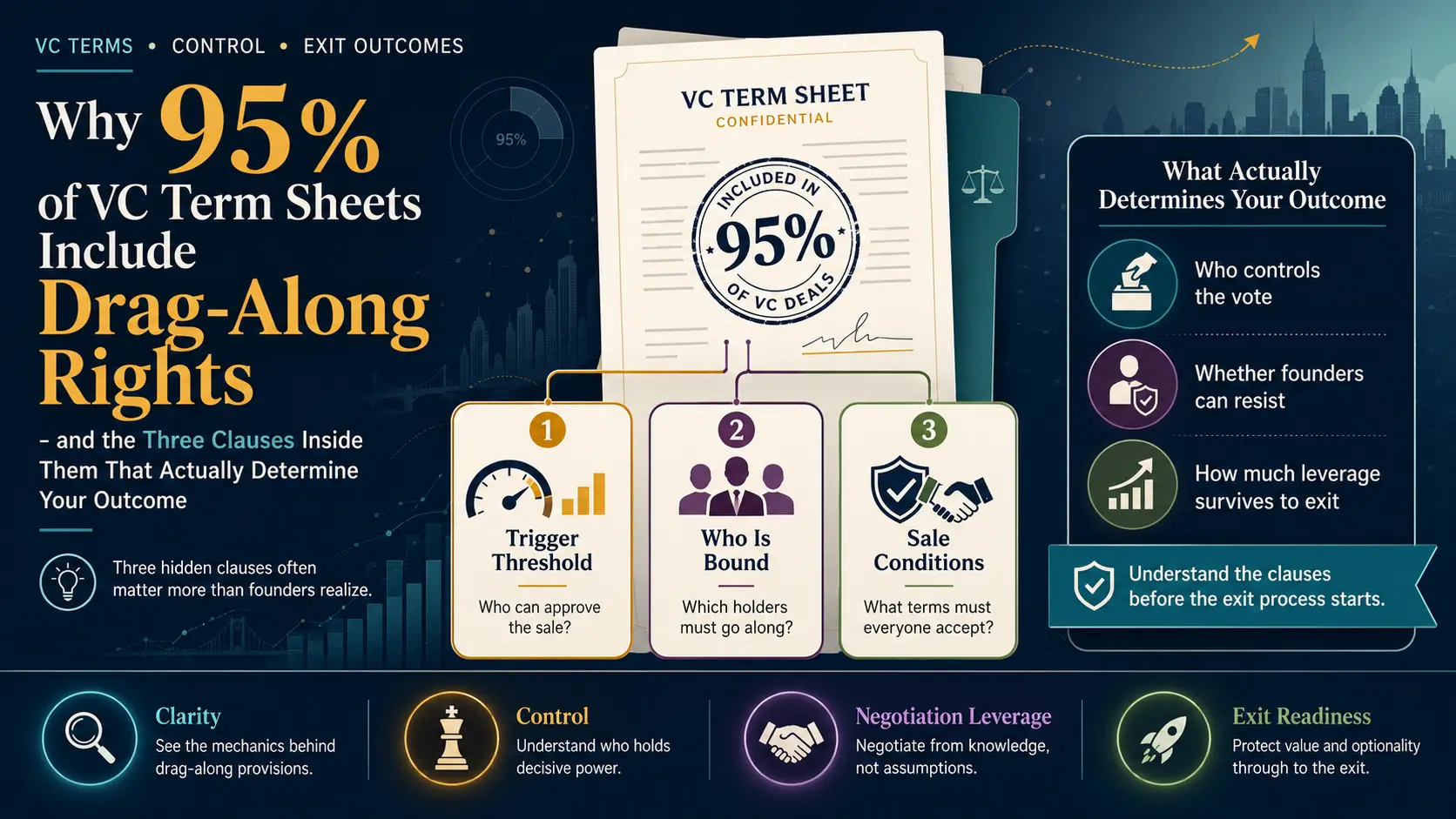
Why 95% of VC Term Sheets Include Drag-Along Rights - and the Three Clauses Inside Them That Actually Determine Your Outcome
Disclosure
Nothing on this site constitutes an offer to sell, or a solicitation of an offer to purchase, any security under the Securities Act of 1933, as amended, or any applicable state securities laws. Any offering of securities is made only by means of a formal private placement memorandum or other authorized offering documents delivered to qualified investors.
IRC Partners is a capital advisory firm. IRC Partners is not a registered investment adviser under the Investment Advisers Act of 1940 and does not provide investment advice as defined thereunder.
Certain statements in this article may constitute forward-looking statements, including statements regarding market conditions, capital availability, investor demand, and transaction outcomes. Such statements reflect current assumptions and expectations only. Actual results may differ materially due to market conditions, regulatory developments, company-specific factors, and other variables. IRC Partners makes no representation that any outcome, return, or result described herein will be achieved.
References to prior mandates, transaction volume, network credentials, or capital raised are provided for illustrative purposes only and do not constitute a guarantee or prediction of future results. Past performance is not indicative of future outcomes. Individual results will vary. Network credentials and transaction statistics referenced on this site reflect the aggregate experience of IRC Partners' principals and affiliated advisors and are not a representation of assets managed or transactions closed solely by IRC Partners.
Certain data, statistics, and information presented in this article have been obtained from third-party sources. IRC Partners has not independently verified such information and expressly disclaims responsibility for its accuracy, completeness, or timeliness. Readers should independently verify any third-party data before relying on it.
Readers are strongly encouraged to consult qualified legal, financial, and tax professionals before making any investment, capital raising, or business decision.
Schedule A Meeting
You get one shot to raise the right way. If this raise is worth doing, it’s worth doing with precision, leverage, and control.
This isn’t a practice run. Serious capital. Serious strategy. Let’s raise it right.
We onboard a maximum of seven
new strategic partners each quarter, by application only, to maximize your chances of securing the capital you need.
