.svg "CTA Arrow")


.png "Investor Ready Capital decorative background element")

Negotiate Lighter Reporting for Growth-Stage Sponsors Raising $10M+
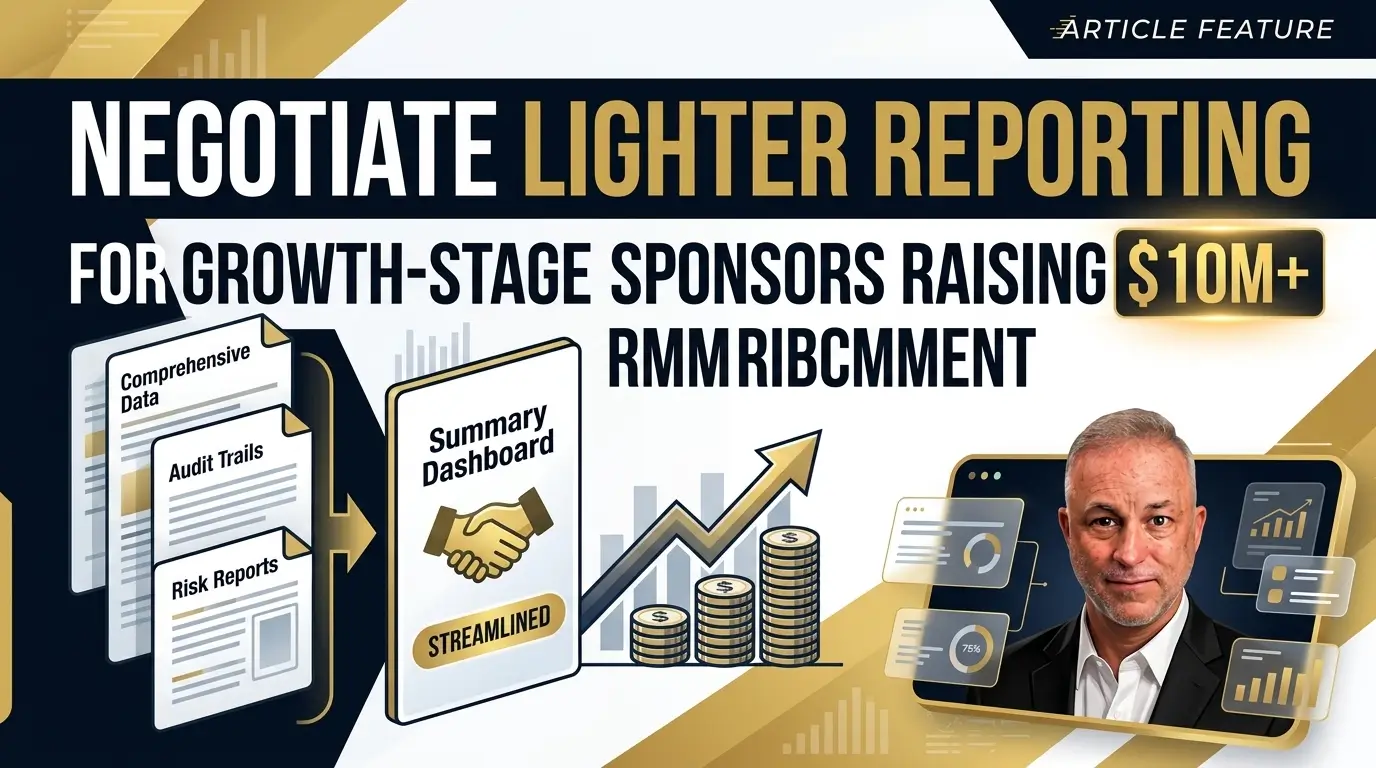
Growth-stage sponsors raising $10M+ can successfully negotiate lighter reporting obligations before signing definitive documents without undermining investor confidence. The key to this process is reframing the conversation entirely around quality, stage appropriateness, and decision-useful disclosure rather than simply trying to reduce workload for its own sake. Most institutional investors initially circulate broad, boilerplate templates that are not designed specifically for your deal size or your finance team's existing operational capacity. By actively auditing the document stack early and anchoring counter-proposals to recognized market benchmarks—such as the October 2025 NVCA Model Legal Documents baseline—sponsors can secure fewer, higher-quality reporting requirements that protect team bandwidth while still providing investors with full visibility into core deal economics.
Most investors start from a broad template. That template was not designed specifically for your deal, your stage, or your finance team's capacity. Negotiating information rights and reporting obligations with institutional investors is a standard part of the pre-signing process, and lighter terms are more common than sponsors assume when the request is framed correctly.
Before accepting a reporting package at face value, sponsors should understand what is actually driving investor confidence. According to the Center for Audit Quality's 2025 Institutional Investor Survey, 91% of institutional investors identify audited financial statements as their primary information source, and 96% say current reporting already gives them what they need.
Key takeaways for growth-stage sponsors:
- Investors often circulate broad reporting templates as a starting point, not a final position
- A lighter package remains institutional-grade when it is reliable, scoped, and tied to investor decisions
- Stage and deal size are legitimate calibration anchors, not excuses
- The goal is fewer but better reports, not fewer reports with less visibility
What Makes a Reporting Package Too Heavy for a Growth-Stage Sponsor?
A reporting package becomes too heavy when it requires the sponsor to build new systems, produce custom dashboards, or generate recurring narrative output that does not already exist in the normal course of operations. The headline cadence (monthly, quarterly, annual) is rarely the real problem. The weight usually hides in the details.
Heavy obligations tend to cluster in three places: bespoke KPI schedules that require new data infrastructure, recurring narrative memo requirements that function as standing management updates, and broad ad hoc request clauses with no defined scope, frequency, or trigger. These terms can add more operating burden than the headline reporting cadence combined.
The right test for any reporting line item is whether it materially improves investor visibility into economics, risk, or variance. If the answer is no, it is administrative drag rather than decision-useful disclosure.
Sponsors should also watch for reporting terms that function more like management rights than information rights. An obligation to produce custom analysis on request, or to prepare bespoke projections on investor demand, effectively expands oversight expectations without labeling itself as oversight.
How to Frame the Ask So "Lighter" Sounds Stronger, Not Weaker
The framing of the request matters as much as the substance. Sponsors who lead with "we want less reporting" invite skepticism. Sponsors who lead with "we want reliable, consistent reporting scoped to what investors actually use" are making a quality argument, not a convenience argument.
Understanding which term sheet clauses carry the most long-term operating risk is part of the same discipline. Reporting obligations can look routine in a term sheet and become significant obligations after close. The negotiation framing you use before signing sets the tone for how those obligations are interpreted and enforced.
Four framing moves that work in practice:
- Anchor to stage and deal size. The NVCA Model Legal Documents guidance is explicit that reporting obligations should be appropriate for company stage and deal size. A growth-stage sponsor raising $10M+ is not a publicly traded platform. The reporting package should reflect that.
- Offer a scoped alternative, not just an objection. Come to the conversation with a counter-package that preserves core economics reporting, key variance commentary, and exception triggers. Investors respond better to a credible alternative than to a redline with no substitute.
- Lead with reliability. A lighter package that the sponsor can actually deliver on time, every quarter, builds more trust than a heavy package that produces inconsistent or delayed output.
- Separate recurring obligations from ad hoc rights. Investors often need ad hoc access in specific circumstances. Narrowing ad hoc requests by trigger and topic is easier to negotiate than eliminating them, and it gives investors the protection they actually want.
Where to Lighten the Package Without Undermining Visibility
Once the framing is right, sponsors can work through the package line by line and identify where lighter alternatives preserve investor visibility without adding operating strain.
The NVCA Model Legal Documents (October 2025 update) set a useful calibration point: quarterly unaudited financials within 45 days, annual audited financials within 120 days, monthly financials only upon request, and no obligation to create new information beyond what is reasonably maintained. That is the institutional baseline. Many sponsors are being asked for more.
For a deeper look at how these obligations interact with broader investor-access questions, limiting VC and institutional investor access to sensitive data before signing covers the related access-control dimension that often travels alongside reporting terms.
Sponsors raising capital through advisors who understand how securing better information-rights terms in growth capital raises works in practice will find it easier to present a scoped alternative as a commercial standard rather than a one-off request.
How to Make Sure Lighter Terms Survive the Final Document Set
Verbal agreement on lighter reporting is not enough. Reporting obligations can re-expand in side letters, annexes, defined terms, and diligence request lists that sponsors review separately from the main agreement. A clean main clause does not guarantee a clean final package.
The SEC's 2026 materiality guidance reinforces this point: disclosures should be decision-useful and tied to investor economics, not broad administrative production. That principle supports a sponsor's position during document review, but only if the sponsor reviews the full document set before signing.
Sponsors should also review how pushing back on broad investor reporting clauses before close works in practice, particularly when late-stage document changes reintroduce obligations that were already negotiated down.
Pre-sign document checklist:
- Confirm the reporting schedule is captured in one place with cadence, content, timing, and carve-outs listed explicitly
- Check side letters and annexes for obligations that expand on the main clause
- Look for defined terms that broaden what counts as required reporting
- Identify any obligation to create new information beyond what is reasonably maintained
- Confirm ad hoc request rights have defined scope, trigger, and frequency limits
{{main-cta}}
How One Growth-Stage Sponsor Narrowed a Heavy Reporting Package Before Signing
A growth-stage multifamily sponsor raising a $10M+ round received an investor reporting package that included monthly full financial packs on a fixed schedule, a bespoke KPI dashboard requiring new data infrastructure, recurring quarterly narrative memos, and broad ad hoc request rights with no defined scope or frequency.
Before signing, the sponsor reframed the conversation around three points: the finance team's existing reporting systems, what information investors actually needed to monitor economics and material risk, and the NVCA baseline for a deal of this stage and size.
The package was narrowed to quarterly unaudited financials within 45 days, annual audited financials within 120 days, variance commentary limited to material items, existing internal KPIs shared quarterly, and ad hoc requests scoped by topic and trigger. Monthly financials were available on request rather than recurring.
The negotiation remained commercial throughout. The close stayed on track. The sponsor entered the post-close period with a reporting package the finance team could actually sustain.
The difference between that outcome and accepting the original package was not legal sophistication. It was knowing which terms to challenge, how to frame the challenge, and doing it before the document stack hardened.
What to Do Before Documents Harden
The best time to negotiate a lighter reporting package is before legal language gets baked into the final document stack. Once terms are embedded across a main agreement, side letters, and defined-term schedules, changing them becomes a late-stage concession rather than a commercial conversation.
A short self-audit before that point:
- Does each reporting obligation map to a decision investors actually need to make?
- Does the package require new systems or data infrastructure the sponsor does not already maintain?
- Are ad hoc request rights defined by scope, trigger, and frequency, or left open?
- Have side letters and annexes been reviewed for obligations that expand the main clause?
- Is the full reporting schedule captured in one place before signing?
If any of those answers is unclear, the package has not been scoped correctly yet.
IRC Partners works with growth-stage sponsors before documents harden to structure reporting obligations that are reliable, stage-appropriate, and defensible to institutional investors. Getting the scope right before signing is easier than renegotiating it after close.
Frequently Asked Questions
How does a growth-stage sponsor justify lighter reporting without sounding like they are hiding risk?
The strongest justification is quality, not convenience. Sponsors should explain that a lighter package tied to existing systems will produce consistent, on-time output rather than delayed or incomplete reporting from an overbuilt obligation. Investors are more concerned about reliability than volume. A package the sponsor can sustain every quarter is a stronger signal than a heavy package that breaks down after close.
What is the difference between information rights and management rights in a reporting context?
Information rights give investors visibility into economics, risk, and material events. Management rights effectively give investors a role in how the sponsor operates. Reporting terms cross into management-rights territory when they require the sponsor to produce custom analysis on investor demand, prepare bespoke projections outside normal operations, or provide recurring narrative updates that function as standing operational oversight. Sponsors should identify and narrow those terms specifically.
How do you reduce ongoing reporting load without triggering investor concern mid-negotiation?
Introduce the lighter package as a scoped alternative, not a reduction. Present it alongside the original ask with a clear explanation of what each item provides, what it costs to produce, and whether it maps to a decision investors actually need to make. Investors respond better to a counter-package with reasoning than to a redline with no substitute. Framing it as a quality and scope conversation keeps the negotiation commercial.
Can a sponsor push back on bespoke KPI and narrative memo requests without losing credibility?
Yes, and the NVCA Model Legal Documents support that position. The October 2025 update confirms there is no obligation to create new information beyond what is reasonably maintained. Sponsors can narrow bespoke KPI requests to metrics already tracked internally, tied to investor economics, and shared on a defined schedule. Narrative memo obligations can be replaced with exception reporting triggered by material events rather than a standing recurring requirement.
What should a sponsor say when an investor claims their reporting template is "standard"?
Ask which deal stage and size the template was designed for. Most institutional reporting templates originate from larger, more mature platforms with dedicated finance teams. The NVCA guidance is explicit that obligations should be appropriate for company stage and deal size. A growth-stage sponsor raising $10M+ is not the same as a $500M platform. Stage appropriateness is a recognized calibration standard, not a negotiating tactic.
How do sponsors confirm lighter reporting obligations actually hold across side letters and annexes before signing?
Review every document in the final stack, not just the main agreement. Side letters, annexes, diligence request lists, and defined-term schedules can each introduce or expand reporting obligations independently. Sponsors should confirm that the reporting schedule is captured in one consolidated place, that no document in the stack creates an obligation to produce new information beyond what is reasonably maintained, and that ad hoc request rights are scoped consistently across all documents.
At what point in the process is it too late to negotiate lighter reporting terms?
It is rarely impossible, but it becomes significantly harder once the main agreement is in final form and side letters are being circulated. At that stage, requesting changes to reporting obligations reads as a late concession rather than a commercial conversation. The practical window is during term sheet review and early document negotiation, before legal language is baked into multiple documents and the investor's legal team has marked up the final draft.
Continue reading this series:
- How to negotiate information rights and reporting obligations with institutional investors before signing
- Top negotiation tactics for VC information rights before signing
- How sponsors push back on heavy VC reporting requirements before signing
Most founders don't lose the raise because of the pitch. They lose it because the structure was wrong before the first investor call. IRC Partners advises founders raising $5M to $250M of institutional capital. 7 strategic partners per quarter. Start here to schedule a call with our team.
Sponsors weighing this decision should first complete a capital raise readiness assessment for sponsors to confirm the raise is investor-ready.
Need guidance on your capital raise?


Side Letters and Side Agreements: How Quiet Investor Accommodations Become Series B Diligence Landmines

What SAFE Note Legal and Structuring Work Costs

When Does a Company Need Capital Raising From Sovereign Wealth and Pension Funds?
Disclosure
Nothing on this site constitutes an offer to sell, or a solicitation of an offer to purchase, any security under the Securities Act of 1933, as amended, or any applicable state securities laws. Any offering of securities is made only by means of a formal private placement memorandum or other authorized offering documents delivered to qualified investors.
IRC Partners is a capital advisory firm. IRC Partners is not a registered investment adviser under the Investment Advisers Act of 1940 and does not provide investment advice as defined thereunder.
Certain statements in this article may constitute forward-looking statements, including statements regarding market conditions, capital availability, investor demand, and transaction outcomes. Such statements reflect current assumptions and expectations only. Actual results may differ materially due to market conditions, regulatory developments, company-specific factors, and other variables. IRC Partners makes no representation that any outcome, return, or result described herein will be achieved.
References to prior mandates, transaction volume, network credentials, or capital raised are provided for illustrative purposes only and do not constitute a guarantee or prediction of future results. Past performance is not indicative of future outcomes. Individual results will vary. Network credentials and transaction statistics referenced on this site reflect the aggregate experience of IRC Partners' principals and affiliated advisors and are not a representation of assets managed or transactions closed solely by IRC Partners.
Certain data, statistics, and information presented in this article have been obtained from third-party sources. IRC Partners has not independently verified such information and expressly disclaims responsibility for its accuracy, completeness, or timeliness. Readers should independently verify any third-party data before relying on it.
Readers are strongly encouraged to consult qualified legal, financial, and tax professionals before making any investment, capital raising, or business decision.
Schedule A Meeting
You get one shot to raise the right way. If this raise is worth doing, it’s worth doing with precision, leverage, and control.
This isn’t a practice run. Serious capital. Serious strategy. Let’s raise it right.
We onboard a maximum of seven
new strategic partners each quarter, by application only, to maximize your chances of securing the capital you need.
