.svg "CTA Arrow")


.png "Investor Ready Capital decorative background element")

What Fund Administration Agreements Do Institutional LPs Require Before Committing to a Real Estate Fund?
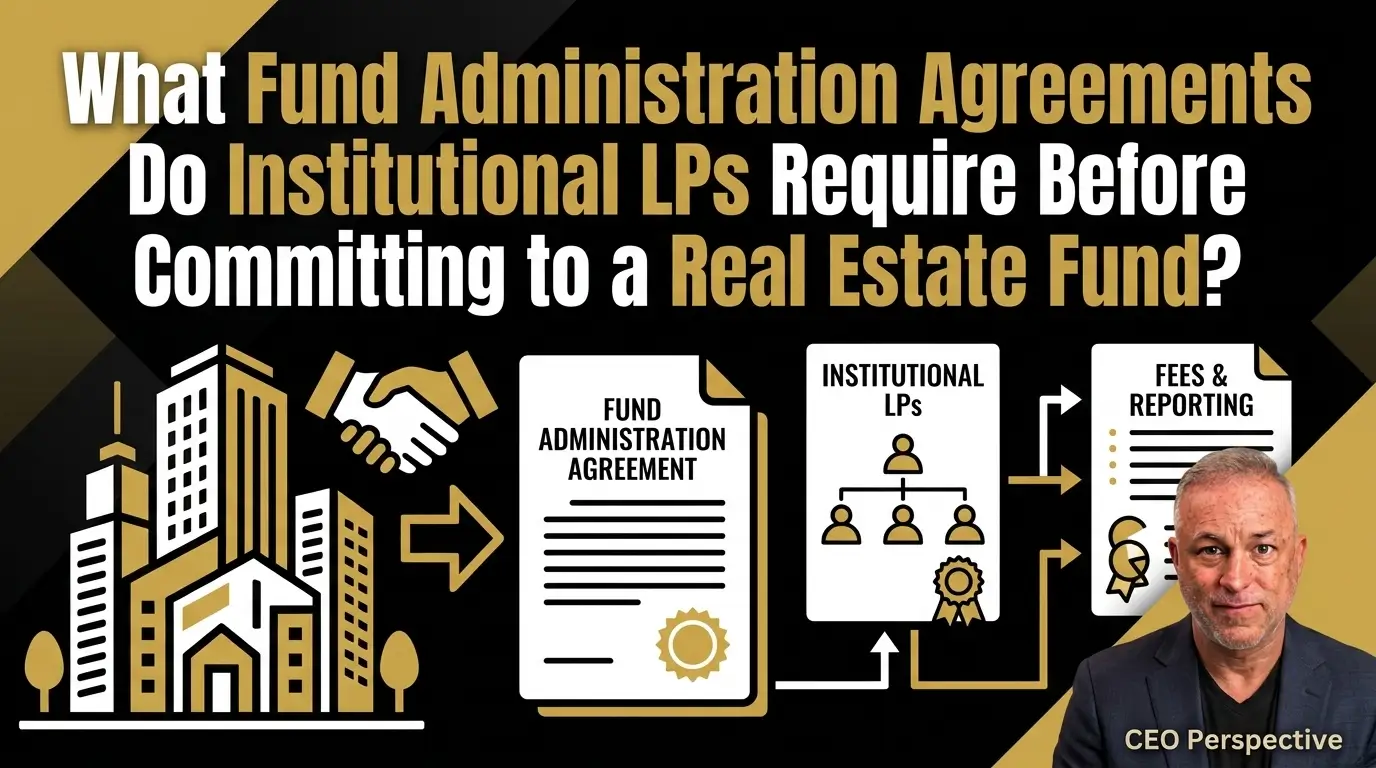
What Fund Administration Agreements Do Institutional LPs Require Before Committing to a Real Estate Fund?
Before a pension fund, endowment, or institutional family office commits capital to a real estate closed-end fund, they will check whether a credible, independent fund administrator is already in place. Not promised. Not being evaluated. Already engaged, scoped, and documented.
This is not a formality. It is an operational readiness test. Institutional LPs use the presence or absence of a fund administration agreement to judge whether the manager is prepared to handle investor capital at institutional scale, before they spend time evaluating the underlying investment strategy.
Key takeaway: The fund administration agreement is not back-office paperwork. It is proof that you can deliver institutional-grade controls, reporting, and investor transparency from day one.
Here is what institutional LPs generally expect to see before they commit:
- An executed or near-final fund administration agreement with an independent, third-party administrator, not a related party or in-house function
- Clear scope covering fund accounting, capital account maintenance, investor registry, capital calls, distributions, and waterfall allocation support
- Reporting infrastructure that supports quarterly LP communications, audit preparation, and tax coordination
- AML/KYC workflow coverage, with documented responsibilities between the administrator, the manager, and fund counsel
- The agreement and administrator credentials already placed in the data room, with the PPM describing the administrative setup consistently
The real question LPs are asking is not whether administration exists. It is whether the controls are institutional-grade and in place before diligence deepens. For first-time managers, the answer to that question often determines whether the conversation continues.
This article is a practical guide, not legal or financial advice. Engage qualified fund counsel and a reputable fund administrator before going to market. The full document stack for an institutional raise is covered in the complete fund document guide for raising $100M from institutional investors.
What a Fund Administration Agreement Is, and Why LPs Care About It
Definition: A fund administration agreement is the formal service contract between the fund (or its general partner) and an independent third-party administrator. It defines which party is responsible for fund accounting, investor record-keeping, capital account calculations, reporting preparation, and compliance support processes. It is a legal document and an operational blueprint.
Most first-time managers think of this agreement as a vendor contract. Institutional LPs read it as evidence of governance.
When a pension fund or endowment reviews the agreement, they are checking for a specific thing: has the manager separated investment decision-making from accounting, record-keeping, and reporting? If the same team managing deal flow is also calculating capital accounts and preparing investor statements, that is a conflict risk. The administrator's role is to sit between those functions.
LPs care about this document for four practical reasons:
- It shows who calculates investor records and how often those records are independently verified
- It shows who maintains the investor registry and processes capital calls and distributions
- It shows what reporting the administrator is contractually obligated to produce and on what timeline
- It shows how the fund handles errors, disputes, and audit support without relying solely on the GP's own team
For first-time managers with limited institutional track records, the administration agreement carries more signaling weight than most realize. It is one of the few documents that can substitute for operational history. A clean, well-scoped agreement with a credible administrator tells LPs the manager understands how institutional capital works.
{{main-cta}}
Why Independent Administration Matters More Than Self-Administration
Self-administration is the single most common operational red flag for first-time managers going into institutional diligence. It does not matter how good the deal is. If the manager is calculating its own capital accounts and preparing its own investor statements, many institutional LPs will screen the fund out before the investment committee ever sees the strategy.
The reason is structural. Independent administration creates a separation between who manages the money and who keeps the records. That separation is the foundation of institutional controls. Without it, LPs have no independent check on NAV calculations, waterfall allocations, or investor account balances. They are trusting the GP's math entirely.
Directional data from allocator frameworks suggests that a majority of institutional LPs require independent administration for first-time fund managers, and a significant share treat the absence of it as a disqualifying condition. Those numbers vary by LP type, but the direction is consistent: pensions and endowments are not flexible on this point.
The right independent administrator also shortens diligence. It gives LPs a recognizable operational counterparty, cleaner answers to operational due diligence questions, and a documented chain of responsibility that the ILPA Due Diligence Questionnaire 2.0 framework now treats as equal in weight to investment diligence.
What Services the Administration Agreement Should Cover
The scope of the agreement is where most first-time managers fall short. They engage a credible administrator but leave the scope too narrow, which creates gaps that show up during LP diligence or, worse, during the fund's first year of operations.
A well-structured fund administration agreement for a real estate closed-end fund should address four service categories. The table below reflects the scope that institutional allocators expect to see documented, based on frameworks like the U.S. International Development Finance Corporation's 2026 fund administrator requirements and standard institutional LP operational diligence checklists.
Important on AML/KYC: Starting January 1, 2026, covered investment advisers are required under FinCEN rules to maintain written AML/CFT programs. Delegation to a fund administrator is permitted, but the adviser remains legally responsible for compliance. The administration agreement must reflect this clearly, including oversight responsibilities, audit rights, and escalation protocols. This is not a detail to leave to verbal understanding.
The scope section of the agreement is also what the private placement memorandum must describe accurately. LPs cross-reference the two documents. Inconsistencies between the PPM and the actual administration agreement are a diligence flag.
How LPs Evaluate the Agreement Itself During Diligence
Institutional LPs do not just confirm that an administrator exists. They read the agreement. Their operational due diligence teams look for specific things, and a thin or vague agreement creates questions the manager then has to answer verbally, which is a weaker position than having the paper speak for itself.
Here is what sophisticated LPs typically check when reviewing a fund administration agreement:
- Scope clarity: Are responsibilities explicitly named for each service area, or is the language vague enough to create ambiguity about who does what?
- Service-level expectations: Does the agreement specify reporting timelines, quarter-end close deadlines, and turnaround standards for capital call notices and investor statements?
- Error and exception handling: What happens when a calculation error occurs? Who is responsible for correction, and how is the LP notified?
- Technology and security: Does the administrator use a secure, scalable platform? Is there documented business continuity and data security language?
- Staffing and real estate experience: Does the administrator have dedicated real estate fund experience, or is the fund being handled by a generalist team?
- Audit support obligations: Is the administrator contractually required to deliver audit-ready packages, and on what timeline relative to the fund's fiscal year-end?
- Named responsibilities across parties: Are the roles of the administrator, the manager, the auditor, and the tax preparer clearly delineated so there are no gaps?
The agreement and the administrator's credentials belong in the data room before LP meetings begin. LPs expect to find them there. If they have to ask for the administration agreement, the manager has already created a friction point.
Avoid common mistakes that derail first institutional raises, including showing up to LP meetings with incomplete operational infrastructure.
Which Administrator Type Fits Different Real Estate Fund Sizes
Not every fund needs the same administrator. The right fit depends on fund size, LP type, and structural complexity.
The wrong fit is more common than managers expect. Using a cheap generalist administrator with no real estate closed-end fund experience is a diligence problem, not a cost savings. Pensions and endowments will ask about the administrator's real estate AUM under administration, client references, and reporting methodology. A generalist firm cannot answer those questions credibly.
Engaging a credible administrator too late is equally damaging. The agreement needs to be in place before LP meetings, not drafted in response to LP requests.
For managers targeting capital from institutional sources in the $10M-$250M range, the administrator selection decision is part of the capital stack preparation, not a post-raise operational task.
How Fund Administration Connects to Quarterly Reporting and Investor Transparency
The fund administration agreement does not end at first close. It becomes the operational backbone for everything the manager owes LPs on a recurring basis.
What institutional LPs expect from quarterly reporting: DPI, RVPI, TVPI, and IRR with clear methodology notes, capital account statements for each LP, capital call and distribution history, and portfolio-level performance commentary. These are not optional for pension funds and endowments.
The administrator is the party responsible for producing the data infrastructure behind that reporting. A well-scoped agreement ensures the administrator delivers clean, audit-ready data packages on a defined quarterly timeline, reducing the GP's exposure to errors, delays, and LP complaints.
Industry research suggests that 77% of fund managers are increasing technology spending to reduce reporting errors and improve close timelines. LPs are driving that shift. They expect on-demand access to performance data, not quarterly PDF emails.
The connection between the administration agreement and quarterly reporting obligations is direct. Managers who want to understand the full scope of what institutional LPs expect on a recurring reporting basis should review the quarterly reporting requirements for real estate fund managers. The administration agreement is what makes consistent delivery of those requirements operationally possible.
What First-Time Managers Get Wrong, and What to Do Instead
Three mistakes account for most of the fund administration problems first-time managers run into during institutional diligence:
- Self-administering: Calculating your own capital accounts and preparing your own investor statements signals that you do not understand how institutional controls work. It is the fastest way to get screened out before the investment case is evaluated.
- Hiring the wrong administrator: Engaging a generalist firm with no real estate closed-end fund experience because the fee is lower. LPs will find this during ODD. The administrator's references, real estate AUM, and waterfall methodology will all be questioned.
- Engaging too late: Waiting until LP meetings are underway to finalize the administration agreement. By that point, the credibility gap already exists.
A fourth mistake is treating AML/KYC delegation as a handoff. Delegation to the administrator is permitted under the 2026 FinCEN framework, but the manager remains legally responsible. The agreement must document oversight responsibilities, audit rights, and escalation procedures. "We delegated it to our administrator" is not a compliant answer.
The right sequence is: select the administrator, scope the agreement, execute the paper, reflect the setup in the PPM, and load the agreement and credentials into the data room. All of this happens before active institutional outreach begins.
The payoff is not cosmetic. Institutional-grade fund administration reduces diligence friction, strengthens LP confidence, and removes one of the most common reasons first-time managers get passed over before their deal is ever underwritten.
Frequently Asked Questions
What is the difference between a fund administration agreement and a fund accounting agreement?
A fund administration agreement is broader. It covers the full operational scope of the administrator's responsibilities, including investor services, capital call processing, compliance support, and reporting. A fund accounting agreement is narrower and focuses specifically on the bookkeeping and financial statement preparation functions. Institutional LPs expect the broader administration agreement, not just fund accounting, because it covers the governance controls they are evaluating.
Do I need a fund administrator in place before my first LP meeting?
Yes. Institutional LPs, particularly pension funds and endowments, expect to see an executed or near-final fund administration agreement before they commit capital. Waiting until after LP meetings begin to engage an administrator signals that fund operations are not ready for institutional capital. The agreement and the administrator's credentials should be in the data room before outreach starts.
Can a real estate fund manager self-administer and still attract institutional LPs?
Self-administration is treated as a governance red flag by most institutional allocators. It removes the independent check on NAV calculations, capital account balances, and waterfall allocations that institutional LPs rely on to verify reporting accuracy. Some smaller family offices may be flexible, but pension funds and endowments typically require third-party independence as a baseline condition.
What AML and KYC obligations does the fund administration agreement need to address?
Starting January 1, 2026, covered investment advisers must maintain written AML/CFT programs under FinCEN rules. The fund manager can delegate AML/KYC process support to the administrator, but the adviser remains legally responsible for compliance. The administration agreement must document the scope of delegated tasks, the administrator's oversight responsibilities, audit rights, and escalation procedures for suspicious activity. This is a legal obligation, not a best practice.
What is the minimum scope a fund administration agreement should cover for an institutional raise?
At minimum, the agreement should cover fund accounting, quarterly NAV calculation, capital account maintenance, investor registry, capital call and distribution processing, waterfall allocation support, quarterly and annual financial reporting, audit-support packages, AML/KYC process support, and K-1 tax coordination. Anything narrower than this creates scope gaps that will surface during LP operational diligence.
How does the administration agreement connect to what goes in the PPM?
The private placement memorandum must describe the fund's administrative arrangements, including the identity of the administrator and the general scope of their responsibilities. Institutional LPs cross-reference the PPM and the administration agreement during diligence. If the descriptions are inconsistent or the PPM is vague about the administrative setup, it creates a diligence flag that the manager then has to resolve verbally.
How do institutional LPs verify that a fund administrator has real estate closed-end fund experience?
LPs ask directly during operational due diligence. They request the administrator's real estate AUM under administration, client references from comparable fund structures, and documentation of the administrator's waterfall calculation methodology. A generalist administrator that cannot answer these questions with specifics will undermine the manager's credibility, even if the administrator is otherwise credible for other fund types.
Continue reading this series:
- What Fund Documents Do You Need to Raise $100M From Institutional Investors in Real Estate?
- How to Organize a Data Room for a First-Time Real Estate Fund Manager Raising $100M
- What Quarterly Reporting Do Institutional LPs Require From a Real Estate Fund Manager?
The wrong structure doesn't just cost you this round. It costs you the next three. IRC Partners advises founders raising $5M to $250M of institutional capital. If you're about to go to market and want the structure reviewed before investors see it, book a call here
Sponsors weighing this decision should first complete a capital raise readiness assessment for sponsors to confirm the raise is investor-ready.
Need guidance on your capital raise?



Top Firms for Real Estate Capital Raising Without Losing Equity

What Is Capital Raising From Sovereign Wealth and Pension Funds

How Should a Startup Prepare a Closing Checklist For a Convertible Note Financing with Investors In Multiple States?
Disclosure
Nothing on this site constitutes an offer to sell, or a solicitation of an offer to purchase, any security under the Securities Act of 1933, as amended, or any applicable state securities laws. Any offering of securities is made only by means of a formal private placement memorandum or other authorized offering documents delivered to qualified investors.
IRC Partners is a capital advisory firm. IRC Partners is not a registered investment adviser under the Investment Advisers Act of 1940 and does not provide investment advice as defined thereunder.
Certain statements in this article may constitute forward-looking statements, including statements regarding market conditions, capital availability, investor demand, and transaction outcomes. Such statements reflect current assumptions and expectations only. Actual results may differ materially due to market conditions, regulatory developments, company-specific factors, and other variables. IRC Partners makes no representation that any outcome, return, or result described herein will be achieved.
References to prior mandates, transaction volume, network credentials, or capital raised are provided for illustrative purposes only and do not constitute a guarantee or prediction of future results. Past performance is not indicative of future outcomes. Individual results will vary. Network credentials and transaction statistics referenced on this site reflect the aggregate experience of IRC Partners' principals and affiliated advisors and are not a representation of assets managed or transactions closed solely by IRC Partners.
Certain data, statistics, and information presented in this article have been obtained from third-party sources. IRC Partners has not independently verified such information and expressly disclaims responsibility for its accuracy, completeness, or timeliness. Readers should independently verify any third-party data before relying on it.
Readers are strongly encouraged to consult qualified legal, financial, and tax professionals before making any investment, capital raising, or business decision.
Schedule A Meeting
You get one shot to raise the right way. If this raise is worth doing, it’s worth doing with precision, leverage, and control.
This isn’t a practice run. Serious capital. Serious strategy. Let’s raise it right.
We onboard a maximum of seven
new strategic partners each quarter, by application only, to maximize your chances of securing the capital you need.
