.svg "CTA Arrow")


.png "Investor Ready Capital decorative background element")

How to Choose an Advisor for Real Estate Capital Raising

TL;DR: Selecting the wrong real estate capital advisor ruins your credibility. Use a four-part framework to audit process discipline and alignment.
- What Matters Most When Choosing a Real Estate Capital Advisor: For a mid-market sponsor pursuing a $10M to $50M institutional real estate raise, selecting the right capital advisor requires shifting past broad network claims or low fee structures to rigorously evaluate an intermediary's process discipline, investor-match precision, and economic alignment.
- Why Advisor Selection Got Harder in 2025-2026: Capital is returning to commercial real estate, but it is not returning evenly.
- The Four-Part Final Selection Framework: Most developers evaluate advisors on credentials and fee structure.
What Matters Most When Choosing a Real Estate Capital Advisor
For a mid-market sponsor pursuing a $10M to $50M institutional real estate raise, selecting the right capital advisor requires shifting past broad network claims or low fee structures to rigorously evaluate an intermediary's process discipline, investor-match precision, and economic alignment. While macro data indicates that commercial real estate investment volumes are recovering, capital remains highly discriminating, concentrating predominantly with multi-cycle managers and large-scale deals over $50M. This extreme selectivity means that an un-calibrated, undisciplined advisory process will not merely delay a raise—it can actively destroy a sponsor's foundational credibility with family offices and institutional limited partners. Incoming allocators focus deeply on operational and diligence readiness rather than asset type alone. Consequently, sophisticated operators must stress-test prospective advisors with targeted scenario questions, audit underlying contract terms like un-credited retainers or short tail periods, and consider equity-aligned partnership models to protect general partner economics well before initiating market outreach.
The core selection question: Not "who do they know?" but "how do they run a process, and will that process survive institutional LP diligence in a more selective capital market?"
Four lenses this article uses:
- Process discipline: what happens between mandate signing and first LP conversation
- Investor-match logic: whether the advisor can identify the right capital for your specific asset
- Economic alignment: how compensation structures shape advisor behavior
- Capital partnership value: whether this engagement serves one raise or many
Why Advisor Selection Got Harder in 2025-2026
Capital is returning to commercial real estate, but it is not returning evenly. CBRE projects U.S. commercial real estate investment volume will reach $562 billion in 2026, roughly a 16% increase from 2025. Nuveen reports that nearly three times as many institutions plan to increase real estate allocations as plan to reduce them. That sounds like a favorable market. For mid-market sponsors, the reality is more complicated.
The table below shows what the macro recovery means in practice for developers raising in the $10M-$50M range:
As PwC summarized in its 2026 Asset and Wealth Management Real Estate Deals Outlook: "Capital is finite, more discriminating, and focused on trophy/prime assets, resilient sectors, and stronger sponsors."
What this means for advisor selection: A weak process in this environment does not just slow a raise. It can damage your credibility with the family offices and institutional LPs you will need for the next deal. The advisor you choose controls that first impression.
The Four-Part Final Selection Framework
Most developers evaluate advisors on credentials and fee structure. Those matter, but they do not predict execution quality. The following four criteria are better predictors of whether an advisor will improve close probability on a $10M-$50M institutional raise.
Criterion 1: Process Discipline
Ask what happens in the 60 to 90 days between mandate signing and the first LP conversation. A disciplined advisor runs a defined pre-outreach sequence: data room audit, narrative refinement, financial model stress-testing, diligence gap identification, and objection mapping. An undisciplined one moves straight to outreach.
Morgan Stanley's 2026 real estate outlook noted that "investors are increasingly focusing on operational diligence rather than asset type alone." That applies to how LPs evaluate the sponsor's advisory process as much as the deal itself.
The advisor worth hiring will tell you where the deal fails before the market does, ideally through a 12-category pass/fail diagnostic rather than a polite read.
Criterion 2: Deal-Specific Investor-Match Logic
Broad network claims are not a selection criterion. The question is whether the advisor can articulate, before outreach begins, which specific LP types fit this asset class, geography, check size, and return profile. A multifamily ground-up raise in a secondary market requires a different LP conversation than an industrial acquisition in a primary market. If the advisor cannot make that distinction clearly, the outreach list will be wrong.
Criterion 3: Economic Alignment
Fee structures shape behavior. The scoring matrix below maps the key economic terms to evaluate:
For a detailed breakdown of how these terms interact across a real engagement, the guide to what a capital advisor charges for a real estate raise covers each term and its downstream effect on advisor behavior.
Criterion 4: Capital Partnership Value
A single-raise engagement is a transaction. A capital partnership is a relationship built across multiple raises, refinancings, and LP re-ups. The difference matters because institutional LP relationships compound over time. An advisor who closes one deal but exits immediately leaves the sponsor starting from zero on the next raise. Ask directly: does the engagement letter contemplate future capital events, or does the mandate expire at close? For a detailed look at how this plays out in practice, the guide to raising $10M-$50M in institutional capital without losing control of your deal covers the full raise sequence and what long-term LP relationship management actually requires.
{{main-cta}}
How to Test Advisor-Developer Fit Beyond Credentials
Credentials tell you what an advisor has done. Scenario questions tell you how they will behave when your raise gets difficult. The five questions below are designed to reveal process thinking, not just experience.
- What happens if the first round of LP outreach produces soft interest but no commitments? A strong answer describes a repositioning protocol: reassessing the LP target list, tightening the narrative, adjusting terms if warranted, and running a second outreach sequence. A weak answer describes "following up" with the same list.
- Can you show me a closed process at a similar raise size, not just a mandate? Mandates are easy to claim. Closed processes with documented LP commitments are harder to fabricate. Ask for anonymized closing timelines and the number of LP introductions that resulted in commitments versus those that did not.
- How do you handle a situation where an LP pushes back on governance or reporting terms? This tests whether the advisor understands the post-close relationship, not just the close itself. Advisors who have only run introductions cannot answer this well. Advisors who have sat in LP diligence calls can.
- What experience do you have at the $10M-$50M raise band specifically? Aggregate capital raised across a career means little if it came from a handful of $200M+ fund placements. Experience in the same raise band matters because LP decision dynamics, check sizes, and diligence timelines are different at this level. Relevant project-level experience outweighs total volume claims.
- Does your engagement letter cover future capital events, or does it terminate at close? The answer reveals whether the advisor is structured as a transaction intermediary or a capital partner. Neither is wrong, but you need to know which one you are hiring before you sign.
What you are really screening for: As one institutional investor summarized to Bfinance, the goal is simply "to generate healthy returns and not make a mistake." Your advisor's process discipline is what prevents that mistake from happening at the outreach stage.
For a structured way to build the candidate list before running these questions, the guide to evaluating real estate capital advisory firms for a $50M raise covers the comparison framework in detail.
Where an Equity-Aligned Advisory Model Scores Highest
Not every raise needs an equity-aligned advisor. If the sponsor is already institutionally packaged, has an established LP base, and only needs curated distribution to a targeted list, a narrower intermediary can be the right fit. The equity-aligned model earns its premium in a specific set of circumstances.
This model fits best when:
- The sponsor has a strong track record but has not yet broken into institutional LP relationships at the $10M+ check size
- The capital stack needs structural work before outreach, not just distribution
- The sponsor wants the advisor embedded across multiple future raises, not just the current transaction
- GP economics and waterfall terms need to be protected through the raise process, not just negotiated at the end
- The LP base needs to shift from high-net-worth individuals to family offices and institutional allocators
Where it scores highest on the four-part framework:
An equity-aligned advisor has a direct financial interest in the outcome, not just the activity. That alignment affects process discipline (they will not rush outreach before the data room is ready), investor-match logic (a bad introduction damages their equity position too), fee structure (success-based with long-tail provisions), and capital partnership value (they hold equity across future events, not just this close).
IRC Partners has served as capital advisor on projects including a $150M multifamily development in Texas, a $300M condominium development in California, and a $900M mixed-use development in Florida. These engagements span asset classes and capitalization levels, and reflect the institutional-grade process discipline this model requires.
For a broader look at how this model compares to traditional placement agents and other advisory structures, the comparison of real estate capital raising advisor types covers the full landscape.
For a developer who needs more than introductions, equity alignment is not a premium. It is a structural answer to the misalignment problem that makes most advisory engagements underperform.
Frequently Asked Questions
How long should a capital advisor's tail period be for a $10M-$50M real estate raise?
A standard tail period runs 12 to 24 months after engagement termination. For mid-market raises in the $10M-$50M range, 18 months is a reasonable market norm. Tail periods shorter than 12 months create an incentive for the advisor to rush introductions before the mandate ends. If an advisor proposes a 6-month tail, treat it as a process alignment concern, not just a contract detail.
What is a reasonable retainer structure for a real estate capital advisory engagement?
Retainers for institutional capital advisory at the $10M-$50M level typically range from $5,000 to $25,000 per month, depending on scope, timeline, and the advisor's role in structuring versus distribution. The key term is whether the retainer credits against the success fee at close. A retainer that does not credit means the advisor is paid regardless of outcome, which weakens their incentive alignment from day one.
How do I know if an advisor's investor network actually fits my deal?
Ask the advisor to identify, before signing, which LP types are the best fit for your specific asset class, geography, and check size. They should be able to name the investor profile, the typical check range, and why this deal fits their mandate. Vague references to "a broad network of family offices and institutional investors" are not an answer. Specific LP-type targeting, with rationale tied to your deal, is the standard you should require.
Should I use the same advisor for every raise, or hire deal-by-deal?
Continuity has compounding value in institutional capital raising. LPs who met your advisor on the first deal already have a relationship when the second deal arrives. That reduces cold-start friction and shortens the decision timeline on subsequent raises. Deal-by-deal hiring resets that relationship capital each time. For developers building a long-term institutional LP base, a permanent advisory relationship is structurally more efficient than rotating intermediaries.
What does "process discipline" actually mean in an advisory engagement?
Process discipline means the advisor runs a defined sequence before any LP outreach begins: data room review, narrative stress-testing, diligence gap identification, and objection preparation. It also means they manage the LP conversation sequence, not just the introduction. An undisciplined process sends outreach before materials are ready, mismatches LP mandates with deal characteristics, and has no protocol for repositioning when early conversations underperform.
How do I evaluate an advisor's track record at the $10M-$50M raise level specifically?
Ask for anonymized closing data on comparable mandates: the raise size, asset class, LP type, number of introductions made, and number that resulted in commitments. Volume claims across a career are less relevant than demonstrated close rates in your raise band. An advisor who has placed three $200M+ fund raises has a very different experience base than one who has closed ten $15M-$40M project-level raises. The LP dynamics, check sizes, and diligence timelines are materially different.
What should an equity-aligned advisor's engagement letter include that a standard placement agent's would not?
An equity-aligned engagement letter typically includes an advisory equity grant of 3-5% tied to long-term outcomes rather than a single close, provisions covering future capital events and refinancings, explicit language on capital stack structuring responsibilities (not just distribution), and a longer tail period reflecting the multi-raise relationship. It should also specify what the advisor is responsible for delivering before LP outreach begins, including data room readiness standards and narrative approval milestones.
Continue reading:
- What capital raising for real estate actually involves at the institutional level
- Common mistakes developers make in capital raising for real estate
- Key benefits of institutional capital raising for real estate developers
IRC Partners works with operators raising $5M to $250M of institutional capital. The full engagement is for founders at $1M+ ARR who have raised before. The $2,997 Capital Raise Pre-Flight audit is open to earlier-stage companies, including pre-revenue, that are raising $5M+ and have a pitch deck and financial model ready for review. If that's you, schedule a call to discuss HERE.
Need guidance on your capital raise?


.jpeg "The easiest way to raise capital for your business")
The easiest way to raise capital for your business
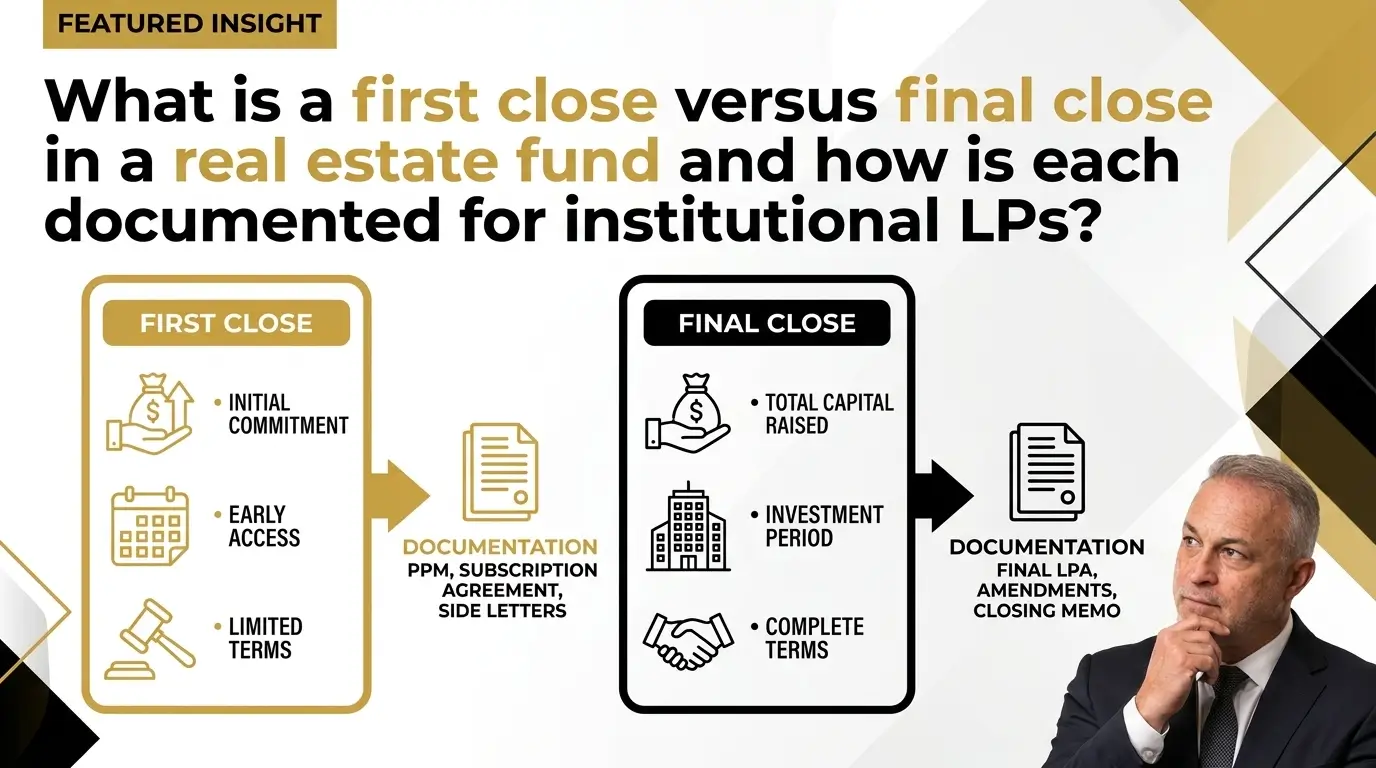
What is a first close versus final close in a real estate fund and how is each documented for institutional LPs?
What Is Venture Capital Fundraising Advisory
Disclosure
Nothing on this site constitutes an offer to sell, or a solicitation of an offer to purchase, any security under the Securities Act of 1933, as amended, or any applicable state securities laws. Any offering of securities is made only by means of a formal private placement memorandum or other authorized offering documents delivered to qualified investors.
IRC Partners is a capital advisory firm. IRC Partners is not a registered investment adviser under the Investment Advisers Act of 1940 and does not provide investment advice as defined thereunder.
Certain statements in this article may constitute forward-looking statements, including statements regarding market conditions, capital availability, investor demand, and transaction outcomes. Such statements reflect current assumptions and expectations only. Actual results may differ materially due to market conditions, regulatory developments, company-specific factors, and other variables. IRC Partners makes no representation that any outcome, return, or result described herein will be achieved.
References to prior mandates, transaction volume, network credentials, or capital raised are provided for illustrative purposes only and do not constitute a guarantee or prediction of future results. Past performance is not indicative of future outcomes. Individual results will vary. Network credentials and transaction statistics referenced on this site reflect the aggregate experience of IRC Partners' principals and affiliated advisors and are not a representation of assets managed or transactions closed solely by IRC Partners.
Certain data, statistics, and information presented in this article have been obtained from third-party sources. IRC Partners has not independently verified such information and expressly disclaims responsibility for its accuracy, completeness, or timeliness. Readers should independently verify any third-party data before relying on it.
Readers are strongly encouraged to consult qualified legal, financial, and tax professionals before making any investment, capital raising, or business decision.
Schedule A Meeting
You get one shot to raise the right way. If this raise is worth doing, it’s worth doing with precision, leverage, and control.
This isn’t a practice run. Serious capital. Serious strategy. Let’s raise it right.
We onboard a maximum of seven
new strategic partners each quarter, by application only, to maximize your chances of securing the capital you need.
