.svg "CTA Arrow")


.png "Investor Ready Capital decorative background element")

How Long Does Real Estate Capital Raising Take?

A real estate capital raise in the $10M to $50M range typically takes 4 to 9 months from pre-launch preparation to final investor commitment. Raises with existing institutional relationships and clean materials can close in 3 to 4 months. Raises involving new investor relationships, complex capital structures, or incomplete documentation regularly run 9 to 12 months or longer.
Key takeaways:
- Raises with existing institutional relationships and clean deal materials can close in 3–4 months
- Raises involving new investor relationships, complex capital structures, or incomplete documentation often run 9–12 months or longer
- The longest phase is almost always investor diligence and commitment — not initial outreach
- The biggest drivers of timeline are sponsor readiness, investor channel fit, and documentation quality at launch — not market conditions alone
- In 2026, institutional equity raised by real estate funds reached $121 billion, up 33% from 2024, but capital is concentrating with experienced operators who can clear diligence fast
Planning a raise as one blended number leads to bad calendar assumptions. The process has distinct phases, and delays cluster in specific places. Understanding where those are is the starting point for controlling the outcome.
A Realistic Raise Timeline by Phase
Most developers think about a raise as a single event. In practice, it runs through four distinct phases, each with its own pacing logic and failure modes.
Total typical range: 15–32 weeks (roughly 4–8 months)
A few things to note about how these phases work in practice. Phase 1 is where most sponsors underinvest time. Rushing materials to launch faster almost always adds weeks later in the process when investors return with questions that should have been answered upfront.
Phase 4 is where raises stall most often. A full investor diligence cycle at the institutional level involves internal memos, committee scheduling, legal review, and documentation — none of which moves at the sponsor's pace. Understanding how real estate capital raising works step by step helps sponsors anticipate these handoffs before they happen.
What Actually Drives the Timeline Up or Down
Not all raises in the $10M–$50M range move at the same speed. Four variables account for most of the variation.
Capital Structure Complexity
Straight equity raises in a single asset class move faster because investors can underwrite them with standard models. Layered structures involving preferred equity returns in the 12–18% range, mezzanine coordination, or complex promote splits require more time at the legal and underwriting stage. Each additional layer adds review cycles.
Sponsor Track Record
Experienced developers with documented exits and institutional-grade reporting can clear investor credentialing in days rather than weeks. First-time institutional raisers, even with strong projects, often spend 3–6 additional weeks answering background questions that repeat sponsors handle with a single data room submission.
Market Selectivity in 2026
In the current environment, NAIOP research confirms that capital is available but selective. Sponsors in favored sectors with clear execution history move faster. Deals in slower-demand segments face longer calibration periods and more investor passes before commitment.
The Longest Phase Is Investor Diligence, Not Outreach
Most sponsors expect the hard part to be getting meetings. It is not. Initial outreach, even with new relationships, can generate first-round engagement within 4–6 weeks. The real timeline pressure comes after interest is established.
Here is why diligence consistently runs longer than sponsors plan for:
- Internal memo preparation. Before any institutional investor takes a deal to committee, an analyst or portfolio manager must write an internal memo. This alone can take 2–4 weeks after the sponsor delivers materials.
- Investment committee scheduling. Most institutional LPs hold IC meetings on fixed calendars — monthly or quarterly. Missing a cycle adds 4–6 weeks to the timeline with no action from the sponsor capable of accelerating it.
- Legal review and documentation. Subscription agreements, operating agreements, and side letter negotiations add 2–4 weeks at minimum after a verbal commitment. Complex structures take longer.
- Debt-side changes that force equity model updates. Lenders in the current environment frequently revise terms between term sheet and closing. When the debt structure shifts, equity investors must re-underwrite. Each cycle costs 1–3 weeks.
- Parallel diligence on multiple investors. Sponsors often run 4–8 serious investor conversations simultaneously. Each one has its own document requests, Q&A cycles, and committee timing. Coordinating across all of them without letting any go cold is operationally intensive.
The practical implication: sponsors who expect a 30-day close after a strong management call are routinely surprised by a 60–90 day gap between expressed interest and signed documents. That gap is normal. It is not a signal the deal is falling apart — but it does require active management to keep investors engaged and moving.
How Document Readiness Can Save or Lose 30–90 Days
Incomplete materials at launch do not just slow the first investor conversation. They create compounding delays across every subsequent stage. A sponsor who launches with a half-finished data room often spends the first 4–6 weeks of formal outreach answering questions that should have been pre-empted — which means investors are not advancing, they are waiting.
What Needs to Be Ready Before You Launch
The following items should be complete before the first formal investor introduction. Missing any of them creates a predictable bottleneck:
- Financial model: Fully reconciled, with clear assumptions, sensitivity tables, and scenario outputs
- Offering memorandum or investment summary: Complete, consistent with the model, and reviewed for factual accuracy
- Sponsor track record package: Prior project list with dates, capitalization, returns, and current status for each asset
- Organizational chart and key person bios: Including equity ownership, decision authority, and development team depth
- Third-party reports: Phase I environmental, appraisal, market study, and geotechnical (if applicable) — all current and without unresolved flags
- Debt term sheet or lender LOI: Investors want to see that the capital stack is not speculative
- Legal entity structure: Clean cap table, no pending disputes, and clear GP/LP mechanics
Gaps in any of these categories trigger extra diligence loops. An investor who has to ask for the same document twice often deprioritizes the deal in favor of cleaner opportunities.
The real estate due diligence checklist for $10M+ sponsors covers the full 47-document standard that institutional reviewers expect before they begin serious underwriting.
Why Family Office, Private Equity, and Institutional LP Timelines Differ
Not all capital sources move at the same speed. The decision cycle varies significantly depending on who is writing the check. Treating all investor types as interchangeable is one of the most common causes of timeline miscalculation.
Family Offices
Family offices now account for a meaningful share of direct real estate transactions. According to NCREIF data, real estate remains a core allocation for large family offices, with average exposure around 18% of total portfolio. They can move faster than institutional LPs because authority is concentrated. But they can also pause without warning when a principal shifts focus. The best family office relationships are built before the raise formally opens — not during it.
Institutional LPs
Institutional LPs are the slowest-moving capital source but often the most durable once committed. Their process involves portfolio managers, internal analysts, external consultants, and investment committees that meet on fixed schedules. A sponsor who misses the March IC cycle may not get another look until June.
Matching the right investor type to the deal's pacing needs is not an advisor-selection question — it is a capital strategy question that should be resolved before outreach begins. Developers who are unclear on when to raise equity for a real estate deal often find themselves targeting the wrong investor channel for their timeline.
How to Compress the Timeline Without Sacrificing Investor Quality
Speed and quality are not opposites in a capital raise. The fastest closes happen when sponsors do more work before launch, not less. The tactics below shorten the active raise period without forcing deal terms or accepting weaker capital.
- Complete the data room before the first call. Every document an investor will eventually request should already be in the room before outreach begins. Reactive document delivery adds 1–2 weeks per request cycle.
- Run lender coordination in parallel with investor outreach. Sponsors who wait for a signed debt term sheet before approaching equity investors lose 4–8 weeks. Lender and equity processes can overlap without creating structural risk.
- Prioritize investor channel fit over volume. Sending the deal to 40 investors who are not the right fit generates noise, not momentum. Ten well-matched investors with active deal flow in your asset class move faster and convert at higher rates.
- Set a weekly diligence cadence. Q&A turnaround, model update delivery, and follow-up scheduling should happen on a fixed weekly rhythm. Letting diligence drift by even a few days per cycle compounds into weeks of lost time.
- Use soft marketing to pressure-test the narrative before formal launch. Early investor conversations surface objections that can be addressed in the materials before the formal process begins. This prevents the same question from stalling 6 different conversations simultaneously.
- Maintain a live decision tracker. Knowing exactly where each investor is in their process — and when their next IC meeting is — lets sponsors sequence follow-up to hit windows rather than miss them.
Sponsors who take shortcuts in pre-launch preparation to start outreach faster almost always extend the total raise duration. The math works the other way: investing 3–4 extra weeks in Phase 1 typically saves 6–10 weeks in Phase 4.
Signals Your Raise Is on Track Versus Stalling
Knowing whether a delay is normal process friction or a genuine warning sign changes how a sponsor should respond. The two look different.
A raise that is genuinely on track shows narrowing focus and increasing specificity. Investors who are serious ask harder questions, not easier ones.
If multiple investors stop progressing after the same question — about the debt structure, sponsor track record, or market assumptions — the issue is almost always in the materials or the capital structure, not in market appetite. That is a solvable problem, but only if it is identified early.
Developers who want to understand what a well-structured process looks like before it starts can review the common mistakes in real estate capital raising that cause raises to stall at predictable points.
{{main-cta}}
How IRC's Process Is Built to Reduce Avoidable Delays
Most timeline delays in a $10M–$50M raise are not caused by market conditions. They are caused by sponsor-side execution gaps: materials that are not ready, investor channels that do not fit, and diligence coordination that drifts without active management.
IRC's advisory process is designed around reducing those specific friction points before they cost weeks.
- Readiness review before launch. IRC evaluates materials, capital structure, and positioning before the first investor introduction. Gaps are identified and resolved in Phase 1, not discovered in Phase 4.
- Investor channel fit. IRC's network includes institutional allocators, with curated introductions matched to asset class, deal size, and sponsor profile. Volume outreach to mismatched investors is replaced with targeted introductions to active capital sources.
- Active diligence coordination. IRC manages the Q&A cycle, tracks investor status, and keeps sponsor-side responses on a weekly cadence so diligence does not drift between conversations.
IRC has served as capital advisor on projects ranging from a $150M multifamily development in Texas to a $300M condominium project in California. The process is the same regardless of scale: institutional-grade preparation, disciplined investor targeting, and active coordination through close.
Developers who want to understand what a structured raise engagement looks like can review the IRC capital raising engagement model before deciding whether an advisory relationship is the right fit.
Ready to evaluate your raise timeline? IRC works with seasoned developers raising $10M to $50M+ to assess whether their deal, materials, and capital structure are positioned for an efficient institutional raise. Contact IRC to find out whether your raise qualifies for an equity-aligned advisory engagement.
Frequently Asked Questions
How long does it typically take to raise $10M in real estate equity from institutional investors?
A $10M raise from institutional sources typically takes 3–6 months when the sponsor has prior institutional relationships, clean materials, and a deal in a high-demand asset class. Without existing relationships or with incomplete documentation, the same raise can take 6–9 months. The size of the raise matters less than the quality of materials and the fit between the deal and the investor channel.
What is the most common reason a real estate capital raise takes longer than expected?
Investor diligence and internal committee review almost always run longer than sponsors anticipate. Most sponsors plan for 30–45 days between a positive management call and a signed commitment. In practice, that gap is typically 60–90 days for institutional LPs, driven by internal memo preparation, IC scheduling, and legal review. Missing a single IC cycle can add 4–6 weeks with no action the sponsor can take to accelerate it.
Does the capital structure affect how long the raise takes?
Yes, significantly. Straight common equity raises in a single asset class move fastest because investors underwrite them with standard models. Layered structures involving preferred equity (typically priced at 12–18%), mezzanine coordination, or complex promote splits require additional legal review and underwriting cycles at each layer. Every added structural element extends Phase 4 by 1–4 weeks on average.
How early should a developer start the capital raising process relative to their construction or closing timeline?
Most developers should begin pre-launch preparation at least 6 months before they need capital in place. For institutional LP targets with quarterly IC calendars, starting 9 months out provides a meaningful buffer. Developers who begin outreach 90 days before a hard deadline often find themselves accepting weaker terms or lower-quality capital because they cannot afford to wait for the right investor to complete diligence.
Can a developer compress a raise to under 3 months?
Rarely, and usually only when the sponsor has an existing institutional relationship, a deal the investor has already seen in soft marketing, and materials that require no additional preparation. For new institutional relationships, 3 months is not enough time to complete credentialing, diligence, legal review, and documentation at the institutional standard. Attempting to compress below 3 months typically results in either weaker capital sources or deal terms that reflect the sponsor's urgency.
How do rising interest rates or tighter debt markets affect the raise timeline?
When lenders revise terms between term sheet and closing — which has been common in the 2025–2026 environment — equity investors must re-underwrite their position based on the updated debt structure. Each revision cycle costs 1–3 weeks. Sponsors who lock in debt terms early in the process, before equity outreach begins, eliminate this variable entirely. Leaving debt terms open while pursuing equity simultaneously is one of the most reliable ways to extend a raise by 4–8 weeks.
What is a realistic timeline for a first-time institutional raise versus a repeat sponsor?
A repeat sponsor with documented exits, institutional reporting history, and existing LP relationships can realistically target a 4–6 month timeline. A first-time institutional raiser, even with a strong project, should plan for 7–12 months. The difference is almost entirely in credentialing time: repeat sponsors clear investor background review in days, while first-time institutional raisers spend 3–6 additional weeks answering questions that established track records answer automatically.
Continue reading this series:
- How Real Estate Capital Raising Works: A Step-by-Step Guide for Developers Raising $10M–$50M
- When to Raise Equity for a Real Estate Deal
- Common Mistakes in Real Estate Capital Raising
IRC Partners advises founders raising $5M to $250M in institutional capital on structure, positioning, and round architecture. We work with 7 strategic partners per quarter - no placement agent model, no success-only theater. If you want a structural review of your current raise, apply HERE.
Sponsors weighing this decision should first complete a capital raise readiness assessment for sponsors to confirm the raise is investor-ready.
Need guidance on your capital raise?


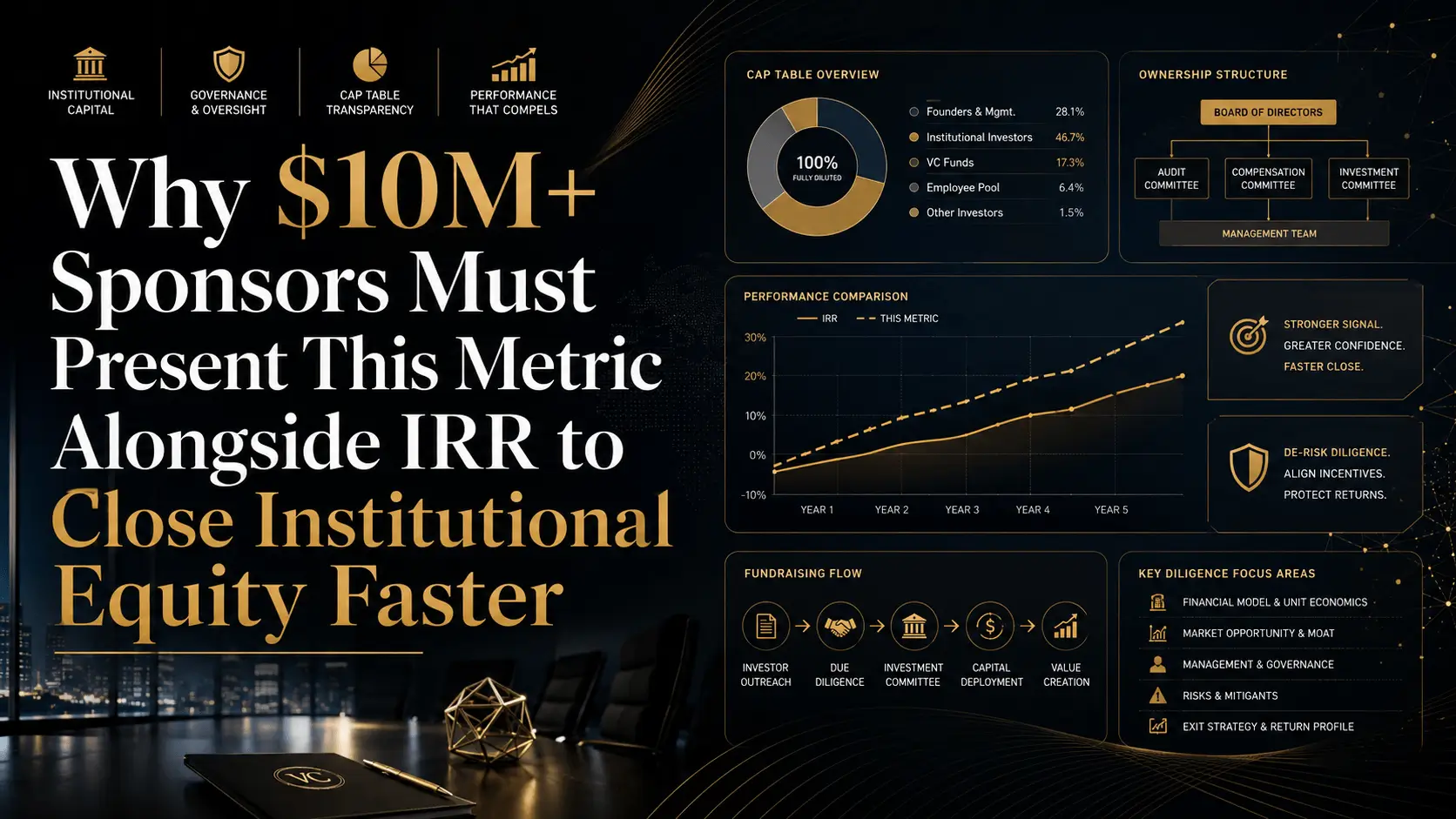
Real Estate Cash on Cash Return: Why $10M+ Sponsors Must Present This Metric Alongside IRR to Close Institutional Equity Faster
What is Original Issue Discount, and When Can It Affect a Convertible Note Financing?
When Should a Sponsor Offer a Family Office an Investment Committee Observer Right Rather Than a Voting Seat?
Disclosure
Nothing on this site constitutes an offer to sell, or a solicitation of an offer to purchase, any security under the Securities Act of 1933, as amended, or any applicable state securities laws. Any offering of securities is made only by means of a formal private placement memorandum or other authorized offering documents delivered to qualified investors.
IRC Partners is a capital advisory firm. IRC Partners is not a registered investment adviser under the Investment Advisers Act of 1940 and does not provide investment advice as defined thereunder.
Certain statements in this article may constitute forward-looking statements, including statements regarding market conditions, capital availability, investor demand, and transaction outcomes. Such statements reflect current assumptions and expectations only. Actual results may differ materially due to market conditions, regulatory developments, company-specific factors, and other variables. IRC Partners makes no representation that any outcome, return, or result described herein will be achieved.
References to prior mandates, transaction volume, network credentials, or capital raised are provided for illustrative purposes only and do not constitute a guarantee or prediction of future results. Past performance is not indicative of future outcomes. Individual results will vary. Network credentials and transaction statistics referenced on this site reflect the aggregate experience of IRC Partners' principals and affiliated advisors and are not a representation of assets managed or transactions closed solely by IRC Partners.
Certain data, statistics, and information presented in this article have been obtained from third-party sources. IRC Partners has not independently verified such information and expressly disclaims responsibility for its accuracy, completeness, or timeliness. Readers should independently verify any third-party data before relying on it.
Readers are strongly encouraged to consult qualified legal, financial, and tax professionals before making any investment, capital raising, or business decision.
Schedule A Meeting
You get one shot to raise the right way. If this raise is worth doing, it’s worth doing with precision, leverage, and control.
This isn’t a practice run. Serious capital. Serious strategy. Let’s raise it right.
We onboard a maximum of seven
new strategic partners each quarter, by application only, to maximize your chances of securing the capital you need.
