.svg "CTA Arrow")


.png "Investor Ready Capital decorative background element")

How Unpaid Founder Salaries Converted to Equity Create Hidden Cap Table Liabilities That Derail Series B Diligence
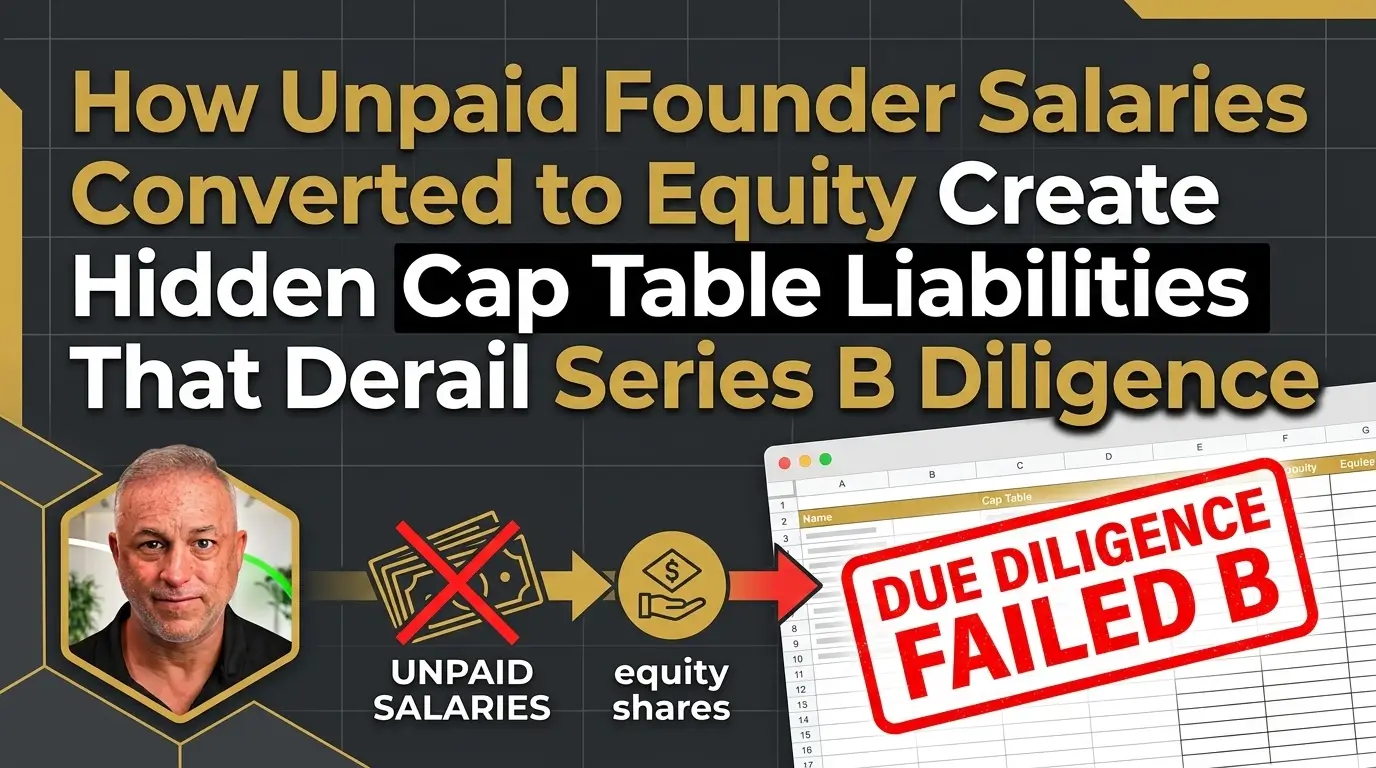
How Unpaid Founder Salaries Converted to Equity Create Hidden Cap Table Liabilities That Derail Series B Diligence
A salary-to-equity conversion occurs when a founder or early employee formally trades accrued, unpaid wages for company shares in lieu of a cash payment. While this arrangement serves as a practical tool to preserve runway during a startup's leanest phases, an informal or improperly papered exchange transforms an intended cleanup into a defective share entry sitting inside the cap table. Institutional Series B investors do not look at these undocumented conversions as mere historical compensation trivia; they evaluate them as highly uncertain, legally vulnerable equity issuances that threaten the accuracy of the fully diluted share count. If a company cannot firmly prove that a conversion possessed board authorization, supportive fair-market-value pricing under Section 409A, a valid securities law exemption, and an explicit, written release of the underlying wage claim, it faces severe dual-liability risks and securities violations. Rather than allowing investor counsel to uncover these structural defects mid-diligence—which can trigger costly price adjustments, escrow holdbacks, or broken deal momentum—founders must proactively audit their compensation archives and formalize their legal paper trail well before initiating investor outreach.
Series B investors do not treat undocumented salary conversions as compensation history. They treat them as uncertain equity issuances that require answers: who authorized the shares, at what price, under what legal basis, and whether the original wage obligation was ever formally extinguished. If those answers are missing or inconsistent, the conversion becomes a structural liability. This is one of the most common cap table problems covered in our complete guide to cap table issues that kill a Series B.
Key takeaways:
- A salary-to-equity conversion is only clean if the issuance was authorized, priced, documented, and legally released at the time it occurred.
- Informal or retroactively papered conversions create up to four separate diligence risks: defective authorization, unsupported pricing, missing securities exemption, and surviving wage liability.
- Series B investors price these gaps as structural defects, not administrative oversights.
- Proactive cleanup or disclosure before outreach is almost always better than investor discovery during diligence.
What a Salary-to-Equity Conversion Is, and Why Documentation Is the Whole Issue
When a company cannot afford to pay a founder's full salary, the parties sometimes agree to defer the cash and later convert the unpaid amount into equity. The company issues shares representing the value of the deferred wages, and the founder accepts those shares in place of the cash owed.
A clean conversion requires five things to exist at the time of the issuance: a written agreement documenting the exchange, a board consent authorizing the share issuance, a defensible fair market value for the shares, documented reliance on a securities law exemption such as Rule 701 under the Securities Act of 1933, and a written release of the underlying wage claim.
Informal conversions typically fail one or more of these requirements. The table below shows how the two paths differ.
The diligence question is not whether the founder morally earned those shares. It is whether the company can prove, document by document, that the issuance was valid when it happened.
What Breaks When the Conversion Is Undocumented or Defectively Papered
Each missing element creates a separate legal and diligence problem. They do not collapse into a single issue. A company that has three of the five documents still has two independent gaps to resolve.
The four failure points
- Missing board approval. Without a valid board consent, the company may not have legally authorized the share issuance at all. Investors cannot accept the shares as validly outstanding until authorization is confirmed or cured.
- Missing or stale pricing support. Under IRS Section 409A, equity issued at a price below fair market value can be treated as deferred compensation, triggering immediate income inclusion and a 20% additional tax for the recipient. If no contemporaneous valuation existed, the pricing basis cannot be reconstructed after the fact.
- Missing securities exemption documentation. Every share issuance is a securities transaction. If the company cannot show it relied on a valid exemption, whether Rule 701, Section 4(a)(2), Regulation D, or another basis, the issuance may have been unregistered without a valid exemption, which is a securities law violation.
- Missing wage claim release. Without a written release, the salary obligation may still exist as a legal liability even if equity was recorded on the cap table. The company could face both equity overhang and a surviving cash claim.
Why Investors Treat This as a Series B Problem, Not a Payroll Footnote
A Series B lead is not reviewing compensation history. They are reviewing a cap table that they will price off, a set of equity representations they will rely on, and a company they are betting will survive legal scrutiny through closing and beyond. An undocumented salary conversion touches all three.
Here is what the investor actually sees:
- Cap table accuracy risk. If shares were issued without proper authorization, the fully diluted count the investor is pricing off may be wrong. Ownership percentages, dilution modeling, and option pool calculations all depend on every issuance being valid.
- Dual liability risk. If the wage claim was never formally released, the company may owe both the equity and the underlying cash. That is a contingent liability sitting off the balance sheet that the investor's counsel will flag.
- Rep and warranty risk. The financing documents will require the company to represent that all equity has been validly issued. A defective conversion makes that representation false unless the issue is disclosed or cured first.
Investor takeaway: When a lead investor finds undocumented salary conversions during diligence, the question is not whether to address them. The question is who bears the cost: the company through cleanup, the founder through a price adjustment, or the deal through a holdback or escrow. The National Law Review noted in its breakdown of the October 2025 NVCA model document updates that investors are increasingly requiring regulatory health checks on equity history as part of standard pre-close diligence.
For founders who also need to understand the broader capital structure context before a raise, our complete guide to startup funding in 2026 covers how investors evaluate equity structure at each stage.
Who Is Actually at Risk: Not Just the CEO
The exposure does not stop with the founding CEO. Any person who deferred compensation and received equity in exchange can be a source of diligence risk if the conversion was not properly documented.
The risk compounds when multiple conversions happened at different times, under different board compositions, or with different legal counsel. Each instance is its own issuance. Each needs its own paper trail.
{{main-cta}}
Investors reviewing a cap table with multiple undocumented conversions do not treat each one individually. They treat the pattern as evidence of systemic equity administration problems, which raises questions about every other issuance in the company's history. This is the same diligence dynamic covered in the context of equity grants to advisors, contractors, and strategic partners, where informal issuance practices create compounding cap table risk.
What to Confirm Before You Approach a Series B Lead
Before opening a data room, work through these four steps with startup counsel and your finance team. Each step maps to a specific diligence exposure.
Step 1: Identify every instance of deferred compensation that was converted to equity. Pull payroll records, board minutes, cap table entries, and any written or email communications that reference salary deferrals or equity exchanges. Match each conversion to a specific issuance event. If a cap table entry exists without a corresponding document file, that is a gap.
Step 2: Confirm whether a valid board consent and contemporaneous pricing support exist for each issuance. Board approval must predate the issuance. Pricing support, typically a 409A valuation or other documented fair market value basis, must have been valid at the time of grant with no intervening material event that would have required a refresh. A 409A valuation is only a safe harbor if it was current and relied upon at the time the shares were issued.
Step 3: Confirm the securities exemption reliance and written conversion agreement. The company should be able to identify the specific exemption relied upon for each issuance and show it was satisfied. The written agreement should document the amount of deferred compensation, the number of shares issued, the price per share, and the release of the underlying wage claim.
Step 4: Determine whether any wage claim exposure remains open. If a formal written release was never executed, consult startup counsel about whether the original salary obligation may still be legally enforceable. This affects both the balance sheet and the representations the company will make at closing. Understanding how equity and debt interact in your capital structure is also relevant here, and our guide on debt vs. equity financing covers the structural distinctions that matter when investors review your overall capitalization.
When Cleanup, Disclosure, or Outside Counsel Is Required
Not every documentation gap can be fixed. Some can only be disclosed.
A retroactive board consent or an amended cap table entry may cure a recordkeeping deficiency. It does not change the price at which shares were issued, retroactively establish a securities exemption that was not relied upon at the time, or eliminate a 409A compliance issue that arose from the original transaction structure. The fix addresses the paper; it does not rewrite the facts.
When the exposure is material, the realistic options are:
- Legal cleanup: Curing curable defects with counsel before outreach, including corrected consents, signed releases, and updated exemption documentation where the underlying facts support it.
- Disclosure scheduling: Adding the issue to the disclosure schedule in the financing documents so the investor accepts it with full knowledge.
- Deal-term protection: An investor who discovers the issue may require an escrow holdback, a price adjustment, or a legal opinion as a condition to closing.
- Counsel-led remediation memo: A written legal analysis of the exposure, the cure, and any remaining risk, placed in the data room to demonstrate the company has addressed the issue proactively.
Proactive disclosure with a memo is almost always better than investor discovery. An investor who finds an undisclosed defect during diligence loses confidence in the company's representations across the board. The same principle applies to tax-related equity defects, as covered in our analysis of missing 83(b) elections and the tax exposure they create at Series B.
Pre-Series B Salary-to-Equity Conversion Audit Checklist
Use this checklist with startup counsel before opening your data room.
- Identify every arrangement in which founder or employee compensation was deferred and subsequently converted to equity
- Confirm a written conversion agreement exists for each instance, signed at or near the time of the exchange
- Confirm a valid board consent authorizing each share issuance predates the issuance date
- Confirm a contemporaneous 409A valuation or documented fair market value basis was in place at the time of each grant
- Confirm the securities exemption relied upon for each issuance is identified and the conditions of that exemption were satisfied
- Confirm a written release of the underlying wage claim was executed by the recipient
- For any gap identified, prepare a short disclosure memo for the data room explaining the issue, the cure taken, and any remaining exposure
-
Frequently Asked Questions
What is a salary-to-equity conversion in plain English?
A salary-to-equity conversion is when a founder or employee agrees to give up unpaid wages in exchange for company shares instead of receiving a cash payment. The company records the shares on the cap table, and the recipient gives up the right to collect the cash owed. Whether that exchange is legally valid depends entirely on how it was documented at the time it occurred.
What documentation makes a salary-to-equity conversion clean versus defective?
A clean conversion requires five contemporaneous documents: a written agreement specifying the exchange terms, a board consent authorizing the issuance, a defensible fair market value for the shares at the time of issuance, documented reliance on a securities law exemption, and a written release of the underlying wage claim. Missing any one of these creates a separate diligence defect, not a single fixable problem.
Is a verbal or informal agreement to convert salary to equity legally enforceable?
A verbal agreement may create an enforceable obligation to pay the deferred salary, but it does not make the resulting equity issuance valid. Share issuances require board authorization and compliance with securities laws regardless of what the parties agreed informally. An informal agreement may mean the company owes the cash and has also issued shares without proper legal authority.
Does the wage claim survive if the equity conversion was never formally documented?
In many U.S. jurisdictions, an unwritten or informally documented salary-to-equity conversion may not extinguish the underlying wage claim. If no signed written release was executed by the recipient, the original obligation may still be enforceable as a matter of employment or contract law. Founders should confirm the status of any surviving wage obligations with startup counsel before approaching investors.
How do Series B investors treat defective salary conversions during diligence?
Series B investors treat undocumented salary conversions as defective share issuances, not compensation history. The investor's counsel will ask for the board consent, pricing support, exemption documentation, and wage release for each conversion. If those documents do not exist, the investor will require legal cleanup, a disclosure schedule entry, or deal-term protection such as an escrow holdback or price adjustment before closing.
Can a defective salary-to-equity conversion be fixed retroactively?
Some documentation gaps can be cured, such as obtaining a missing signature or confirming an exemption that was actually satisfied at the time. However, retroactive paperwork cannot change the price at which shares were issued, establish a 409A valuation that did not exist at the grant date, or retroactively create a securities exemption that was never relied upon. The cure addresses the record; it does not rewrite the underlying transaction.
What should the data room include to address salary conversion risk?
The data room should include the written conversion agreement, the board consent, the pricing support or 409A valuation in effect at the time, the securities exemption documentation, and the signed wage claim release for each conversion. If any of these are missing, include a counsel-prepared disclosure memo explaining the gap, the steps taken to address it, and any remaining exposure. Investors respond better to organized disclosure than to gaps discovered during review.
Continue reading this series:
- The Capital Stack Explained: Equity, Debt, SAFEs, and What Investors Actually Want
- How to Value a Startup: Complete Valuation Guide for Founders 2026
- How to Raise Capital in 2026 for Your Series A Round
Most founders don't lose the raise because of the pitch. They lose it because the structure was wrong before the first investor call. IRC Partners advises founders raising $5M to $250M of institutional capital. 7 strategic partners per quarter. Start here to schedule a call with our team.
Sponsors weighing this decision should first complete a capital raise readiness assessment for sponsors to confirm the raise is investor-ready.
Need guidance on your capital raise?


Do Convertible Notes Count Toward the Drag-Along Threshold? The Definition Gap That Blows Up Acquisition Closings
Investment Committee Deck Feedback From Institutional Investors

When Does a Company Need Capital Raising for Real Estate
Disclosure
Nothing on this site constitutes an offer to sell, or a solicitation of an offer to purchase, any security under the Securities Act of 1933, as amended, or any applicable state securities laws. Any offering of securities is made only by means of a formal private placement memorandum or other authorized offering documents delivered to qualified investors.
IRC Partners is a capital advisory firm. IRC Partners is not a registered investment adviser under the Investment Advisers Act of 1940 and does not provide investment advice as defined thereunder.
Certain statements in this article may constitute forward-looking statements, including statements regarding market conditions, capital availability, investor demand, and transaction outcomes. Such statements reflect current assumptions and expectations only. Actual results may differ materially due to market conditions, regulatory developments, company-specific factors, and other variables. IRC Partners makes no representation that any outcome, return, or result described herein will be achieved.
References to prior mandates, transaction volume, network credentials, or capital raised are provided for illustrative purposes only and do not constitute a guarantee or prediction of future results. Past performance is not indicative of future outcomes. Individual results will vary. Network credentials and transaction statistics referenced on this site reflect the aggregate experience of IRC Partners' principals and affiliated advisors and are not a representation of assets managed or transactions closed solely by IRC Partners.
Certain data, statistics, and information presented in this article have been obtained from third-party sources. IRC Partners has not independently verified such information and expressly disclaims responsibility for its accuracy, completeness, or timeliness. Readers should independently verify any third-party data before relying on it.
Readers are strongly encouraged to consult qualified legal, financial, and tax professionals before making any investment, capital raising, or business decision.
Schedule A Meeting
You get one shot to raise the right way. If this raise is worth doing, it’s worth doing with precision, leverage, and control.
This isn’t a practice run. Serious capital. Serious strategy. Let’s raise it right.
We onboard a maximum of seven
new strategic partners each quarter, by application only, to maximize your chances of securing the capital you need.
