.svg "CTA Arrow")


.png "Investor Ready Capital decorative background element")

How Drag-Along Consent Structures Can Let a Minority Investor Force a Majority Outcome
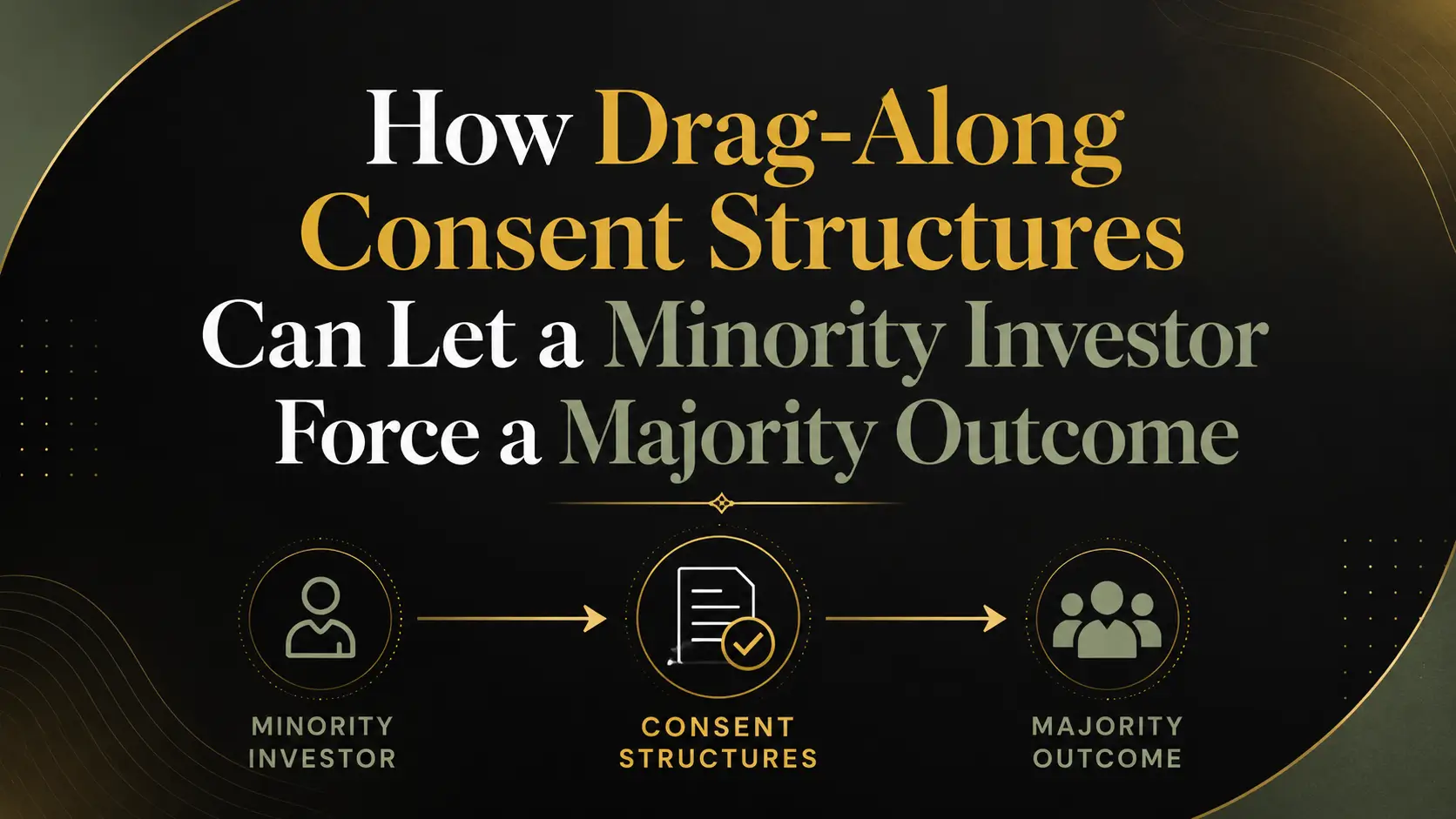
A minority investor can force or block a sale when the drag-along provision is tied to a share class or approval path they control, not to overall cap table ownership. An investor holding 18% of a fully diluted cap table can still satisfy a drag-along trigger if the documents require majority approval of Series A preferred and that investor controls 51% of that class. The percentage on the cap table is not what gives them the power - the consent structure in the voting agreement and charter is what gives them the power. Founders who read their drag-along threshold as a percentage of the company they own are measuring the wrong number entirely.
The foundation article on drag-along provisions explains how these rights work across growth-stage financings. This article focuses on one specific and often missed mechanic: how consent structure design, not ownership percentage, determines who actually controls a sale outcome. If your company has issued convertible instruments that might count toward a threshold, this article on convertible notes and drag-along thresholds covers that layer in detail.
Three things this article will show you:
- Why the class that triggers the drag-along matters more than who owns the most shares
- The three consent structure designs that most commonly produce minority-controlled outcomes
- What to review and negotiate in a term sheet before class-based consent rights become an exit problem
How Class-Based Consent Structures Create Minority Control
Most drag-along provisions are not written as a simple majority-of-all-stockholders vote. They specify which stockholder groups must approve a sale, and that specification is where minority control gets built in.
There are three common voting structures used in growth-stage financings. Each one places approval power in a different set of hands.
The key question is not "who owns the most of the company?" It is "who controls the class or series that the documents say must approve the sale?"
A lead investor can hold 18% of the fully diluted cap table and still control 51% or more of a narrow preferred series. When the drag-along trigger is written to require majority approval of that series, the lead investor satisfies the threshold alone. The rest of the cap table, including common stockholders and other preferred holders, does not get a vote on whether the threshold is met.
Understanding how voting calculations interact with instrument definitions is also important here.
The Three Consent Designs That Let a Minority Investor Drive the Outcome
Not every financing produces minority-controlled drag-along outcomes. But three specific drafting patterns make it possible, and all three are common in growth-stage term sheets.
- Narrow preferred class thresholds. The drag-along is triggered by majority approval of a single preferred series rather than all preferred or all stock. If one investor controls that series, they control the trigger. This is the most direct path to minority forcing power.
- Layered consent rights. The charter, voting agreement, and board approval requirements are written separately and interact in ways founders did not anticipate. A sale might require board approval plus majority preferred plus majority of a specific series. Each layer may seem reasonable on its own. Combined, they can give a single investor the ability to block a sale by withholding consent at any one layer, even if every other constituency approves.
- Lead investor blocking positions. A minority holder does not need to satisfy the threshold alone to have control. In some structures, they only need to hold enough of a class to prevent anyone else from reaching the threshold without them. A 35% stake in Series A preferred can be a blocking position if the threshold requires 67% of that class and no other investor holds enough to reach it without the blocker's vote.
What founders miss: These are drafting choices, not standard features of every financing. They appear in documents because they were negotiated that way, often by lead investors who understood their practical effect better than the founders reviewing the term sheet did. The NVCA Model Legal Documents provide a baseline for what balanced drag-along consent language looks like, which is a useful comparison point when reviewing your own documents.
The difference between these three patterns matters when you are deciding what to push back on. A narrow class threshold can sometimes be broadened. A blocking position can sometimes be diluted in a later round. Layered consent rights are harder to unwind once they are in place across multiple documents. If your cap table already has consent rights embedded across multiple investor agreements, how consent rights can turn your cap table into a governance problem before your next raise explains how those layers compound over time.
Worked Example: 18% of the Cap Table, 51% of Series A Preferred
Here is how a minority investor satisfies a class-based drag-along threshold while holding a small overall ownership position.
Simplified cap table:
The drag-along provision in the voting agreement requires approval from: (1) the board of directors, (2) a majority of the Series A preferred, voting as a separate class.
How the drag-along is activated:
- A buyer approaches and the lead investor wants to sell. The board approves the transaction.
- The lead investor votes its 1,800,000 Series A preferred shares in favor. That is 51% of the Series A preferred class.
- The majority-of-Series-A threshold is satisfied by the lead investor alone.
- The drag-along is triggered. All stockholders, including founders and common holders who oppose the sale, are required to vote in favor and execute the sale documents.
The founders hold 55% of the fully diluted cap table. They still get dragged. Their ownership percentage was never the relevant number. The relevant number was who held majority of the class the documents named as the consent trigger.
This is not a hypothetical edge case. It is a direct consequence of how class-based drag-along provisions are commonly drafted in Series A financings. Understanding the threshold design before signing is the only point at which founders have leverage to change it.
Why Founders Miss This Until a Sale Process Starts
Term sheet negotiations focus on economics. Founders spend most of their attention on valuation, liquidation preference, pro-rata rights, and board composition. The operational mechanics of consent structure design rarely get the same scrutiny.
This creates a gap between what founders think they signed and what the documents actually say.
Myth: "Majority preferred" means a broad investor consensus is required to trigger a drag-along. Reality: If one lead investor controls the majority of the preferred class named in the provision, "majority preferred" means that one investor.
Myth: Founders holding 50%+ of the cap table can block a sale they oppose. Reality: Common stock is often excluded from the approval group that triggers the drag-along. Founder ownership percentage is irrelevant if the documents do not give common a separate class vote.
Myth: The consent structure stays the same through later rounds. Reality: Bridge notes, SAFE conversions, and new series creation can all shift who controls the relevant approval class, especially if the documents are not reviewed and updated carefully at each financing.
The problem compounds because it is invisible until a transaction is on the table. By the time a buyer is in the room and the consent structure becomes relevant, the leverage to renegotiate it is gone. Consent structure issues are also one of the structural problems that surface during investor diligence on later rounds, as covered in this breakdown of cap table issues that can stop a raise before investors read your deck.
What Founders Should Review and Negotiate Before Signing
The term sheet stage is the only point where founders can negotiate consent structure design without needing investor agreement to change already-executed documents. Here is what to review before signing any term sheet that includes drag-along provisions tied to a preferred class threshold.
Checklist: drag-along consent structure review
- Identify exactly which holders must approve a sale: board, all preferred as a class, a specific series, common separately, or all stock voting together as-converted
- Check whether the threshold is a percentage of total voting power or a percentage of a narrow class that one investor may control
- Identify whether any single investor holds or will hold enough of the named class to satisfy the threshold alone
- Ask whether later note conversions, SAFE settlements, or new series issuances could shift who controls the approval class
- Negotiate for broader approval groups, as-converted voting where possible, or explicit common class consent rights if the deal warrants it
- Review whether the drag-along threshold interacts with any separate board approval, investor rights agreement, or co-sale provision in a way that creates layered blocking power
Founders who work with IRC Partners before signing a term sheet are reviewing these consent mechanics before they become embedded in the capital structure. The right time to identify a narrow class threshold is during term sheet negotiation, not during a sale process when the documents are already signed and the buyer is waiting.
For additional context on how drag-along rights surface in buyer diligence, this M&A due diligence checklist covers what buyers request and how to be prepared.
{{main-cta}}
Frequently Asked Questions
Can a minority preferred investor force a sale that common stockholders oppose?
Yes, a minority preferred investor can force a sale when the drag-along threshold is tied to a preferred class they control and common stockholders are not included in the approval group. If the documents require only majority approval of a specific preferred series, common opposition does not stop the drag-along from being triggered. The common holders are dragged into the sale regardless of how they would vote.
What is a class-based drag-along threshold and how does it differ from a cap-table-wide threshold?
A class-based drag-along threshold requires approval from a specific class or series of stockholders, such as majority of Series A preferred, rather than from all stockholders voting together. A cap-table-wide threshold counts every share on an as-converted basis, which distributes approval power more broadly. The class-based version concentrates approval power in whoever controls the named class, which can be a single investor even if they hold a small percentage of total ownership.
How does a lead investor use a blocking position in a preferred class to control a drag-along outcome?
A blocking position means the investor holds enough shares in the relevant class to prevent the threshold from being reached without their vote. If the drag-along requires 67% of Series A preferred and one investor holds 35% of that class, no other group can reach 67% without them. That investor can block a sale by withholding consent even if every other stockholder wants to proceed. The blocking position is not about owning the most shares. It is about owning enough of the right class to make the threshold unreachable without them.
What is the difference between voting by class and voting as a single group in a drag-along?
Voting by class means each defined class of stock, such as Series A preferred or common, votes separately and each class must reach its own threshold. Voting as a single group means all shares are counted together on an as-converted-to-common basis, and only one combined threshold must be met. Voting by class gives each class a separate consent right, which means a minority investor controlling one class can satisfy or block that class's threshold independently of what the other classes want.
Can founders negotiate to remove or limit a minority investor's drag-along forcing power?
Founders can negotiate this at the term sheet stage, before documents are executed. The most direct approaches are broadening the approval group to include all preferred voting together or all stock as-converted, raising the threshold percentage within the named class so one investor cannot satisfy it alone, or adding a separate common stockholder consent right. Once the documents are signed, changing the consent structure typically requires investor consent, which means the investor with the forcing power must agree to give it up.
Does the drag-along apply to all share classes or only the class that triggers it?
The drag-along obligation typically applies to all stockholders once the trigger is satisfied, not just the class that voted to activate it. When the threshold is met by a preferred class, all common holders, all other preferred holders, and all option holders are usually required to vote in favor of the sale and sign the sale documents. The trigger class determines who activates the drag-along. The obligation that follows applies to everyone the voting agreement covers.
What should founders check in a term sheet before agreeing to a class-based drag-along threshold?
Founders should identify exactly which class or series must approve the sale, check whether any single investor already holds or will hold majority of that class after the round closes, and ask whether the threshold percentage is low enough for one investor to satisfy it alone. They should also check whether the drag-along interacts with board approval rights or other consent provisions in a way that layers additional blocking power into one investor's hands. Delaware General Corporation Law Section 212 governs voting rights by class for Delaware-incorporated companies, which is the legal framework most growth-stage financings operate under.
Continue reading this series:
- How Drag-Along Rights Get Buried in Your Term Sheet
- 51% vs. 75% Drag-Along Threshold: What the Difference Means for Founders
- Why Ambiguous Voting Calculations in Drag-Along Clauses Create Risk
The structure you carry into your first investor meeting sets the terms for every round that follows it. Founders who get it wrong spend the next three rounds negotiating from behind. The Capital Raise Pre-Flight is IRC Partners’ fixed-fee diagnostic that scores a raise against the same twelve institutional gates a deal must clear before IRC Partners takes it into a strategic partnership. IRC Partners advises operators raising $5M to $250M of institutional capital. Book your Capital Raise Pre-Flight here.
Sponsors weighing this decision should first complete a capital raise readiness assessment for sponsors to confirm the raise is investor-ready.
Need guidance on your capital raise?



Preferred Equity Real Estate: When Sponsors Use It, What It Costs, and What the Data Room Must Include

How to Negotiate Information Rights in $10M+ VC Term Sheets
How Long a SAFE Round Takes From Term Agreement to Close
Disclosure
Nothing on this site constitutes an offer to sell, or a solicitation of an offer to purchase, any security under the Securities Act of 1933, as amended, or any applicable state securities laws. Any offering of securities is made only by means of a formal private placement memorandum or other authorized offering documents delivered to qualified investors.
IRC Partners is a capital advisory firm. IRC Partners is not a registered investment adviser under the Investment Advisers Act of 1940 and does not provide investment advice as defined thereunder.
Certain statements in this article may constitute forward-looking statements, including statements regarding market conditions, capital availability, investor demand, and transaction outcomes. Such statements reflect current assumptions and expectations only. Actual results may differ materially due to market conditions, regulatory developments, company-specific factors, and other variables. IRC Partners makes no representation that any outcome, return, or result described herein will be achieved.
References to prior mandates, transaction volume, network credentials, or capital raised are provided for illustrative purposes only and do not constitute a guarantee or prediction of future results. Past performance is not indicative of future outcomes. Individual results will vary. Network credentials and transaction statistics referenced on this site reflect the aggregate experience of IRC Partners' principals and affiliated advisors and are not a representation of assets managed or transactions closed solely by IRC Partners.
Certain data, statistics, and information presented in this article have been obtained from third-party sources. IRC Partners has not independently verified such information and expressly disclaims responsibility for its accuracy, completeness, or timeliness. Readers should independently verify any third-party data before relying on it.
Readers are strongly encouraged to consult qualified legal, financial, and tax professionals before making any investment, capital raising, or business decision.
Schedule A Meeting
You get one shot to raise the right way. If this raise is worth doing, it’s worth doing with precision, leverage, and control.
This isn’t a practice run. Serious capital. Serious strategy. Let’s raise it right.
We onboard a maximum of seven
new strategic partners each quarter, by application only, to maximize your chances of securing the capital you need.
