



Why Is My Series A Stalling After 30 Investor Meetings?

TL;DR: Many first meetings and few second meetings means one gate keeps failing. It is usually the deck and traction story, the financial model, or the round terms and investor fit. Track where each talk stopped, find the pattern, fix the top gap, then go back to your list.
Thirty first meetings with few second meetings means investors saw the deal and one gate keeps failing. That gate is usually one of three: the proof and story in your deck, the financial model, or the round terms and investor fit.
If you are still building your raise strategy, start with this guide on how to raise capital in 2026 for your Series A round.
What does it mean when investors take the first meeting but not the second?
A first meeting is easy to get. Investors take them to stay informed. A second meeting is a signal that they want to go deeper.
When a founder gets 30 first meetings and very few second calls, the deal cleared the headline screen. The investor looked at the sector, the round size, and the founder's background and said yes to a conversation. Then they saw more and went quiet.
That silence is data.
It usually means one of three things:
- The story or traction in the deck did not hold up under basic scrutiny.
- The financial model raised questions the founder could not answer.
- The round terms or the investor's own mandate were a poor match.
How do you tell which gate is failing?
Track where each conversation stopped. Write it down for every meeting. Patterns will appear fast.
| Where talks stop | What it usually signals | What to fix first |
|---|---|---|
| No reply after the deck is sent | Story, traction slide, or headline metrics are not compelling | Rewrite the narrative; sharpen the traction proof |
| First meeting then silence | The pitch did not convert curiosity into conviction | Strengthen the core value proposition and market size argument |
| Model requested then silence | Financial model has gaps or raises more questions than it answers | Rebuild the model with clear assumptions and a clean three-statement structure |
| Partner meeting then pass | Deal passed early screens but failed deeper diligence | Identify the specific objection; often governance, unit economics, or cap table |
| Term talk then pass | Economics or structure did not work for that investor | Review valuation, liquidation preference, and pro-rata rights |
| "Too early" or "not a fit" | Stage, check size, or sector is outside the investor's mandate | Requalify your target list against actual investment criteria |
Is it the pitch deck and traction story?
If most conversations stop after the deck is sent or after the first meeting, the story is the problem.
Investors see a lot of decks. They are looking for a clear answer to one question: why is this company going to win in this market? A deck that answers it fast and backs it up with traction data earns the second call.
What breaks the traction story
- Vanity metrics front and center. Downloads, sign-ups, and social followers do not tell an investor whether the business works. Revenue, retention, and growth rate do.
- Market size claims without a bottoms-up build. Saying the market is large means nothing if you cannot show how you capture a real slice of it.
- No clear why now. Investors want to know why this company, at this moment, is positioned to grow fast.
- Traction that does not match the ask. If your metrics look like a Seed-stage company, investors will say you are too early.
Fix the deck before you book more meetings.
"Access to affordable capital clearly remains a challenge for entrepreneurs." Source: SEC Chairman Paul S. Atkins, 2026 Small Business Forum Report.
Is it the financial model?
If conversations stall after an investor asks for the model, the model is the problem.
Investors use the model to test whether you understand your own business. They check the assumptions behind your revenue projections, whether your cost structure makes sense, and whether the business holds up under pressure.
A weak model slows the process. It also tells investors the founder has not done the work.
What investors find in a broken model
- Revenue projections with no clear driver. If your model shows strong growth next year but cannot explain what causes it, the number has no credibility.
- Costs that do not scale with the business. A model that shows flat costs alongside aggressive growth will raise immediate questions.
- Missing or thin unit economics. Customer acquisition cost, lifetime value, and payback period are basic inputs at the Series A level. If they are absent or vague, investors assume you do not know them.
- A single scenario with no downside case. Investors always ask what happens if growth is slower than planned. A model with only an upside case looks like wishful thinking.
For a deeper look at what institutional diligence finds in financial models, read financial model red flags that institutional diligence catches in 15 minutes.
Is it the round size, terms, or investor fit?
If conversations make it to term discussions and then stop, or if you keep hearing "too early" or "not a fit," the issue is often alignment between your deal and the investors you are targeting. The deck and model might be solid. The mismatch is structural.
Stage fit
Every investor has a stage where they do their best work. Some focus on early revenue. Others want more recurring revenue before they engage seriously. If your metrics put you between stages, you will get polite passes.
Target investors whose entry point matches where your traction actually is.
Check size fit
A large raise looks very different to a fund that writes small checks versus one that writes large ones. Review your target list and confirm that the check sizes you need match what each investor actually deploys.
Sector focus
Institutional investors usually have a thesis. They back specific categories. If your company does not fit their current thesis, they will pass even if they like you. Find investors for whom your category is already a priority.
Understanding how investors think about Series A valuations can also help you set terms that match what the market will actually support.
The Capital Raise Pre-Flight from IRC Partners scores your deal across the 12 gates investors screen before they commit and ranks the gaps, so you can fix them. It covers your pitch deck, financial model, deal terms and raise strategy. $5,000, credited toward the build if you move forward.
Run the Capital Raise Pre-Flight before meeting 31.
How does a public 506(c) Form D change a stalled Series A?
Founders raising a Series A under Rule 506(c) can use general solicitation. That means you can talk publicly about the raise, post about it, and reach out broadly. Every buyer must be accredited, and the issuer must take reasonable steps to verify that accreditation.
According to Carta's State of Private Markets report for Q2 2025, Series A deal count was down 18% year over year in Q2 2025.
That is a real advantage when you are building a wide outreach list. But it also creates a public record that changes how investors see your deal.
What is on your Form D
When you sell the first security in a 506(c) offering, you must file a Form D within 15 days. If the offering continues, you amend it annually, on or before the first anniversary of the last notice. The form is a public filing.
Anyone can search your Form D on EDGAR. That includes Item 13, which shows offering and sales amounts, and Item 14, which shows the number of investors who have already invested.
Why this matters when your raise is stalling
If your Form D shows that you have been raising for several months with few investors closed, a sophisticated investor will see that. They will draw their own conclusions about why the round has not come together.
A round that has been sitting open for a long time is harder to close than one that is moving.
Important: Questions about your Form D filing, amendment deadlines, and verification requirements under 506(c) should be directed to qualified securities counsel. This article is for educational purposes only.
What should you do before meeting number 31?
Before you send one more outreach email, stop. Run through these four steps in order.
Step 1: Pause new outreach
More meetings with a broken gate will produce the same result. Pausing protects your reputation with investors you have not yet contacted.
Step 2: Collect the real reasons for each pass
Go back through every conversation. Look at what the investor said, when they went quiet, and what they asked for before they stopped responding. If you have feedback emails, read them carefully. If you do not, send a short note asking for honest input.
Investors often give a polished reason. Look for the pattern underneath the polished reason.
Step 3: Fix the top-ranked gap
Once you know which gate is failing most often, fix it. Rebuild the deck, rebuild the model, or requalify the investor list. Do the work before you go back to market.
This step is where founders often lose time. They try to fix everything at once or they keep pitching while making small adjustments. A clean fix on the top gap will do more than a dozen small tweaks across the whole package.
Step 4: Return to the list
Once the fix is done, go back to your outreach list. Start with investors you have not yet contacted. If you repaired something significant, you may also be able to re-engage a few investors who passed early.
The Capital Raise Pre-Flight scores your deal across the 12 gates investors screen before they commit and ranks the gaps, so you can fix them. It is $5,000, credited toward the build if you move forward.
Frequently Asked Questions
Why do investors take first meetings but pass without explanation?
First meetings are low-cost for investors. They take them to stay current on what is in the market. A pass without explanation usually means the deal did not clear an internal threshold. Send a short follow-up asking for one specific thing they would want to see changed. You will learn more from that than from any amount of guessing.
How many investor meetings is too many before you should pause and reassess?
There is no fixed number. A long run of first meetings with very few second calls is a clear sign that something in the package is failing. More outreach will produce more of the same result. Pause, diagnose the gap, fix it, and return to market.
How can you tell a pitch deck problem from a model problem?
A pitch deck problem shows up early. Investors go quiet after the deck is sent or after the first meeting. A model problem shows up later. Investors ask for the model, review it, and then stop responding. The timing of the drop-off tells you which one to fix first.
Can a stalled raise be restarted with the same investor list?
Sometimes. If you make a material change to the deck, model, or terms, it can be worth re-engaging investors who passed early. Keep the message short and specific. Tell them what changed and why. Investors who passed on a weak version of the deal may respond differently to a stronger one.
What does Rule 506(c) mean for my outreach strategy?
Rule 506(c) allows you to solicit investors publicly, including through social media, email campaigns, and public announcements. Every investor who buys must be accredited, and you must take reasonable steps to verify that. Confirm your specific verification approach with securities counsel before you begin broad outreach.
What information does my Form D make public?
Your Form D on EDGAR includes the offering amount, the amount sold to date, and the number of investors who have already invested. Sophisticated investors will look at this before they engage. If the filing shows a round that has been open for a long time with limited closes, it will raise questions. Confirm all filing questions with your securities counsel.
What does the Capital Raise Pre-Flight cover?
The Capital Raise Pre-Flight from IRC Partners scores your deal across the 12 gates investors screen before they commit and ranks the gaps, so you can fix them. It covers your pitch deck, financial model, deal terms, and raise strategy. The fee is $5,000 and is credited toward the build if you move forward. See how the Capital Raise Pre-Flight works.
Continue reading this series:
Need guidance on your capital raise?



Best Advisors for Real Estate Capital Raising
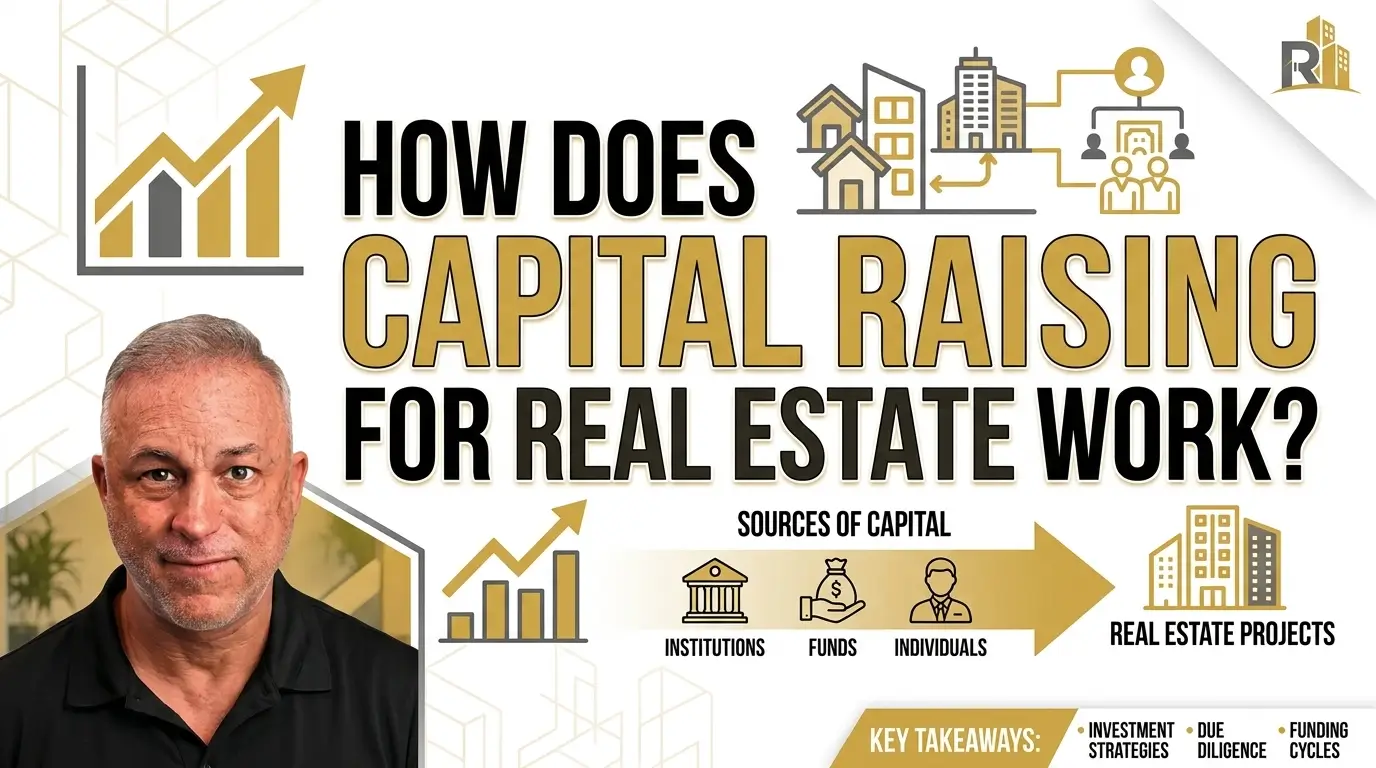
How Does Capital Raising for Real Estate Work?
How Should a Startup Handle Bridge Financing When a Founder or Executive Wants to Invest Personally in The Round?
Disclosure
Nothing on this site constitutes an offer to sell, or a solicitation of an offer to purchase, any security under the Securities Act of 1933, as amended, or any applicable state securities laws. Any offering of securities is made only by means of a formal private placement memorandum or other authorized offering documents delivered to qualified investors.
IRC Partners is a capital advisory firm. IRC Partners is not a registered investment adviser under the Investment Advisers Act of 1940 and does not provide investment advice as defined thereunder.
Certain statements in this article may constitute forward-looking statements, including statements regarding market conditions, capital availability, investor demand, and transaction outcomes. Such statements reflect current assumptions and expectations only. Actual results may differ materially due to market conditions, regulatory developments, company-specific factors, and other variables. IRC Partners makes no representation that any outcome, return, or result described herein will be achieved.
References to prior mandates, transaction volume, network credentials, or capital raised are provided for illustrative purposes only and do not constitute a guarantee or prediction of future results. Past performance is not indicative of future outcomes. Individual results will vary. Network credentials and transaction statistics referenced on this site reflect the aggregate experience of IRC Partners' principals and affiliated advisors and are not a representation of assets managed or transactions closed solely by IRC Partners.
Certain data, statistics, and information presented in this article have been obtained from third-party sources. IRC Partners has not independently verified such information and expressly disclaims responsibility for its accuracy, completeness, or timeliness. Readers should independently verify any third-party data before relying on it.
Readers are strongly encouraged to consult qualified legal, financial, and tax professionals before making any investment, capital raising, or business decision.
Schedule A Meeting
You get one shot to raise the right way. If this raise is worth doing, it’s worth doing with precision, leverage, and control.
This isn’t a practice run. Serious capital. Serious strategy. Let’s raise it right.
We onboard a maximum of seven
new strategic partners each quarter, by application only, to maximize your chances of securing the capital you need.
