.svg "CTA Arrow")


.png "Investor Ready Capital decorative background element")

What Materials Help Institutional Investors Evaluate a Sponsor's Capital Formation Readiness?
What Materials Help Institutional Investors Evaluate a Sponsor's Capital Formation Readiness?
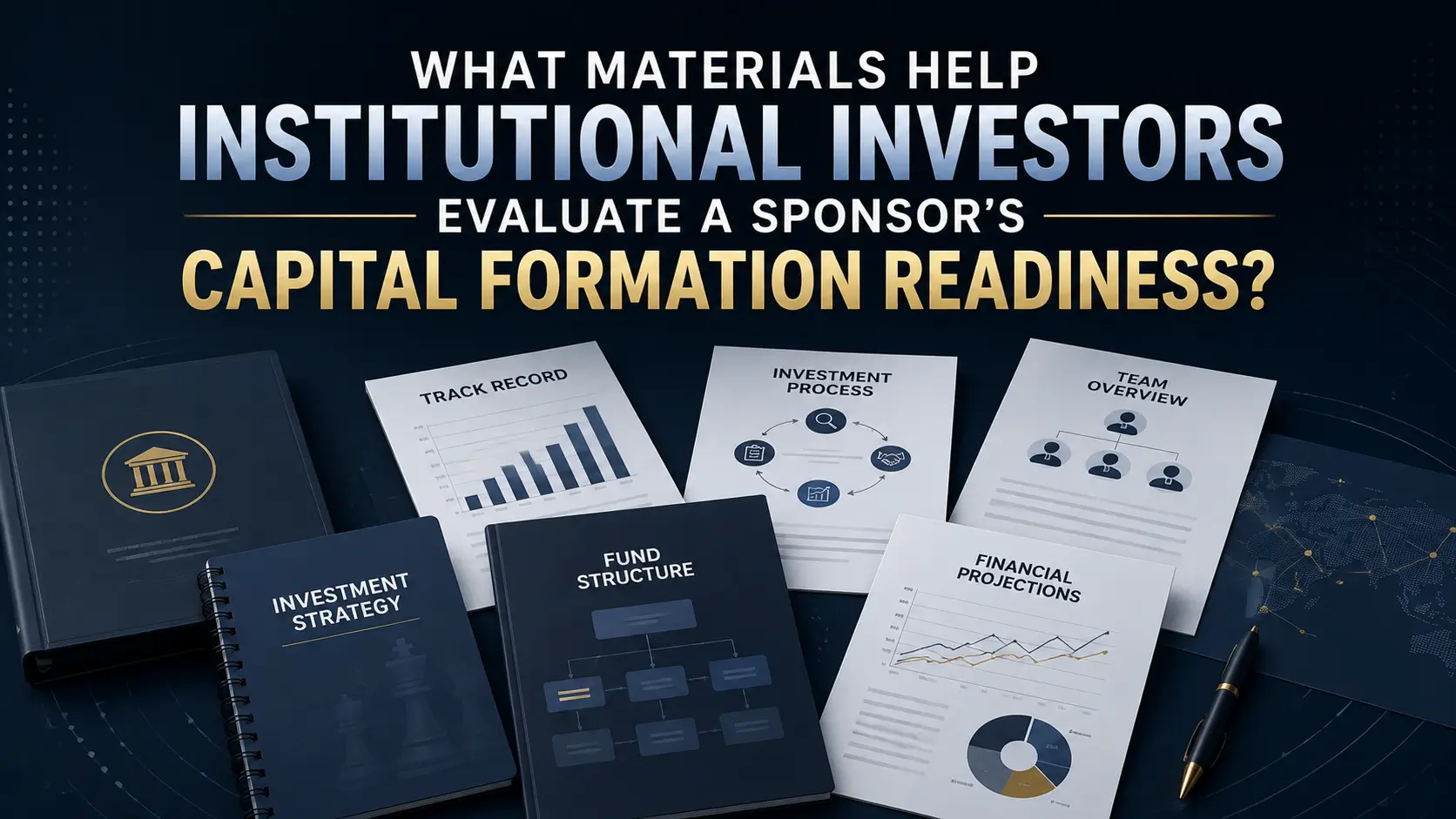
Institutional investors decide whether a sponsor is ready for deeper diligence before they evaluate return projections. An incomplete, inconsistent, or poorly organized materials package signals weak internal controls and can stall a raise at the initial screening stage. To pass this review, sponsors need six material groups that prove operational readiness: an executive summary, reconcilable track record, organized data room, financial support, current legal documents, and disciplined follow-up.
This article extends the investor-ready materials package guide by focusing on readiness signals rather than the master checklist. Sponsors who want a broader view of how capital raising advisory works for real estate teams can use that as a companion reference for the advisory scope that surrounds materials preparation. The question here is specific: what does each material group prove, and what do LPs infer when those materials are weak, inconsistent, or late?
For sponsors raising $5M or more, the answer matters early. Most institutional screens happen at the package review stage, well before a formal diligence call. Understanding how pre-data-room mistakes affect raise momentum is the first step toward protecting your access window.
The six material groups reviewed in every institutional screen:
- Executive summary and sponsor overview
- Track record schedule with project-level detail
- Data room structure, version control, and file organization
- Financial support materials including models, assumptions, and sensitivity tables
- Organizational, legal, and governance documents
- Follow-up responsiveness and document update discipline
Why Institutional Investors Treat Materials as a Readiness Screen
Institutional capital sources allocate time carefully. Before a senior investment officer joins a call or a committee reviews a deal, someone on the investment team has already reviewed the package. That review is a filter. It operates on one question: does this sponsor show the organizational discipline required to manage institutional capital? In 2026, investment and operational due diligence run as parallel tracks, and both must pass independently before capital moves.
A sponsor with a strong deal and a weak package loses to a sponsor with a good deal and a clean package. Investment staff need to summarize the opportunity to a senior committee. If the materials make that summary harder, the package stalls. The person forwarding it takes on reputational risk every time they send something that generates questions.
"The quality of a sponsor's materials reflects the quality of their internal controls. Institutional investors are evaluating the operator."
Materials get reviewed before models are stress-tested and before reference calls happen. A package that passes this early screen earns expanded diligence. One that raises questions about consistency or completeness often stops there.
Three ways weak materials create friction before the first real conversation:
- Missing information forces follow-up. A sponsor who cannot produce a clean data room index or a complete track record schedule on first send signals that the raise is still being assembled. Every clarification request adds days and reduces LP confidence.
- Inconsistencies across documents raise internal control questions. When the executive summary shows one equity multiple and the model shows another for the same project, investment staff flag it. That flag rarely resolves quietly.
- Promotional language without data support slows internal forwarding. A deck built on narrative rather than reconcilable figures gives investment staff nothing to anchor a committee summary. The package sits.
The Five Material Groups and What Each One Signals
Each material group communicates something specific about how the sponsor operates. LPs read these signals deliberately. Institutional review practice holds that investors must assure the consistency, completeness, and accuracy of documents before investing. The table below maps each group to what it proves and what a weak version communicates.
Executive Summary
The executive summary is reviewed first and sets the frame for everything that follows. A strong summary answers the institutional reader's core questions in the first two pages: who is the sponsor, what is the asset, what is the capital need, and what is the return structure. A weak one opens with the sponsor's founding story or a market overview that buries the capital ask on page four. By then, the reader has already formed an impression. Sponsors who understand what an LP-ready executive summary requires build this document around the reader's decision process.
Track Record Schedule
The track record schedule is the most scrutinized document in the package. LPs use it to test whether the sponsor's historical performance is reconcilable, comparable, and complete. A well-prepared track record schedule includes project-level detail, vintage year, total capitalization, equity deployed, exit date, and realized returns where applicable. A common mistake: sponsors list completed projects but omit the ones that underperformed or were restructured. Institutional LPs notice gaps in the vintage timeline. A schedule that jumps from 2018 to 2022 with no explanation creates an immediate question about what happened in between. Inconsistencies between the schedule and the executive summary are among the most common reasons a package stalls at the screening stage.
Data Room Structure
A well-organized data room signals that the sponsor can manage a structured diligence process without constant hand-holding. LPs look for logical folder architecture, consistent file naming, version-controlled documents, and a clear index. A disorganized room sends a specific signal: the sponsor has not run a structured raise before. A folder named "Final v3 REVISED USE THIS" tells an institutional reviewer everything they need to know about the sponsor's document control. Sponsors preparing for institutional outreach should review how to organize a data room before institutional outreach to ensure the room can support a 4 to 9 month raise process without document drift.
Financial Support Materials
Financial support materials include the deal-level model, assumptions schedule, sensitivity tables, and any third-party appraisals or market studies. These documents prove that the underwriting is sponsor-controlled, internally consistent, and stress-tested. A frequent failure point: the executive summary projects a 1.8x equity multiple but the model base case shows 1.6x with no explanation of the gap. Institutional readers do not assume the higher number is correct. They assume the sponsor does not own the model. The package should show the same numbers in every document, formatted consistently and traceable to a single source.
Organizational, Legal, and Process Materials
Governance documents, entity structure charts, operating agreements, and advisor engagement letters signal that the sponsor is legally and operationally prepared for an institutional relationship. LPs use these materials to assess whether the entity structure can support institutional co-investment, whether legal counsel is engaged, and whether the sponsor can respond to document requests under a defined timeline. A sponsor who cannot produce a current operating agreement or who has an entity structure that was set up for a retail syndication will trigger a legal review round that adds weeks. Institutional LPs co-invest through specific structures. If the entity cannot accommodate that, the conversation ends before the economics are debated.
What Investors Infer When Materials Are Inconsistent, Late, or Overly Polished
The package is a live test. LPs draw operational conclusions from how materials behave during review, not just what they contain.
Common inferences institutional investors make during the screening stage:
- Inconsistent figures across documents signal weak internal controls. When the deck, model, and track record show different numbers for the same project, LPs assume the sponsor does not have a single source of truth. That assumption extends to how the sponsor will manage capital reporting after close.
- Slow or incomplete responses to document requests signal poor process ownership. A sponsor who cannot produce a clean, updated data room within a reasonable window suggests that diligence management will be a burden throughout the raise.
- Overly promotional language without data support reduces forwarding confidence. Investment staff need to summarize the sponsor to a senior committee. A package built on narrative rather than reconcilable data makes that summary harder and increases reputational risk for the person forwarding it.
- Version drift across documents suggests the sponsor is revising in real time. Multiple versions of the same document in circulation signal that the package was not ready for distribution. LPs interpret this as a sign that the sponsor is still developing the opportunity rather than presenting a mature one.
- Missing organizational or legal materials delay timeline. When entity documents, operating agreements, or advisor letters are absent, LPs cannot assess governance readiness. That gap typically triggers a document request round that adds weeks to the process.
A clean, consistent, and complete package does the opposite. It reduces friction at every step, supports clean internal forwarding, and signals that the sponsor can manage institutional relationships at scale. Sponsors who have worked through capital stack risk reduction before outreach understand that documentation discipline and structural clarity are evaluated together. The five most common real estate capital raising mistakes that kill institutional raises all trace back to the same root: weak operational signals in the materials, not weak deals.
{{main-cta}}m
A Large-Cap Raise and the Role of Package Discipline
Documentation rigor shapes how institutional conversations begin. In one multifamily development raise in Texas with a total capitalization of $150M, IRC's advisory work centered on package structure, LP-facing economics clarity, and document coordination across the capital stack. That work sits alongside broader capital stack risk reduction discipline that institutional LPs evaluate in parallel with materials quality. The sponsor had a strong track record and a credible asset. The work was in aligning how that track record was presented, ensuring that the executive summary, financial model, and legal structure told a consistent story before institutional outreach began.
The result was a package that could move through internal review at the LP level without generating clarification requests that slow momentum. That kind of reviewability is built before the first conversation, not during it.
Key takeaway: Capital formation readiness depends on whether documents work together under the review conditions institutional LPs actually apply.
How to Become Review-Ready Before Institutional Outreach
Sponsors who want to pass the materials screen should run a readiness audit before distributing anything. The goal is to stress-test whether an LP could review the full package without generating follow-up questions.
Five-step review-readiness checklist:
- Reconcile all figures across every document. Pull the equity multiple, total capitalization, and projected return from the executive summary, model, and track record side by side. Any number that differs across documents must be resolved before anything is sent. One discrepancy is enough to stall a review.
- Audit the data room for completeness and structure. Walk through the room as if you are the LP seeing it for the first time. Every folder should be labeled, every file named consistently, and a master index present at the top level. If you cannot find a document in under 30 seconds, neither can the reviewer.
- Strip promotional language from financial documents. Replace phrases like "exceptional upside" or "strong market tailwinds" with the actual assumption behind them. Institutional readers skip narrative. They look for the number and the source.
- Confirm legal and organizational documents are current. Check that entity structure charts, operating agreements, and advisor letters reflect the current raise structure. A document dated two years ago for a different project creates questions about whether this raise has been properly structured.
- Test response readiness. Identify who owns each document category and how quickly they can produce an updated version on request. If the answer is "I need to check with my attorney" for a basic operating agreement, that gap will surface during diligence at the worst possible time.
Sponsors raising $5M or more can cross-reference the 47-document due diligence checklist to confirm completeness, then assess how those documents hold up under the readiness signals covered in this article before outreach begins.
Frequently Asked Questions
What is the first document an institutional investor reviews in a sponsor's package?
The executive summary is typically the first document reviewed in an institutional sponsor package. It sets the frame for everything that follows. If the summary cannot answer the reader's core questions within two pages, including sponsor identity, asset type, capital need, and return structure, the package loses momentum before deeper materials are opened.
How many documents does a sponsor typically need before institutional outreach?
A sponsor preparing for institutional outreach typically needs a minimum of six document categories ready before distribution: executive summary, track record schedule, data room with organized files, financial model with assumptions, organizational and legal documents, and a defined process for responding to follow-up requests. Gaps in any category trigger clarification rounds that slow a 4 to 9 month raise process.
What does a weak track record schedule signal to an institutional LP?
A weak track record schedule signals that the sponsor's historical performance may be incomplete, inconsistently formatted, or difficult to reconcile across projects. Institutional LPs use the schedule to test data integrity. When figures are missing, project comparisons are inconsistent, or realized returns cannot be verified, LPs treat the gap as an indicator of broader reporting risk.
How does document inconsistency affect a sponsor's raise timeline?
Document inconsistency directly extends a raise timeline by generating clarification requests at the screening stage. When figures differ across the executive summary, model, and track record, investment staff cannot summarize the sponsor internally without flagging the discrepancy. Each clarification round adds time and reduces the LP's confidence in the sponsor's internal controls.
What do institutional investors look for in a data room beyond the documents themselves?
Institutional investors evaluate data room structure, version control, and file organization as signals of operational maturity. A room with logical folder architecture, consistent file naming, a clear index, and no duplicate or outdated versions signals that the sponsor can manage a structured diligence process. A disorganized room increases perceived execution risk before any document is read.
When should a sponsor involve legal counsel in preparing materials for institutional review?
Legal counsel should be engaged before institutional outreach begins. Organizational documents, operating agreements, entity structure charts, and any advisor engagement letters need to reflect the current raise structure at the time of distribution. Institutional LPs review these materials to assess governance readiness and co-investment compatibility. Gaps or outdated documents are among the most common reasons a diligence process stalls at the organizational review stage.
How does follow-up responsiveness affect LP perception of a sponsor?
Follow-up responsiveness is treated as a proxy for diligence management capability. Sponsors who respond to document requests quickly, with accurate and version-controlled materials, signal that they can manage institutional reporting demands after close. Slow or incomplete responses suggest that the sponsor lacks process ownership, which raises questions about how they will manage investor relations throughout the hold period.
Continue reading this series:
- What should be included in an investor-ready materials package for a real estate sponsor?
- How should a real estate sponsor organize a data room before institutional outreach?
- What should an institutional LP-ready executive summary include for a real estate raise?
IRC Partners advises operators raising $5M to $250M of institutional capital on structure, positioning, and round architecture. We take seven strategic partners per quarter. No placement agent model. No success-only theater. Capital is raised on the strength of how the deal is built. If you want your current raise reviewed before it reaches the market and silently fails, apply here.
Need guidance on your capital raise?


How Do Family Offices Evaluate a Sponsor's Succession Plan Before Entering a Multi-Year Real Estate Investment Relationship?
How Long a SAFE Round Takes From Term Agreement to Close
How Should a Startup Amend Convertible Notes When Noteholders Have Different Maturity Dates?
Disclosure
Nothing on this site constitutes an offer to sell, or a solicitation of an offer to purchase, any security under the Securities Act of 1933, as amended, or any applicable state securities laws. Any offering of securities is made only by means of a formal private placement memorandum or other authorized offering documents delivered to qualified investors.
IRC Partners is a capital advisory firm. IRC Partners is not a registered investment adviser under the Investment Advisers Act of 1940 and does not provide investment advice as defined thereunder.
Certain statements in this article may constitute forward-looking statements, including statements regarding market conditions, capital availability, investor demand, and transaction outcomes. Such statements reflect current assumptions and expectations only. Actual results may differ materially due to market conditions, regulatory developments, company-specific factors, and other variables. IRC Partners makes no representation that any outcome, return, or result described herein will be achieved.
References to prior mandates, transaction volume, network credentials, or capital raised are provided for illustrative purposes only and do not constitute a guarantee or prediction of future results. Past performance is not indicative of future outcomes. Individual results will vary. Network credentials and transaction statistics referenced on this site reflect the aggregate experience of IRC Partners' principals and affiliated advisors and are not a representation of assets managed or transactions closed solely by IRC Partners.
Certain data, statistics, and information presented in this article have been obtained from third-party sources. IRC Partners has not independently verified such information and expressly disclaims responsibility for its accuracy, completeness, or timeliness. Readers should independently verify any third-party data before relying on it.
Readers are strongly encouraged to consult qualified legal, financial, and tax professionals before making any investment, capital raising, or business decision.
Schedule A Meeting
You get one shot to raise the right way. If this raise is worth doing, it’s worth doing with precision, leverage, and control.
This isn’t a practice run. Serious capital. Serious strategy. Let’s raise it right.
We onboard a maximum of seven
new strategic partners each quarter, by application only, to maximize your chances of securing the capital you need.
