.svg "CTA Arrow")


.png "Investor Ready Capital decorative background element")

How Long a SAFE Round Takes From Term Agreement to Close
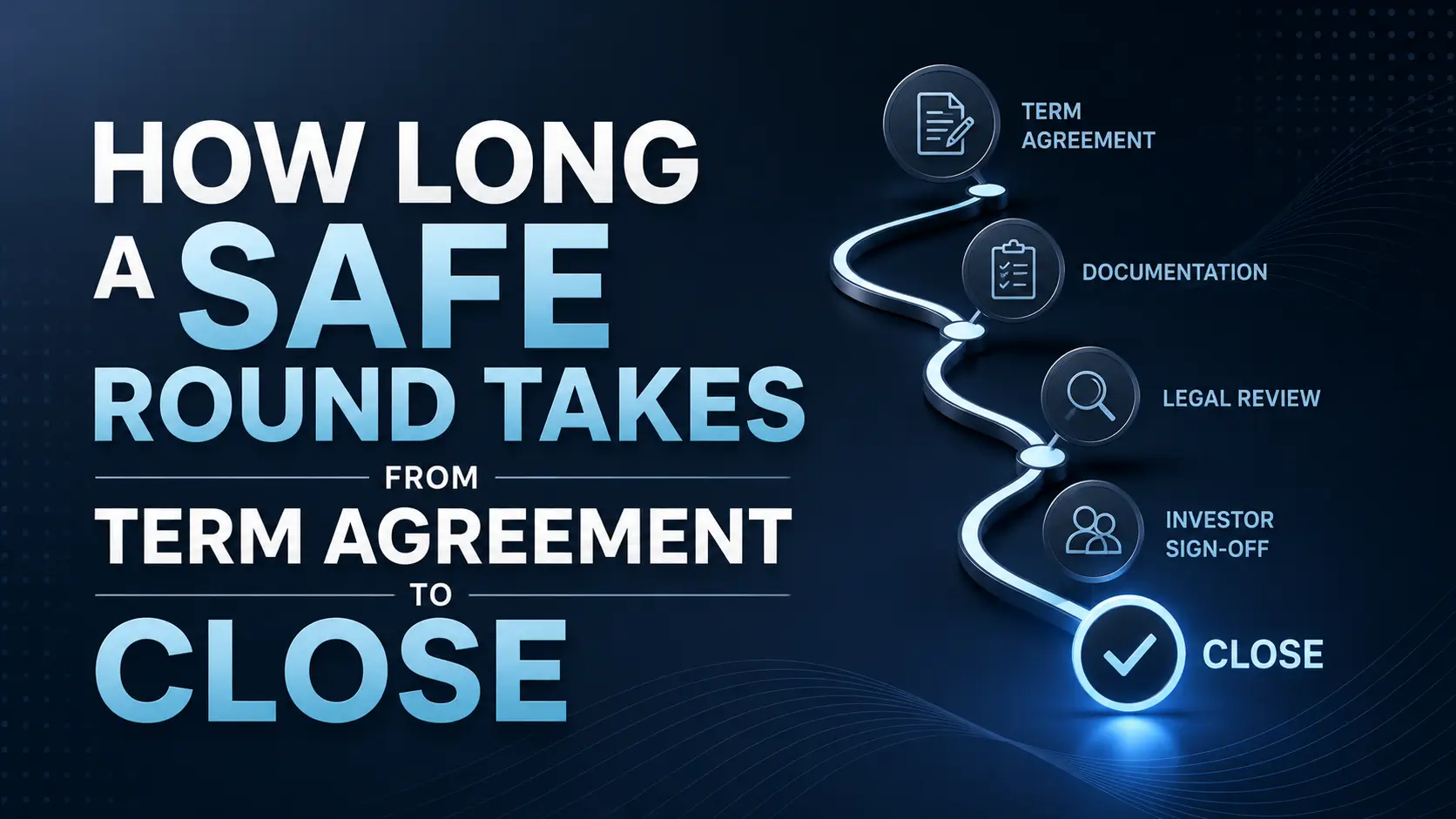
A SAFE round can close in 1 to 2 weeks after final term agreement when the founder uses a standard post-money SAFE, has counsel ready, and keeps all investors on one clean set of terms. Most founder-run rounds take 4 to 8 weeks because the close gets slowed by late counsel engagement, mixed investor terms, incomplete cap table records, side-letter requests, or legacy instrument cleanup.
The SAFE itself is rarely the timeline constraint. In 2026, post-money SAFE forms are widely standardized, so the real variable is founder preparation before drafting begins. Founders who resolve economics, investor documents, signatory details, wire logistics, and prior instrument issues before term agreement reach cash faster and avoid the 8 to 12 week close timelines that come from process fragmentation.
Key takeaway: In 2026, post-money SAFE forms are widely standardized. The primary timeline variable is how prepared the founder is before drafting begins, not how complex the instrument is.
For a full breakdown of how SAFEs and early-stage instruments work, including conversion mechanics and cost to the founder, see the SAFE notes and early-stage instruments. If you are deciding how to scope a SAFE structuring engagement before term agreement, how SAFE note structuring engagements are scoped covers what that process typically includes and how long it takes.
Convertible notes follow the same general sequence but add accrued interest modeling, maturity date review, and sometimes amendment or extension work before counsel can close. That adds time at almost every stage.
The Four Stages of a SAFE Close: What Each One Takes
Most founders think about close timelines as a single event. The reality is four distinct stages, each with its own delay profile. Understanding which stages are fixed and which are compressible is how founders forecast cash timing accurately.
Stage 1: Term Agreement to Legal Kickoff
This stage is compressible to one business day when the cap, investment amount, document type, and side-letter policy are already settled. It expands when any of those are still moving. Founders who treat "term agreement" as a handshake on rough economics rather than a fully resolved set of inputs will spend the first week of the close process finishing the negotiation they thought was done.
Stage 2: Legal Drafting and Review
Standard post-money SAFE paper is short. Counsel working from a clean YC-form SAFE with settled inputs can turn a draft in two to three business days. The stage expands when counsel must start from a custom template, when investors submit redlines, or when the instrument type changes after drafting begins.
Stage 3: Investor Signing
Signature logistics are the most underestimated delay in a SAFE close. Entity names, signatory authority, accredited investor confirmations, and side letter execution often surface after the main document circulates. Batching signature packets and confirming signatory details before circulation compresses this stage significantly.
Stage 4: Fund Transfer
Wire timing is mostly fixed at one to three business days once documents are fully executed. The compressible part is the pre-wire confirmation step. Founders who set up wire instructions and verification protocols before signing begins eliminate the back-and-forth that adds two to four extra days after execution.
Why the Same Instrument Produces Wildly Different Timelines
The 2026 SAFE market has largely converged on the post-money SAFE form as the default early-stage instrument. That standardization means the document itself is rarely the source of delay. What varies is the process around it.
Rounds that stretch to 8 to 12 weeks almost always share the same profile:
- Founders offered different caps, discount rates, or MFN rights to different investors and are now trying to reconcile terms after drafting starts
- Side letters for pro-rata rights, information rights, or board observer seats were promised verbally but never documented before circulation
- Legacy SAFEs or convertible notes from prior rounds need cleanup, amendment, or summary before the current round can close cleanly
- Multiple tranches with different economics are being processed as a single close instead of sequenced separately
The market shift matters here. In 2026, post-money SAFE forms are widely standardized. A long timeline now reflects process fragmentation: investors on different terms, counsel brought in late, or inputs that were never locked before the round opened.
Convertible notes add a separate layer. Before counsel can close a note round, they typically need to confirm maturity dates, calculate accrued interest, and assess whether any outstanding notes require amendment or extension. Each of those steps adds legal time that a plain SAFE does not require.
What Compresses the Timeline
Founders who close in four weeks or fewer share a common pattern: they resolve process inputs before term agreement, not after. The compression comes from arriving at the close with fewer open questions.
The four inputs that shorten every stage:
- A current, fully diluted cap table. Counsel needs this to draft accurately. Founders who hand over a clean cap table on day one of legal kickoff eliminate the discovery phase that adds three to five business days to most drafts.
- One standard SAFE form with one set of economics. Mixing caps, discounts, or side-letter terms across investors forces counsel to manage a matrix of variations instead of executing one clean document. One term set keeps the process linear.
- A pre-built investor packet. Confirmed legal entity names, signatory authority, accredited investor status, and wiring instructions collected before circulation prevent the back-and-forth that stalls signing by two to seven days.
- Counsel briefed before drafting begins. Counsel who receives a complete brief, standard form selection, and resolved inputs before the first draft turns execution work, not issue-spotting work. That distinction alone can compress the drafting stage by three to four business days.
What Extends the Timeline and the Red Flags That a Close Is Stalling
Most founders who experience an 8 to 12 week close can trace it back to one or more of the following:
- Unsigned or still-moving core terms after "agreement." A verbal agreement on a cap is not a term agreement. The clock on a real close starts when all material terms are resolved and confirmed in writing.
- Investor silence after verbal commitment. Radio silence after a verbal yes often reflects unresolved internal approval, entity paperwork not yet assembled, or discomfort with a term that was not fully negotiated. Chasing investors during the close is a sign the round was not actually ready to close.
- Counsel not engaged within two weeks of term agreement. Waiting more than two weeks to bring counsel in after term agreement is a process failure. It signals either that terms are still moving or that the founder has not yet assembled the inputs counsel needs to start.
- Legacy instrument cleanup discovered mid-close. Outstanding SAFEs or notes with mismatched records, missing signatures, or ambiguous economics that surface during drafting add one to three weeks of cleanup before the new round can proceed. The structural decisions that create that cleanup are covered in common mistakes founders make with SAFE notes and convertible instruments.
- Multiple tranches with different economics being treated as one close. Each tranche with distinct terms is effectively a separate legal close. Treating them as one extends the timeline for every investor in the round.
A stalled close rarely recovers on its own. If two or more of these signals are present three weeks into a close, the timeline will likely extend further without direct intervention on process.
{{main-cta}}
What Founders Should Have Ready Before Term Agreement
The fastest closes start well before the first investor signs. Founders who treat term agreement as the finish line of prep, not the starting line, consistently move through each stage faster.
Pre-term-agreement checklist:
- Current fully diluted cap table, including all outstanding SAFEs, convertible notes, warrants, and option pool
- Summary of every outstanding SAFE and convertible note: instrument type, cap, discount, MFN status, maturity date if applicable, and signing status
- Confirmed instrument selection: post-money SAFE, pre-money SAFE, or convertible note, with a clear rationale for the choice
- Resolved economics for all investors: one cap, one discount rate, one side-letter policy applied consistently
- Side-letter decisions made in advance: which rights, if any, will be offered and to whom
- Counsel identified and briefed, with a clear engagement scope before drafting begins
- Signatory and entity details collected for each investor, including accredited investor documentation
- Wire instructions and internal finance approval process confirmed before signing packets circulate
Founders who arrive at term agreement with these inputs resolved are not just faster. They are also less likely to encounter mid-close surprises that reopen economics or require legal cleanup.
For a step-by-step look at how SAFE conversion works after the round closes, see how SAFE note conversion works step by step. For a broader view of how timeline discipline shows up in a full engagement, see how long capital raising advisory takes.
Four Weeks vs. Eight Weeks: What the Difference Actually Looks Like
The gap between a four-week close and an eight-week close is almost never about the instrument. It is about when the founder resolved the inputs.
Composite Founder A: Four-Week Close
Before term agreement, this founder had a clean cap table, one post-money SAFE form with one cap applied to all investors, and counsel already briefed. Side-letter policy was set before the first investor was approached. Signature packets and wire instructions were built before circulation. From final term agreement to first wire: 22 business days.
Composite Founder B: Eight-Week Close
This founder reached term agreement with a verbal cap and two investors still asking for different discount rates. Counsel was engaged after the third week. Legacy notes from a prior round needed amendment before the new SAFE could close cleanly. Signature packets went out without confirming entity names. From verbal agreement to first wire: 41 business days, and the round was still collecting stragglers at week ten.
The difference is process control at the founder level.
Preparation shortens the path. Founders who resolve inputs before term agreement consistently reach cash faster and with fewer mid-close surprises.
Frequently Asked Questions
How long does a SAFE round typically take from term agreement to first wire?
A SAFE round takes 1 to 2 weeks from final term agreement to first wire when founders use a standard post-money SAFE form, have counsel engaged before drafting starts, and consolidate all investors on one set of terms. Most founder-run rounds land closer to 4 to 8 weeks because one or more of those conditions is not met at the time term agreement is reached.
What is the single biggest cause of SAFE close delays in 2026?
The most common cause of delay is fragmented investor terms: founders who offered different caps, discount rates, or MFN rights to different investors and then try to reconcile those differences after drafting begins. This forces counsel to manage multiple document variations instead of executing one clean instrument, which can add two to four weeks to the drafting and review stage alone.
Does a convertible note take longer to close than a plain SAFE?
A convertible note typically takes longer than a post-money SAFE because counsel must confirm the maturity date, calculate accrued interest, and assess whether any outstanding notes require amendment or extension before the new round can close. Each of those steps adds legal time that a plain SAFE does not require. For founders with existing notes, budget an additional one to two weeks compared to a clean SAFE close.
When should a founder engage legal counsel relative to term agreement?
Counsel should be identified, scoped, and briefed before term agreement is finalized. Founders who engage counsel on the day of term agreement or later lose the ability to compress the drafting stage. Counsel who receives a complete brief, confirmed document selection, and resolved inputs at kickoff can turn a draft in two to three business days. Counsel who must issue-spot from scratch typically takes seven to ten.
What inputs does counsel need at legal kickoff to start drafting immediately?
Counsel needs five things to start drafting without delay: a current fully diluted cap table, a confirmed instrument type and form, resolved economics for all investors, a side-letter policy decision, and confirmed signatory details for each investor. Founders who hand over all five at kickoff eliminate the discovery phase that adds three to five business days to most drafts.
Can a SAFE round close with multiple investors on different terms?
A SAFE round can include investors on different terms, but each distinct term set is effectively a separate legal close. Founders who process multiple term variations as a single close extend the timeline for every investor in the round and increase the risk of errors in the final documents. The cleaner approach is to standardize terms before approaching investors or to sequence tranches with different economics as separate closes.
What is a rolling close and how does it affect the overall SAFE round timeline?
A rolling close means the company executes and accepts SAFE documents from investors on a one-by-one basis as each investor is ready, rather than waiting for all investors to sign simultaneously. Rolling closes allow the company to receive early wires faster, sometimes within one to two weeks of the first investor signing, but they extend the total round timeline because the company continues collecting investors for weeks or months after the initial close. Founders using a rolling close structure should set a clear final close date to avoid indefinite collection periods.
Continue reading this series:
- What is a SAFE note and how do early-stage instruments work
- Valuation cap and discount: what each one costs the founder
- When a company should use a SAFE instead of a priced round
By the time most founders are rehearsing the pitch, the outcome of the raise has already been set by the structure underneath it. IRC Partners advises operators raising $5M to $250M of institutional capital and accepts seven strategic partners per quarter. If you are going to market this year, have the structure reviewed before investors do. Schedule a call with our team here.
Need guidance on your capital raise?


Negotiate Lighter Reporting for Real Estate Sponsors Raising $10M+

Why Your Drag-Along Threshold From Your Seed Round No Longer Protects You at Series A
How Should a Sponsor Present Acquisition Basis and Total Project Cost in Investor Materials?
Disclosure
Nothing on this site constitutes an offer to sell, or a solicitation of an offer to purchase, any security under the Securities Act of 1933, as amended, or any applicable state securities laws. Any offering of securities is made only by means of a formal private placement memorandum or other authorized offering documents delivered to qualified investors.
IRC Partners is a capital advisory firm. IRC Partners is not a registered investment adviser under the Investment Advisers Act of 1940 and does not provide investment advice as defined thereunder.
Certain statements in this article may constitute forward-looking statements, including statements regarding market conditions, capital availability, investor demand, and transaction outcomes. Such statements reflect current assumptions and expectations only. Actual results may differ materially due to market conditions, regulatory developments, company-specific factors, and other variables. IRC Partners makes no representation that any outcome, return, or result described herein will be achieved.
References to prior mandates, transaction volume, network credentials, or capital raised are provided for illustrative purposes only and do not constitute a guarantee or prediction of future results. Past performance is not indicative of future outcomes. Individual results will vary. Network credentials and transaction statistics referenced on this site reflect the aggregate experience of IRC Partners' principals and affiliated advisors and are not a representation of assets managed or transactions closed solely by IRC Partners.
Certain data, statistics, and information presented in this article have been obtained from third-party sources. IRC Partners has not independently verified such information and expressly disclaims responsibility for its accuracy, completeness, or timeliness. Readers should independently verify any third-party data before relying on it.
Readers are strongly encouraged to consult qualified legal, financial, and tax professionals before making any investment, capital raising, or business decision.
Schedule A Meeting
You get one shot to raise the right way. If this raise is worth doing, it’s worth doing with precision, leverage, and control.
This isn’t a practice run. Serious capital. Serious strategy. Let’s raise it right.
We onboard a maximum of seven
new strategic partners each quarter, by application only, to maximize your chances of securing the capital you need.
