.svg "CTA Arrow")


.png "Investor Ready Capital decorative background element")

What Financing Documents Should Be Updated When Bridge Capital is Raised Through Multiple Affiliated Entities?
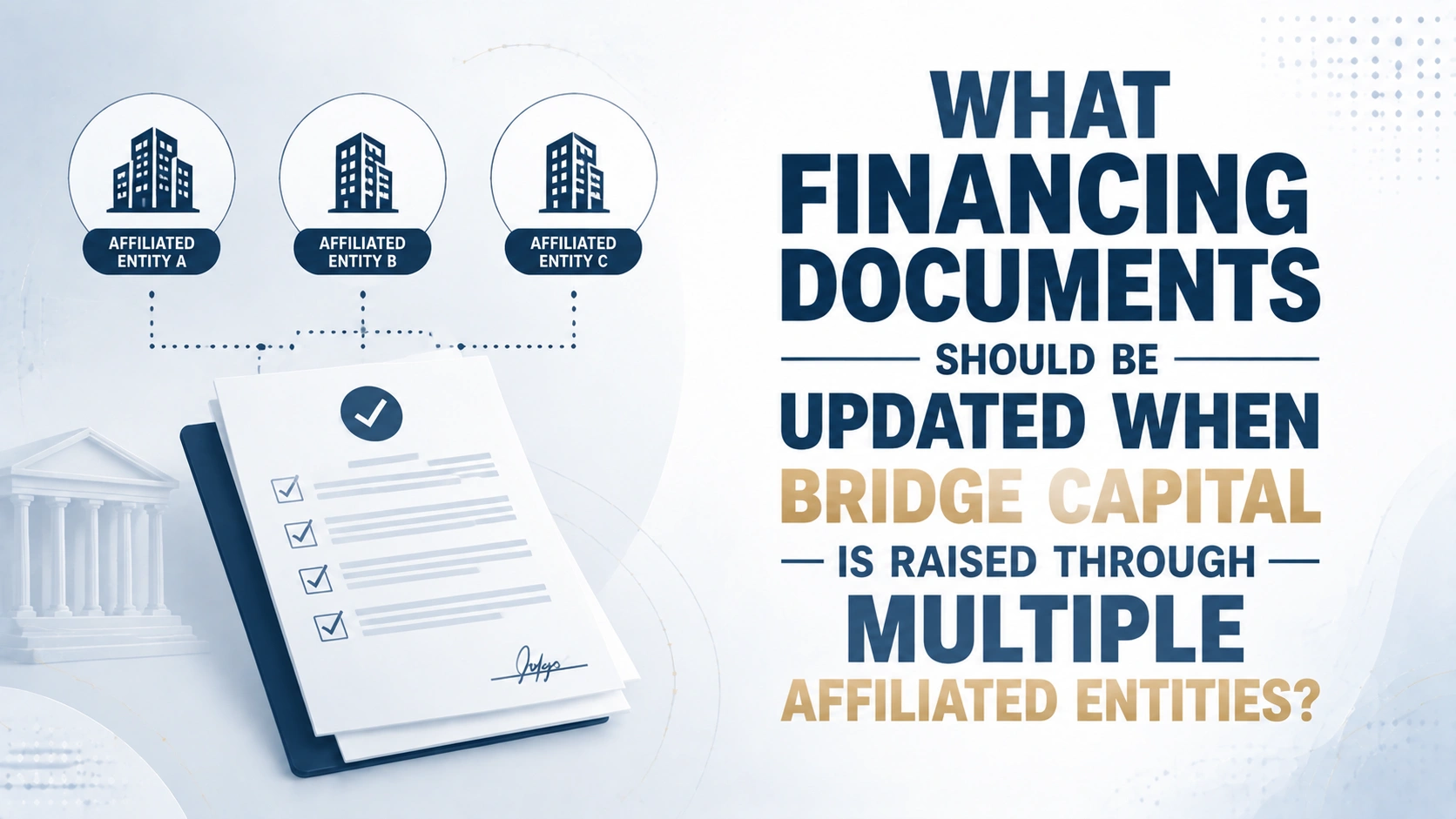
What Financing Documents Should Be Updated When Bridge Capital is Raised Through Multiple Affiliated Entities?
TL;DR: When bridge capital flows through multiple affiliated entities, six document layers must be updated at every entity before the first close.
- Why Multiple Affiliated Entities Create Document Update Risk: A single-entity bridge is straightforward.
- The Six Document Layers That Must Be Updated: Each layer below applies at the issuing company level and at every affiliated entity that participates in the bridge.
- How to Sequence the Updates Before First Close: The sequence matters as much as the checklist.
When bridge capital flows through two or more affiliated entities, six document layers must be updated across every entity before the first close: the cap table, the note purchase agreement, the board and entity-level authorizations, the stockholders agreement, any existing investors' rights agreement, and each investor's side letter. Skipping any one layer creates conflicting ownership records at the issuing company, unenforceable conversion rights at the SPV or holding company level, and cap table ambiguity that surfaces at the next priced round.
This is a sequencing problem. The documents do not update themselves when capital moves through a parallel fund or holding company. Each entity in the structure needs its own authorization, its own signature block, and its own reflected position in the cap table. Founders who treat the update as a single-company task discover the gap when a Series A or Series B lead requests a clean cap table and finds positions that do not reconcile across entities.
If you are structuring a bridge with pay-to-play provisions across multiple investor groups, the document update obligation compounds. The pay-to-play bridge financing framework explains how participation mechanics interact with conversion rights at the entity level. For context on how undisclosed side letters from these same bridge rounds surface as diligence problems later, the side letters and Series B diligence landmines article covers the downstream exposure in detail.
Why Multiple Affiliated Entities Create Document Update Risk
A single-entity bridge is straightforward. The issuing company signs a note purchase agreement, the board approves the issuance, and the cap table reflects the new notes. When a second entity enters the structure, the document chain multiplies.
Here is why the risk compounds:
- Separate legal existence. An SPV, holding company, or parallel fund is a distinct legal entity. Its authorization to invest, hold notes, and exercise conversion rights must come from its own governing documents, its own board or manager approval, and its own signature on the note purchase agreement.
- Separate cap table positions. The issuing company's cap table must reflect each entity as a distinct holder. Grouping affiliated entities under a single line item obscures the actual ownership structure and creates reconciliation problems at the next priced round.
- Separate side letter obligations. If any affiliated entity received a side letter with MFN rights, information rights, or pro-rata participation rights, those obligations run to that entity specifically. A side letter signed with Fund I does not automatically bind or benefit Fund II or an associated SPV.
- Separate conversion mechanics. When the bridge converts, each entity's conversion calculation runs independently. Discount rates, valuation caps, and accrued interest apply to each entity's note balance. If the note purchase agreement does not name each entity as a separate holder with its own principal amount, the conversion math is unenforceable.
Key point: The legal exposure is not theoretical. Institutional investors conducting Series A or Series B diligence request the complete capitalization table and all financing documents. When entity-level authorizations are missing or note holders are misidentified, counsel flags the gap as a structural defect. That flag can delay a close by weeks or require a remediation filing.
The problem is not that founders intend to skip a layer. The problem is that multi-entity bridge structures are often assembled quickly, and the document update sequence across every entity does not get the same attention as the commercial terms. That same off-document risk shows up in how side letters become Series B diligence landmines, where hidden rights surface late and force cleanup.
The Six Document Layers That Must Be Updated
Each layer below applies at the issuing company level and at every affiliated entity that participates in the bridge. Working through them in order prevents gaps.
1. Cap Table
Update the cap table before any funds transfer. Each affiliated entity must appear as a named holder with its own note balance, principal amount, and accrued interest tracking. If your cap table software groups entities, override the grouping. Diligence counsel will request the underlying records.
The convertible note overhangs article covers how misidentified note holders from earlier bridge rounds become conversion-math problems at Series B. The same dynamic applies when affiliated entities are not individually reflected.
2. Note Purchase Agreement
The note purchase agreement must name each affiliated entity as a separate purchaser with its own signature block and its own principal amount. A single omnibus signature by a managing entity does not establish the legal relationship between the issuing company and each entity in the structure. Each entity must sign in its own capacity.
Investor authorization requirements in convertible note transactions confirm that all action necessary for execution must be taken by each investor entity prior to closing. Those obligations run to named holders, not to affiliated groups.
3. Board and Entity-Level Authorizations
Two separate authorization chains must be completed before closing:
- Issuing company board approval. The board must approve the issuance to each named entity. A single board resolution that authorizes the bridge round should list each purchasing entity by name and reflect the principal amount allocated to each.
- Affiliated entity authorization. Each SPV, holding company, or parallel fund must produce its own authorization to invest. This is typically a manager consent, board resolution, or investment committee approval depending on the entity type. Without it, the entity's signature on the note purchase agreement may be challenged as unauthorized.
4. Stockholders Agreement
If existing investors hold rights under a stockholders agreement, the bridge issuance may trigger consent requirements, ROFR mechanics, or anti-dilution provisions. Check the consent thresholds. A bridge that crosses a threshold without the required consent creates a breach of the stockholders agreement, which surfaces in diligence as a governance defect.
Each affiliated entity that is a new party to the stockholders agreement must execute a joinder. Joinder agreement mechanics in stockholders agreements require each joining party to individually accept and be bound by the agreement's terms. Joinders cannot be executed in bulk on behalf of multiple entities by a single signatory unless the stockholders agreement explicitly permits it.
5. Investors' Rights Agreement
Pro-rata rights, information rights, and registration rights under an existing investors' rights agreement may need to be extended to each affiliated entity that participates in the bridge. Check whether the agreement covers "affiliates" by definition or requires each entity to be named as a separate party. If the agreement requires a separate joinder, each entity must execute one.
6. Side Letters
Any side letter from a prior round that includes MFN provisions must be reviewed before the bridge closes. If a new affiliated entity receives terms that are more favorable than terms in an existing side letter, the MFN provision may require the existing investor to receive the same terms. Failing to check this before close creates a breach that must be disclosed or remediated before the next round.
New side letters issued to affiliated entities in connection with the bridge must name each entity specifically. A side letter addressed to a fund manager does not automatically run to the fund's parallel vehicles or co-investment SPVs.
How to Sequence the Updates Before First Close
The sequence matters as much as the checklist. Completing steps out of order creates gaps that require re-execution.
Step 1: Confirm entity identities and signing authority. Before drafting any document, confirm the legal name, jurisdiction, and authorized signatory for each affiliated entity. Errors in entity names on a note purchase agreement require an amendment before the next round.
Step 2: Prepare the note purchase agreement with individual signature blocks. Draft one note purchase agreement that names each entity as a separate purchaser. Each entity signs in its own capacity. Do not use a single signature line with an "and its affiliates" addendum.
Step 3: Obtain entity-level authorizations. Collect the manager consent, board resolution, or investment committee approval from each affiliated entity before the closing date. These authorizations should reference the specific note purchase agreement and principal amount.
Step 4: Obtain issuing company board approval. The issuing company board resolution should list each purchasing entity by name. This is the record that counsel will pull in diligence to confirm authorized issuance.
Step 5: Update the cap table. Enter each entity as a named holder immediately after closing. Do not batch the update. The cap table date-stamps matter when diligence counsel audits the issuance timeline.
Step 6: Execute joinders and side letters. Complete any stockholders agreement or investors' rights agreement joinders. Issue any new side letters to named entities. Run the MFN check before issuing any new side letter.
Sequence rule: Steps 1 through 4 must be complete before any funds transfer. Steps 5 and 6 must be complete before any subsequent financing event is announced.
{{main-cta}}
What Breaks When a Layer Is Missed
A capital advisory engagement working with a growth-stage company preparing for an institutional raise uncovered a bridge round that had been closed through two affiliated entities. The note purchase agreement carried a single signature block executed by the managing entity on behalf of both vehicles. The cap table showed one combined note balance with no entity-level breakdown. Neither entity had produced its own authorization.
When the company's counsel ran a pre-raise document review, three problems surfaced. First, the conversion calculation was ambiguous because the note balance was not split between entities. Second, one of the affiliated entities had a side letter from a prior round with MFN rights. The new bridge terms were more favorable, which triggered the MFN obligation retroactively. Third, the stockholders agreement required a joinder from any new investor. Neither entity had executed one.
Remediating those three issues required amendments, retroactive joinders, and a side letter amendment, all of which had to be disclosed to the incoming institutional investor. The round closed, but the remediation added six weeks to the timeline and raised questions about governance discipline that the team had to address directly in management presentations.
The lesson is simple. Document discipline at the bridge stage is not a legal formality. It is a control point that protects the next raise.
Working With IRC Partners Before the Next Round
Institutional investors raising $5M to $250M need their bridge documentation to hold up under diligence. IRC Partners works with growth-stage founders and finance operators to audit the document stack across every entity layer before outreach begins. If a bridge was closed quickly and the entity-level updates were not fully completed, that gap can be identified and remediated before it becomes a diligence flag.
The cap table issues that kill a Series B article covers the full set of cap table defects institutional investors screen for before the first meeting. The enhanced pro-rata rights in bridge financing article addresses how allocation decisions across entities interact with pro-rata mechanics. If you are preparing for a raise and have a multi-entity bridge in your history, reach out to IRC Partners to review the document stack before investor outreach begins.
Frequently Asked Questions
Does each affiliated entity need its own signature on the note purchase agreement?
Yes. Each affiliated entity is a separate legal party to the transaction. A single signature by a managing entity "on behalf of" affiliated vehicles does not create a direct contractual relationship between the issuing company and each entity. When conversion rights are exercised, the issuing company needs a clear legal basis for issuing shares to each specific entity. That basis comes from each entity's own signature and principal amount in the note purchase agreement.
What happens to conversion rights if an affiliated entity's authorization is missing?
Missing entity-level authorization creates a challenge to the validity of that entity's note. If the entity's governing documents required investment committee approval or a manager consent before committing capital, and that approval was not obtained, the entity's investment may be voidable. At conversion, the issuing company's counsel may require a ratification or amendment before issuing shares, which delays the priced round close.
Can a single board resolution cover multiple affiliated entities?
The issuing company's board resolution can authorize the entire bridge round in a single document, but it must list each purchasing entity by name and reflect each entity's principal amount. What the resolution cannot do is substitute for the affiliated entity's own internal authorization. The issuing company board approves the issuance. Each affiliated entity's governing body approves the investment. These are two separate approvals.
When must the cap table be updated after a multi-entity bridge close?
The cap table must be updated immediately after closing, before any subsequent financing event is announced or any investor diligence request is received. Each affiliated entity must appear as a named holder with its own note balance. Cap table software that groups affiliated entities under a single line item must be overridden to show individual positions. The date of the update matters because diligence counsel audits the issuance timeline against board resolutions and transfer records.
Do MFN provisions in existing side letters automatically apply to affiliated entities in a new bridge?
MFN provisions run to the specific investor named in the side letter. They do not automatically extend to affiliated entities that were not parties to the original side letter. However, if the original investor's side letter includes broad MFN language covering any financing round, and a new affiliated entity receives more favorable terms in the bridge, the original investor may have a claim that the MFN was triggered. Review all existing side letters for MFN scope before issuing new side letters to affiliated entities.
What is a joinder and when does a bridge investor need to sign one?
A joinder is a short document by which a new party agrees to be bound by an existing agreement, typically a stockholders agreement or investors' rights agreement. If the existing agreements require any new investor to execute a joinder, each affiliated entity that participates in the bridge must sign its own joinder. A joinder signed by a fund manager on behalf of multiple affiliated vehicles is binding only if the agreement expressly permits omnibus execution. Check the agreement before accepting a single joinder for multiple entities.
How does a multi-entity bridge affect the cap table at the next priced round?
At the next priced round, each affiliated entity's notes convert independently based on that entity's principal amount, accrued interest, discount rate, and valuation cap. If the entities were not individually reflected in the cap table and note purchase agreement, the conversion math is ambiguous. The lead investor's counsel will request the underlying records to verify each entity's position. Ambiguity at this stage creates a remediation requirement before closing, which adds time and raises governance questions that the company must address directly.
Continue reading this series:
- How cap table issues kill a Series B before the lead investor reads your deck
- How convertible note overhangs from earlier rounds become Series B time bombs
- How consent rights turn your cap table into a governance blocker before Series B
IRC Partners advises operators raising $5M to $250M of institutional capital on structure, positioning, and round architecture. We take seven strategic partners per quarter. No placement agent model. No success-only theater. Capital is raised on the strength of how the deal is built. If you want your current raise reviewed before it reaches the market and silently fails, apply here.
Need guidance on your capital raise?


What Is Capital Raising Outcomes and Advisor Success Rates?
%20Elections%20Create%20a%20Tax%20Time%20Bomb%20at%20Series%20B.webp "How Missing 83(b) Elections Create a Tax Time Bomb at Series B")
How Missing 83(b) Elections on Founder and Employee Stock Create a Tax Time Bomb That Surfaces in Series B Diligence
How Should a Startup Document Investor Default Remedies in a Multi-Close Bridge Financing?
Disclosure
Nothing on this site constitutes an offer to sell, or a solicitation of an offer to purchase, any security under the Securities Act of 1933, as amended, or any applicable state securities laws. Any offering of securities is made only by means of a formal private placement memorandum or other authorized offering documents delivered to qualified investors.
IRC Partners is a capital advisory firm. IRC Partners is not a registered investment adviser under the Investment Advisers Act of 1940 and does not provide investment advice as defined thereunder.
Certain statements in this article may constitute forward-looking statements, including statements regarding market conditions, capital availability, investor demand, and transaction outcomes. Such statements reflect current assumptions and expectations only. Actual results may differ materially due to market conditions, regulatory developments, company-specific factors, and other variables. IRC Partners makes no representation that any outcome, return, or result described herein will be achieved.
References to prior mandates, transaction volume, network credentials, or capital raised are provided for illustrative purposes only and do not constitute a guarantee or prediction of future results. Past performance is not indicative of future outcomes. Individual results will vary. Network credentials and transaction statistics referenced on this site reflect the aggregate experience of IRC Partners' principals and affiliated advisors and are not a representation of assets managed or transactions closed solely by IRC Partners.
Certain data, statistics, and information presented in this article have been obtained from third-party sources. IRC Partners has not independently verified such information and expressly disclaims responsibility for its accuracy, completeness, or timeliness. Readers should independently verify any third-party data before relying on it.
Readers are strongly encouraged to consult qualified legal, financial, and tax professionals before making any investment, capital raising, or business decision.
Schedule A Meeting
You get one shot to raise the right way. If this raise is worth doing, it’s worth doing with precision, leverage, and control.
This isn’t a practice run. Serious capital. Serious strategy. Let’s raise it right.
We onboard a maximum of seven
new strategic partners each quarter, by application only, to maximize your chances of securing the capital you need.
