.svg "CTA Arrow")


.png "Investor Ready Capital decorative background element")

What a Price Floor Provision Is - and Why Accepting a Drag-Along Without One Puts Founders at Risk in a Down Market
What a Price Floor Provision Is - and Why Accepting a Drag-Along Without One Puts Founders at Risk in a Down Market
A price floor provision is a contractual term inside a drag-along clause that sets a minimum acceptable sale value before drag-along rights can be used to compel dissenting holders into a transaction. Without one, the drag-along trigger is purely governance-based: once the required consent threshold is met, the sale can proceed at any price, regardless of what founders or common stockholders consider economically acceptable. That distinction matters most in a down market, where investors with liquidation preference coverage may rationally support a low-price exit that still returns meaningful capital to them while leaving founders, employees, and common holders with little or nothing.
Understanding how this risk works starts with the basics of how drag-along provisions function in growth-stage companies and how they differ from tag-along rights. Confusing drag-along and tag-along rights costs founders real money at exit, because tag-along protects your right to participate in a sale while drag-along compels you to support one, even if you disagree with the price.
Three things every founder should know before the next round closes:
- A price floor provision sets a minimum sale value or minimum economic outcome that must be satisfied before drag-along rights can force a transaction.
- Without a floor, approving holders can legally satisfy the drag-along consent threshold while supporting a sale price that founders and common holders consider destructive.
- In a weak market, low-price exits become more plausible and more attractive to parts of the cap table with senior stack protection, making the missing floor a concrete risk rather than a theoretical one.
How a Drag-Along Can Force a Low-Price Sale Even When Founders Oppose It
Most founders assume that opposing a sale gives them meaningful protection. It does not, once a drag-along clause is in the documents and the required consent group has voted in favor. The mechanics work in a specific sequence that has nothing to do with whether founders think the price is fair.
- The consent threshold is satisfied without founder approval. Depending on how the drag-along is drafted, the required approval may be a majority of preferred shares, a supermajority of all shares voting together, or some combination. If founders do not hold enough of the approving class, their objection does not block the trigger. How threshold design affects who actually controls the vote is a separate structural question covered in the 51% vs 75% drag-along threshold analysis.
- Once triggered, dissenting holders are compelled to sign. The drag-along requires minority and dissenting holders to execute the sale documents, vote in favor, and take any other steps necessary to close the transaction. Refusal can expose dissenting holders to legal liability for blocking a valid transaction.
- The trigger is governance-based, not outcome-based. There is no economic check built into a standard drag-along. The clause asks whether the right parties approved, not whether the price is acceptable to everyone on the cap table. That is precisely what a price floor provision is designed to fix.
- A separate common approval overlay adds an economic constituency check. Rather than relying on investor-majority consent alone, a common approval overlay requires that a separate vote of common holders, or common holders above a defined threshold, also approve before drag-along compulsion applies. This is stronger protection than a price floor alone, because it adds a constituency with aligned economic interests to the approval gate.
Delaware merger law under Section 251 of the General Corporation Law governs the statutory mechanics of merger approval. It does not solve the private allocation problem. A transaction can satisfy Delaware's merger approval requirements and still leave founders with no proceeds if the private drag-along documents contain no minimum price protection.
Why Investors and Founders Experience the Same Sale Price Differently
The headline sale number is not the number that matters. What matters is how proceeds move through the waterfall after senior claims are paid. In a down market, the gap between headline value and founder proceeds can be large enough to make the same transaction look like a win for preferred holders and a wipeout for common.
A Simple Waterfall Illustration
Consider a hypothetical company that raised $15M across two rounds, with a 1x non-participating liquidation preference on the Seed and a 1.5x participating preference on the Series A. The company sells for $18M.
At an $18M sale, investors recover their capital plus a return. Common holders split roughly $1.5M across founders, employees, and the option pool. If the option pool is 15%, the actual founder share of that residual is smaller still.
The real risk: A preferred investor with full preference coverage may support a sale at $18M because they recover their invested capital plus a return. A founder who joined at a $40M post-money valuation receives a fraction of what they expected. Neither party is acting improperly. Their economic incentives simply diverge at low sale prices.
Participation rights widen this gap further. A participating preferred holder recovers their liquidation preference first and then shares in remaining proceeds alongside common. That structure, documented in the NVCA Model Legal Documents as a standard but founder-unfavorable term, can produce dramatically different outcomes for different holder classes at the same sale price.
This is why a price floor provision cannot be evaluated in isolation. The floor must be calibrated against the actual proceeds waterfall, not against the headline sale value, or it may be set at a level that still leaves common with little after preferences are paid.
What Happens When There Is No Price Floor in a Weak Market
A missing price floor does not announce itself. Founders often discover the gap only when a sale process is already live, term sheets are on the table, and the leverage to renegotiate governance documents has already shifted to the investors running the process.
Here is what that looks like in practice:
- Investor incentives diverge without anyone acting improperly. In a soft market, a preferred holder with 1x or 1.5x preference coverage may genuinely prefer a lower-price exit now over holding for an uncertain higher-price exit later. That preference is rational for them. Without a price floor, nothing in the drag-along documents requires their preferred outcome to align with founder outcomes.
- Employees and option holders absorb the most concentrated risk. Proceeds disappear above the common line before the option pool sees anything. A company can sell for a headline number that sounds meaningful while the option pool receives near zero after preferences are paid. How founders lose exit timing control is closely related: the same market conditions that compress valuations also compress the window in which founders can negotiate better terms.
- Ambiguous valuation definitions make the problem worse. If the drag-along documents do not define what counts as consideration, whether earnouts and escrows are included, or how rollover equity is valued, then even a floor that exists on paper can be satisfied in ways that do not reflect actual founder economics. Why ambiguous voting calculations in drag-along clauses create hidden exposure applies equally to valuation definitions inside price floor provisions.
- Layered rounds increase the exposure. Each new preferred round adds another preference claim ahead of common. The more capital raised at stacked preferences, the lower the sale price at which investors break even, and the wider the gap between what satisfies investor downside and what produces any real return for founders.
{{main-cta}}
The pattern is consistent: founders who treat price floor provisions as a future negotiation item discover that the future negotiation happens under conditions where they have the least leverage.
What Founders Should Ask to Include in a Price Floor Provision
A price floor provision is only as strong as its drafting. The term can exist in a document and still fail to protect founders if the formula is weak, the valuation definitions are vague, or the floor operates independently of the actual proceeds waterfall. Before the next round closes, founders should ask for the following:
- Tie the floor to a specific, measurable formula. A fixed dollar threshold, a multiple of total invested capital, or a minimum per-share return for common holders are all workable formulations. Vague language like "fair value" or "reasonable consideration" gives the approving group room to argue that any price satisfies the floor.
- Pair the floor with a separate common approval overlay. A price floor sets a minimum value. A common approval overlay adds a separate vote requirement from the economic constituency most affected by a low-price exit. Both together are stronger than either alone. Clause variations that favor investors over founders often omit the common overlay entirely, leaving the floor as the only protection.
- Define what counts as consideration. The floor calculation should specify whether earnouts, escrow holdbacks, rollover equity, assumed liabilities, and contingent proceeds are included or excluded. A floor set against total headline consideration can be satisfied at a price that does not reflect what founders actually receive at closing.
- Review the floor against the full liquidation waterfall. A floor set at $20M means very little if $18M of that is absorbed by preference claims before common sees proceeds. The floor should be calibrated to produce a minimum economic outcome for common, not just a minimum sale price for the transaction overall.
- Start the conversation before the round closes, not after. IRC Partners works with founders on capital structure and investor economics before financing events close, when the terms are still negotiable and the leverage to request protections like a price floor provision is at its highest.
The NVCA Model Legal Documents provide a useful drafting reference for how sale-related protections and investor rights are typically framed in venture financing agreements. They are a starting point for understanding market norms, not a substitute for reviewing your specific documents with qualified counsel.
Frequently Asked Questions
What is a price floor provision in a drag-along clause?
A price floor provision is a contractual term that sets a minimum sale value, minimum per-share price, or minimum economic return that must be met before drag-along rights can be used to compel dissenting holders into a transaction. Without a floor, the drag-along trigger depends entirely on whether the required consent group approved the deal, not on whether the sale price produces an acceptable outcome for founders or common stockholders.
Why is a price floor different from a drag-along voting threshold?
A voting threshold determines which holders must approve a sale before drag-along compulsion applies. A price floor determines the minimum value at which that compulsion can be triggered. They are separate protections. A high voting threshold, such as 75% of all shares, tells you who must approve. A price floor tells you the minimum the company must sell for before anyone can be compelled. Founders need both, because a high threshold with no floor still allows a forced sale at a low price if the required approving group consents.
Can investors force a company sale at a price founders think is too low?
Yes, if the drag-along documents contain no minimum price protection and the required consent threshold is met. Once the approving group satisfies the threshold, the drag-along compels dissenting holders to execute sale documents and support the transaction regardless of their view on the price. The absence of a price floor means there is no economic check on the trigger, only a governance one.
How do liquidation preferences change the economics of a down-market drag-along sale?
Liquidation preferences allow preferred holders to recover a fixed amount before common stockholders receive any proceeds. In a down market, a sale price that fully covers investor preferences may leave little or no residual value for common. A 1x non-participating preference means preferred holders get their invested capital back first. A 1.5x participating preference means they get 1.5x their investment back and then share in remaining proceeds alongside common. The lower the sale price relative to total invested capital, the more completely preferences absorb the waterfall before common sees anything. This is why IRS Section 409A valuations use a different methodology than negotiated sale-price protections: tax valuation concepts and drag-along economic protections are separate questions that require separate analysis.
What should a founder ask to include in a drag-along price floor provision?
Founders should ask that the floor be tied to a specific formula rather than a vague standard, that the definition of consideration include or explicitly exclude earnouts, escrow holdbacks, and rollover equity, and that the floor be calibrated against the proceeds waterfall rather than just the headline sale price. Pairing the floor with a separate common approval overlay is also worth requesting, because a floor that can be satisfied at a price that still wipes out common after preferences is not meaningful protection.
Does a price floor protect employee option holders and common stockholders?
A well-drafted price floor can protect common stockholders and option holders, but only if it is structured around what they actually receive after the proceeds waterfall is applied, not around the headline sale value. A floor set at total transaction value may be satisfied at a price that still leaves the common pool with near zero after liquidation preferences and participation rights are paid. Protection for option holders specifically requires that the floor be calibrated to produce residual proceeds below the preference line, not just a transaction price that satisfies senior holders.
Can a price floor still fail if the valuation definition is vague?
Yes. A price floor that uses undefined terms like "aggregate consideration," "total transaction value," or "fair market value" without specifying how earnouts, escrows, assumed liabilities, and contingent proceeds are treated can be satisfied in ways that do not reflect what founders or common holders actually receive. Vague definitions give the approving group room to argue that a low-cash, high-contingency deal satisfies the floor even if the founder's real economic outcome is far below the stated minimum. Precise drafting of the valuation definition is as important as the floor itself.
Continue reading this series:
- Why your drag-along threshold from your seed round no longer protects you at Series A
- How drag-along consent structures can let a minority investor force a majority outcome
- What happens to drag-along rights when you layer a Series B
The structure you carry into your first investor meeting sets the terms for every round that follows it. Founders who get it wrong spend the next three rounds negotiating from behind. The Capital Raise Pre-Flight is IRC Partners’ fixed-fee diagnostic that scores a raise against the same twelve institutional gates a deal must clear before IRC Partners takes it into a strategic partnership. IRC Partners advises operators raising $5M to $250M of institutional capital. Book your Capital Raise Pre-Flight here.
Sponsors weighing this decision should first complete a capital raise readiness assessment for sponsors to confirm the raise is investor-ready.
Need guidance on your capital raise?



The Option Pool Shuffle: How Investors Use Pre-Money Pool Creation to Dilute You Before the Round Closes
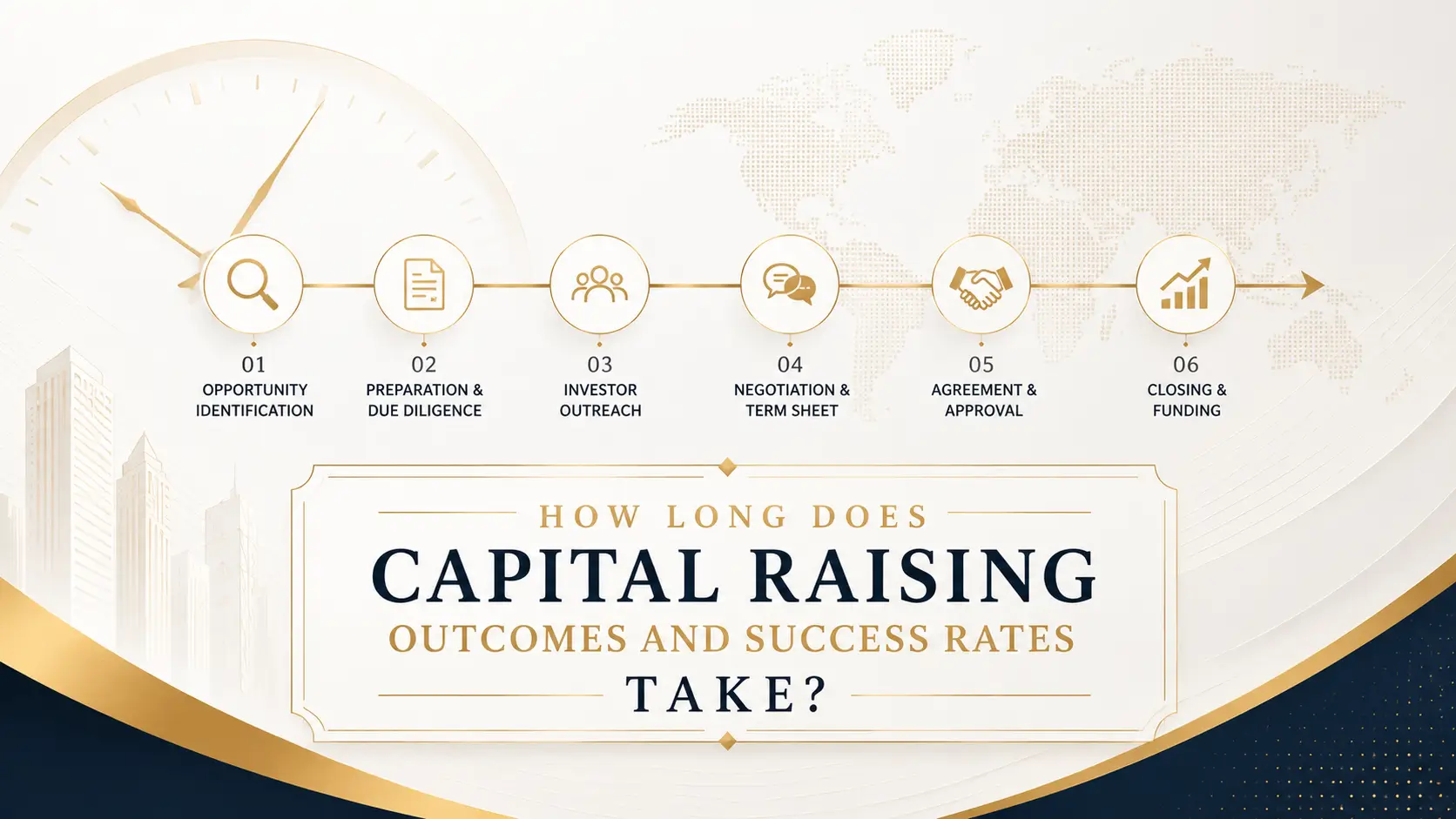
How Long Does Capital Raising Outcomes and Success Rates Take?
What Bridge Financing Terms Create Problems When a Company Expects To Pursue a Strategic Sale Within Twelve Months?
Disclosure
Nothing on this site constitutes an offer to sell, or a solicitation of an offer to purchase, any security under the Securities Act of 1933, as amended, or any applicable state securities laws. Any offering of securities is made only by means of a formal private placement memorandum or other authorized offering documents delivered to qualified investors.
IRC Partners is a capital advisory firm. IRC Partners is not a registered investment adviser under the Investment Advisers Act of 1940 and does not provide investment advice as defined thereunder.
Certain statements in this article may constitute forward-looking statements, including statements regarding market conditions, capital availability, investor demand, and transaction outcomes. Such statements reflect current assumptions and expectations only. Actual results may differ materially due to market conditions, regulatory developments, company-specific factors, and other variables. IRC Partners makes no representation that any outcome, return, or result described herein will be achieved.
References to prior mandates, transaction volume, network credentials, or capital raised are provided for illustrative purposes only and do not constitute a guarantee or prediction of future results. Past performance is not indicative of future outcomes. Individual results will vary. Network credentials and transaction statistics referenced on this site reflect the aggregate experience of IRC Partners' principals and affiliated advisors and are not a representation of assets managed or transactions closed solely by IRC Partners.
Certain data, statistics, and information presented in this article have been obtained from third-party sources. IRC Partners has not independently verified such information and expressly disclaims responsibility for its accuracy, completeness, or timeliness. Readers should independently verify any third-party data before relying on it.
Readers are strongly encouraged to consult qualified legal, financial, and tax professionals before making any investment, capital raising, or business decision.
Schedule A Meeting
You get one shot to raise the right way. If this raise is worth doing, it’s worth doing with precision, leverage, and control.
This isn’t a practice run. Serious capital. Serious strategy. Let’s raise it right.
We onboard a maximum of seven
new strategic partners each quarter, by application only, to maximize your chances of securing the capital you need.
