.svg "CTA Arrow")


.png "Investor Ready Capital decorative background element")

How Sponsors Negotiate Reporting Before a $10M Institutional Close
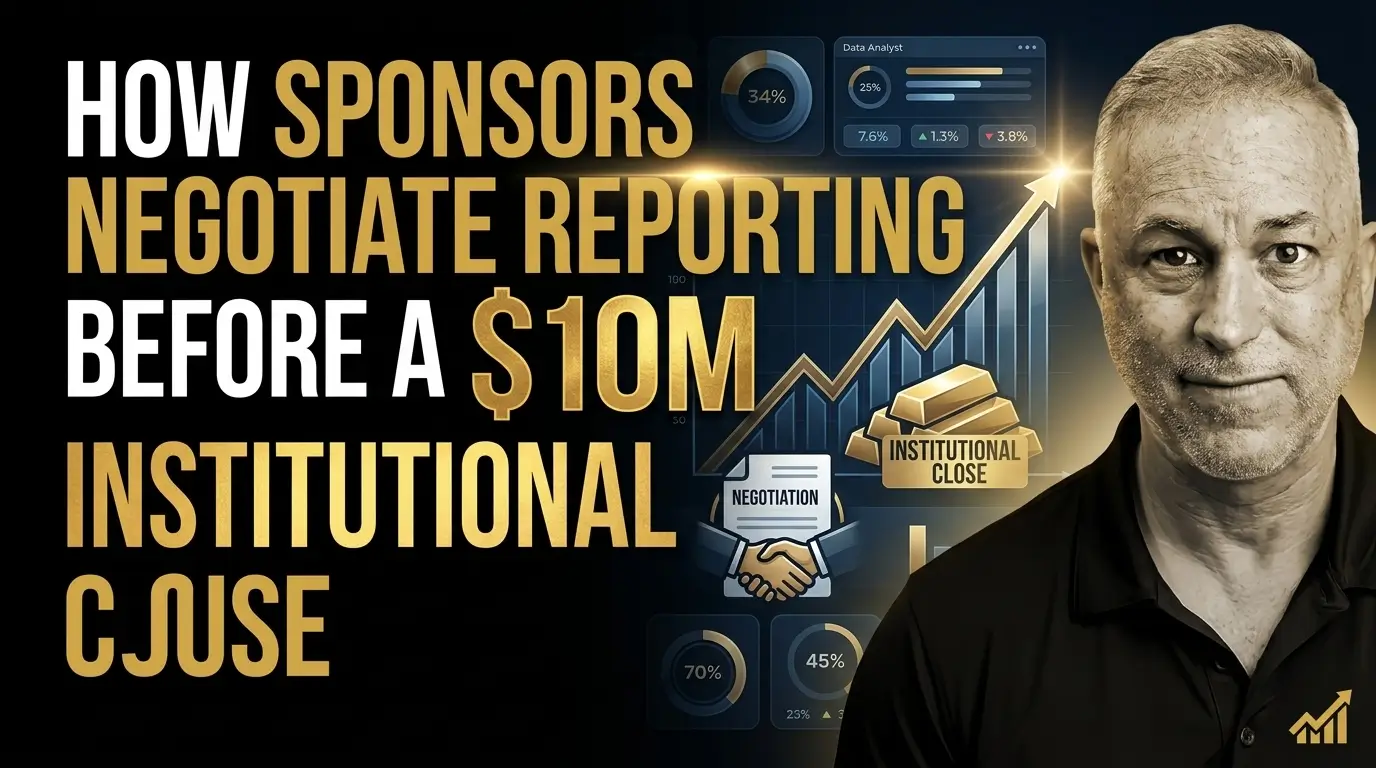
During a $10M institutional close, real estate sponsors often receive draft investors' rights agreements containing reporting requirements meant for larger, more mature companies. Because these documents are locked upon signing, the pre-close window is the only time to ensure reporting is decision-useful rather than administratively burdensome.
At a $10M institutional close, the reporting package in the draft investors' rights agreement is almost never written for a company your size. It is written for a template. Institutional investors use standardized legal documents because they are efficient, not because every clause fits every deal. The NVCA Model Legal Documents, updated in October 2025, reflect what market norms actually look like at this stage: quarterly unaudited financials within 45 days, annual audited financials within 120 days, monthly financials only upon request, and no obligation to create new reporting infrastructure beyond what the company already maintains. Most draft agreements sponsors receive at the $10M close stage ask for more than that.
This is not a complaint about investor intentions. It is a structural reality. The investor's legal team starts from a document built for a $50M growth deal, and the burden is on the sponsor to flag what does not fit. The leverage window is narrow: once the investors' rights agreement is signed, the package is locked. Before signing, a well-framed calibration ask reads as close-readiness. After signing, the same ask reads as a renegotiation.
Understanding how to negotiate information rights and reporting obligations with institutional investors before signing is the broader framework. This article is specifically about the $10M close stage, where the dynamics are different.
Three things sponsors at the $10M stage need to know before engaging on reporting terms:
- The investor's draft is a starting point, not a final position, and many clauses are template carryover rather than intentional asks
- The right framing is not "less reporting" but "decision-useful reporting calibrated to this deal's size, stage, and existing systems"
- Every narrowing request should come paired with a reliability statement: what you already track, how fast you can deliver it, and what triggers a management update
What Template Overreach Looks Like at the $10M Stage
Template overreach is not about any single clause being unreasonable in isolation. It is about a mismatch between what the reporting package assumes and what a lean finance team at a $10M deal can actually support.
The most common signs of overreach at this deal size: standing monthly financial deliverables with short turnaround windows, custom KPI schedules that require new data infrastructure, board-style narrative memos on a recurring basis, and accelerated deadlines that assume a controller-level finance function the sponsor does not yet have.
The SEC's 2026 materiality direction is useful framing here. Disclosures should be decision-useful and tied to investor economics. Reporting obligations that produce administrative cost without adding governance value at the $10M stage do not meet that standard, and sponsors can use that logic directly in the negotiation.
The harder judgment call is distinguishing what is template carryover from what is an intentional ask. Not every heavy clause is lazy drafting.
When in doubt, the fastest way to tell the difference is to ask the investor's counsel what specific decision or obligation the clause supports. Template language rarely has a clean answer. Intentional asks almost always do.
How to Frame the Calibration Argument Without Sounding Resistant
The sponsor's goal in this conversation is not to fight reporting. It is to show the investor that the proposed package is calibrated to the actual deal. That framing matters more than the specific clauses you are trying to move.
NVCA guidance is explicit that reporting obligations should be appropriate for company stage and deal size. A $10M sponsor has a legitimate basis to propose narrower terms than a $50M deal would carry. The argument is not "this is too much." It is "this package was built for a different company, and here is what reliable visibility looks like at our stage."
Use this three-step sequence when opening the conversation:
- Anchor to market norms. Reference the NVCA October 2025 baseline as the calibration standard for a deal of this size: quarterly unaudited statements within 45 days, annual audited statements within 120 days, monthly financials only on request. This frames the ask as market-informed, not self-serving.
- State what you already track. Tell the investor what your existing reporting systems produce, how fast, and in what format. This is the reliability statement that converts a narrowing request from "less" to "what we can actually deliver consistently."
- Offer a trigger-based management update. Commit to a short management commentary tied to material developments: major leasing events, budget variances above a defined threshold, capital events, or material operational changes. This replaces open-ended narrative obligations with a defined, manageable scope.
This sequence works because it reads as operational clarity, not friction. Sponsors who come to the reporting conversation with a prepared baseline and a reliability statement close faster than those who push back clause by clause without a framework.
If you are still working through how to read the draft agreement before this conversation, the guide on how to read a term sheet and the key clauses to know before signing is a useful reference point.
Stage-Appropriate Substitutions That Protect Investor Visibility
The CAQ's 2025 institutional investor survey found that 91% of institutional investors rely on audited financial statements as their primary financial information source, and 96% say current reporting has provided the information they need. That data supports a clear argument: a well-structured baseline package already covers what most institutional investors actually rely on at the $10M stage.
The substitution approach works because it does not delete reporting. It replaces obligations that require new infrastructure with obligations that use what the sponsor already has. For investors, the outcome is the same: reliable, timely visibility. For sponsors, the outcome is a package their team can sustain without a finance build-out.
For additional tactics on limiting quarterly reporting burdens when signing with institutional investors for $10M deals, the sibling article in this series covers the cadence-specific negotiation in more depth.
The key principle across all substitutions: the investor should be able to see what they need to make decisions. The sponsor should not be required to build new systems to produce it.
{{main-cta}}
How One Sponsor Narrowed the Package and Still Closed
A real estate development sponsor approaching a first institutional close near $10M received a draft investors' rights agreement with three reporting obligations that did not match the deal. The draft required standing monthly financial delivery within 21 days, a custom KPI schedule tied to metrics the sponsor did not currently track, and a recurring narrative management memo with no defined scope or trigger.
The sponsor's advisory team identified all three as template carryover. None of the obligations appeared in the investor's diligence requests, and when the investor's counsel was asked what specific decision each clause supported, two of the three had no clear answer.
The sponsor proposed three substitutions before the final negotiation session: monthly financials on written request only, existing operating reports in place of the custom KPI schedule, and a defined management update triggered by material variances or capital events rather than a standing delivery requirement. The investor accepted all three. The deal closed on the original timeline without repricing.
This outcome is not guaranteed. Deal dynamics vary, and investors with fund-level reporting constraints may hold firm on specific clauses regardless of deal size. What the example shows is that calibrated, well-framed asks, backed by a reliability statement and a clear substitute, are not inherently deal-threatening at the $10M stage.
For context on how sponsors push back on heavy reporting requirements before signing, the broader methodology behind this kind of negotiation is covered in the companion article in this series.
Pre-Sign Confirmation Checklist Before Documents Harden
Before signing, run through this checklist to confirm the negotiated reporting package is consistent across all closing documents:
- Investors' rights agreement vs. side letters: Confirm that any reporting terms modified in negotiation are reflected in side letters and not reintroduced through ancillary documents
- Timing and format alignment: Verify that delivery windows, financial statement formats, and recipient lists are consistent across the main agreement, disclosure schedules, and any annexes
- Trigger-based obligations: Confirm that any management update or inspection right tied to a trigger event has a defined threshold written into the document, not left to interpretation
- Monthly reporting scope: If monthly financials were narrowed to on-request only, confirm the request mechanism and turnaround window are defined, not open-ended
- No new information obligation: Confirm the agreement includes language consistent with the NVCA October 2025 baseline: the company has no obligation to create new information beyond what it already reasonably maintains
Reporting terms that look settled in negotiation can drift back in through drafting. The checklist above is the final gate before paper hardens.
If reporting obligations need to be calibrated before the investors' rights agreement is signed, this is the stage to bring in a capital advisor. IRC Partners works with sponsors at the $10M close stage to structure reporting packages that give institutional investors reliable visibility without locking sponsors into obligations their teams cannot sustain. The conversation is most useful before the final document session, not after.
Frequently Asked Questions
How do I know which reporting obligations in the draft are actually sized for a $10M deal?
Compare the draft against the NVCA October 2025 baseline for a deal of this size: quarterly unaudited financials within 45 days, annual audited financials within 120 days, and monthly financials only on written request. Any standing obligation that requires more frequent delivery, shorter turnaround windows, or custom data infrastructure beyond what you already maintain is likely sized for a larger, more mature company and is worth flagging before signing.
What is the right moment during close to raise reporting calibration, without slowing things down?
Raise it during the investors' rights agreement redline phase, before the final negotiation session. That is the natural window for document-level comments. Framing it as a calibration question tied to deal size, rather than a general objection, keeps it in the drafting conversation rather than escalating it to a deal-level issue. Sponsors who wait until after the final session have far less room to move.
Can I use the NVCA baseline as a direct argument in the negotiation, or does that come across as too legalistic?
Yes, and it does not need to be legalistic. Reference it as a market norm, not a legal mandate: "For a deal at this stage and size, the market standard is quarterly unaudited and annual audited. We want to confirm our package aligns with that before we sign." That framing is commercially literate and positions the ask as informed, not combative.
What happens if the investor says the reporting package is non-negotiable?
Push back on the scope of that claim before accepting it. Ask whether all clauses are firm or whether specific obligations, such as monthly delivery cadence or custom KPI schedules, have flexibility. Investors with fund-level reporting constraints often have fixed requirements on specific items but room to move on others. A blanket "non-negotiable" response usually means the investor has not thought through which clauses actually matter to them.
How do I confirm that reporting terms negotiated verbally are actually reflected in the final documents?
Do not rely on verbal confirmation. After each negotiation session, send a short written summary of agreed changes and ask counsel to confirm the redline reflects them before the next draft circulates. Then run a final cross-check across the investors' rights agreement, any side letters, disclosure schedules, and annexes before signing. Drafting drift is common and is usually not intentional.
If the investor has board observer rights, does that change what reporting I am obligated to provide?
Observer rights and information rights are separate obligations in most investors' rights agreements, but they interact. An investor with observer rights may expect board-level materials on a defined schedule, which can expand the practical scope of reporting even if the information rights clause is narrow. Confirm what the observer rights section requires in terms of materials, timing, and format, and make sure those obligations are consistent with the information rights package you negotiated.
Should I involve legal counsel or a capital advisor first when I want to push back on reporting terms?
Both serve different functions. Legal counsel can redline the document and confirm that proposed changes are enforceable. A capital advisor can tell you which asks are realistic given the investor type, deal size, and current market norms, and can help frame the conversation so it reads as close-readiness rather than friction. At the $10M stage, involving a capital advisor before the final document session often produces better outcomes than starting with a legal redline and escalating from there.
Continue reading this series:
- How to negotiate information rights and reporting obligations with institutional investors before signing
- Top negotiation tactics for VC information rights before signing
- How sponsors push back on heavy VC reporting requirements before signing
Most founders don't lose the raise because of the pitch. They lose it because the structure was wrong before the first investor call. IRC Partners advises founders raising $5M to $250M of institutional capital. 7 strategic partners per quarter. Start here to schedule a call with our team.
Sponsors weighing this decision should first complete a capital raise readiness assessment for sponsors to confirm the raise is investor-ready.
Need guidance on your capital raise?


What KYC and AML Documents Do Institutional LPs Need to Submit When Investing in a Real Estate Fund?
Capital Raise Audit vs Pitch Deck Review: What Institutional Investors Actually Screen

How Acqui-Hire Attempts and Failed M&A Discussions Leave Cap Table Scars That Series B Investors Always Find
Disclosure
Nothing on this site constitutes an offer to sell, or a solicitation of an offer to purchase, any security under the Securities Act of 1933, as amended, or any applicable state securities laws. Any offering of securities is made only by means of a formal private placement memorandum or other authorized offering documents delivered to qualified investors.
IRC Partners is a capital advisory firm. IRC Partners is not a registered investment adviser under the Investment Advisers Act of 1940 and does not provide investment advice as defined thereunder.
Certain statements in this article may constitute forward-looking statements, including statements regarding market conditions, capital availability, investor demand, and transaction outcomes. Such statements reflect current assumptions and expectations only. Actual results may differ materially due to market conditions, regulatory developments, company-specific factors, and other variables. IRC Partners makes no representation that any outcome, return, or result described herein will be achieved.
References to prior mandates, transaction volume, network credentials, or capital raised are provided for illustrative purposes only and do not constitute a guarantee or prediction of future results. Past performance is not indicative of future outcomes. Individual results will vary. Network credentials and transaction statistics referenced on this site reflect the aggregate experience of IRC Partners' principals and affiliated advisors and are not a representation of assets managed or transactions closed solely by IRC Partners.
Certain data, statistics, and information presented in this article have been obtained from third-party sources. IRC Partners has not independently verified such information and expressly disclaims responsibility for its accuracy, completeness, or timeliness. Readers should independently verify any third-party data before relying on it.
Readers are strongly encouraged to consult qualified legal, financial, and tax professionals before making any investment, capital raising, or business decision.
Schedule A Meeting
You get one shot to raise the right way. If this raise is worth doing, it’s worth doing with precision, leverage, and control.
This isn’t a practice run. Serious capital. Serious strategy. Let’s raise it right.
We onboard a maximum of seven
new strategic partners each quarter, by application only, to maximize your chances of securing the capital you need.
