.svg "CTA Arrow")


.png "Investor Ready Capital decorative background element")

Do You Need a Placement Agent to Raise a $100M Real Estate Fund?

A $100M real estate fund does not automatically need a placement agent. If your biggest gap is fund structure, track record positioning, governance, or institutional diligence readiness, more investor introductions will not solve the problem.
Most fundraising content skips this distinction entirely. For a deeper look at the structural mistakes that derail first institutional raises, the 10 mistakes that kill your first institutional raise covers the most common traps in detail. This article focuses on one specific decision: placement agent, capital advisor, or hybrid, and how to choose based on your actual stage and platform goals.
Here is what this article covers:
- What placement agents actually do and do not do
- Where the fee structure creates misalignment for emerging managers
- What institutional LPs actually look for on a Fund I
- When a capital advisor is the better structural fit
- A decision framework you can use today
What a Placement Agent Actually Does - and What They Do Not Do
A placement agent is a registered intermediary, typically a FINRA-registered broker-dealer or SEC-registered investment adviser, hired to help a fund manager raise capital from qualified investors. They work on a best-efforts basis, meaning they do not guarantee a close.
According to a standard placement agent agreement structure on file with the SEC, their core duties include advising on offering size, identifying and evaluating prospective investors, and approaching those investors on the manager's behalf.
Here is where the scope begins and ends:
The distinction matters because many emerging managers confuse capital introduction with capital architecture. A placement agent can open doors. They cannot make you fundable.
For a Fund I manager, the doors are only useful if what is behind them can survive institutional diligence. Narrative quality, fund structure, economics, and team depth all come before LP access on the priority list.
Key insight: Distribution is a late-stage problem. For most Fund I managers, the earlier problem is institutional readiness.
The Fee Structure: Where the Economics Start to Misalign
Placement agent compensation follows a fairly standard structure, but the total cost is often larger than managers expect when they sign the engagement letter.
What the numbers look like at $100M
Source: 2026 placement agent fee benchmarks
The tail provision is where managers are most often caught off guard. If an LP introduced during the engagement commits to your Fund II within the tail window, the agent typically earns a fee on that commitment even though the engagement has ended and the agent did no work on the second raise.
Why the economics get worse for emerging managers
Top-tier placement agents prefer mandates at $300M or more, where a 2% fee yields $6M or above. For sub-$100M mandates or first-time managers without institutional LP relationships, agents who accept the engagement typically charge at the higher end of the fee range, 2.5% or above, because the work is harder and the mandate is less attractive.
The core misalignment is structural. The agent is paid when commitments are sourced. The GP needs deeper work on fund design, LP positioning, and institutional readiness. Those are different services with different economics.
- On a $100M fund, a 2.0% success fee plus retainer exceeds $2 million before tail economics
- For Fund I managers, placement fees can exceed year-one management fee revenue
- Fees rise, not fall, for managers who need the most help
This does not mean placement agents are never worth the cost. It means the economics deserve scrutiny before signing, especially for managers where institutional readiness is still a work in progress.
Do Placement Agents Actually Improve Outcomes for Emerging Managers?
The assumption behind hiring a placement agent is that it will shorten the fundraise and improve the odds of closing. The data does not fully support that assumption, especially for newer managers.
According to PitchBook data on private capital fundraising through Q4 2022, only about 12.5% of funds that closed during that period used a placement agent. More telling: in 2017, funds using agents averaged 15.4 months to close versus 26.4 months without them. That gap has since reversed. By 2021, agent-led funds averaged 18.6 months in market compared to 16.6 months for funds that raised without agents.
The timeline advantage that once justified placement agent fees has largely disappeared.
What the evidence actually shows
- Agents do not guarantee a faster close. The fundraising timeline advantage has narrowed and in recent years reversed.
- Agents can add value when the fund is already packaged. When a manager has a strong track record, clean fund structure, and institutional-grade materials, an agent's network can accelerate distribution.
- Agents are less effective when the core problem is fundability. If LPs are passing because of structure, key-person concerns, or thin track records, more introductions will not fix the outcome.
- Emerging managers face the worst agent economics. Harder mandates mean higher fees, less senior attention, and a lower priority in the agent's portfolio of active raises.
The burden of proof should be on whether the partner improves fundability, not just outreach volume. For Fund I managers, the honest question to ask before signing an engagement letter is: are we ready for the rooms this agent can get us into?
If the answer is not a confident yes, the money is better spent on getting ready.
What Institutional LPs Actually Think About Placement Agents on a Fund I
Institutional LPs do not automatically pass on a fund because a placement agent made the introduction. But they do pay close attention to what the use of an agent signals, and the signals matter more on a Fund I than at any other stage.
"The economic arrangement of the GP and its placement agents should be fully disclosed as part of the due diligence materials provided to prospective LPs. Placement agent fees should be borne by the fund manager." ILPA Principles 3.0
Undisclosed or poorly disclosed placement arrangements are a red flag. LPs who discover fee arrangements were not clearly surfaced in the PPM or side letters lose trust quickly. That trust is very hard to rebuild on a first-time fund.
{{main-cta}}
What institutional LPs are actually evaluating on a Fund I
- Track record attribution: can the GP demonstrate returns that are genuinely theirs?
- Team depth and succession: what happens if the key person leaves?
- Fund structure and economics: are the fee terms, waterfall, and GP commitment aligned with LP interests?
- Governance: is there an LPAC? Are there provisions for key-person events?
- Fee transparency: are all costs, including placement costs, clearly disclosed?
The question of how the introduction was made ranks well below all of the above. An agent introduction does not substitute for institutional-grade preparation on any of these points.
For a deeper look at how LPs weigh team risk on a first-time fund, the spoke on how institutional LPs evaluate key-person risk in a first-time real estate fund covers the diligence process in detail.
The real risk: Paying for access before solving the fundability issues that will surface in diligence anyway.
When a Capital Advisor Is the Better Fit
A capital advisor is not a placement agent with a different name. The scope of work is different, the fee model is different, and the alignment is different.
Where a placement agent earns fees on commitments sourced, a capital advisor typically works on an equity-aligned or retainer basis and is embedded in the capital formation process from structure through close. The advisory relationship often extends across multiple raises, not just the current one.
When a capital advisor fits better than a placement agent
The distinction becomes especially important for developers moving from deal-by-deal capital to institutional fund formation. That transition is not just a fundraising exercise. It requires a different fund structure, a different LP relationship model, and a different set of institutional standards. A placement agent is not built to guide that transition.
For guidance on how to identify and evaluate advisors who specialize in this type of work, the spoke on finding advisors who specialize in first-time real estate fund formation covers the selection process in detail.
IRC Partners has advised on capital raises across mixed-use, multifamily, and condominium development platforms at scale, working with managers who needed more than distribution. They needed institutional architecture.
Placement Agent vs Capital Advisor vs Hybrid: A Practical Decision Framework
Use this framework to match your situation to the right model before committing to any engagement.
The deciding factors
- Readiness: Is the fund diligence-ready today?
- LP base: Do you have any existing institutional relationships to build from?
- Internal capability: Can your team manage LP outreach without full outsourcing?
- Fee tolerance: Can the fund absorb $2M+ in placement costs at this stage?
- Platform goals: Is this a single raise or the first of multiple institutional funds?
One regulatory note worth knowing: under SEC Rule 206(4)-5, any third party soliciting government entity investors must be a registered broker-dealer or SEC-registered investment adviser. Unregistered finders operating in a placement agent role create compliance exposure for the GP. Verify registration before signing any solicitation agreement.
The Bottom Line
Placement agents are not bad. They are often mismatched to what Fund I and many Fund II managers actually need.
At $100M, the question is not whether to hire an agent. The question is whether you are solving the right problem. Distribution is the last mile. Institutional readiness, fund structure, LP economics, and credibility are the first mile.
Get the first mile right, and the last mile gets easier regardless of which model you use.
If you are a seasoned developer or emerging fund manager ready to build an institutional capital platform the right way, apply to work with IRC Partners.
Frequently Asked Questions
Do I need a placement agent to raise a 100M dollar real estate fund?
No, it is not a requirement. The decision depends on your specific bottleneck, whether it is investor access or institutional readiness. If your fund structure and track record are already market ready, an agent can accelerate reach. If you still need to refine your narrative, attribution, or governance, a capital advisor is a more effective first step to ensure you do not burn through leads prematurely.
How much does a placement agent cost for a 100M dollar fund?
Direct costs typically exceed 2 million dollars. This usually comprises a 2.0 percent success fee plus a monthly retainer ranging from 25,000 dollars to 100,000 dollars. For emerging managers, rates are often at the higher end because Fund I mandates require more intensive heavy lifting to place than established brands with existing institutional relationships.
What is the difference between a placement agent and a capital advisor?
A placement agent is a distribution intermediary focused on introductions and sourcing commitments. A capital advisor works upstream, focusing on fund architecture, waterfall design, and diligence preparation. While agents get you in the door, advisors ensure you are prepared to stay in the room once the deep diligence begins.
What do institutional partners think about placement agents on a Fund I?
Partners are indifferent to the source of the introduction, provided there is transparency. Under institutional standards, any economic arrangement between the developer and the agent must be fully disclosed. Partners will quickly identify a fund that is over-marketed but under-structured, so readiness remains more important than the agent pedigree.
Are placement agents regulated?
Yes. In the U.S., they must be registered as broker dealers with FINRA or as investment advisers with the SEC. Using an unregistered finder is a significant compliance risk for the developer. If a solicitation violation occurs, it can jeopardize the entire capital raise and your future regulatory standing.
When does a hybrid model make sense?
A hybrid model is ideal for managers who need both structural guidance and selective introductions. By engaging an advisor first to handle positioning and diligence prep, and layering in distribution only when the fund is fundable, the developer avoids paying high success fees before the foundational work is complete.
What should I look for in a capital advisor for a first time fund?
Prioritize advisors with specific real estate fund formation experience. Evaluate whether they are equity aligned, meaning they take a stake in your success, or purely fee based. A strong advisor should help you build a durable platform that supports future raises rather than just focusing on a one off transaction.
Continue reading this series:
- How do emerging real estate fund managers get their first institutional LP anchor commitment?
- How do institutional LPs evaluate key-person risk of a first-time real estate fund manager?
- How do you find advisors who specialize in first-time real estate fund formation?
The wrong structure doesn't just cost you this round. It costs you the next three. IRC Partners advises founders raising $5M to $250M of institutional capital. If you're about to go to market and want the structure reviewed before investors see it, book a call here
Need guidance on your capital raise?


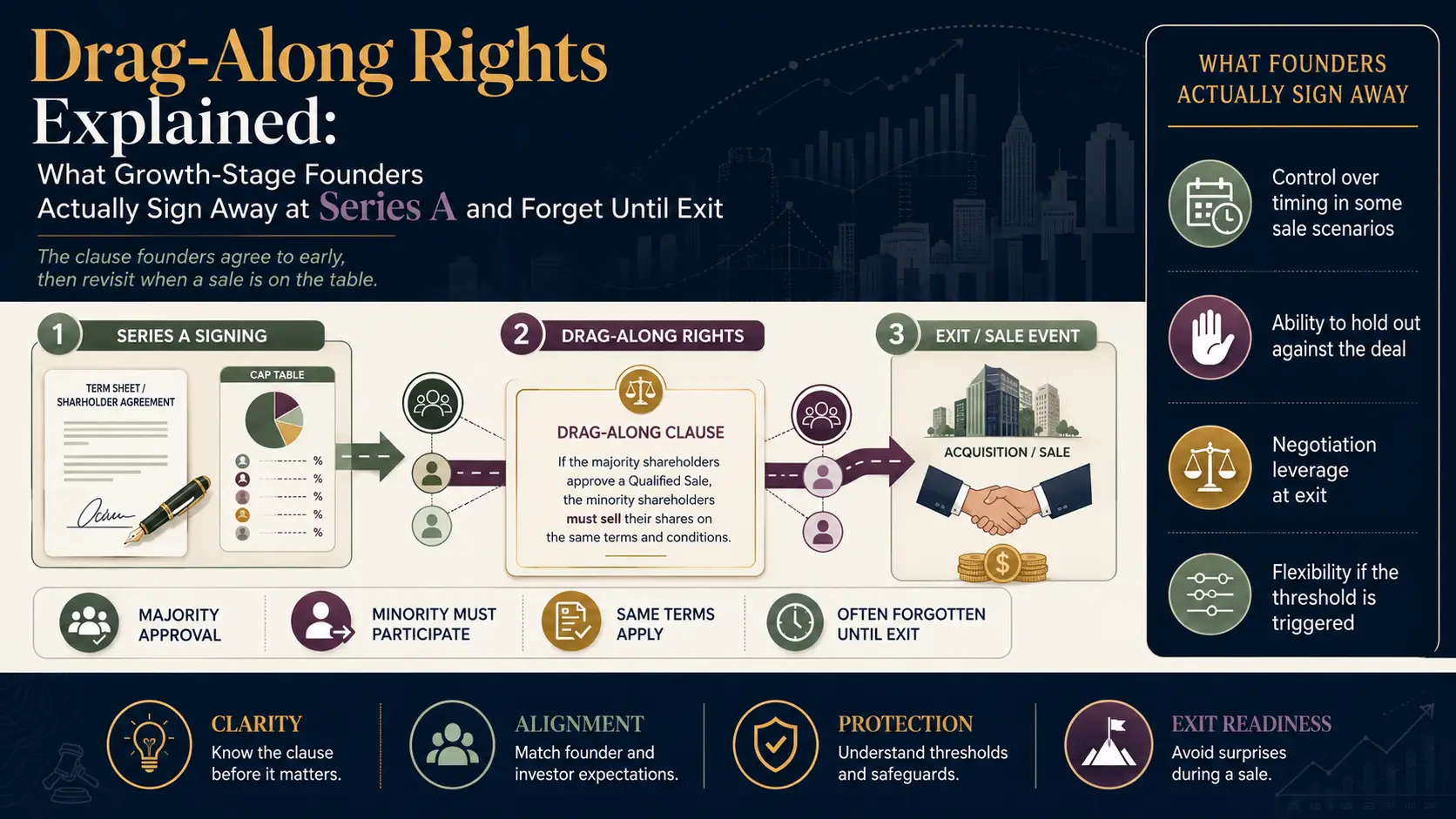
Drag-Along Rights Explained: What Growth-Stage Founders Actually Sign Away at Series A and Forget Until Exit

What Is a Standard GP Promote Structure for a $100M Real Estate Closed-End Fund Targeting Institutional LPs?

How Long Does Sovereign Wealth and Pension Capital Take
Disclosure
Nothing on this site constitutes an offer to sell, or a solicitation of an offer to purchase, any security under the Securities Act of 1933, as amended, or any applicable state securities laws. Any offering of securities is made only by means of a formal private placement memorandum or other authorized offering documents delivered to qualified investors.
IRC Partners is a capital advisory firm. IRC Partners is not a registered investment adviser under the Investment Advisers Act of 1940 and does not provide investment advice as defined thereunder.
Certain statements in this article may constitute forward-looking statements, including statements regarding market conditions, capital availability, investor demand, and transaction outcomes. Such statements reflect current assumptions and expectations only. Actual results may differ materially due to market conditions, regulatory developments, company-specific factors, and other variables. IRC Partners makes no representation that any outcome, return, or result described herein will be achieved.
References to prior mandates, transaction volume, network credentials, or capital raised are provided for illustrative purposes only and do not constitute a guarantee or prediction of future results. Past performance is not indicative of future outcomes. Individual results will vary. Network credentials and transaction statistics referenced on this site reflect the aggregate experience of IRC Partners' principals and affiliated advisors and are not a representation of assets managed or transactions closed solely by IRC Partners.
Certain data, statistics, and information presented in this article have been obtained from third-party sources. IRC Partners has not independently verified such information and expressly disclaims responsibility for its accuracy, completeness, or timeliness. Readers should independently verify any third-party data before relying on it.
Readers are strongly encouraged to consult qualified legal, financial, and tax professionals before making any investment, capital raising, or business decision.
Schedule A Meeting
You get one shot to raise the right way. If this raise is worth doing, it’s worth doing with precision, leverage, and control.
This isn’t a practice run. Serious capital. Serious strategy. Let’s raise it right.
We onboard a maximum of seven
new strategic partners each quarter, by application only, to maximize your chances of securing the capital you need.
