.svg "CTA Arrow")


.png "Investor Ready Capital decorative background element")

Best Advisors for Capital Stack Strategy
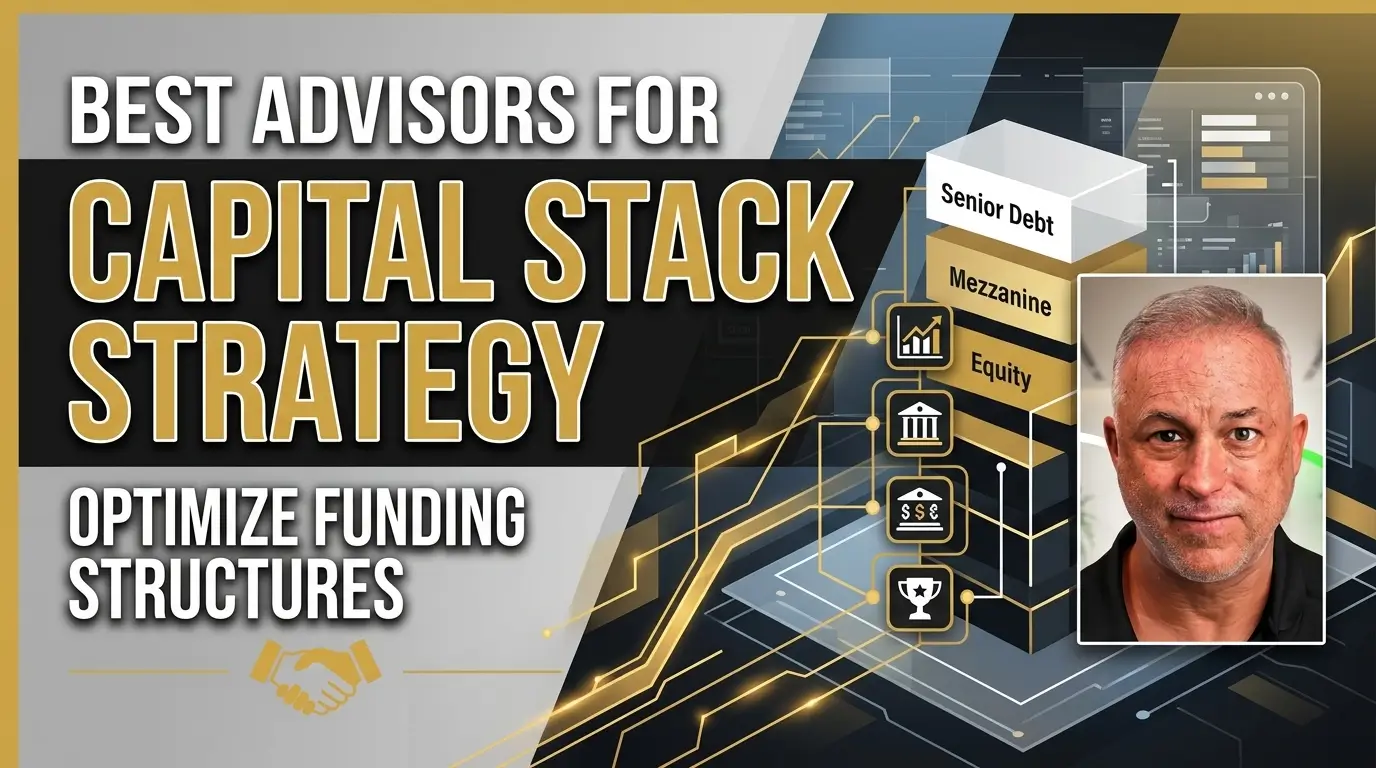
The best advisors for capital stack strategy are not defined by the firm name on the door or the size of a claimed network. They are defined by whether the individual advisor can design the right stack, personally owns active allocator relationships, has structured mandates comparable to yours in size and asset class, and will remain accountable through closing. Firm brand can get a meeting. Only the right individual advisor can carry the raise.
This article does not rank advisors by name. It gives you the evaluation framework to identify which individual advisor profiles belong in a serious review set for a capital stack advisory engagement on a $10M+ institutional raise.
Use it to narrow a broad market to 3–5 advisors who pass the individual-level test. Then move into firm evaluation and shortlist construction.
The three-part individual quality test:
- Can this specific advisor personally design the capital stack for your mandate?
- Does this advisor personally own the allocator relationships relevant to your raise?
- Will this advisor remain the primary accountable party from kickoff through closing?
Why Advisor-Level Evaluation Matters More Than Firm Brand
A recognizable firm name signals market presence. It does not prove that the specific advisor assigned to your mandate has the structuring depth, allocator access, or execution discipline your raise requires.
The risk is predictable: a senior partner leads the pitch, wins the engagement, then hands execution to a junior team member who has never managed a $25M LP raise independently. By the time diligence intensifies, the person you evaluated is no longer running the process.
In 2026, that risk costs more than it used to. Institutional capital is available but selective. CREFC's 2026 market reporting shows CRE lending conditions have stabilized, but sponsor execution quality is under heavier scrutiny than in prior cycles. Allocators are running deeper diligence, taking longer to commit, and passing on sponsors whose advisors cannot answer structural questions directly. A junior handoff at the wrong moment can stall or kill a raise.
For a deeper look at how firm-level factors stack up alongside individual advisor quality, evaluating firms for capital stack strategy is covered in full in the next piece in this series.
Three questions to ask before you evaluate anything else:
- Who specifically will own this mandate after the engagement letter is signed?
- What is that person's individual track record on raises of similar size and asset class?
- Will that person be the primary contact through closing, or does the firm use a handoff model?
What a Best-in-Class Advisor Brings to the Capital Stack
Relationship management is not structuring. An advisor who can open doors but cannot design the stack is a connector, not a capital stack advisor. For a $10M+ institutional raise, the individual needs to demonstrate five competencies at the individual level, not the firm level.
The five individual competencies that separate top advisors
1. Waterfall design fluency. The advisor should be able to model preferred return thresholds, promote structures, and catch-up mechanics without deferring to an internal analyst. LP economics are not a back-office function.
2. LP economics literacy. The best advisors understand how institutional allocators evaluate IRR hurdles, MOIC targets, and fee load relative to comparable mandates. They can explain how a structural choice affects LP returns before it reaches the data room.
3. Governance structuring. Institutional LPs expect governance provisions that align with ILPA Principles 3.0 standards: fee transparency, conflict disclosure, and reporting obligations. An advisor who cannot speak to these in the first meeting is unlikely to protect your economics when allocators push back.
4. Pre-marketing diligence discipline. Top advisors run structured pre-marketing diligence before any investor conversation begins. They identify structural weaknesses, flag documentation gaps, and pressure-test assumptions. Advisors who skip this step tend to discover problems mid-raise when they are expensive to fix.
5. Assumption pressure-testing. A credible advisor will challenge your return projections, cost assumptions, and exit timeline before launch. If an advisor agrees with everything in the first meeting, that is a signal, not a compliment.
Allocator Relationships: Owned vs. Borrowed
Every capital advisor claims network access. The relevant question is whether the relationships are personally owned and currently active, or whether they exist in a firm database that a junior originator manages.
The difference matters because institutional allocators respond to relationship context, not cold introductions. A family office that has deployed capital alongside an advisor on a prior mandate will take a call within 48 hours. A family office receiving an outreach from a back-office sourcing team may not respond at all.
Four screening questions to test relationship ownership
Ask these directly during your first advisor meeting. Credible advisors answer without hesitation. Advisors relying on institutional lists deflect, generalize, or promise to follow up.
- Who are the specific allocator types you have personally worked with on mandates comparable to mine in size and asset class? (Look for check-size specificity: $10M–$50M per commitment, not vague references to "family offices" or "institutional investors.")
- When did you last have a substantive conversation with those allocators about an active mandate? (Relevance matters more than volume. A relationship that has not been active in 18 months is not a current relationship.)
- What was the allocator's check size and role on the last comparable transaction you personally closed? (Lead commitments and follow-on positions signal very different relationship depth.)
- Will you introduce us to three allocators before we sign an engagement letter? (Not all advisors will agree, but the willingness to have this conversation separates advisors confident in their relationships from those who are not.)
Database size is not a proxy for relationship quality. Current mandate relevance, check-size fit, and asset-class alignment are the only filters that matter.
{{main-cta}}
Accountability Model and Engagement Structure
The best advisors define the engagement in writing before work begins. Scope, deliverables, timeline, and decision ownership are documented. The advisor who will run the raise is named explicitly. That clarity is not a formality. It is the structural test of whether the advisor intends to stay accountable through closing or disappear between milestones.
How an advisor structures their engagement also shapes their incentive to perform. A fee model that rewards signing over delivery, or a tail provision that runs 24 months without performance thresholds, creates misalignment that compounds over the life of the raise. Understanding how the retainer model compares to traditional placement agent structures is a useful reference point when evaluating what accountability looks like in practice.
If an advisor cannot describe their engagement model in writing before you sign, that is not a process preference. It is a red flag about how they intend to operate under pressure.
How to Evaluate an Advisor's Track Record at the Individual Level
Firm tombstones show what the organization closed. They do not show what the individual advisor did on each transaction. An advisor may appear on a $150M multifamily raise where their actual role was managing one LP relationship and attending two investor calls. That is not a comparable mandate.
Evaluating individual track record requires asking attribution questions, not accepting portfolio summaries.
- Raise-size comparability. Ask for mandates within 50% of your target raise size. An advisor with a strong track record on $5M raises has not proven they can manage the diligence load, LP coordination, and timeline pressure of a $30M institutional process.
- Asset-class repetition. Relevant experience means repeated mandates in your specific asset class, not adjacent experience. Multifamily structuring and industrial structuring involve different LP economics, governance expectations, and diligence focus areas.
- Role specificity. Ask what the advisor personally owned on each mandate: structuring, investor outreach, diligence management, or closing support. Advisors who led all four on comparable transactions are rare and worth identifying early.
- Developer references. Request references from developers on mandates of similar size and asset class. Speak to those developers directly. Ask whether the senior advisor remained the primary point of contact through closing and whether the final capital stack matched the structure proposed at engagement.
Once an advisor passes this test, you have enough to move them into a shortlist. Narrowing the market to a shortlist is covered in Spoke 7, including how to compare advisors who have all passed the individual evaluation threshold.
Red Flags Specific to Individual Advisors
These signals tend to appear before diligence starts, which makes them useful. If you catch them in the first meeting or during proposal review, you can eliminate early and compare only the advisors who meet the standard.
- Vague role descriptions in prior mandates. "I was involved in a $75M raise" without specifics on what the advisor personally owned is not a track record. It is a proximity claim.
- Inability to name personal allocator relationships. An advisor who cannot name specific allocator types, check sizes, or recent mandate context when asked directly does not own those relationships.
- No written scope before engagement. If an advisor resists putting deliverables, timeline, and named accountabilities in writing before signing, that resistance will not improve after signing.
- Handoff language during the pitch. Phrases like "our team will manage day-to-day execution" or "you will have a dedicated point of contact" often signal that the senior advisor who pitched is not the one who will run the raise.
- Fee structures that reward signing over delivery. A large upfront retainer with no performance-linked milestones, or a success fee structure with no accountability provisions, creates incentive to close the engagement, not the raise.
Eliminate any advisor who shows two or more of these signals in the first meeting. They will not improve under live raise pressure.
How to Use This Framework
This article is a filter, not a ranking. Use the individual evaluation criteria here to identify 3–5 advisor profiles who pass on structuring fluency, personally owned allocator relationships, comparable mandate history, and accountability model. That group becomes your starting set.
Your next two steps:
- Move into firm-level evaluation. Individual quality matters most, but the firm context, resources, and infrastructure around the advisor still affect execution. Spoke 6 covers how to evaluate firms for capital stack strategy alongside the individual advisors you have already screened.
- Build your shortlist. Once you have 3–5 advisors who pass the individual test, Spoke 7 walks through how to compare them, structure the shortlist review, and prepare for final selection.
Frequently Asked Questions
What credentials or background should the best capital stack advisors have for a $10M+ raise?
The strongest individual advisors for institutional raises typically have 8–15 years of direct experience in CRE capital markets, structured finance, or institutional investment management, not just brokerage or deal sourcing. Look for advisors who have personally led structuring on at least 5–10 mandates in the $10M–$100M range and who can demonstrate LP economics fluency, not just relationship history. Licenses such as Series 65, Series 7, or equivalent securities credentials indicate the advisor operates within a regulated accountability framework.
How do you tell if an advisor personally owns their allocator relationships or is just accessing a firm list?
Ask for specific allocator types, recent check sizes, and the last date of substantive contact. An advisor who personally owns relationships can name the allocator category, confirm check sizes in the $5M–$50M range, and describe the last mandate context without hesitation. If the advisor references their firm's database, their origination team, or promises to "check internally," the relationships are institutional, not personal. That distinction determines whether your outreach gets a warm response or lands in a cold queue.
How many prior mandates should a top advisor have completed in your asset class before you shortlist them?
A minimum of 3 completed mandates in your specific asset class at a comparable raise size is a reasonable threshold before shortlisting. Two mandates is thin. One is not a pattern. Asset-class repetition matters because LP economics, governance expectations, and diligence focus areas differ meaningfully between multifamily, industrial, and mixed-use. An advisor with 10 mandates in office and none in multifamily has not proven they understand your LP's evaluation lens.
What is the difference between a senior advisor and a junior originator, and why does it matter for a $10M+ raise?
A senior advisor owns the structuring decisions, leads investor conversations, manages LP diligence directly, and is accountable for closing. A junior originator sources introductions, manages CRM activity, and coordinates logistics. The distinction matters because institutional LPs at the $10M+ check-size level expect to speak directly with a senior decision-maker throughout the process. A raise that routes LP communication through junior staff signals execution weakness and can extend the decision cycle by 3–6 months or cause allocators to deprioritize the mandate entirely.
Should a best-in-class advisor be willing to provide developer references before engagement?
Yes. Any advisor unwilling to provide at least 2–3 developer references from mandates of comparable size and asset class before engagement should be viewed with skepticism. References should come from developers on raises in the $10M–$100M range, completed within the last 3–5 years. When you speak to those references, ask specifically whether the senior advisor remained the primary point of contact through closing and whether the capital stack delivered matched the structure proposed at kickoff.
How does an advisor's personal track record differ from their firm's track record, and which matters more?
For a $10M+ raise, the individual advisor's track record matters more. A firm may have closed $2B in aggregate transactions, but if the advisor assigned to your mandate has personally led structuring on only two comparable deals, the firm's aggregate history does not transfer. Evaluate the individual's raise-size comparability, asset-class repetition, and role specificity on each transaction. Firm infrastructure supports execution, but the individual's judgment, relationships, and accountability determine whether the raise closes.
What engagement scope should the best advisors define in writing before a raise begins?
A written engagement scope for a $10M+ raise should include: the named senior advisor responsible for the mandate, defined deliverables at each phase (pre-marketing, investor outreach, diligence management, closing support), a timeline with milestone checkpoints, the fee structure with retainer amount and success fee basis points, tail provision length (12 months is standard; anything over 18 months requires scrutiny), and conflict disclosure. Any advisor who resists committing this to writing before signing is signaling that accountability is not part of their model.
Continue reading this series:
The wrong structure doesn't just cost you this round. It costs you the next three. IRC Partners advises founders raising $5M to $250M of institutional capital. If you're about to go to market and want the structure reviewed before investors see it, book a call here.
Sponsors weighing this decision should first complete a capital raise readiness assessment for sponsors to confirm the raise is investor-ready.
Need guidance on your capital raise?



What Makes a Programmatic Real Estate Joint Venture Attractive To a Family Office After an Initial Single-Asset Investment?

When Does a Company Need Investor Relations Management for Growth Companies

How to Choose an Advisor for Real Estate Capital Raising
Disclosure
Nothing on this site constitutes an offer to sell, or a solicitation of an offer to purchase, any security under the Securities Act of 1933, as amended, or any applicable state securities laws. Any offering of securities is made only by means of a formal private placement memorandum or other authorized offering documents delivered to qualified investors.
IRC Partners is a capital advisory firm. IRC Partners is not a registered investment adviser under the Investment Advisers Act of 1940 and does not provide investment advice as defined thereunder.
Certain statements in this article may constitute forward-looking statements, including statements regarding market conditions, capital availability, investor demand, and transaction outcomes. Such statements reflect current assumptions and expectations only. Actual results may differ materially due to market conditions, regulatory developments, company-specific factors, and other variables. IRC Partners makes no representation that any outcome, return, or result described herein will be achieved.
References to prior mandates, transaction volume, network credentials, or capital raised are provided for illustrative purposes only and do not constitute a guarantee or prediction of future results. Past performance is not indicative of future outcomes. Individual results will vary. Network credentials and transaction statistics referenced on this site reflect the aggregate experience of IRC Partners' principals and affiliated advisors and are not a representation of assets managed or transactions closed solely by IRC Partners.
Certain data, statistics, and information presented in this article have been obtained from third-party sources. IRC Partners has not independently verified such information and expressly disclaims responsibility for its accuracy, completeness, or timeliness. Readers should independently verify any third-party data before relying on it.
Readers are strongly encouraged to consult qualified legal, financial, and tax professionals before making any investment, capital raising, or business decision.
Schedule A Meeting
You get one shot to raise the right way. If this raise is worth doing, it’s worth doing with precision, leverage, and control.
This isn’t a practice run. Serious capital. Serious strategy. Let’s raise it right.
We onboard a maximum of seven
new strategic partners each quarter, by application only, to maximize your chances of securing the capital you need.
