.svg "CTA Arrow")


.png "Investor Ready Capital decorative background element")

What Percentage of Equity Should Founders Still Own Before a Series B? The Institutional Investor Standard

What Percentage of Equity Should Founders Still Own Before a Series B? The Institutional Investor Standard
While institutional venture capital allocators do not enforce a single, rigid founder ownership percentage before a Series B close, the collective equity position of a startup’s founding team serves as one of the fastest signals of historical cap table discipline. Data indicates that the median founding team holds approximately 23% of their company fully diluted at the close of a Series B round, marking a steep trajectory from 56% at seed and 36% at Series A. Growth-stage institutional investors evaluate this indicator not out of sentimentality, but to confirm that the team remains sufficiently motivated and economically incentivized to handle the operational friction of scaling. When pre-round founder equity falls below the 10% to 20% "concern zone," it alerts investors to past financing mistakes, such as unstructured SAFE stacking, multiple bridge rounds, or poorly negotiated pre-money option pool top-ups. Because adding the standard 15% to 20% dilution of a Series B check alongside a required employee pool expansion can drop under-incentivized founders into a motivation crisis, low ownership frequently triggers severe valuation haircuts or extensive corporate recapitalization demands. To maintain peak transactional leverage, operators must mathematically model their fully diluted cap table and run precise downside dilution scenarios well before scheduling their first institutional pitch meeting.
There is no fixed founder ownership percentage that every institutional investor requires before a Series B. But that does not mean ownership does not matter. According to Carta's 2025 Founder Ownership Report, the median founding team owns about 23% of their company at the time of a Series B close, down from 56% after seed and 36% after Series A. That trajectory reflects normal dilution. What investors are really asking when they look at founder ownership is not just whether the number is in range. They are asking what that number reveals about how the company has been financed, whether the founding team is still properly motivated, and whether the cap table can support the next phase of growth.
If you are approaching a Series B and wondering whether your ownership position is strong enough, the full picture is covered in what cap table issues will kill a Series B before the lead investor even reads your deck. Founder ownership is one signal inside a larger diligence picture.
Key takeaways:
- Median founding team ownership at Series B close is approximately 23%, per Carta 2025 data
- Investors do not apply a single cutoff; they read ownership in context of financing history, founder count, and option pool size
- Ownership that is too low before Series B raises concerns about incentive alignment and future dilution runway
- The concern is not just the current percentage; it is whether the cap table can absorb the new round without breaking founder motivation
- Founders should model post-Series B ownership before entering the process, not after receiving a term sheet
Why Founder Ownership Before Series B Matters More Than Most Founders Think
Founder ownership is one of the fastest signals institutional investors use to assess cap table discipline. Before reading a single revenue metric or growth chart, an investor who sees a founding team collectively holding 8% or 10% of a company will start asking questions. Not because there is a hard floor, but because low ownership is a shorthand flag. It suggests something happened earlier in the financing history that consumed more equity than the business performance justified.
The concern is not sentimental. Investors at the growth stage are writing large checks into companies that still carry significant execution risk. They need the founding team to be fully committed and financially motivated through the next phase of scaling. A founder who owns very little has weaker economic incentive to stay, push through hard periods, or resist future acqui-hire offers. That changes the risk profile of the investment.
The real question investors are asking: Not "how much do founders own?" but "does this ownership level still make the founding team economically dangerous enough to build the company we are betting on?"
Low founder ownership before a Series B can also signal fragility in future rounds. If the cap table is already thin on founder equity before the growth round, adding another 15-20% of dilution from the Series B itself, plus an option pool refresh, can push founders into a range where retention and motivation become structural concerns rather than theoretical ones.
What Institutional Investors Usually Want to See Before a Series B
There is no universal rule, but there are observable patterns. Investors typically look for a founding team that still holds enough combined ownership to remain meaningfully aligned through the Series B and at least one more round. What that looks like in practice depends on several variables.
The table below shows how investors typically read founder ownership ranges before a Series B closes, assuming a two-founder company on a standard seed-to-Series A path.
A few important caveats apply to any benchmark reading:
- Founder count matters. A solo founder at 25% fully diluted reads very differently from two co-founders splitting 25% combined.
- Pre-round versus post-round. Investors are modeling what founders will own after the Series B closes, including the new round dilution and any option pool expansion. The pre-round number is a starting point, not the final read.
- Capital efficiency. A company that reached strong Series B metrics while raising a modest seed and Series A will have more founder ownership than one that burned through multiple bridges. Investors weight the context.
- Option pool size. A large existing pool already baked into the fully diluted count affects how much room remains for future grants without further founder dilution.
The practical standard: Investors want to see enough post-Series B founder ownership that the founding team is still economically dangerous. That typically means the lead founders collectively owning a meaningful stake after the round closes, not before.
The Dilution Patterns That Make Investors Nervous
Investors do not just count dilution events. They read the judgment behind them. The following patterns are the most common causes of excessive pre-Series B founder dilution, and each one carries a specific signal for investors reviewing the cap table.
- Stacked post-money SAFEs. Under the post-money SAFE structure that became standard after Y Combinator introduced it in 2018, each new SAFE dilutes founders directly rather than diluting other SAFE holders. According to CRV's 2026 Startup Equity Structure guide, raising $2 million across three SAFE tranches at different caps locks in that dilution against founders before the first priced round even closes. Founders who raised multiple SAFEs without modeling cumulative conversion often arrive at Series A or B owning significantly less than they expected. The full mechanics of how stacked SAFEs and convertible notes interact at conversion are covered in how SAFE notes and convertible notes silently destroy your Series B cap table. The investor signal: insufficient dilution modeling and possibly a history of raising in small, reactive increments rather than with a plan.
- Oversized option pool expansions. More than 70% of equity financings include an option pool top-up as part of the round. When the pool increase is included in the pre-money valuation, founders bear the full cost of that expansion while new investors pay less per share. A pool that has been expanded multiple times without a clear hiring plan signals that prior investors extracted favorable terms. Founders who did not push back on pre-money pool sizing in earlier rounds often find their ownership significantly lower than the dilution from the round itself would suggest.
- Multiple bridge rounds. Every bridge round is a dilution event. Two or three bridges before a priced Series B signal that the company needed to buy time repeatedly. Each one typically came with either a discount, a warrant, or a low valuation cap that locked in more dilution than a clean priced round would have. Investors read multiple bridges as evidence that the company struggled to hit milestones on schedule, which compounds the concern about ownership levels.
- Co-founder splits and reshuffling. When a co-founder departs early and their shares are not properly recaptured through vesting clawback or buyback, the cap table can carry dead equity held by a former team member. That equity does not go away. It sits on the fully diluted share count, reducing everyone else's percentage and sometimes creating governance complications. Investors flag this immediately in diligence.
- Early secondary sales. Founders who sold secondary shares before Series B are not automatically penalized. But large or early secondary sales, especially before the company had meaningful scale, raise questions. The global secondary market reached roughly $220 billion in 2025, but secondary liquidity is highly concentrated in the most valuable companies. For earlier-stage founders, secondary sales can signal that founders were looking for personal liquidity before the company was ready, which investors sometimes read as a confidence signal about the business itself.
- Aggressive terms from earlier rounds. Full ratchet anti-dilution provisions, participating preferred structures, or punishing liquidation preferences from seed or Series A investors can distort the effective cap table. Even if founder ownership looks acceptable on a basic percentage basis, these terms can hollow out the economic value of that ownership at exit. Sophisticated Series B investors model liquidation waterfalls, not just ownership percentages.
How Investors Interpret Founder Ownership That Is Too Low
When founder ownership is well below the contextual range for a company at Series B stage, investors follow a specific inference chain. The ownership percentage itself is not the problem. The problem is what it implies about the financing decisions that produced it.
The inference typically runs like this: low ownership suggests the company either raised too much capital too cheaply, accepted poor terms under pressure, or allowed dilution to compound across multiple instruments without modeling the cumulative effect. Any of those conclusions creates concern about the quality of financial judgment the founders have been applying. At the growth stage, that judgment matters because the company will face more complex financing decisions ahead, not fewer.
The downstream risk investors are actually pricing: A founding team that is under-incentivized is more likely to accept an acqui-hire offer, lose key executives who are watching the founders' commitment, or negotiate poorly on the next term sheet because they have less to protect. Institutional investors model this risk before they model the revenue.
The governance concern is real as well. When founder ownership has been diluted heavily and is distributed across many small early holders, the cap table can create voting fragmentation or a governance structure where the founding team no longer has the leverage to drive key decisions. Investors who plan to build a long-term relationship with the company need to know the founding team has the standing to lead it.
Founder ownership below the institutional standard is one of the inputs that pulls down an Institutional Readiness Score before a single term is discussed.
For a closer look at how documentation and equity record problems compound these issues, the analysis of poor cap table documentation in a Series B data room explains what investors find when they open the data room.
When Low Founder Ownership Is Survivable and When It Becomes a Deal Problem
Low founder ownership is not automatically a deal-killer. The business performance and the story behind the ownership level both matter. The table below separates the scenarios investors tend to look past from the ones that create real resistance.
The key test is not the number in isolation. It is whether the cap table, after the Series B closes, still gives the founding team enough economic skin in the game to drive the company through the next phase.
For founders who have identified ESOP pool issues as part of the dilution picture, the detailed breakdown of what happens when your ESOP pool is too small or too large before a Series B covers the specific investor concerns around pool sizing.
What Founders Should Model Before Starting a Series B Process
The founders who enter a Series B process with the strongest negotiating position are the ones who have already run the ownership math before the first investor meeting. Modeling this in advance does two things: it tells you whether you have a problem to address, and it gives you a defensible answer when an investor asks about the cap table.
Here are the steps to work through before the process begins:
- Calculate current fully diluted ownership by founder. Do not use a basic share count. Include all issued shares, all outstanding options and warrants, all SAFEs and convertible notes on an as-converted basis. This is the real number investors will use.
- Model SAFE and convertible note conversion. If any instruments have not yet converted, run the conversion math at realistic Series B valuations. Post-money SAFEs convert based on their cap, not the new round price. Investopedia's SAFE explainer covers the mechanics clearly. Know exactly what percentage converts at each scenario.
- Run a realistic Series B dilution scenario. Assume a 15-20% dilution range from the new round itself. Series B investors typically target 10-20% ownership. Model both ends of that range at your expected raise size and valuation. If your Series A terms included participating preferred or aggressive anti-dilution provisions, the guide on how to raise capital for your Series A round explains how those terms compound into Series B dilution math.
- Model the option pool refresh. Most Series B term sheets will require a pool top-up. If the increase is pre-money, founders bear the full cost. Model a 5-8% pool expansion as a base case and understand who absorbs it.
- Test a downside scenario. What happens if the round takes six months longer than planned, prices 20% lower, or requires a bridge first? Model the ownership impact of a slower or cheaper round. This is the scenario where founder motivation concerns become most acute.
- Assess the post-round picture. After running all of the above, ask whether each key founder still holds enough equity to remain fully committed through a Series C or a potential exit three to five years out. If the answer is uncertain, that is the conversation to have before investor meetings begin, not during term sheet negotiations.
{{main-cta}}
Founder Ownership Stress Test Checklist
Before starting a Series B process, work through each item below. If any answer is uncertain, resolve it before investor outreach begins.
- Current founder ownership calculated on a fully diluted basis, including all instruments
- All SAFEs and convertible notes modeled on an as-converted basis at realistic Series B valuations
- Option pool refresh impact modeled, including whether the increase is pre-money or post-money
- Post-Series B ownership calculated under base, upside, and downside scenarios
- Any secondary sales by founders identified and ready to explain in diligence
- Dead equity from departed co-founders or early holders identified and addressed
- Founding team ownership assessed for whether it still supports full motivation through Series C or exit
- Cap table confirmed as financeable after the new round without recap pressure
For founders who have found equity record discrepancies during this process, the breakdown of what happens when equity records do not match your cap table software covers how to identify and resolve those issues before they surface in diligence.
Before starting a Series B process, calculate founder ownership on a fully diluted basis, model the impact of SAFEs, convertibles, option pool refreshes, and the new round itself, and ask one hard question: will the founding team still be meaningfully motivated after this financing closes? If the answer is unclear, the ownership problem is not theoretical. It is already part of the deal risk.
Frequently Asked Questions
What does the typical founding team own at the time of a Series B close?
According to Carta's 2025 Founder Ownership Report, the median founding team owns approximately 23% of their company at the time of a Series B close. That figure reflects cumulative dilution from seed, Series A, and option pool expansions. The range is wide; companies that raised capital efficiently and with disciplined terms can arrive at Series B with founding teams holding 30-40% or more, while those with heavy SAFE stacking or multiple bridge rounds often land lower.
Can a company still raise a Series B if the founding team owns less than 20%?
Yes, but it requires a stronger explanation and a cleaner cap table story. Investors will ask what drove the dilution and whether the founding team is still fully committed. If the business is performing well and the low ownership reflects a single explainable event rather than a pattern of poor financing decisions, most institutional investors will work through it. If the low ownership reflects multiple compounding problems, the bar for performance to offset the concern is much higher.
Do investors care more about individual founder ownership or total founding team ownership?
Both matter, but in different ways. Total founding team ownership tells investors whether the management incentive base is still meaningful as a group. Individual ownership tells investors whether any single key founder is at risk of being under-incentivized. A three-founder team where one founder holds 15% and two hold 2% each creates a different risk profile than a team where ownership is more evenly distributed. Investors will look at both the aggregate and the individual breakdown.
How does an option pool expansion before a Series B affect founder ownership?
Option pool expansions directly reduce founder ownership on a fully diluted basis. When a pool top-up is required as part of a financing and is structured as a pre-money increase, the full dilution cost falls on existing shareholders, primarily founders, before the new investors come in. Founders who accepted pre-money pool expansions in earlier rounds without negotiating the size often find their current ownership is 3-5 percentage points lower than a post-money structure would have produced. Every future pool expansion compounds that effect.
Does selling secondary shares before a Series B hurt investor confidence?
It depends on the size, timing, and context. A modest secondary sale that gave a founder some personal liquidity at a reasonable valuation and was disclosed cleanly typically does not create concern. A large secondary sale before the company had meaningful scale, especially if it was not disclosed proactively, raises questions about whether the founder was betting against the company's trajectory. Investors will ask about any secondary activity during diligence. Having a clear, honest answer prepared matters more than the transaction itself.
How should founders explain a low ownership percentage during Series B diligence?
The strongest approach is to explain the financing history factually and connect each dilution event to a decision that made sense at the time. Investors are experienced enough to recognize that early-stage financing involves tradeoffs. What they are less tolerant of is founders who do not understand why their ownership is where it is, or who try to minimize or obscure the history. A founder who can walk through the cap table clearly, explain each instrument and its impact, and demonstrate that the team is still fully committed will fare better than one who is caught off guard by the question.
Is there a minimum ownership threshold below which a Series B is effectively off the table?
There is no published floor, but in practice, a founding team collectively holding under 10% on a fully diluted basis before a Series B creates serious structural concerns. At that level, the Series B itself plus an option pool refresh could push founders into single-digit combined ownership, which most institutional investors view as an incentive problem rather than just an optics issue. Deals at that ownership level sometimes proceed only after a restructuring conversation or an incentive grant that resets founder equity, which adds complexity and time to the process.
Continue reading this series:
- How to Value a Startup: Complete Guide for Founders 2026
- How SAFE Notes and Convertible Notes Stack Up and Silently Destroy Your Series B Cap Table
- Series A Valuations: How to Calculate Your Raise and What Investors Look For in 2026
IRC Partners works with operators raising $5M to $250M of institutional capital. The full engagement is for founders at $1M+ ARR who have raised before. The $2,997 Capital Raise Pre-Flight audit is open to earlier-stage companies, including pre-revenue, that are raising $5M+ and have a pitch deck and financial model ready for review. If that's you, schedule a call to discuss HERE.
Need guidance on your capital raise?


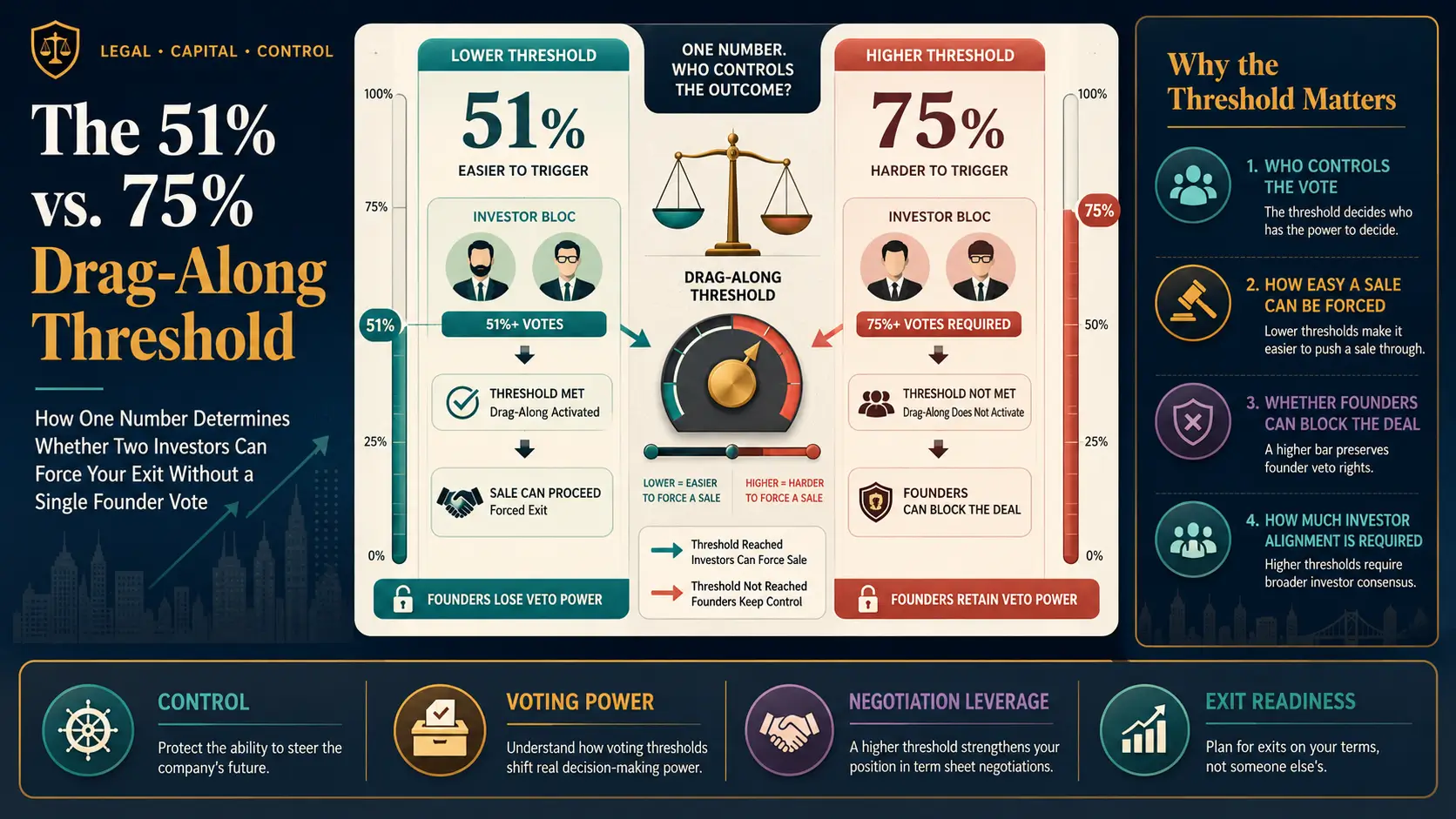
The 51% vs. 75% Drag-Along Threshold: How One Number Determines Whether Two Investors Can Force Your Exit Without a Single Founder Vote
.jpeg "Illustration for pitch deck mistakes that stop fundraising")
I Studied 1,000 Pitch Decks: What Stops Founders From Raising Money | IRC Partners
What Bridge Financing Terms Create Problems When a Company Expects To Pursue a Strategic Sale Within Twelve Months?
Disclosure
Nothing on this site constitutes an offer to sell, or a solicitation of an offer to purchase, any security under the Securities Act of 1933, as amended, or any applicable state securities laws. Any offering of securities is made only by means of a formal private placement memorandum or other authorized offering documents delivered to qualified investors.
IRC Partners is a capital advisory firm. IRC Partners is not a registered investment adviser under the Investment Advisers Act of 1940 and does not provide investment advice as defined thereunder.
Certain statements in this article may constitute forward-looking statements, including statements regarding market conditions, capital availability, investor demand, and transaction outcomes. Such statements reflect current assumptions and expectations only. Actual results may differ materially due to market conditions, regulatory developments, company-specific factors, and other variables. IRC Partners makes no representation that any outcome, return, or result described herein will be achieved.
References to prior mandates, transaction volume, network credentials, or capital raised are provided for illustrative purposes only and do not constitute a guarantee or prediction of future results. Past performance is not indicative of future outcomes. Individual results will vary. Network credentials and transaction statistics referenced on this site reflect the aggregate experience of IRC Partners' principals and affiliated advisors and are not a representation of assets managed or transactions closed solely by IRC Partners.
Certain data, statistics, and information presented in this article have been obtained from third-party sources. IRC Partners has not independently verified such information and expressly disclaims responsibility for its accuracy, completeness, or timeliness. Readers should independently verify any third-party data before relying on it.
Readers are strongly encouraged to consult qualified legal, financial, and tax professionals before making any investment, capital raising, or business decision.
Schedule A Meeting
You get one shot to raise the right way. If this raise is worth doing, it’s worth doing with precision, leverage, and control.
This isn’t a practice run. Serious capital. Serious strategy. Let’s raise it right.
We onboard a maximum of seven
new strategic partners each quarter, by application only, to maximize your chances of securing the capital you need.
