



What Does "Investor Ready" Actually Mean to an Institutional Investor?
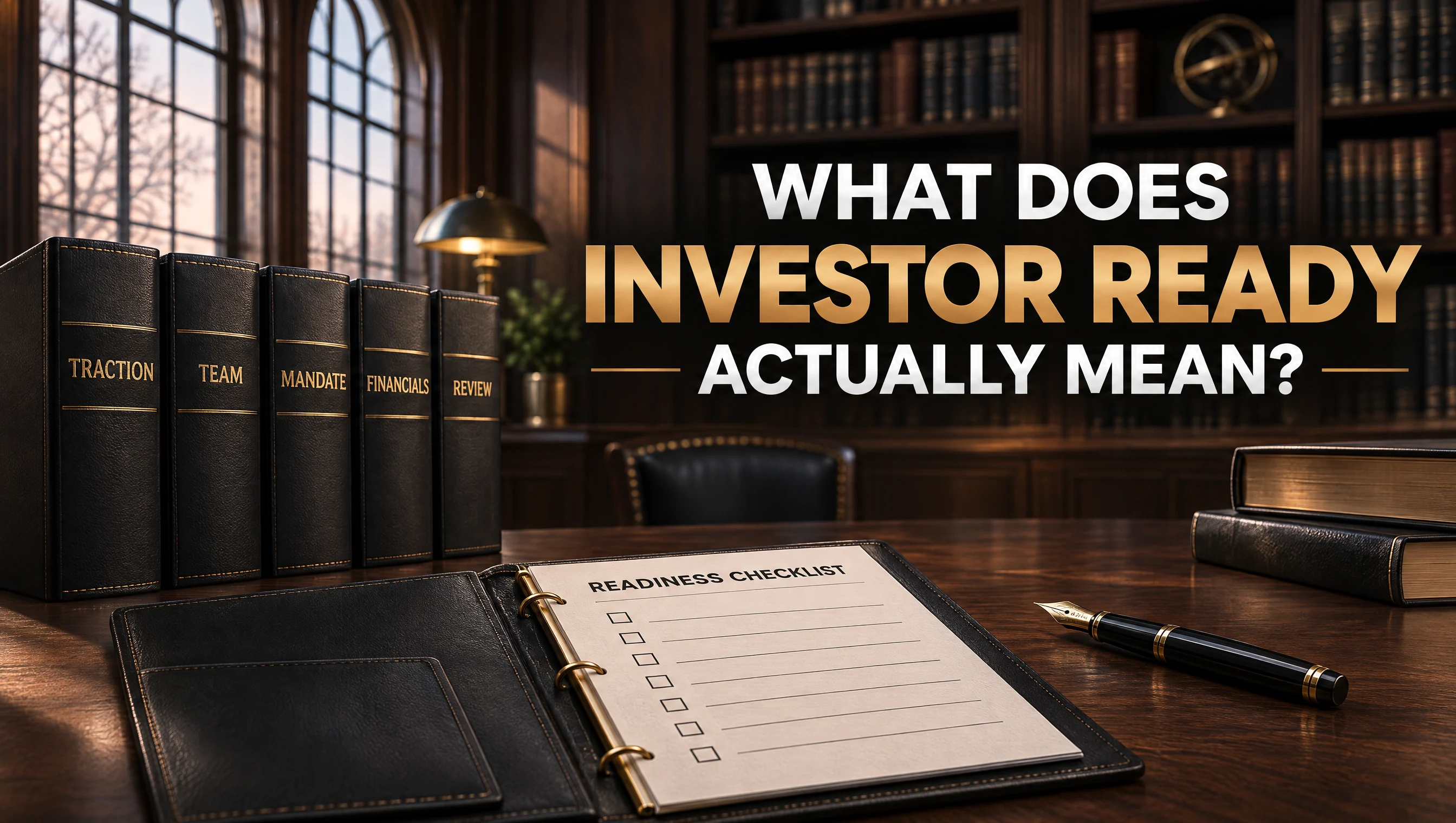
TL;DR: Investor ready means an institutional investor can review your company, trust what it sees and decide without doing extra work. Five gates decide it: traction, team, market and mandate fit, financials that tie out, and ease of review. "Come back later" usually means one gate failed, and you can find which one yourself.
- What does "investor ready" actually mean? Investor ready means an institutional investor can evaluate your company quickly, trust what it sees and say yes without taking on extra work.
- What are the five gates investors check before a second meeting? Investors check traction, team, market and mandate fit, financials that tie out, and how easy you are to review.
- Why does "come back later" usually mean one gate failed? Investors rarely fail a company on all five gates at once, so a polite pass usually points to one specific gap.
- How do you find which gate failed? You find it by running the investor's checklist on yourself before you go back.
- How does investor readiness differ for a real estate sponsor? The five gates stay the same for a sponsor, and the documents inside each gate change.
Investor ready means your company can survive a full institutional review without the investor asking for the same document twice. Your traction is real, your team is credible, your deal fits the investor's mandate, your numbers tie out and your materials are easy to review. The bar is high because the screen is tight. A 2016 National Bureau of Economic Research (NBER) study of 885 venture capitalists by Gompers, Gornall, Kaplan and Strebulaev found that the median firm considered 100 deals for every deal it closed. With that many deals in the pile, any gap gives an investor an easy reason to move on.
What does "investor ready" actually mean?
Investor ready means an institutional investor can evaluate your company quickly, trust what it sees and say yes without taking on extra work.
Investors review a lot of deals with very little time. Will Gornall, one of the study's authors, summed up the funnel in an August 2019 post on the Harvard Law School Forum on Corporate Governance: "The average firm in our sample screens 200 companies and makes only four investments in a given year."
When a company is ready, the materials are organized, the numbers agree and the story is clear. When it is not, the investor has to do extra work just to understand the deal, and that extra work is itself a signal.
Does investor ready mean perfect?
Investor ready means clear. Early-stage companies have gaps, and investors expect them. What investors do not expect is confusion: financials that contradict the deck, or a founder who cannot explain the cap table.
A company with modest revenue can be investor ready. A company with strong revenue can still fail the review. Readiness measures how well you have built the case for the business, at whatever size it is today.
Geoff Ralston of Y Combinator described the bar in his January 2016 guide to seed fundraising:
"Investors write checks when the idea they hear is compelling, when they are persuaded that the team of founders can realize its vision, and that the opportunity described is real and sufficiently large. When founders are ready to tell this story, they can raise money."
What are the five gates investors check before a second meeting?
Investors check five things before they agree to a second meeting: traction, team, market and mandate fit, financials that tie out, and how easy you are to review. Each one is a gate. All five need to pass.
| Gate | What the investor is asking | Common failure |
|---|---|---|
| Traction | Is the business moving in the right direction? | Flat or uneven metrics with no clear explanation |
| Team | Can this group execute at institutional scale? | Key roles empty, or a founder who cannot speak to the financials |
| Market and mandate fit | Does this deal match what we invest in? | Size, sector or stage outside the fund's stated criteria |
| Financials that tie out | Do the numbers tell one consistent story? | Deck figures that do not match the model or the books |
| Ease of review | Can we evaluate this without extra work? | A messy data room or missing documents |
Gate 1: Is the business moving in the right direction?
Traction tells the investor the business works. It does not have to be large. It has to be real and steady. Investors want to see customers paying, coming back or growing. A dip with a clear reason is easy to accept. A flat line with no explanation raises a flag.
Paul Graham, the Y Combinator co-founder, put the effect plainly in his September 2013 essay "How to Raise Money": "If your numbers grow significantly between two investor meetings, investors will be hot to close, and if your numbers are flat or down they'll start to get cold feet."
Gate 2: Can this team execute at institutional scale?
Investors back people as much as ideas. The NBER Digest's December 2016 summary of the same study reported: "Over 55 percent of respondents considered the team the most important factor." Investors check whether the right roles are filled and watch how the founder handles questions. A founder who speaks clearly about the financials, the cap table and the competition shows the team can operate at the next level.
Gate 3: Does the deal fit the investor's mandate?
Every institutional investor has a mandate. The mandate defines what the fund buys: sector, stage, check size and geography. A great company in the wrong sector is still the wrong deal for that fund. Founders often pitch a strong business to an investor whose mandate excludes it. That gap comes from targeting, and it ends the same way as any other failed gate: no second meeting.
Gate 4: Do the financials tie out?
Institutional investors are trained to find inconsistencies. They compare the deck to the model and the model to the data room. If the numbers tell three different stories, the review stops. Clean financials do not require a complex model. They require one story across every document. For the specific mismatches that cost founders credibility, see what mismatches between a pitch deck, model and data room cause investors to lose confidence.
Gate 5: How easy is the company to review?
Investors move faster when the review is easy. A well-organized data room, a one-page executive summary and a deck that answers questions before they are asked all reduce friction. When a founder makes the review hard, the investor moves to the next deal. A clean package shows respect for the investor's time. For a deeper look at what happens inside diligence, see the 12 gates investors never tell you about.
Why does "come back later" usually mean one gate failed?
Investors rarely fail a company on all five gates at once, so a polite pass usually points to one specific gap.
Investors seldom say which gate failed. They use soft language to keep the door open.
That is the core problem with "come back later." The founder walks away thinking the whole company needs to change. Often a single document was missing, the financials did not tie out, or the check size was too small for the fund.
When you do not know which gate failed, you cannot fix it. Founders who spend six months rebuilding the whole pitch when only the model needed work lose time and burn relationships. Find the gate before you go back.
There is also a middle zone that is easy to miss. A company that passes some gates and fails others can do more damage to investor relationships than one that clearly fails. Partial readiness creates false confidence. Read more in the trap zone: why scoring 50 to 84 on investor readiness burns more relationships than failing.
How do you find which gate failed?
You find the failed gate by running the investor's checklist on yourself before you go back.
Traction self-check
- Do you have at least three months of steady, positive movement in your key metric?
- Can you explain any dip or flat period in one clear sentence?
- Is the metric you show the one an investor cares about at your stage?
Team self-check
- Can every member of your leadership team explain the financials without help?
- Are your key operating roles filled by people with relevant experience?
- Is your cap table clean and easy to explain?
Market and mandate self-check
- Have you confirmed this fund invests in your sector, stage and check size?
- Does your market size match the scale this investor needs to see?
Financials self-check
- Does every number in your deck match the same number in your model?
- Does your model match the documents in your data room?
- Can you walk an investor through your assumptions in under ten minutes?
Ease of review self-check
- Is your data room ready, with standard documents organized and labeled?
- Is your executive summary one page?
- Does your deck answer the five gates before the investor asks?
If you answered no to any question in a gate, that gate is the likely cause. Fix it first. Then go back.
How does investor readiness differ for a real estate sponsor?
The five gates stay the same for a sponsor, and the documents inside each gate change.
Traction means a track record of completed deals: deals closed, capital returned, and projects delivered on time and on budget. A sponsor without a completed deal history faces a higher bar at this gate.
Team focuses on asset management. LPs want to know who runs the asset after closing. They look for operators who can execute the business plan.
Market and mandate fit adds geography and asset class. A multifamily sponsor pitching an office-focused fund will not get a second meeting, however good the deal is.
Financials that tie out include the waterfall model, the preferred return and the GP promote. These must match across the offering memorandum, the operating agreement and the investor presentation. A waterfall that changes from one document to the next is a fast way to lose a sophisticated LP.
Ease of review means a clean offering memorandum, a clear deal summary and a data room with the property financials, the rent roll and the market study. Sponsors who make LPs hunt for basic documents lose the deal before the first call. For what LPs check at this stage, see what institutional LPs audit before the first call.
What should you do before your next investor conversation?
Run the five-gate checklist before your next conversation, and fix the weakest gate first. For an outside read, IRC Partners offers a fixed-fee advisory review called the Capital Raise Pre-Flight. It scores your deck, financial model and capital strategy against 12 pass or fail gates and ranks what to fix. It is a readiness review. It does not promise that any investor will commit.
Frequently Asked Questions
What does investor ready mean in simple terms?
Investor ready means your company can pass a full institutional review without the investor chasing missing documents or fixing your numbers. Your traction is clear, your team is credible, your deal fits the investor's mandate, your financials agree and your materials are easy to review.
How long does it take to become investor ready?
It depends on which gate needs work. A founder who only needs to clean up the model and organize a data room can be ready in a few weeks. A founder who needs more traction or key hires may need several months. The first step is finding which gate is the problem.
Can a pre-revenue company be investor ready?
Yes, for some investors and stages. The traction gate looks different before revenue. It may rest on product milestones, letters of intent or pilot agreements. The other four gates still apply, and the team and market evidence need to be stronger to make up for the missing revenue.
What is the difference between investor ready and fundable?
Investor ready means you can survive the review. Fundable means an investor has decided to back you. A company can be investor ready and still go unfunded if the timing is off or the fund is full. Readiness gets you through the review. It does not guarantee a check.
What should a founder do after hearing "come back later"?
Run the five-gate self-check right away. Identify the gate that most likely failed and fix it before you go back. Do not rebuild the whole pitch if only one thing was wrong. If you cannot tell which gate failed, an outside readiness review can find it before you re-engage.
What are the five gates of investor readiness?
Traction, team, market and mandate fit, financials that tie out, and ease of review. An institutional investor checks all five before a second meeting, and each one has to pass.
How does investor readiness differ for a real estate sponsor?
The five gates stay the same and the evidence changes. Traction becomes a record of completed deals, and the waterfall, preferred return and promote must match across the offering memorandum, operating agreement and deck.
Continue reading this series:
- Is a Capital Raise Readiness Audit Worth It Before a $10M+ Raise?
- Investment Committee Deck Preparation for Growth Stage Founders
- Capital Raise Audit vs Pitch Deck Review
IRC Partners advises founders and sponsors raising $5M to $250M of institutional capital. We take 7 strategic partners per quarter. To talk with our team about your raise, start HERE.
Need guidance on your capital raise?


The Investment Verdict: Why a Written Pass or Not-Yet Beats Ten Polite Investor Passes

What Do Pension Funds and Endowments Require Before Investing in a First-Time Real Estate Fund?
How Undisclosed Litigation Involving Cap Table Disputes Surfaces in Series B Diligence and Kills Deals Overnight
Disclosure
Nothing on this site constitutes an offer to sell, or a solicitation of an offer to purchase, any security under the Securities Act of 1933, as amended, or any applicable state securities laws. Any offering of securities is made only by means of a formal private placement memorandum or other authorized offering documents delivered to qualified investors.
IRC Partners is a capital advisory firm. IRC Partners is not a registered investment adviser under the Investment Advisers Act of 1940 and does not provide investment advice as defined thereunder.
Certain statements in this article may constitute forward-looking statements, including statements regarding market conditions, capital availability, investor demand, and transaction outcomes. Such statements reflect current assumptions and expectations only. Actual results may differ materially due to market conditions, regulatory developments, company-specific factors, and other variables. IRC Partners makes no representation that any outcome, return, or result described herein will be achieved.
References to prior mandates, transaction volume, network credentials, or capital raised are provided for illustrative purposes only and do not constitute a guarantee or prediction of future results. Past performance is not indicative of future outcomes. Individual results will vary. Network credentials and transaction statistics referenced on this site reflect the aggregate experience of IRC Partners' principals and affiliated advisors and are not a representation of assets managed or transactions closed solely by IRC Partners.
Certain data, statistics, and information presented in this article have been obtained from third-party sources. IRC Partners has not independently verified such information and expressly disclaims responsibility for its accuracy, completeness, or timeliness. Readers should independently verify any third-party data before relying on it.
Readers are strongly encouraged to consult qualified legal, financial, and tax professionals before making any investment, capital raising, or business decision.
Schedule A Meeting
You get one shot to raise the right way. If this raise is worth doing, it’s worth doing with precision, leverage, and control.
This isn’t a practice run. Serious capital. Serious strategy. Let’s raise it right.
We onboard a maximum of seven
new strategic partners each quarter, by application only, to maximize your chances of securing the capital you need.
