.svg "CTA Arrow")


.png "Investor Ready Capital decorative background element")

How Does Debt Advisory and Venture Debt Placement Work
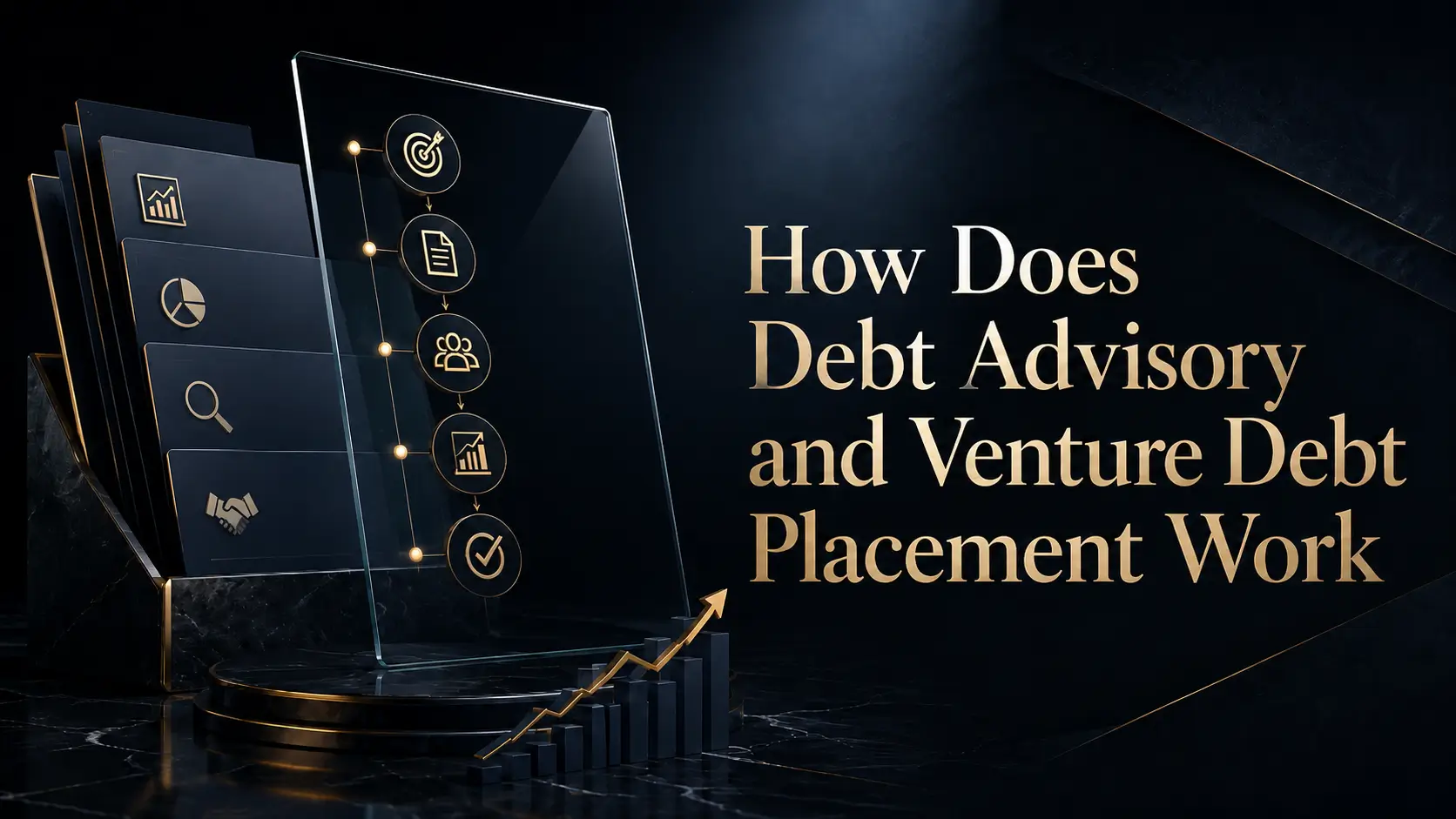
Debt advisory and venture debt placement works as a structured market process, not a casual lender introduction. Before any lender sees the company, the advisor pressure-tests the capital need, repayment path, runway impact, and role of debt in the capital stack. From there, the process moves through lender mapping, sequenced outreach, materials preparation, diligence management, term sheet comparison, negotiation, and close. The goal is to create competitive tension among the right lenders while keeping the company’s story, documents, and timeline controlled from the start. If you want the full picture of what venture debt is and why founders use it, start with the complete guide to debt advisory and venture debt placement. This article covers what happens inside the process, from kickoff through close.
Understanding where debt fits in your capital structure before you start is equally important. The capital stack explained covers how equity, debt, and SAFEs interact, which is the right foundation before you run a placement process.
What this article covers:
- What the advisor does before any lender outreach begins
- How lender mapping and sequencing create competitive leverage
- What materials and narrative positioning actually affect lender decisions
- How term sheets are compared on structure, not just rate
- What founders should prepare before hiring an advisor
Step 1: Kickoff and Underwriting Before Lenders Ever See the Deal
The process starts before any lender is contacted. A good advisor spends the first week pressure-testing the deal internally so lenders never see a half-formed story.
What the advisor examines at kickoff
- Capital need and use of proceeds. How much is the company raising, and what does the money fund? Lenders want clean answers here, not vague runway extension.
- Repayment path. What does the business look like in 18-36 months? Is there a clear path to repayment from operations, a follow-on equity round, or an exit?
- Runway impact. How does the debt interact with current burn and the next equity raise? Does it extend runway or create a repayment cliff?
- Role in the stack. Is this debt replacing equity, complementing it, or bridging to a specific milestone? The answer shapes which lender types are relevant.
What gets decided before outreach
Before any lender sees the deal, the advisor and company align on:
- Maximum acceptable warrant coverage (typically 0.5-1% dilution)
- Covenant tolerance: revenue-based, cash-based, or none
- Interest-only period requirements (most growth-stage deals target 6-12 months)
- Exclusivity limits: how long the company is willing to commit to one lender
- Non-negotiables that will kill a term sheet regardless of rate
Skipping this step is where founders lose leverage before the process even starts. If the company enters outreach without defined limits, lenders set the terms by default.
Step 2: Lender Mapping and Process Design
Not every lender fits every company. An advisor builds a lender map based on real criteria, then sequences outreach to create momentum and term-sheet overlap.
How lenders are evaluated before the list is built
Advisors filter lenders on six dimensions: sector fit, stage fit, check size range, risk tolerance, typical covenant style, and how fast they move from term sheet to close. A lender that is slow, covenant-heavy, or unfamiliar with your ARR profile is not a good target regardless of their brand name.
Structured process vs. random outreach
Sequencing is the part most founders underestimate. If you contact all lenders on the same day with no follow-up plan, the fastest lender controls the process. A well-sequenced outreach creates a window where two or three lenders are evaluating simultaneously, which is where negotiating leverage actually comes from.
Knowing when the right time is to start a debt advisory process matters here too. Lender appetite shifts based on where you are in the equity cycle. It also depends on when deciding how debt fits alongside your existing equity and what role it should play in your capital structure before any lender conversations begin.
Step 3: Materials Prep and Narrative Positioning
Lenders do not evaluate companies the way equity investors do. They are underwriting repayment confidence, not upside potential. The materials and the story have to reflect that difference.
The standard lender package
According to Flow Capital's venture debt term sheet walkthrough, smooth closes typically require 24 months of monthly financials, a current forecast, and a clean cap table before diligence begins. Missing documents extend timelines and signal operational weakness.
Why narrative positioning matters
The advisor's job is not just to package the data. It is to frame the company's performance in terms lenders respond to: revenue durability, repayment confidence, and downside protection. A company with strong NRR but high burn needs a different narrative than a company with lower growth and cash efficiency.
Key insight: Lenders who receive a disorganized or incomplete package often pass before asking a single question. A clean, well-framed package reduces friction at every stage of diligence.
Step 4: Outreach, Lender Management, and Term Sheet Shaping
Once the lender list and materials are ready, the advisor manages the outreach process with one goal: get comparable term sheets close enough in time to create real leverage.
How a managed outreach process runs
- Week 1-2: Initial outreach to the first tier of lenders. Consistent message, controlled timing.
- Week 2-3: Qualification calls. The advisor runs Q&A, manages information flow, and identifies which lenders are serious.
- Week 3-4: Diligence requests begin. The advisor handles document delivery, follow-up, and keeps lenders on parallel timelines.
- Week 4-6: Term sheet window. The advisor works to compress the gap between when the first and last term sheet arrives.
- Week 6+: Comparison, negotiation, and selection.
The advisor's job during outreach is to control pace and information. Every lender should be evaluating the same story at roughly the same stage. If one lender gets three weeks ahead of the others, the company loses the ability to use competing offers as leverage.
What advisors are actually managing
Advisors are not just forwarding emails. They are qualifying lender interest, filtering out slow or poor-fit lenders early, managing the volume and timing of diligence requests so the founder is not overwhelmed, and keeping process pressure on so no single lender controls the timeline.
The difference between getting one term sheet and getting three is usually process management, not company quality.
{{main-cta}}
Step 5: Comparing Structures, Negotiating Terms, and Getting to Close
Comparing term sheets on interest rate alone is one of the most common mistakes founders make. A lower headline rate with heavy covenants, short interest-only, and aggressive warrant coverage can be worse than a higher rate with more flexibility.
What to compare across term sheets
The negotiation and close checklist
- Rank lenders by fit, certainty, and downside behavior, not just lowest rate
- Use competing term sheets as leverage on specific terms, not just price
- Confirm lender's ability to close on the stated timeline before signing
- Engage legal counsel early; non-bank lenders can close in 4-6 weeks with organized diligence
According to Mercury's venture debt term sheet guide, non-bank lenders often offer more flexibility on covenants but may price higher and include more warrant coverage than bank lenders. Understanding that tradeoff before you compare is what lets you negotiate the right levers.
Why Process Quality Changes the Outcome
Anonymized example: A growth-stage SaaS company at $4M ARR initially approached a single lender they knew through their existing bank relationship. That lender moved slowly, offered a 3-month interest-only period, and included a minimum cash covenant that would have triggered at an uncomfortable threshold given the company's burn profile.
After engaging an advisor and running a targeted process with seven qualified lenders, the company received four indications of interest and two full term sheets. The selected structure included a 12-month interest-only period, no minimum cash covenant, and warrant coverage of 0.75%. The advisor also identified a lender whose diligence process was faster, which compressed the close timeline by roughly three weeks.
The outcome was not just a better rate. It was better structure, better fit, and a faster close, all of which came from running a real process rather than a single-lender conversation.
What Founders Should Prepare Before Starting
The fastest way to slow down a debt placement process is to start it before the company is ready. Advisors can move quickly when founders have done this groundwork first. Knowing when a company needs capital raising advisory applies here too - the same readiness logic that governs equity raises governs debt placement timing.
Pre-process preparation checklist
- 24 months of clean monthly financials, reconciled and ready to share
- A forward model with clear assumptions and a repayment scenario built in
- A defined debt rationale: what the capital funds and why debt is the right instrument
- Internal alignment on warrant limits, covenant tolerance, and exclusivity terms
- A list of questions you want answered before selecting a lender
The goal is not to be perfect before you start. It is to know your own non-negotiables so you can evaluate offers clearly rather than reactively.
Frequently Asked Questions
How many lenders does a typical debt advisory process contact?
A well-run process targets 6-10 qualified lenders, not 15-20. The goal is fit, not volume. Advisors filter by stage, sector, check size, and covenant style before outreach begins. Contacting too many lenders without qualification signals desperation and produces inconsistent feedback that is hard to act on.
Does running a competitive process actually improve terms, or just take longer?
A competitive process typically improves structure, not just rate. When two or three lenders are evaluating simultaneously, the company can negotiate on interest-only period length, warrant coverage, covenant design, and prepayment flexibility, not just the headline coupon. The timeline impact is usually minimal when the process is well-sequenced; most organized placements close within 8-12 weeks from kickoff.
What documents do lenders require before issuing a term sheet?
Most lenders require 24 months of monthly financials, YTD actuals versus plan, a 24-36 month forward model, a KPI dashboard, a current cap table, and core corporate documents including any existing lien positions. Missing or disorganized documents are one of the most common reasons lenders pass or slow down before issuing terms.
How does an advisor handle the handoff to legal after a term sheet is signed?
The advisor stays involved through close. After a term sheet is signed, they coordinate the legal review, manage the diligence data room, track outstanding document requests, and flag any terms in the definitive documents that differ from the term sheet. Non-bank lenders can close in 4-6 weeks when diligence is organized. Gaps in execution at this stage can still damage the outcome.
What is exclusivity in a venture debt term sheet and how long should it last?
Exclusivity is a clause that prevents the company from negotiating with other lenders for a defined period after signing a term sheet. Most exclusivity windows run 30-45 days. Advisors negotiate the length and scope of exclusivity before the term sheet is signed, since agreeing to a long exclusivity period with a slow lender removes all remaining leverage.
How is an advisor's involvement different from just asking a lender for a direct intro?
A direct intro produces one conversation. An advisor runs a market process: they prepare materials, build a targeted lender list, sequence outreach, manage Q&A, compress term-sheet timing, and compare structures across multiple offers. The value is not access to lenders. It is the process design that creates competitive leverage and execution discipline from kickoff to close.
How do I know if the advisor I am evaluating actually runs a structured process or just sends emails?
Ask them to describe their lender mapping criteria, how they sequence outreach, and how many term sheets they typically generate per process. Ask for examples of how they have negotiated specific terms, not just closed deals. If the answers are vague or focused on relationship access rather than process mechanics, that is a signal the process will be thin.
Continue reading this series:
- When does a company need debt advisory and venture debt placement?
- Key benefits of debt advisory and venture debt placement
- How long does debt advisory and venture debt take?
By the time most founders are rehearsing the pitch, the outcome of the raise has already been set by the structure underneath it. IRC Partners advises operators raising $5M to $250M of institutional capital and accepts seven strategic partners per quarter. If you are going to market this year, have the structure reviewed before investors do. Schedule a call with our team here.
Sponsors weighing this decision should first complete a capital raise readiness assessment for sponsors to confirm the raise is investor-ready.
Need guidance on your capital raise?


Senior Debt vs. Mezzanine vs. Preferred Equity: Which Layer Do You Actually Need?
The Data Room Disaster: How Poor Cap Table Documentation in Your Series B Data Room Kills Deals Before the First Partner Meeting
What Financing Documents Should Be Updated When Bridge Capital is Raised Through Multiple Affiliated Entities?
Disclosure
Nothing on this site constitutes an offer to sell, or a solicitation of an offer to purchase, any security under the Securities Act of 1933, as amended, or any applicable state securities laws. Any offering of securities is made only by means of a formal private placement memorandum or other authorized offering documents delivered to qualified investors.
IRC Partners is a capital advisory firm. IRC Partners is not a registered investment adviser under the Investment Advisers Act of 1940 and does not provide investment advice as defined thereunder.
Certain statements in this article may constitute forward-looking statements, including statements regarding market conditions, capital availability, investor demand, and transaction outcomes. Such statements reflect current assumptions and expectations only. Actual results may differ materially due to market conditions, regulatory developments, company-specific factors, and other variables. IRC Partners makes no representation that any outcome, return, or result described herein will be achieved.
References to prior mandates, transaction volume, network credentials, or capital raised are provided for illustrative purposes only and do not constitute a guarantee or prediction of future results. Past performance is not indicative of future outcomes. Individual results will vary. Network credentials and transaction statistics referenced on this site reflect the aggregate experience of IRC Partners' principals and affiliated advisors and are not a representation of assets managed or transactions closed solely by IRC Partners.
Certain data, statistics, and information presented in this article have been obtained from third-party sources. IRC Partners has not independently verified such information and expressly disclaims responsibility for its accuracy, completeness, or timeliness. Readers should independently verify any third-party data before relying on it.
Readers are strongly encouraged to consult qualified legal, financial, and tax professionals before making any investment, capital raising, or business decision.
Schedule A Meeting
You get one shot to raise the right way. If this raise is worth doing, it’s worth doing with precision, leverage, and control.
This isn’t a practice run. Serious capital. Serious strategy. Let’s raise it right.
We onboard a maximum of seven
new strategic partners each quarter, by application only, to maximize your chances of securing the capital you need.
