.svg "CTA Arrow")


.png "Investor Ready Capital decorative background element")

Engagement Model for Venture Capital Fundraising
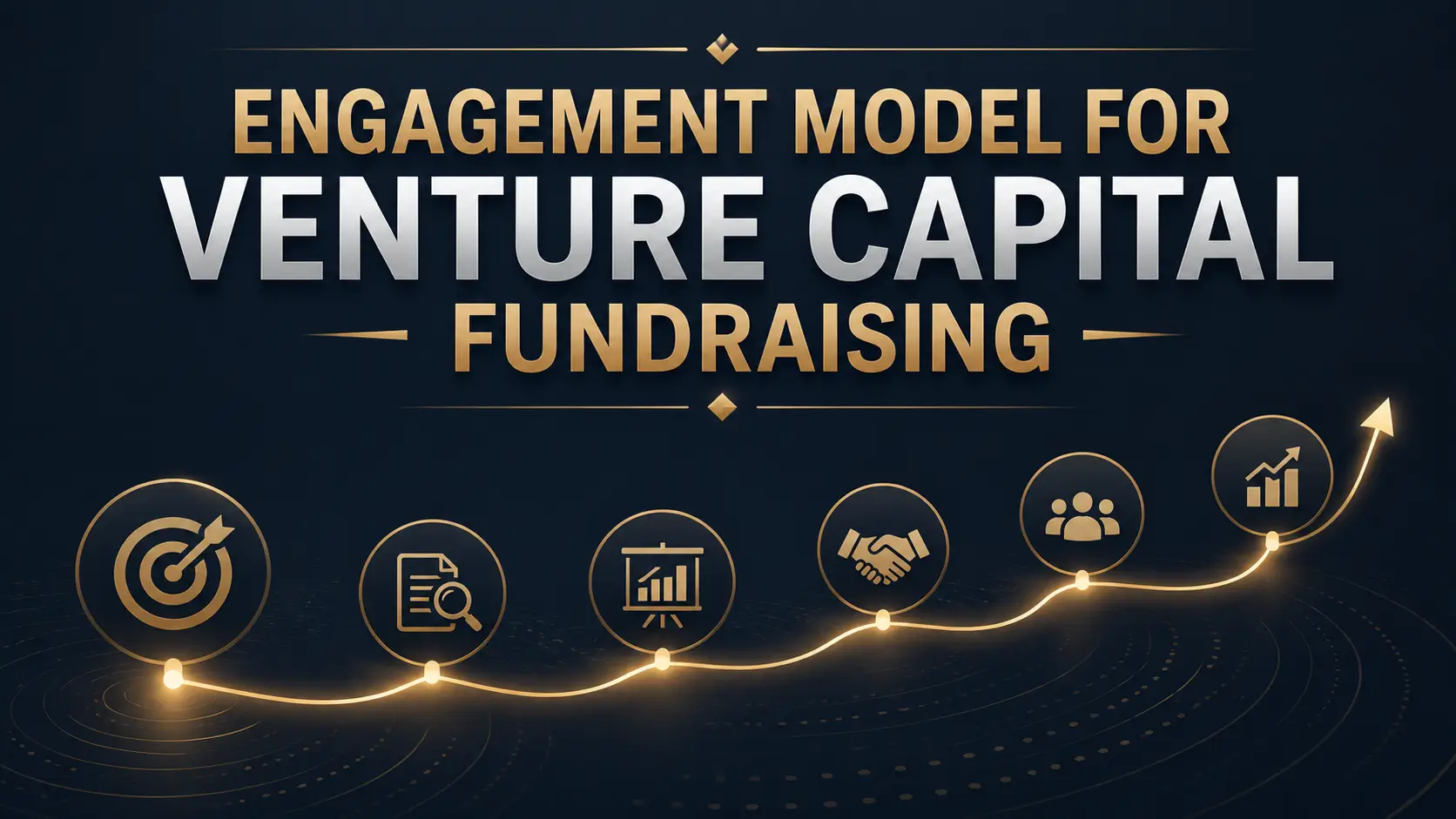
TL;DR: A VC fundraising engagement model should define advisor scope, phased deliverables, success-fee triggers, carve-outs, and accountability rules.
- What a Typical Venture Capital Fundraising Advisory Engagement Model Includes: A well-structured engagement model is not a letter of intent with a fee attached.
- How the Work Should Be Structured Across Phases: A close-oriented engagement is not a single continuous effort.
- What the Advisor Owns and What Stays With the Company: One of the clearest signs of a weak engagement model is blurred ownership.
A venture capital fundraising engagement model should define what the advisor owns, when each deliverable is due, how success fees are triggered, which investors are carved out, and what happens if early outreach does not convert. For founders raising $5M to $10M, the right model is not built around activity or introductions alone. It is structured around phased execution, clear accountability, documented investor contact, diligence support, and a process designed to move from preparation to close without wasting the market window.
The fee is a number. The engagement model is a structure. And structure is what determines whether you pay for a closed round or pay for a busy calendar.
For a $5M–$10M raise, the window matters. Investor attention is not unlimited. Burning three months on poorly sequenced outreach, undefined deliverables, or an advisor who owns nothing specific on a timeline is not just inefficient — it is expensive in ways that do not show up on the invoice.
Before you sign anything, check whether the engagement you are evaluating has clear answers to these three questions:
- What does the advisor own, specifically, and by when?
- What triggers success-fee payment, and what is excluded?
- What happens if early outreach does not convert?
If those answers are vague, the model is built for effort. This guide breaks down what a close-oriented engagement model actually looks like, phase by phase, clause by clause, so you can evaluate the structure before you are inside it.
Understanding how venture capital fundraising advisory works at the process level is a useful starting point, but this article goes one layer deeper: into the specific structural choices that separate an engagement built to close from one built to generate activity.
What a Typical Venture Capital Fundraising Advisory Engagement Model Includes
A well-structured engagement model is not a letter of intent with a fee attached. It is a working document that defines five components with enough specificity that both parties can be held to them.
| Component | What Should Be Defined |
|---|---|
| Scope | Which activities are included, which are excluded, and what decision rights the advisor holds during outreach |
| Term | Start date, duration, renewal conditions, and any phase-gated extensions tied to documented progress |
| Compensation | Retainer structure, payment schedule, success-fee basis, calculation method, and carve-outs for founder-sourced capital |
| Deliverables | Named outputs with expected completion windows: target list, materials, outreach tracker, weekly pipeline report |
| Accountability rules | How performance is tracked, what constitutes documented contact, what triggers a review conversation, and what happens if traction is weak |
The scope section is where most engagement models fail. Broad language like "capital markets support" or "investor relationship management" sounds comprehensive but defines nothing. A model built for accountability names the specific workstreams: investor targeting methodology, materials refinement process, outreach sequencing, pipeline documentation, and feedback synthesis.
Exclusions matter as much as inclusions. If the advisor does not handle legal coordination, term sheet negotiation, or investor due diligence responses, those gaps need to be explicit so you can plan for them.
The test: If you removed the advisor's name from the engagement document and handed it to a stranger, would they know exactly what gets done, by whom, and on what timeline? If not, the model is underspecified.
How the Work Should Be Structured Across Phases
A close-oriented engagement is not a single continuous effort. It runs in phases, and each phase should have defined outputs before the next one starts. If the engagement document does not describe phases, you are buying a relationship, not a process.
Here is what a well-structured engagement looks like across three phases:
Phase 1: Readiness and Positioning (Weeks 1–4)
This phase exists before any investor sees your name. The advisor should be doing the structural work that determines whether outreach lands or gets ignored.
- Audit of existing materials: deck, financial model, data room index
- Investor narrative development and positioning refinement
- Target investor list built against defined criteria: check size, stage fit, sector focus, recent activity
- Internal alignment on valuation range, use of proceeds, and deal terms the company will accept
Deliverable: A completed target list, a refined investor narrative, and materials approved for outreach.
Phase 2: Market Launch and Outreach (Weeks 5–12)
This is the active market phase. The advisor manages sequencing, introduction logistics, and pipeline documentation.
- Tiered outreach sequencing: lead investors first, fill investors after
- Documented introductions with context notes on each contact
- Weekly pipeline tracker updated with status, last contact, and next step
- Feedback synthesis from early conversations fed back into positioning
Deliverable: An active pipeline with documented status on every contact and a repositioning brief if early signals are weak.
Phase 3: Diligence Management and Close (Weeks 10–20)
This phase overlaps with Phase 2 as investors move into diligence. The advisor's role shifts from outreach to process management.
- Coordination of due diligence requests and data room access
- Follow-up sequencing to maintain momentum
- Process pressure: keeping multiple investors moving in parallel to support leverage
- Handoff to legal once terms are agreed
Deliverable: A closed round or a documented decision to pause with a clear market feedback summary.
If early outreach in Phase 2 does not convert, the model should include a defined repositioning step, not a continuation of the same outreach to a wider list. Repetition without repositioning is the most common way advisory engagements burn through a market window. The common mistakes founders make in venture capital fundraising advisory often trace back to this exact failure: no repositioning trigger built into the engagement design.
What the Advisor Owns and What Stays With the Company
One of the clearest signs of a weak engagement model is blurred ownership. When both parties are responsible for everything, neither party is accountable for anything.
A close-oriented model draws a clean line between what the advisor manages and what the founder must own. Neither side can fully substitute for the other. For a plain-English breakdown of what strong advisor agreement what to include looks like in practice, the structure maps closely to what founders should demand in a fundraising advisory context.
| The Advisor Should Own | The Founder Must Own |
|---|---|
| Process design and phase sequencing | Operating data and financial accuracy |
| Investor target list development | Narrative credibility and management responsiveness |
| Outreach management and introduction logistics | Final decisions on investor fit and terms |
| Pipeline documentation and status tracking | Diligence response quality and speed |
| Market feedback synthesis and repositioning recommendations | Cap table decisions and legal direction |
| Materials refinement (structure and positioning) | Company truth: the underlying business performance |
The advisor cannot manufacture credibility the company has not earned. But the company cannot manufacture access, sequencing discipline, or process pressure that a strong advisor provides.
Where founders get into trouble is when the engagement model implies the advisor owns outcomes. No legitimate advisory model guarantees a close. What a well-structured model does guarantee is a defined process, documented activity, and clear accountability for the advisor's specific workstreams.
Watch for this: If the engagement document says the advisor will "use best efforts" without defining what those efforts look like, that language protects the advisor, not you. Best efforts is not a deliverable. A target list delivered by week three is a deliverable. A weekly pipeline report is a deliverable. Best efforts is a hedge.
Founders who understand this distinction before signing are far less likely to end up in a dispute about whether the advisor "did their job." The key benefits of working with a venture capital fundraising advisor are real, but they only materialize when ownership is explicit on both sides.
{{main-cta}}
How to Evaluate Whether the Model Is Built to Close
Before you sign, run the engagement document through a close-readiness test. Most founders skip this step because the conversation feels collaborative and the advisor seems credible. Credibility is not a substitute for structure.
Ask these questions about the document in front of you:
- Does each phase have a named deliverable with a completion window? If the answer is no, the model is built on intent, not accountability.
- Is the investor target list methodology described? Generic access to a broad network is not a targeting methodology. A defined criteria set is.
- Does the success-fee definition specify what qualifies as a covered transaction? Vague language here creates disputes at close, when the stakes are highest.
- Is there a repositioning clause? If outreach runs for six weeks with no traction, what happens next? If the document has no answer, the advisor has no obligation to change course.
- Are founder-sourced relationships carved out of the success fee? If you bring in an investor you already know, you should not pay a success fee on that capital.
- Is the tail period tied to documented contacts? A tail clause that covers any investor you met "during the engagement period" without a documented contact list is a liability, not a protection.
- Can you terminate for cause if deliverables are not met? Termination rights tied to missed deliverables give you leverage. Termination rights tied only to a notice period give the advisor leverage.
The right question is not "How many introductions will I get?" It is "What mechanism in this model increases my probability of closing?" Every answer should point to something specific in the document.
Founders raising at the $5M–$10M level often underestimate how much the engagement structure shapes their outcome. Understanding how long venture capital fundraising takes at this stage makes clear why a model without built-in course correction is a real risk: a six-month window spent on the wrong structure is not recoverable.
Compensation, Term, and Clause Design: Where Founders Get Exposed
Fee structure gets most of the attention in advisory negotiations. It should get less. The clauses around the fee are where founders are most often exposed.
Here is what to review carefully before signing:
- Retainer scope: The retainer should buy specific work with defined outputs, not general availability. If the retainer language does not describe what it covers, it covers whatever the advisor decides it covers.
- Success-fee calculation base: Know whether the fee applies to total capital raised, equity capital only, or all financing including debt. The difference can be material at the $5M–$10M level.
- Success-fee triggers: The fee should trigger on closed, funded transactions, not on signed term sheets or verbal commitments that may not complete.
- Founder-sourced carve-outs: Any investor you introduced, had a prior relationship with, or were in active conversation with before the engagement started should be listed and excluded from the success-fee calculation.
- Tail period and documented contacts: Tail clauses typically run six to twelve months after engagement end. The tail should apply only to investors on a documented contact list maintained throughout the engagement, not to any investor you happened to meet during that period. The engagement letters with investment bankers framework from Venable covers how tail scope, retainer treatment, and termination triggers are typically drafted in institutional advisory contexts.
- Termination rights: You should be able to terminate for cause if named deliverables are not met on schedule. Termination for convenience with a notice period is standard, but without a for-cause provision tied to deliverables, you have limited recourse if the engagement underperforms.
- Renewal mechanics: Understand whether the engagement auto-renews, what triggers an extension, and whether extension terms can be renegotiated based on documented progress.
For a deeper look at how advisory fees are typically structured across retainer and success-fee components, the how advisory fees are typically structured breakdown covers market ranges and what each structure implies about advisor incentives.
The engagement model you sign is a contract, but it is also a signal. An advisor who resists defining deliverables, pushes back on carve-outs, or offers vague tail language is telling you something about how they plan to run the engagement.
Frequently Asked Questions
What should a founder ask before signing a venture capital fundraising advisory engagement?
Ask three things: what the advisor owns by name and deadline in each phase, how success-fee payment is triggered and what is excluded, and what the engagement document says happens if early outreach does not convert. If any of those answers are vague or missing from the document, the model is not built for accountability. A founder who cannot get clear answers before signing will not get them after.
How should deliverables be scheduled in a fundraising advisory engagement?
Deliverables should be tied to phases with completion windows, not to the overall engagement term. A target investor list should be ready before outreach begins, not three months into the engagement. Materials should be approved before the first introduction is made. A pipeline tracker should be live from the first week of outreach. If deliverables float without dates, there is no mechanism to measure whether the advisor is executing on schedule.
What is a tail clause and how should it be structured in a fundraising advisory agreement?
A tail clause extends the advisor's success-fee rights for a defined period after the engagement ends, typically six to twelve months. The clause should apply only to investors on a documented contact list that the advisor maintained throughout the engagement. A tail clause that covers any investor you encountered during the engagement period, without a contact list requirement, is open-ended and difficult to dispute. Always negotiate that the tail is tied to a specific, dated list of documented contacts.
How do you tell whether a retainer is buying execution or just availability?
Look at what the retainer language describes. If it says the advisor will "provide advisory services" or "support the capital raise," it is buying availability. If it names specific workstreams, output cadences, and completion timelines, it is buying execution. The distinction matters because an availability-based retainer gives the advisor full discretion over how to spend the engagement, while an execution-based retainer creates a basis for accountability if work does not get done.
What happens if outreach runs for two months with no investor traction?
A well-structured engagement model has a repositioning clause that defines what happens when early outreach does not convert. That clause should specify a review trigger, who initiates it, what inputs are reviewed, and what outputs are expected. Without that clause, the advisor has no contractual obligation to change course. The engagement continues, the retainer continues, and the market window closes. Founders should treat the absence of a repositioning mechanism as a significant structural gap.
Can a founder negotiate carve-outs for investors they already know?
Yes, and they should. Any investor you introduced to the deal, had a prior relationship with, or were in active conversation with before the engagement started should be documented and excluded from the success-fee calculation before the engagement begins. The time to negotiate carve-outs is before signing, not after a term sheet arrives. Once an investor is in active diligence, the advisor will argue the introduction was theirs. A pre-engagement list eliminates that dispute.
What is the difference between an engagement built to close and one built to generate activity?
The difference is structural, not cosmetic. An engagement built to close has named deliverables, phase-gated milestones, a repositioning trigger, documented contact requirements, and termination rights tied to performance. An engagement built to generate activity has broad scope language, a meeting-volume framing, vague success-fee triggers, and no mechanism to force course correction. Both can produce a busy calendar. Only one is designed to produce a closed round. The full venture capital fundraising advisory overview covers the broader framework for evaluating whether advisory support is the right move before you get to engagement structure.
Continue reading this series:
- How does venture capital fundraising advisory work
- When does a company need venture capital fundraising advisory
- How long does venture capital fundraising take
IRC Partners advises operators raising $5M to $250M of institutional capital on structure, positioning, and round architecture. We take seven strategic partners per quarter. No placement agent model. No success-only theater. Institutional capital follows a deal built to institutional standard. If you want your current raise reviewed before it reaches the market and silently fails , apply here.
Before taking a raise to market, run it through the Capital Raise Pre-Flight to see how it holds up against institutional standards.
Need guidance on your capital raise?


What Happens to Employee Option Holders When a Drag-Along Is Activated Without Proper Carve-Out Language

How Do Family Offices Evaluate Refinance Risk In Value-Add Multifamily Investments?

What Information Should a Board Review Before Approving an Insider-Led Bridge Financing Round?
Disclosure
Nothing on this site constitutes an offer to sell, or a solicitation of an offer to purchase, any security under the Securities Act of 1933, as amended, or any applicable state securities laws. Any offering of securities is made only by means of a formal private placement memorandum or other authorized offering documents delivered to qualified investors.
IRC Partners is a capital advisory firm. IRC Partners is not a registered investment adviser under the Investment Advisers Act of 1940 and does not provide investment advice as defined thereunder.
Certain statements in this article may constitute forward-looking statements, including statements regarding market conditions, capital availability, investor demand, and transaction outcomes. Such statements reflect current assumptions and expectations only. Actual results may differ materially due to market conditions, regulatory developments, company-specific factors, and other variables. IRC Partners makes no representation that any outcome, return, or result described herein will be achieved.
References to prior mandates, transaction volume, network credentials, or capital raised are provided for illustrative purposes only and do not constitute a guarantee or prediction of future results. Past performance is not indicative of future outcomes. Individual results will vary. Network credentials and transaction statistics referenced on this site reflect the aggregate experience of IRC Partners' principals and affiliated advisors and are not a representation of assets managed or transactions closed solely by IRC Partners.
Certain data, statistics, and information presented in this article have been obtained from third-party sources. IRC Partners has not independently verified such information and expressly disclaims responsibility for its accuracy, completeness, or timeliness. Readers should independently verify any third-party data before relying on it.
Readers are strongly encouraged to consult qualified legal, financial, and tax professionals before making any investment, capital raising, or business decision.
Schedule A Meeting
You get one shot to raise the right way. If this raise is worth doing, it’s worth doing with precision, leverage, and control.
This isn’t a practice run. Serious capital. Serious strategy. Let’s raise it right.
We onboard a maximum of seven
new strategic partners each quarter, by application only, to maximize your chances of securing the capital you need.
